Lenny.com
Explore
Create
ActivitiesNewMathEnglish Language ArtsScience & EngineeringSocial StudiesGlobal LanguagesHealth & Physical EducationSpecial EducationCounseling & Life SkillsArts & CreativityESL
Lenny.com
Lenny.com
Explore
Create
ActivitiesNewMathEnglish Language ArtsScience & EngineeringSocial StudiesGlobal LanguagesHealth & Physical EducationSpecial EducationCounseling & Life SkillsArts & CreativityESL
Lenny.com
Lenny.com

Solutions

Lenny for EducatorsLenny for SchoolsLenny for Districts

Product

ExploreSign inCreateSupportAbout

Resources

Getting startedMTSS Acceleration Program

© 2026 Lenny Learning Inc.

TermsPrivacyAccessibility
LinkedInInstagramX
Lenny

Native Peoples of North America

Diverse cultures, languages, and histories of Indigenous nations across North American regions. Analyzes traditional environmental adaptations, social structures, and the long-term impacts of European colonization.

Social StudiesSocial Studies PracticesLocation WordsMapsOrder EventsChronology and CausationEvaluating SourcesHistorical ThinkingGeography, Humans, & the EnvironmentAmerican Symbols and LandmarksCitiesStatesState CapitalsRegions of the United StatesGeographic SkillsPhysical GeographyHuman GeographyRegional GeographyGeography of AfricaGeography of AsiaGeography of EuropeGeography of OceaniaGeography of the AmericasSociety and Environment of EuropeSociety and Environment of AsiaSociety and Environment of The AmericasSociety and Environment of the Middle EastSociety and Environment of AfricaHistoryPrehistoryComparing Ancient River CivilizationsAncient MesopotamiaAncient Egypt and KushAncient South AsiaEarly ChinaGreeceRome and the Byzantine EmpireAncient World HistoryNative Peoples of North AmericaNative Peoples of Mesoamerica and South AmericaAfrican EmpiresMedieval AsiaMedieval EuropeThe Silk RoadMedieval HistoryIslamic EmpiresWorld ReligionsRenaissance PeriodAge of ExplorationThe Thirteen ColoniesThe American RevolutionUS History Early RepublicFounding of the United StatesUS History AntebellumUS Civil WarReconstruction PeriodThe Gilded AgeUS ImperialismWorld ImperialismWorld War IUS History 1920sGreat DepressionWorld War IIThe Cold WarUS History 1950-60sUS History 1960s-70sWorld History 20th CenturyContemporary US HistoryContemporary World HistoryHolidaysCivics and GovernmentCitizenshipGovernment FoundationsThe ConstitutionUS ConstitutionExecutive BranchLegislative BranchJudicial BranchState and LocalPolitical ParticipationPublic PolicyPolitical SystemsPower and AuthoritySocial MovementsDefining DevianceTheories of DevianceCrime and Criminal JusticeEconomicsBasic Economic PrinciplesSupply and DemandWhat is MoneyEconomic FundamentalsMicroeconomicsMacroeconomicsBanking and FinanceEconomic SystemsGlobal EconomicsCorporations and PowerThe Changing WorkplaceUnemployment and LaborClass and InequalitySocial MobilityGlobal InequalityPsychologyHistory of PsychologyPsychology as a ScienceBrain and Nervous SystemNeuroscience and BehaviorGenetics and BehaviorSleep and ConsciousnessSensory ProcessesPerceptual OrganizationClassical ConditioningOperant ConditioningObservational LearningCognitive LearningMemory ProcessesThinking and Problem SolvingLanguage and CognitionTheories of MotivationStress and CopingPrenatal and Infant DevelopmentChildhood DevelopmentAdolescent DevelopmentAdulthood and AgingSelf and IdentitySocial CognitionSocial InfluenceAttraction and RelationshipsGroup BehaviorPrejudice and DiscriminationAnxiety and Mood DisordersClinical PsychologyForensic PsychologyPhilosophy & EthicsIntroduction to PhilosophyMajor Philosophers & IdeasMind and Body ProblemFree Will vs DeterminismEthics & MoralityReligion & PhilosophyPolitical Philosophy

Videos

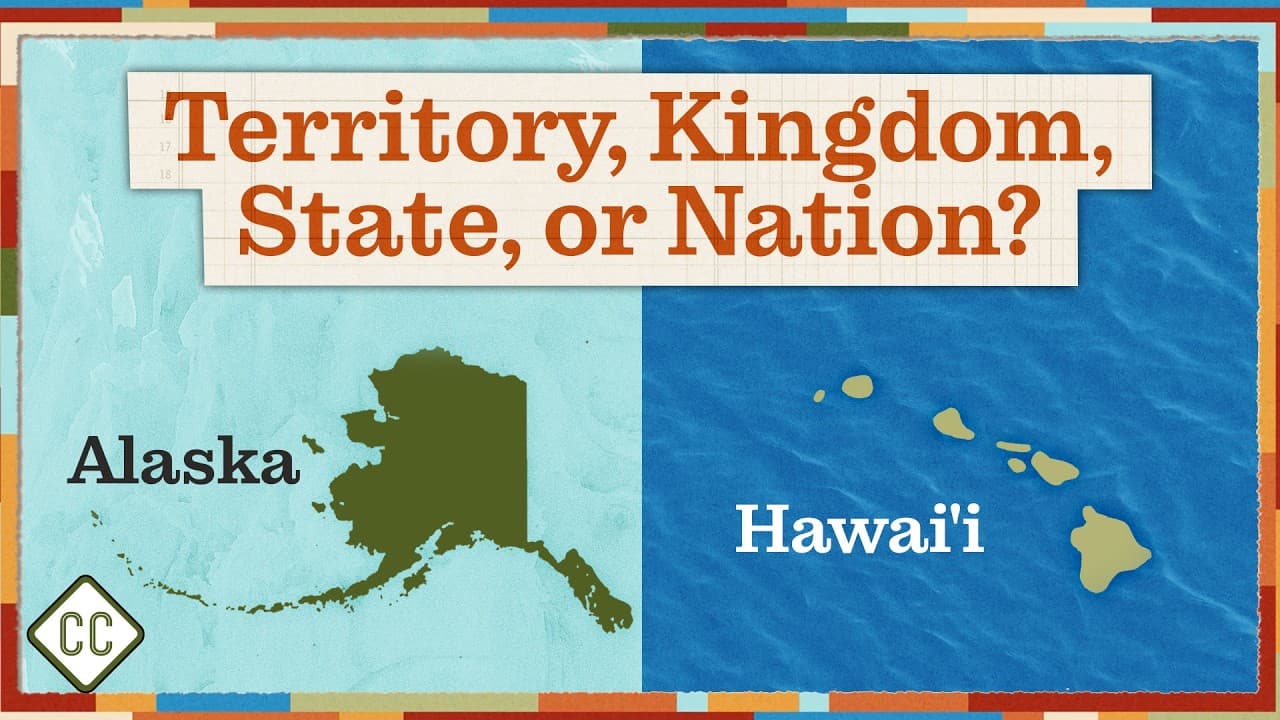
How Native History Differs in Alaska and Hawai'i

How Native History Differs in Alaska and Hawai'i

This educational video explores the distinct and complex histories of Indigenous peoples in the two non-contiguous United States: Alaska and Hawai'i. It contrasts the legal status of Native tribes in both states, highlighting a stark statistic: while 40% of all federally recognized tribes in the U.S. are in Alaska, there are zero in Hawai'i. The host, Che Jim, guides viewers through the timeline of colonization for both regions—from Russian fur traders and the U.S. purchase of Alaska to the overthrow of the Hawaiian Kingdom by American businessmen. The video delves into key themes of sovereignty, land rights, and the lasting impacts of colonization. It explains the unique "corporation" model established by the Alaska Native Claims Settlement Act (ANCSA) and contrasts it with the reservation system found in the lower 48 states. For Hawai'i, it covers the cultural history of the Kānaka Maoli, the illegal overthrow of Queen Liliʻuokalani, and the ongoing debate within the Native Hawaiian community regarding federal recognition versus independence. For educators, this resource is invaluable for teaching U.S. History, Civics, and Indigenous Studies. It moves beyond the standard narrative of westward expansion to cover the specific legal and political mechanisms used to acquire these territories. It provides clear explanations of complex concepts like "subsistence lifestyles," "sovereignty," and "annexation," making it an excellent tool for stimulating high-level classroom discussions about government responsibility, indigenous rights, and historical justice.

CrashCourseCrashCourse

11mins 42s

Why We Study US History: Context, Perspectives, and Themes

Why We Study US History: Context, Perspectives, and Themes

This introductory video for a U.S. History course establishes the fundamental reasons for studying history: to better understand the present, to contextualize events through multiple perspectives, and to develop the skills necessary for civic engagement. Hosted by Anthony with assistance from an animated robot named Mia, the lesson uses relatable analogies and historical examples to demystify abstract concepts like 'contextualization' and 'historical perspective.' It moves beyond memorizing dates to emphasize critical thinking and the application of historical knowledge to modern life. The video introduces three core themes that will guide the course: Community & Belonging, People & The Environment, and the Role of Government. Through specific examples—such as George Washington's mandate for smallpox inoculations during the Revolutionary War—the narrator demonstrates how understanding the circumstances surrounding a decision changes our interpretation of it. The lesson also distinguishes between learning 'about' history versus learning 'from' it, positioning the student as an active participant in society. Educators can use this video to launch a history curriculum by setting expectations for critical inquiry. It provides a perfect framework for teaching students how to analyze primary sources, consider bias, and understand historical empathy. The segment featuring different personas reacting to a single public policy statement is an excellent tool for introducing debate and perspective-taking in the classroom.

Miacademy & MiaPrep Learning ChannelMiacademy & MiaPrep Learning Channel

10mins 51s

How the US Grew: Westward Expansion and the Civil War

How the US Grew: Westward Expansion and the Civil War

This educational video provides a comprehensive overview of United States history from the late 1700s through the end of the Civil War in 1865. Narrated by Maya, the video chronicles the rapid growth of the nation, starting with immigration from Europe and the addition of new states, moving through major land acquisitions like the Louisiana Purchase, and detailing the conflicts that arose from this expansion, including the War of 1812 and the Mexican-American War. It explains how economic differences and the moral crisis of slavery drove a wedge between the North and South, leading to the secession of Southern states. Key historical themes include Westward Expansion, the displacement of Native Americans, the industrial revolution's impact (railroads, cotton, coal), and the political turmoil surrounding slavery. The video introduces critical figures such as Meriwether Lewis, William Clark, Abraham Lincoln, Ulysses S. Grant, and Robert E. Lee. It also covers significant events like the Gold Rush, the Oregon Trail, and the assassination of President Lincoln. For educators, this video serves as an excellent timeline anchor, helping students visualize the chronological progression of the 19th century. It connects geography to history by showing how physical expansion fueled political conflict. The content is well-suited for introducing a unit on the Civil War or Westward Expansion, providing a high-level summary that can be paused for deeper dives into specific topics like the treatment of Indigenous peoples or the economics of the plantation system.
Miacademy & MiaPrep Learning ChannelMiacademy & MiaPrep Learning Channel

8mins 18s

How the First People Migrated to the Americas

How the First People Migrated to the Americas

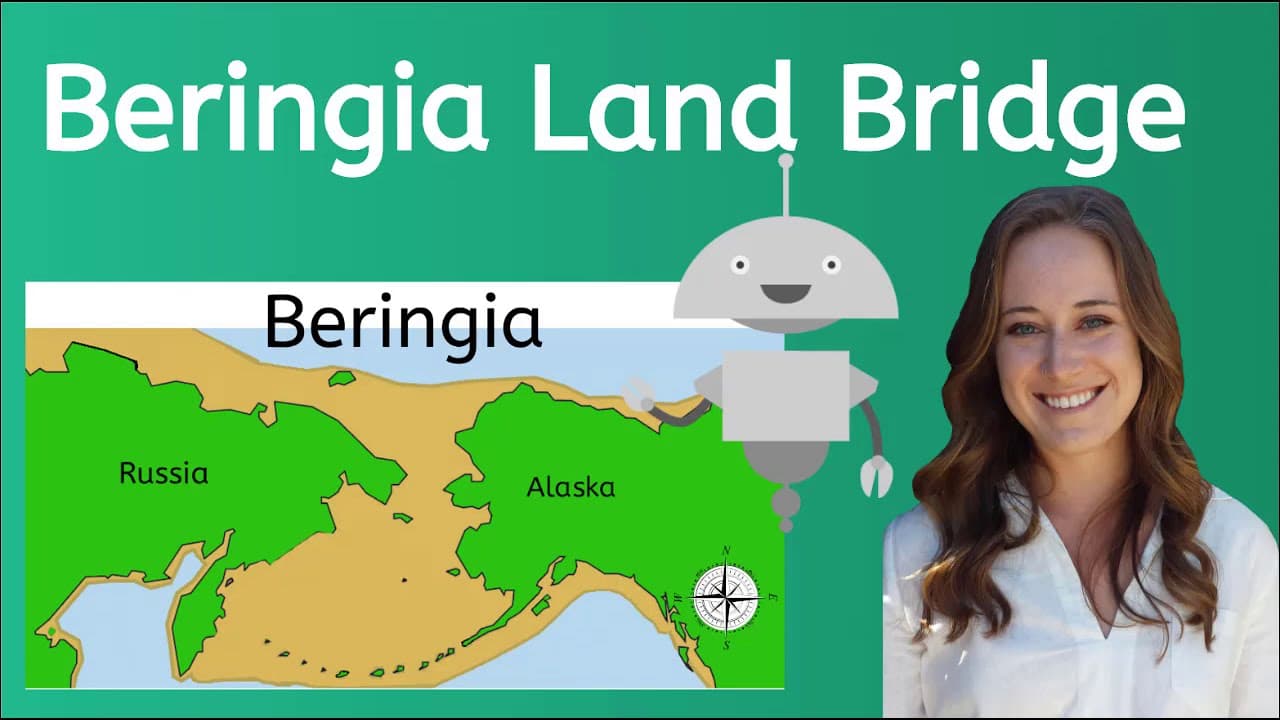
This educational video explores the scientific theory of how the first humans migrated to the Americas via the Beringia Land Bridge. It explains the geographical and climatic conditions of the Ice Age that lowered sea levels, exposing a land connection between present-day Russia and Alaska. The video details the migration routes taken by these early people as they moved through North America down to South America. The content covers key interdisciplinary concepts including geography, earth science, and anthropology. It defines important terms like "migration" and explains the push factors that cause populations to move, such as the search for food, resources, or safety. The video also introduces students to how scientists use evidence to reconstruct the past, specifically looking at how anthropologists use DNA analysis and how archaeologists use artifacts like bronze tools and jade masks to trace human origins. This resource is highly valuable for social studies and history classrooms studying early human civilizations or Native American history. It provides a clear visual representation of complex concepts like changing coastlines and migration patterns. Teachers can use this video to illustrate the intersection of geography and history, demonstrating how physical landscapes shape human movement and settlement patterns.

Miacademy & MiaPrep Learning ChannelMiacademy & MiaPrep Learning Channel

4mins 50s

How Geography Shapes Global Food Security

How Geography Shapes Global Food Security

This educational video explores the complex field of agricultural geography, examining why food insecurity persists in a world that produces enough calories to feed everyone. Host Alizé Carrère guides viewers through the intricate web of historical, political, economic, and environmental factors that determine who has access to food. The narrative moves from local examples of farming to global systems, explaining how colonialism, the Columbian Exchange, and various agricultural revolutions have shaped our modern food landscape. The video covers critical themes including the distinction between subsistence and commercial farming, the shift from polyculture to monoculture, and the impact of the Green Revolution. It delves into the geography of hunger, explaining concepts like food deserts and the difference between food availability and food access. Significant attention is paid to how historical events, such as the triangular trade and colonization, disrupted indigenous food systems and established export-oriented economies that still influence global food distribution today. For educators, this resource serves as a powerful tool to connect geography, history, and economics. It moves beyond simple definitions to show students the systems thinking required to understand global challenges. The video provides excellent opportunities for classroom discussions on food justice, the environmental impacts of industrial agriculture, and the importance of biodiversity. It is particularly useful for units on human geography, economic development, and sustainability.

CrashCourseCrashCourse

11mins 32s

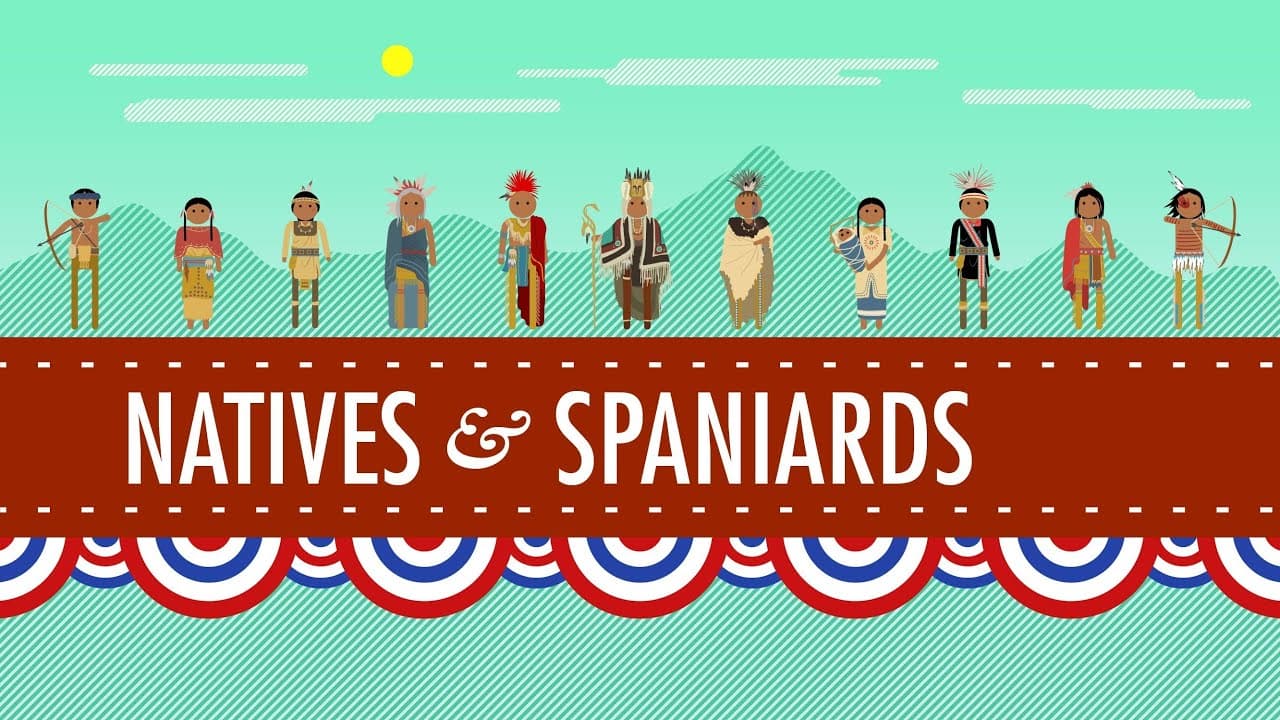
Native American Cultures and Spanish Colonization

Native American Cultures and Spanish Colonization

This high-energy educational video serves as the introductory episode to US History, challenging traditional narratives about pre-Columbian America and early Spanish colonization. Host John Green deconstructs the concept of "primitive" versus "civilized" societies, arguing against the Eurocentric view that Native Americans were backward simply because they lacked specific technologies like the wheel or written language. The video provides a sweeping overview of the diverse and complex Native American cultures that existed before 1492, ranging from the Pueblo peoples of the Southwest to the Iroquois Confederacy in the Northeast, highlighting their sophisticated political structures, religious beliefs, and approaches to property ownership. The narrative transitions to the arrival of the Spanish, detailing their exploration and colonization efforts in Florida and the American Southwest. It covers key figures like Ponce de León and Cabeza de Vaca, the devastating impact of European diseases, and the imposition of the Encomienda system. A significant portion of the video is dedicated to the Pueblo Revolt of 1680, a successful indigenous uprising that forced the Spanish to retreat and subsequently alter their colonial policies. The episode concludes by introducing the "Black Legend"—the idea that the English exaggerated Spanish cruelty to justify their own imperial ambitions—and emphasizes the importance of recognizing historical biases inherent in written records. For educators, this video is an invaluable tool for launching a US History course because it immediately establishes critical thinking habits regarding historical perspective and historiography. It moves beyond rote memorization of explorers' names to explore deep cultural clashes regarding gender roles, religion, and land use. The content is specifically aligned with AP US History (Period 1) frameworks but is accessible to general high school audiences. It provides rich opportunities to discuss how history is constructed, who gets to tell the story, and the complexity of cultural interactions beyond simple conqueror/conquered narratives.

CrashCourseCrashCourse

11mins 20s

Materials

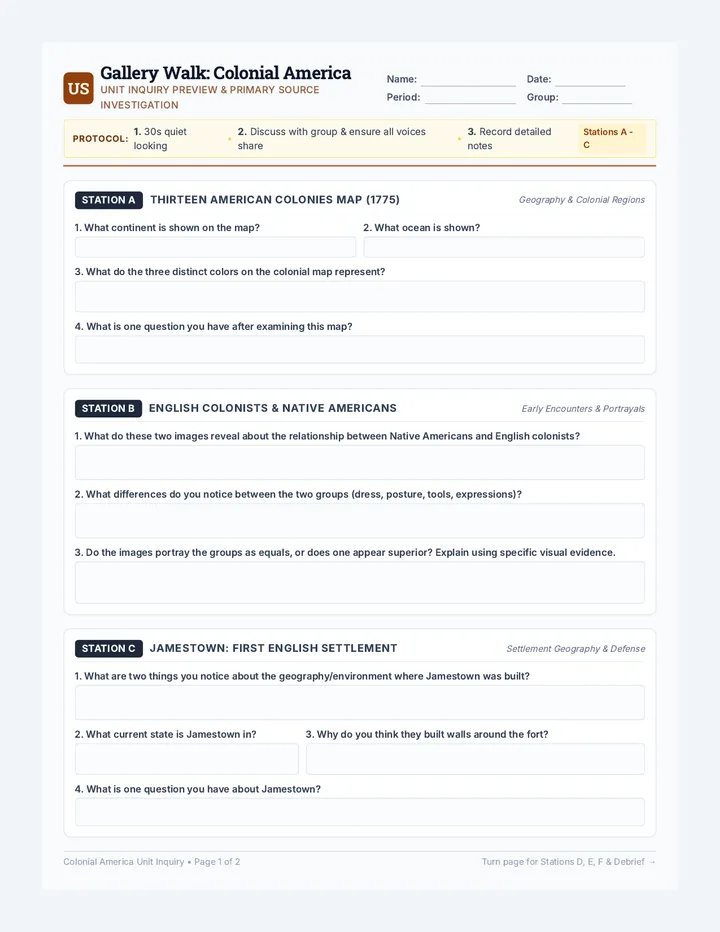
Colonial America Gallery Walk Worksheet

Colonial America Gallery Walk Worksheet

A two-page student-facing gallery walk worksheet examining Colonial America across six stations. Guides students through map analysis, cross-cultural encounters, Jamestown settlement geography, New England town structures, colonial economies, and changing relationships over time.

TP

Tytiana Payne

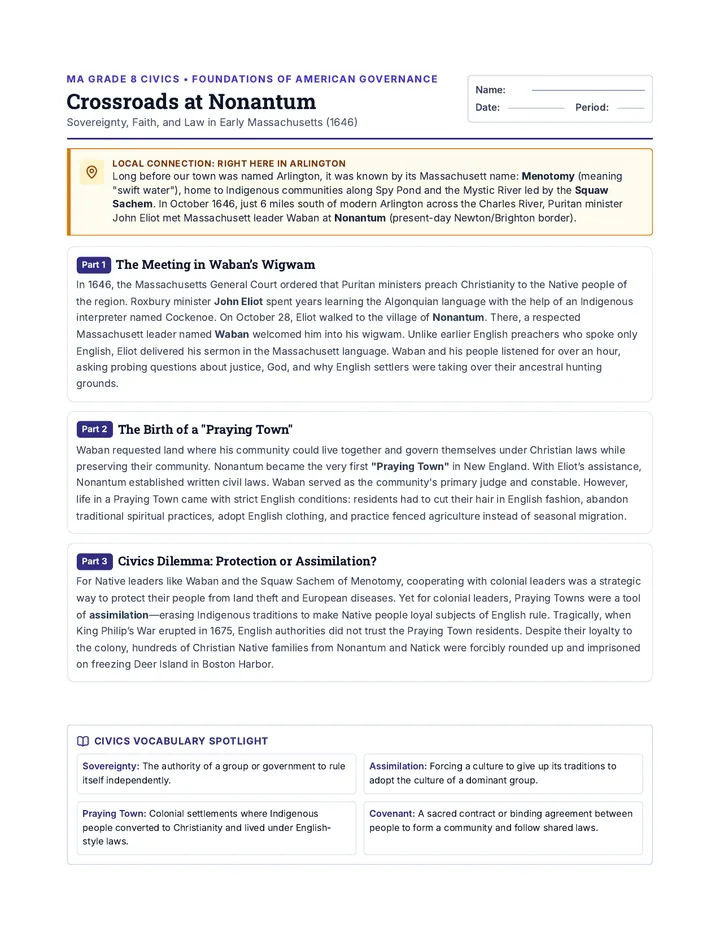
Nonantum Crossroads Worksheet

Nonantum Crossroads Worksheet

An 8th-grade inclusion civics worksheet exploring John Eliot, Waban, and the Praying Town of Nonantum (1646). Features clean print styling without grey backgrounds, chunked historical reading, local Menotomy connections, an explicit civics comparison question with writing lines in Section 2, and an extended ruled student writing response area in Section 3 that fills the page.

E

ebakke

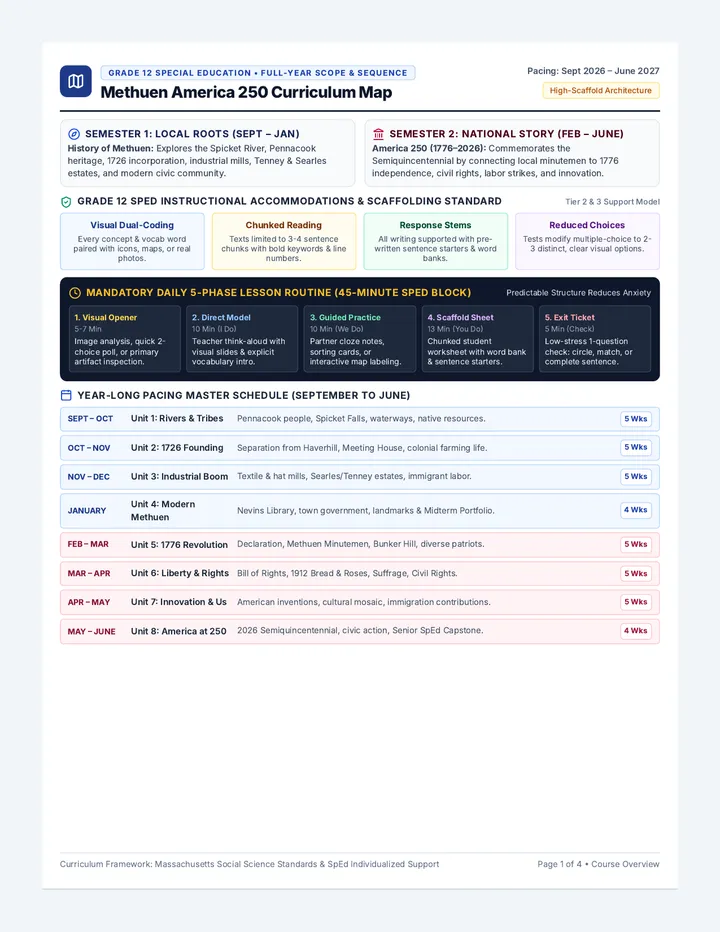
Methuen America 250 Curriculum Map

Methuen America 250 Curriculum Map

A comprehensive, year-long curriculum map and instructional guide for Grade 12 Special Education covering Methuen History (September to January) and America 250 (February to June). Includes unit-by-unit essential questions, key topics, core vocabulary, visual openers, chunked worksheets, exit tickets, modified tests, and a dedicated SpEd implementation toolkit.

L

lialiano

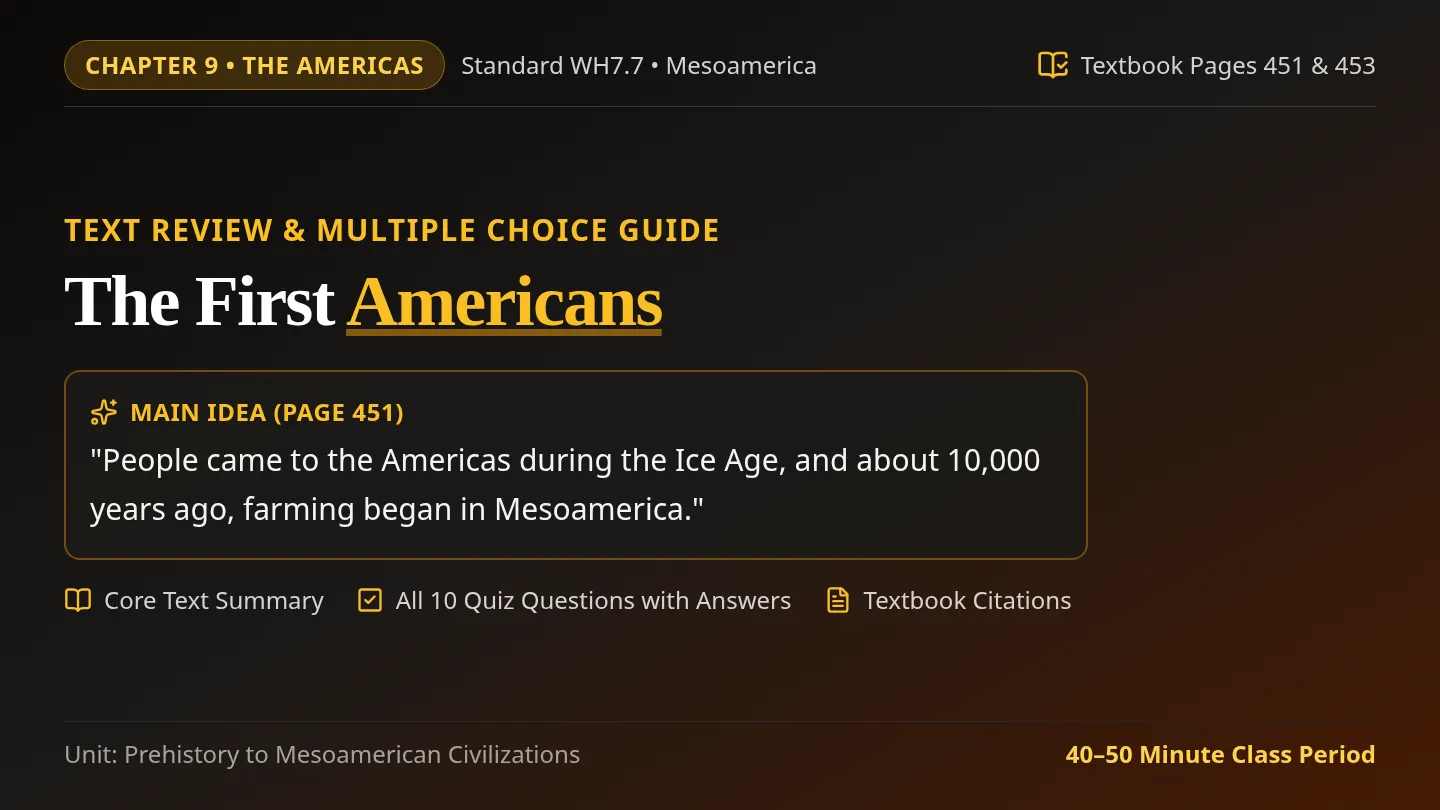
First Americans Review Slides

First Americans Review Slides

A complete 16-slide presentation for a 40–50 minute class reviewing 'The First Americans' (pp. 451 & 453) with key concepts, vocabulary, and dedicated review slides for all 10 worksheet multiple choice questions with revealed answers and textbook evidence.

MA

Maria Avery

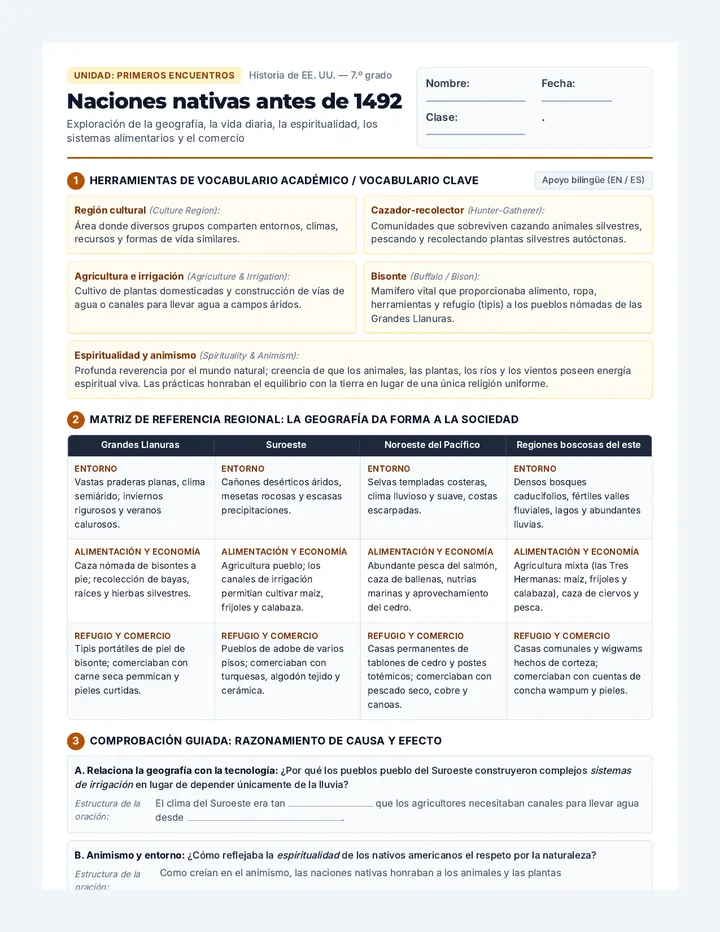
Native Nations Worksheet

Native Nations Worksheet

A scaffolded two-page 7th-grade US History worksheet exploring Native American culture regions, daily life, spirituality, hunting, agriculture, and trade before European contact, featuring bilingual vocabulary supports, guided notes, student-choice regional analysis, and an integrated exit ticket.

AN

Austin Nowak

Ancient Pathways Worksheet

Ancient Pathways Worksheet

A 2-page scaffolded worksheet featuring key vocabulary with Spanish cognates, a comprehensive reading on the 5 North American cultural regions (Arctic, Northwest Coast, Great Plains, Southwest, Eastern Woodlands), regional prediction tasks, an extension question, and an exit ticket.

AN

Austin Nowak

Sequences

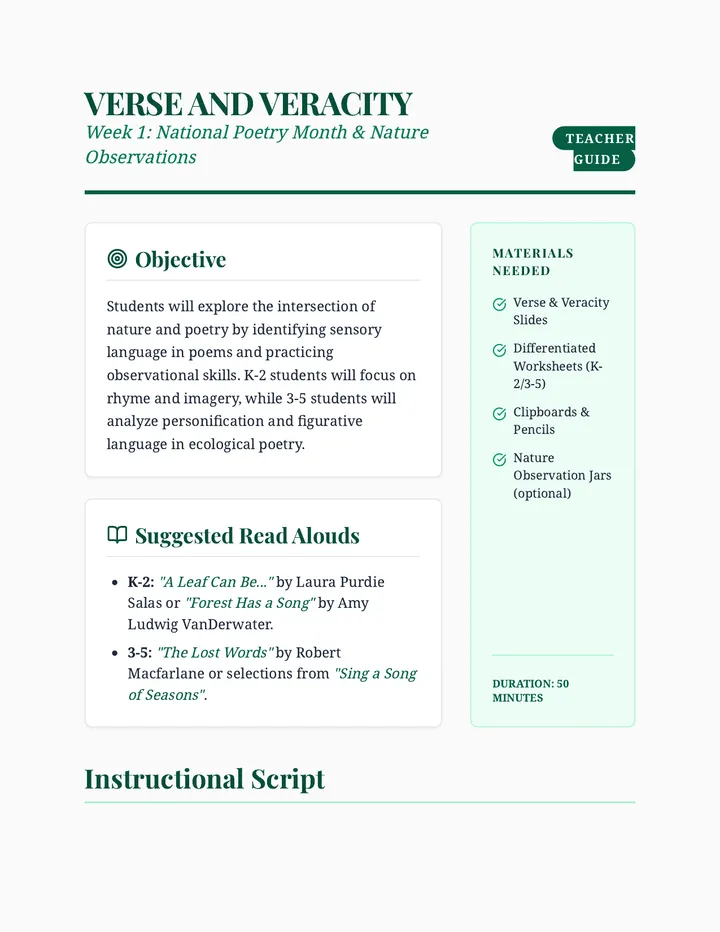
Verse and Veracity Teacher Guide

Media Center Year Curriculum

A comprehensive K-5 Media Center curriculum spanning August to May. Each month features a thematic unit integrating library skills (Dewey Decimal System, research, digital citizenship), literacy (poetry, biographies, informational texts), and STEM/Maker Space challenges. Resources are differentiated for K-2 and 3-5.

B

bethany.nied

50
Peaks and Valleys Teacher Guide

Copper State Chronicles

A 4-day social studies unit for 3rd grade focusing on Arizona's geography, history, and economy, specifically designed to meet standard 3.RI.9 by comparing and contrasting key details across multiple texts.

TD

Taylor Doucet

13
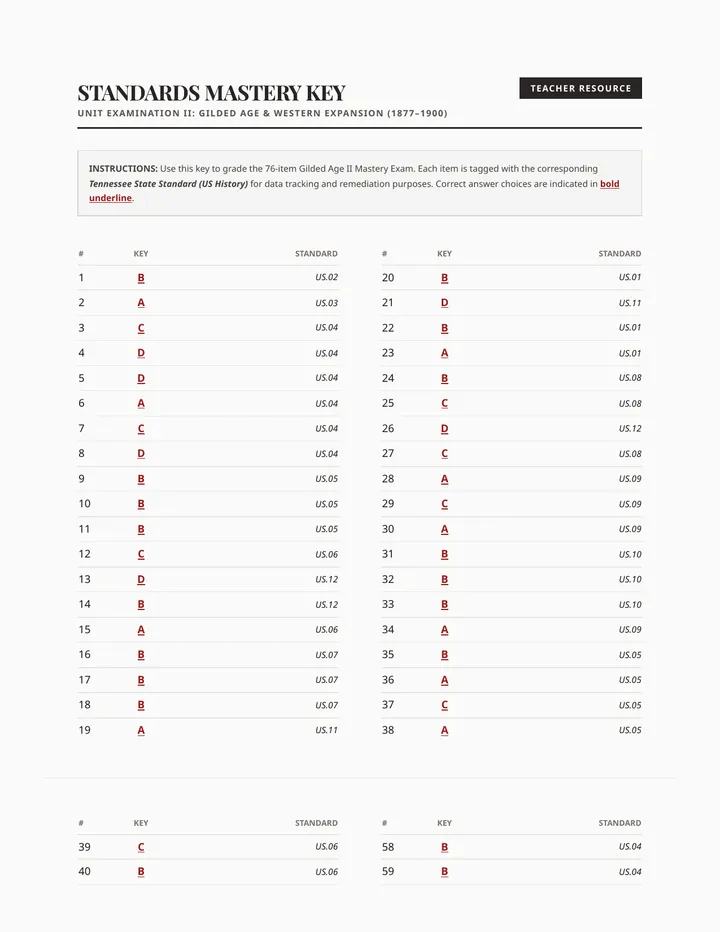
Gilded Age II Standards Key

Modern America Mastery

A comprehensive curriculum sequence covering late 19th and early 20th-century American history, focusing on economic transformation, Western expansion, global imperialism, and the impact of the Great War.

A

Andrew

29
Curriculum Blueprint Document v2

History Horizon Sequence

A comprehensive high school curriculum plan for American History, covering 13 units from the American Revolution to the modern era, aligned with North Carolina Social Studies standards.

AK

Amity Kea

21
Granite and Greenery Slides

Northeast Navigator

A 5-day unit exploring the Northeastern United States, covering its unique geography and climate, the rich history of the Wampanoag, Abenaki, and Iroquois nations, and the vibrant modern culture of its eleven states.

KM

Kristin McCoy

10
Day 1 American Republic Reader

Global Governance Remediation

A comprehensive 7-day remediation unit covering various forms of government, comparing the U.S. constitutional republic to historical and contemporary systems, and analyzing executive structures.

CE

Chelsea Elliott

16