Lenny.com
Explore
Create
ActivitiesNewMathEnglish Language ArtsScience & EngineeringSocial StudiesGlobal LanguagesHealth & Physical EducationSpecial EducationCounseling & Life SkillsArts & CreativityESL
Lenny.com
Lenny.com
Explore
Create
ActivitiesNewMathEnglish Language ArtsScience & EngineeringSocial StudiesGlobal LanguagesHealth & Physical EducationSpecial EducationCounseling & Life SkillsArts & CreativityESL
Lenny.com
Lenny.com

Solutions

Lenny for EducatorsLenny for SchoolsLenny for Districts

Product

ExploreSign inCreateSupportAbout

Resources

Getting startedMTSS Acceleration Program

© 2026 Lenny Learning Inc.

TermsPrivacyAccessibility
LinkedInInstagramX
Lenny

Early China

Development of the Shang and Zhou dynasties alongside the core philosophies of Confucianism, Taoism, and Legalism. Examines agricultural societies along the Yellow River and the origins of the Mandate of Heaven.

Social StudiesSocial Studies PracticesLocation WordsMapsOrder EventsChronology and CausationEvaluating SourcesHistorical ThinkingGeography, Humans, & the EnvironmentAmerican Symbols and LandmarksCitiesStatesState CapitalsRegions of the United StatesGeographic SkillsPhysical GeographyHuman GeographyRegional GeographyGeography of AfricaGeography of AsiaGeography of EuropeGeography of OceaniaGeography of the AmericasSociety and Environment of EuropeSociety and Environment of AsiaSociety and Environment of The AmericasSociety and Environment of the Middle EastSociety and Environment of AfricaHistoryPrehistoryComparing Ancient River CivilizationsAncient MesopotamiaAncient Egypt and KushAncient South AsiaEarly ChinaGreeceRome and the Byzantine EmpireAncient World HistoryNative Peoples of North AmericaNative Peoples of Mesoamerica and South AmericaAfrican EmpiresMedieval AsiaMedieval EuropeThe Silk RoadMedieval HistoryIslamic EmpiresWorld ReligionsRenaissance PeriodAge of ExplorationThe Thirteen ColoniesThe American RevolutionUS History Early RepublicFounding of the United StatesUS History AntebellumUS Civil WarReconstruction PeriodThe Gilded AgeUS ImperialismWorld ImperialismWorld War IUS History 1920sGreat DepressionWorld War IIThe Cold WarUS History 1950-60sUS History 1960s-70sWorld History 20th CenturyContemporary US HistoryContemporary World HistoryHolidaysCivics and GovernmentCitizenshipGovernment FoundationsThe ConstitutionUS ConstitutionExecutive BranchLegislative BranchJudicial BranchState and LocalPolitical ParticipationPublic PolicyPolitical SystemsPower and AuthoritySocial MovementsDefining DevianceTheories of DevianceCrime and Criminal JusticeEconomicsBasic Economic PrinciplesSupply and DemandWhat is MoneyEconomic FundamentalsMicroeconomicsMacroeconomicsBanking and FinanceEconomic SystemsGlobal EconomicsCorporations and PowerThe Changing WorkplaceUnemployment and LaborClass and InequalitySocial MobilityGlobal InequalityPsychologyHistory of PsychologyPsychology as a ScienceBrain and Nervous SystemNeuroscience and BehaviorGenetics and BehaviorSleep and ConsciousnessSensory ProcessesPerceptual OrganizationClassical ConditioningOperant ConditioningObservational LearningCognitive LearningMemory ProcessesThinking and Problem SolvingLanguage and CognitionTheories of MotivationStress and CopingPrenatal and Infant DevelopmentChildhood DevelopmentAdolescent DevelopmentAdulthood and AgingSelf and IdentitySocial CognitionSocial InfluenceAttraction and RelationshipsGroup BehaviorPrejudice and DiscriminationAnxiety and Mood DisordersClinical PsychologyForensic PsychologyPhilosophy & EthicsIntroduction to PhilosophyMajor Philosophers & IdeasMind and Body ProblemFree Will vs DeterminismEthics & MoralityReligion & PhilosophyPolitical Philosophy

Videos

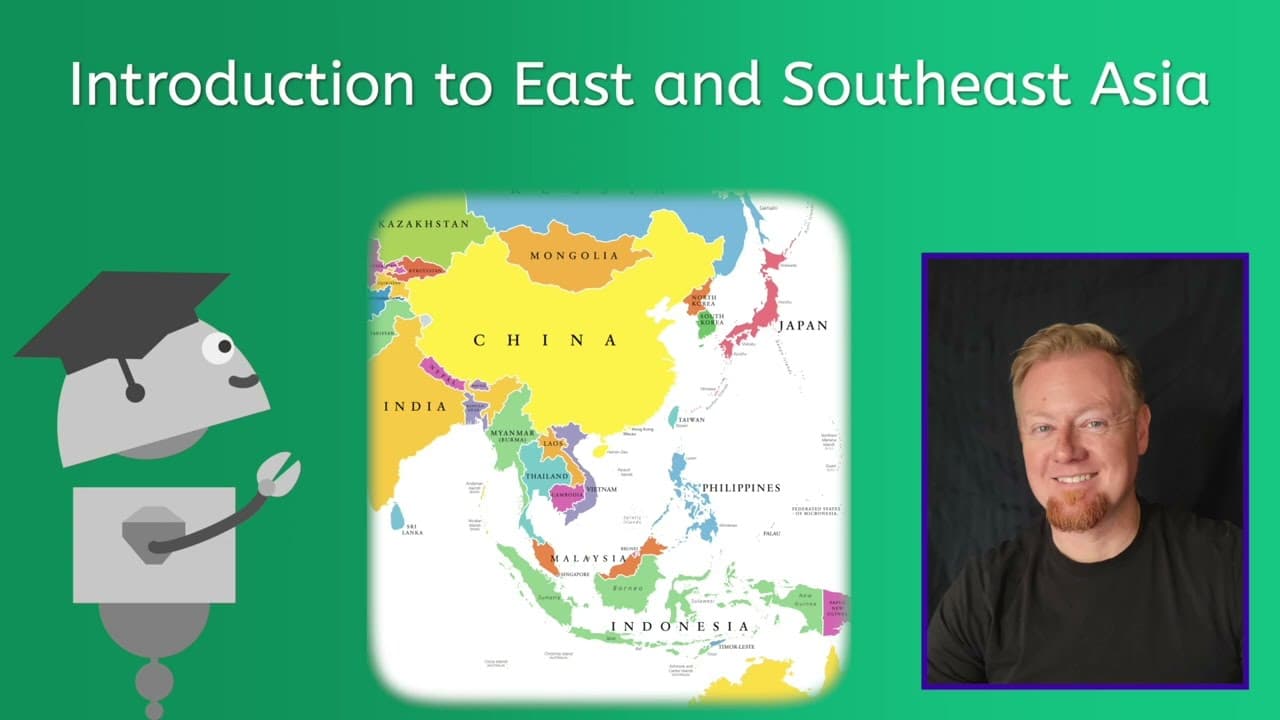
Exploring the Geography and Cultures of East and Southeast Asia

Exploring the Geography and Cultures of East and Southeast Asia

This comprehensive educational video takes students on a geographic and cultural journey through East and Southeast Asia. The lesson begins by identifying the specific nations that make up these two distinct regions, from the steppes of Mongolia to the archipelagos of Indonesia. It provides a historical overview that touches on ancient civilizations, the Silk Road, European colonization, and the political shifts of the 20th century, including the rise of communism in China, North Korea, and Vietnam.

Miacademy & MiaPrep Learning ChannelMiacademy & MiaPrep Learning Channel

10mins 22s

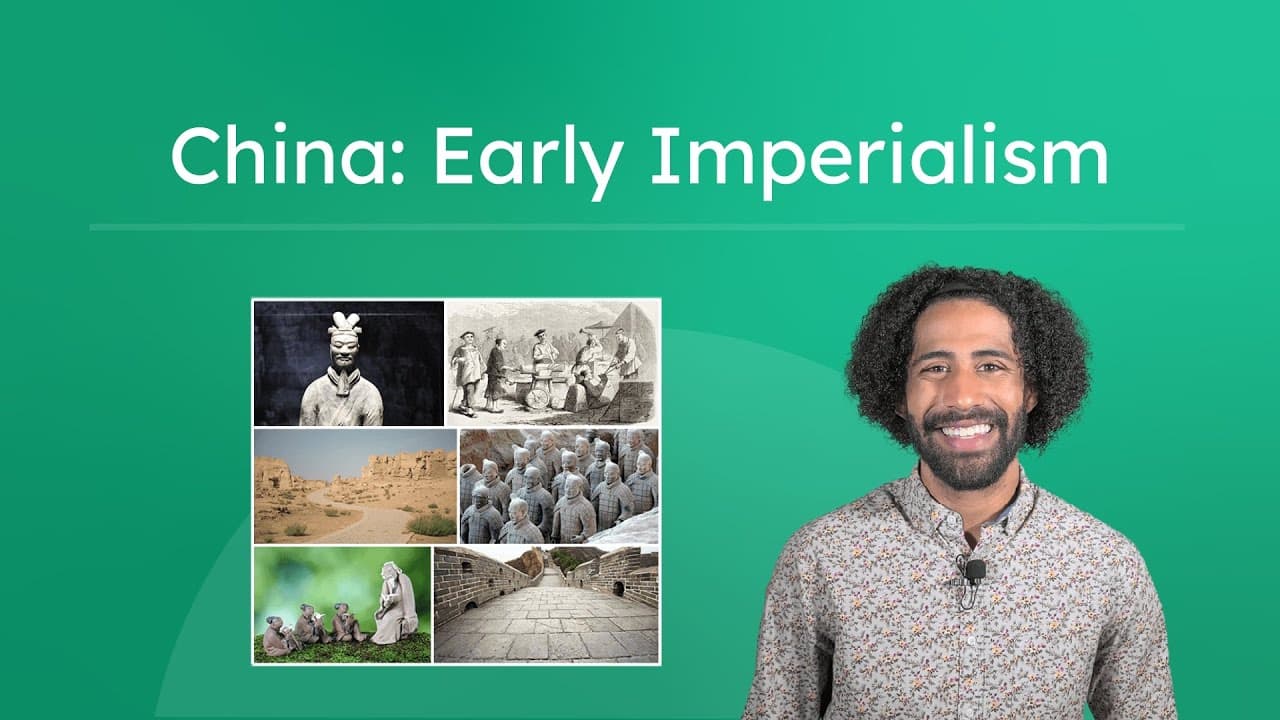
Early Imperial China: The Silk Road, Legalism, and the Qin Dynasty

Early Imperial China: The Silk Road, Legalism, and the Qin Dynasty

This educational video provides an engaging overview of Early Imperial China, focusing on the Qin and Han Dynasties. Hosted by an energetic presenter with a robot sidekick named Mia, the video breaks down complex historical concepts into accessible segments. It explores major technological advancements like paper-making and iron tools, explains the massive cultural and economic impact of the Silk Road, and introduces the strict political philosophy of Legalism that shaped the government structure. The narrative connects these historical events to modern concepts, using analogies like comparing the Silk Road to the internet to help students grasp the importance of cultural exchange. It covers key figures like Emperor Qin Shi Huang and his Terracotta Army, while also discussing the social mobility available through education in ancient China compared to other ancient civilizations. The video concludes by touching on the fall of the Han Dynasty and the subsequent Three Kingdoms period. Teachers can use this video as a core component of a World History unit on Ancient Civilizations. It offers excellent opportunities for classroom discussions on trade, government systems, and the difference between rule by strict law versus moral leadership. The clear pauses for questions make it interactive, allowing educators to check for understanding and encourage critical thinking about how ancient innovations and philosophies still influence the world today.

Miacademy & MiaPrep Learning ChannelMiacademy & MiaPrep Learning Channel

9mins 44s

Mapping the World: History, Types, and Essential Skills

Mapping the World: History, Types, and Essential Skills

This comprehensive video introduces students to the fundamental concepts of cartography, tracing the evolution of mapmaking from ancient clay tablets to modern digital visualizations. It begins by exploring how ancient civilizations like the Babylonians, Indians, and Chinese first documented their surroundings to communicate spatial information. The narrative moves through significant historical milestones, including the "birth certificate of America" and the artistic "Leo Belgicus" map, while also sharing the fascinating story of "paper towns" used to catch copyright infringers. The video breaks down the technical aspects of geography by categorizing maps into three main types: physical, political, and special purpose. It provides clear definitions and visual examples for each category, helping students distinguish between maps that show natural features versus human-made boundaries. The instruction then shifts to essential map-reading skills, detailing critical components such as the compass rose, map keys (legends), scale ratios, and the global grid system of latitude and longitude. For educators, this resource serves as an excellent anchor for a geography unit. It combines historical context with practical skills, making it versatile for both social studies and STEM applications. Teachers can use the segment on "paper towns" to spark discussions about intellectual property, while the sections on scale and coordinates offer direct mathematical applications. The video effectively bridges the gap between viewing a map as a simple picture and understanding it as a complex data visualization tool.

Miacademy & MiaPrep Learning ChannelMiacademy & MiaPrep Learning Channel

10mins 25s

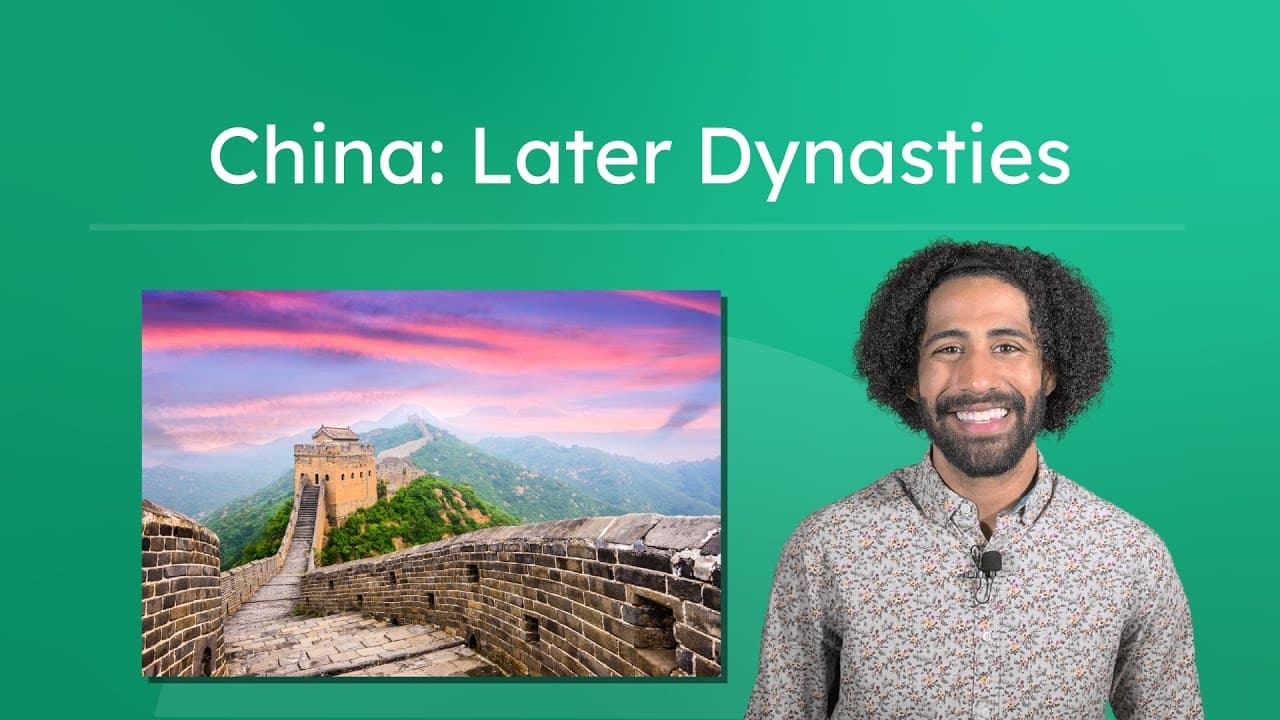
How the Mongols and Ming Shaped China

How the Mongols and Ming Shaped China

This engaging educational video takes students on a journey through the later dynasties of China, specifically focusing on the Mongol invasion that established the Yuan Dynasty and the subsequent "Golden Age" of the Ming Dynasty. The narrator uses accessible analogies—like building blocks and "capture the flag"—to explain complex historical events such as Genghis Khan's conquest and the cyclical nature of dynastic rule. Viewers explore monumental achievements like the expansion of the Great Wall, the construction of the Forbidden City, and the voyages of Zheng He. The content highlights key themes including military conquest, cultural assimilation, economic prosperity, and the pivotal shift from global exploration to isolationism under the "Closed Door" policy. It emphasizes how China's culture, arts, and philosophies (like Confucianism and Taoism) influenced neighboring regions such as Japan and Korea, and how trade routes like the Silk Road connected China to the wider world. For educators, this video serves as an excellent anchor for units on Ancient World History or Asian Studies. It simplifies abstract concepts like "dynastic cycles" and "cultural diffusion" into relatable terms. The video's clear structure, with stated learning objectives and review summaries, makes it easy to integrate into lesson plans involving architectural study, historical debates on isolationism, or mapping exercises of ancient trade routes.

Miacademy & MiaPrep Learning ChannelMiacademy & MiaPrep Learning Channel

10mins 47s

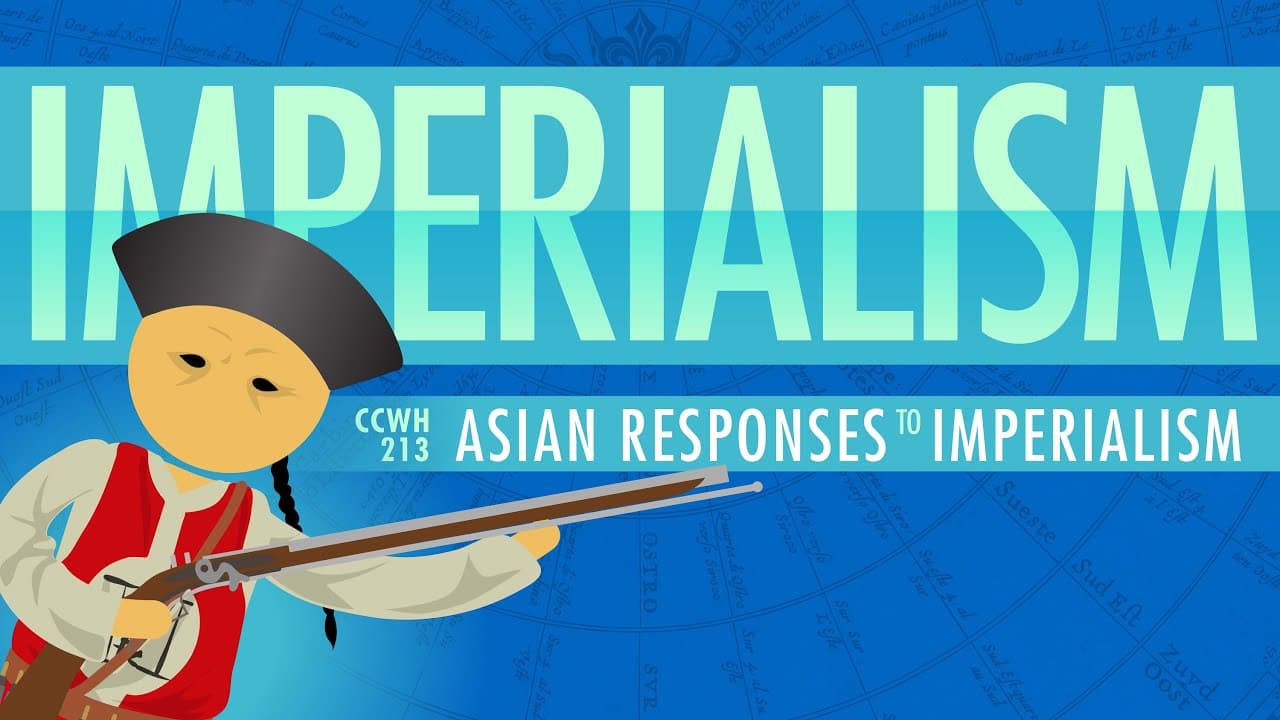
How Asian Intellectuals Responded to Western Imperialism

How Asian Intellectuals Responded to Western Imperialism

In this installment of Crash Course World History, John Green shifts the focus from the "Rise of the West" to the perspectives of those who experienced Western imperialism firsthand. Specifically examining East Asia and the Middle East, the video explores how Asian intellectuals and leaders analyzed the sources of Western power and debated how to respond. Rather than portraying Asian societies as passive victims, the video highlights the active intellectual work done by thinkers like Jamal al-Din al-Afghani, Liang Qichao, and Rabindranath Tagore. The video delves into key themes such as the adoption of Western military and educational models (Self-Strengthening), the rise of nationalism and the nation-state concept in Asia, and the eventual disillusionment with Western liberal democracy. It discusses how early admiration for Western efficiency often turned into a critique of Western materialism and hypocrisy, especially following World War I and the Treaty of Versailles. The content covers specific historical movements including the Tanzimat reforms in the Ottoman Empire, the Self-Strengthening Movement in China, and the complex nature of Indian nationalism. For educators, this video is an invaluable resource for teaching World History from a non-Eurocentric perspective. It challenges students to consider how historical events look different depending on who is telling the story. It provides a nuanced look at the tension between modernization and traditionalism and introduces students to primary source voices that are often omitted from standard textbooks, making it an excellent tool for developing historical empathy and critical thinking skills.

CrashCourseCrashCourse

12mins 55s

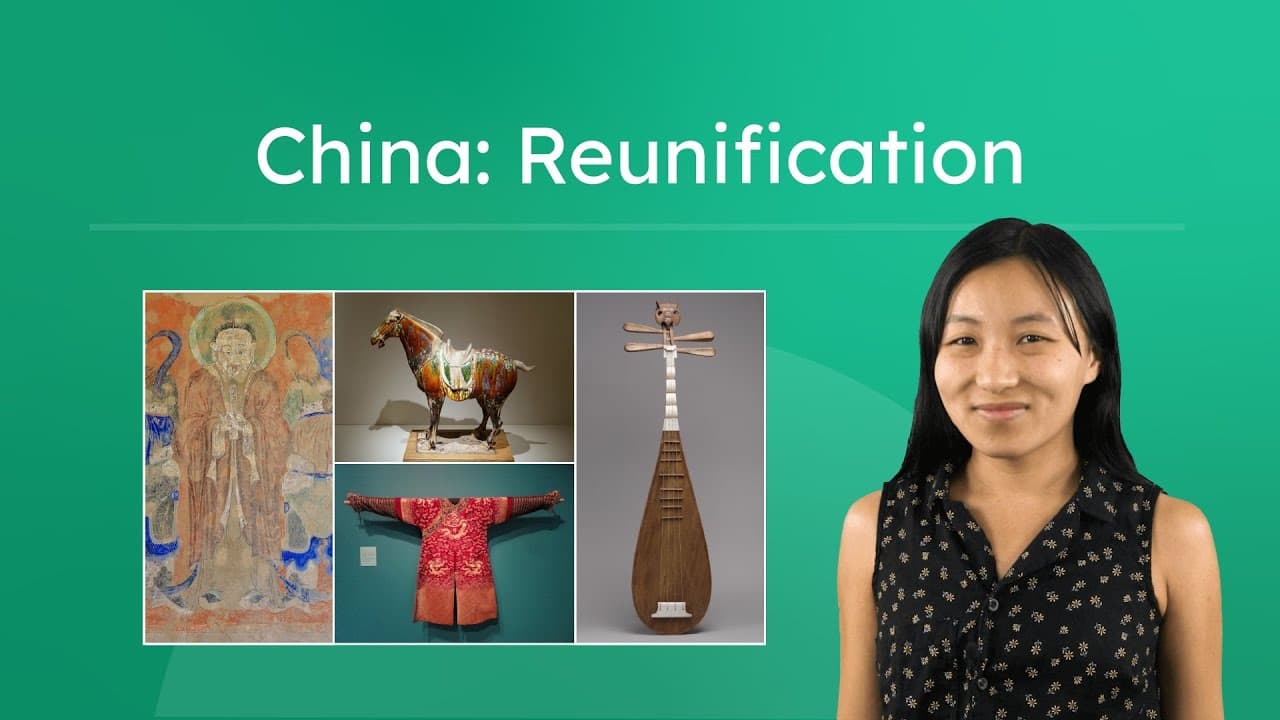
Discovering the Golden Age of Ancient China

Discovering the Golden Age of Ancient China

This educational video explores the reunification and subsequent "Golden Age" of Ancient China under the Sui and Tang dynasties. Narrated by Mia, it takes students on a journey through a timeline of chaos following the Han Dynasty to the stability established by the Sui. The video details significant technological advancements, including the Four Great Inventions (gunpowder, paper, printing, and the compass) and the construction of the massive Grand Canal, highlighting how these innovations connected the world and fueled economic growth. The content dives deep into the cultural explosion of the Tang Dynasty, showcasing its poetry, landscape paintings, ceramics, music, and cuisine. It emphasizes the aesthetic and social values of the time, illustrating how art and daily life were intertwined. Furthermore, the video addresses the philosophical and religious landscape of the era, specifically examining how Buddhism and Confucianism coexisted and complemented one another to guide social behavior and spiritual life. This resource is highly valuable for World History curriculums, offering a clear, engaging overview of a complex historical period. It provides opportunities to discuss the impact of technology on society, the role of infrastructure in economic development, and the syncretism of religious beliefs. Teachers can use the embedded questions to check for understanding and the rich visuals of artifacts and maps to anchor lessons on geography and art history.
Miacademy & MiaPrep Learning ChannelMiacademy & MiaPrep Learning Channel

10mins 10s

Materials

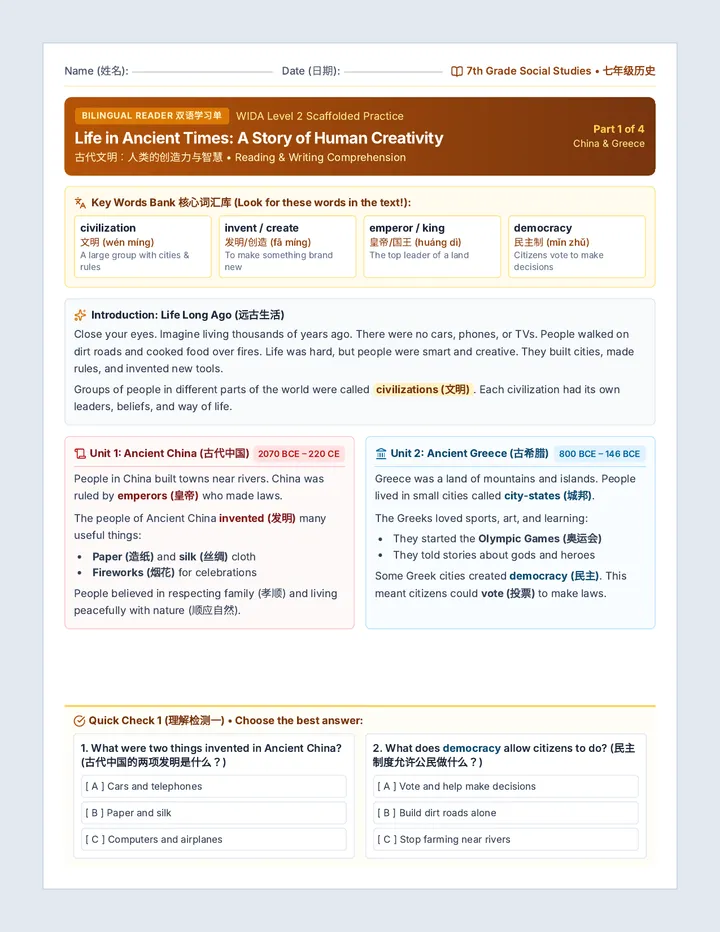
Ancient Creativity Comprehension Packet

Ancient Creativity Comprehension Packet

A 4-page scaffolded reading and writing comprehension packet for 7th-grade social studies, tailored for a Chinese-speaking WIDA Level 2 English learner. Includes bilingual vocabulary glossaries (English, Simplified Chinese, and Pinyin), chunked passages, visual icons, comprehension checks, and guided sentence-frame writing exercises.

KC

Kasie Costopulos

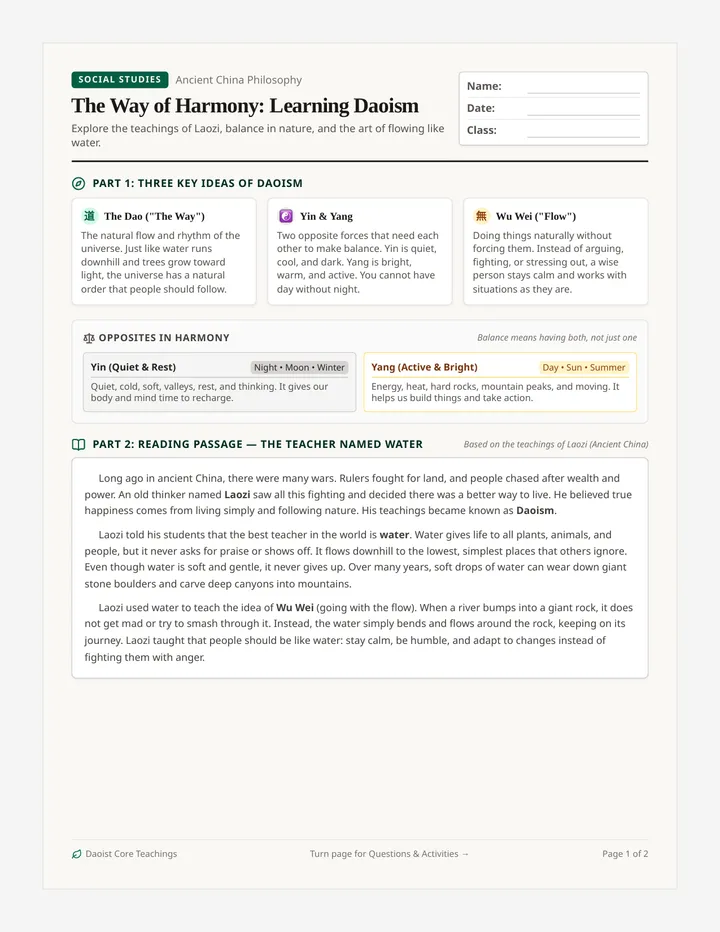
Way of Harmony Worksheet

Way of Harmony Worksheet

An accessible two-page printable student worksheet on Daoism featuring simplified reading passages, foundational concepts (the Dao, Yin and Yang, and Wu Wei), clear text-dependent questions, and balance-matching activities.

M

meagan_asp

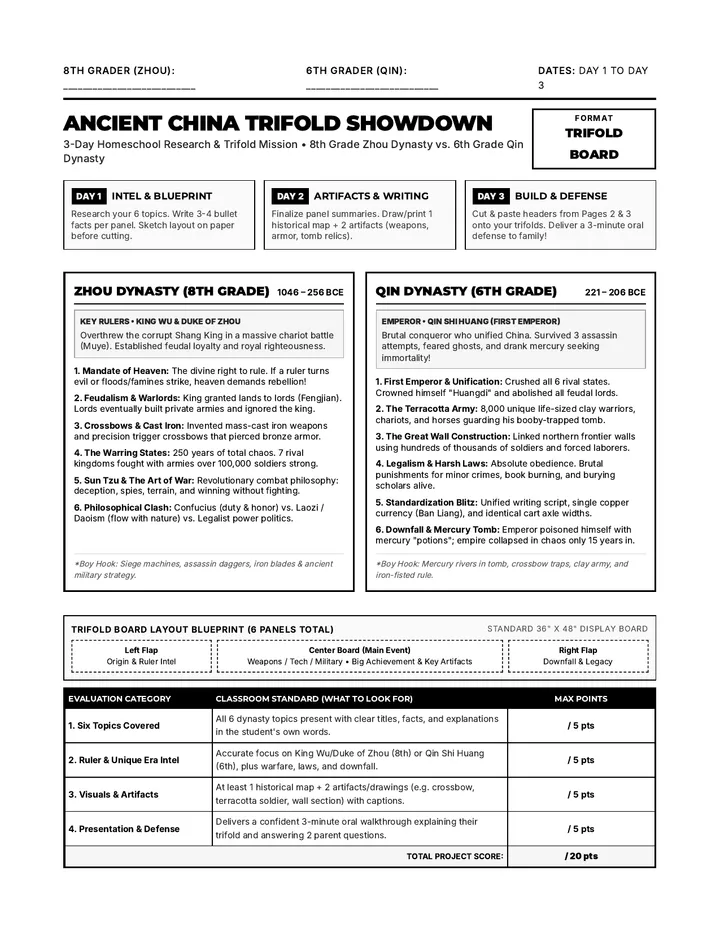
Dynasty Showdown Project Guide

Dynasty Showdown Project Guide

A 3-page print-ready homeschool project guide and enlarged cut-out header pack for two middle school boys completing a 3-day Ancient China trifold board. Page 1 contains the 3-day roadmap, 6 topics each for Zhou (8th grade) and Qin (6th grade), trifold blueprint, and rubric. Pages 2 and 3 provide dedicated full-page, large-format cut-out headers, topic banners, and artifact badges for each dynasty.

DB

Danielle Burham

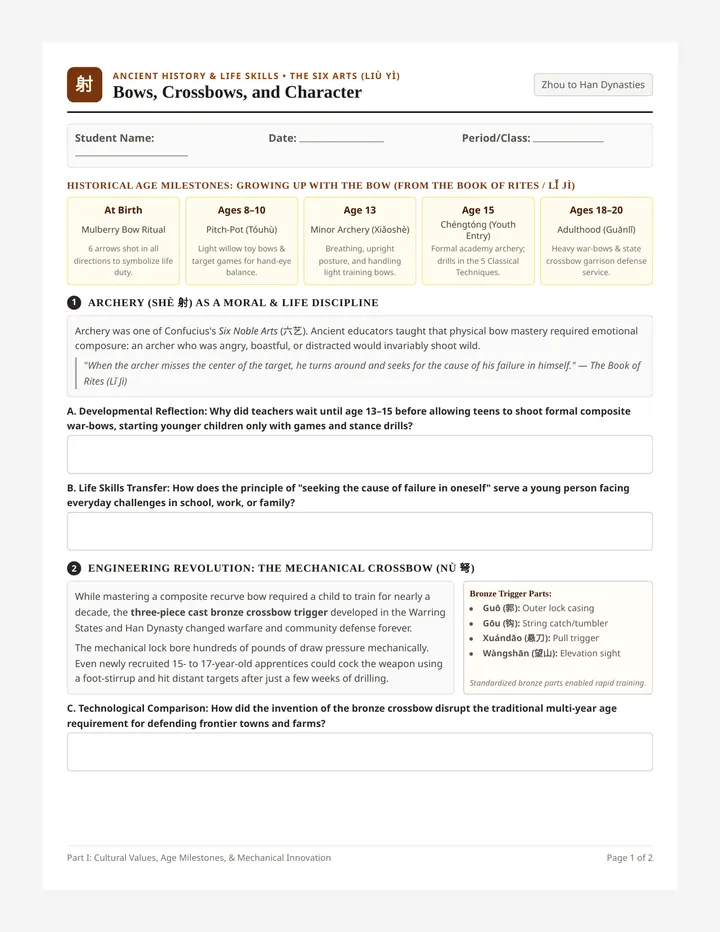
Ancient Archer Worksheet

Ancient Archer Worksheet

A comprehensive 2-page historical analysis worksheet examining the exact age progression (from birth rituals to age 15 and 20) of how ancient Chinese youth learned archery as a life skill, comparing the composite bow with the mechanical bronze crossbow.

DB

Danielle Burham

River Civilizations Adapted Packet

River Civilizations Adapted Packet

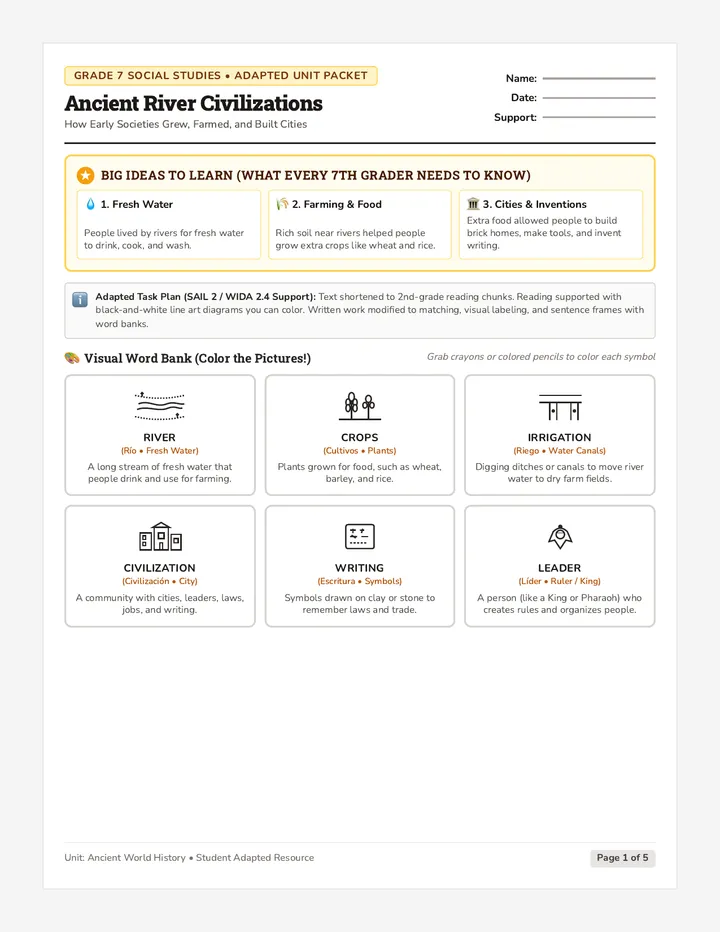
A 5-page adapted student learning packet on ancient river civilizations tailored for a 7th-grade English learner in a SAIL 2 inclusion model (WIDA 2.4). Features simplified chunked text, black-and-white line art illustrations ready for coloring, visual vocabulary cards, an organizer matrix, sentence frames, and a creative draw-and-label culminating task.

CQ

Colleen Quinn

Asian Civilizations Review Worksheet

Asian Civilizations Review Worksheet

A two-page structured review worksheet designed to help students write complete-sentence answers for a test on early Indian and Chinese civilizations. Includes categorized word banks, question-specific sentence starters, handwriting-ready ruled response areas, and a self-assessment sentence quality checklist.

FT

Faith Timberman

Sequences

Curriculum Blueprint Document v2

History Horizon Sequence

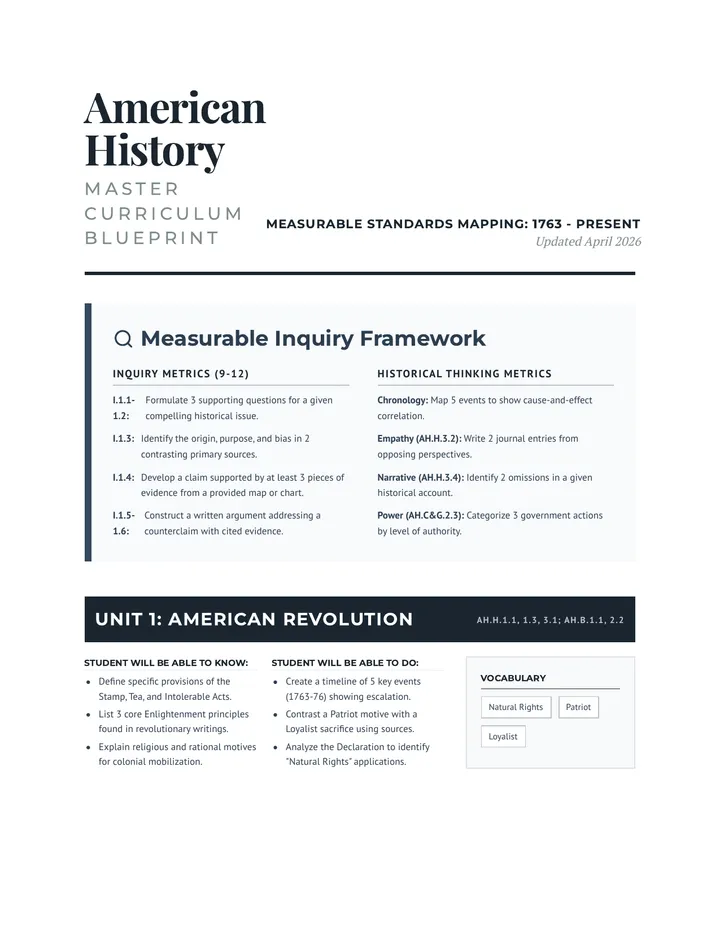
A comprehensive high school curriculum plan for American History, covering 13 units from the American Revolution to the modern era, aligned with North Carolina Social Studies standards.

AK

Amity Kea

21
Pioneer Portfolio Project Guide

River Kingdoms

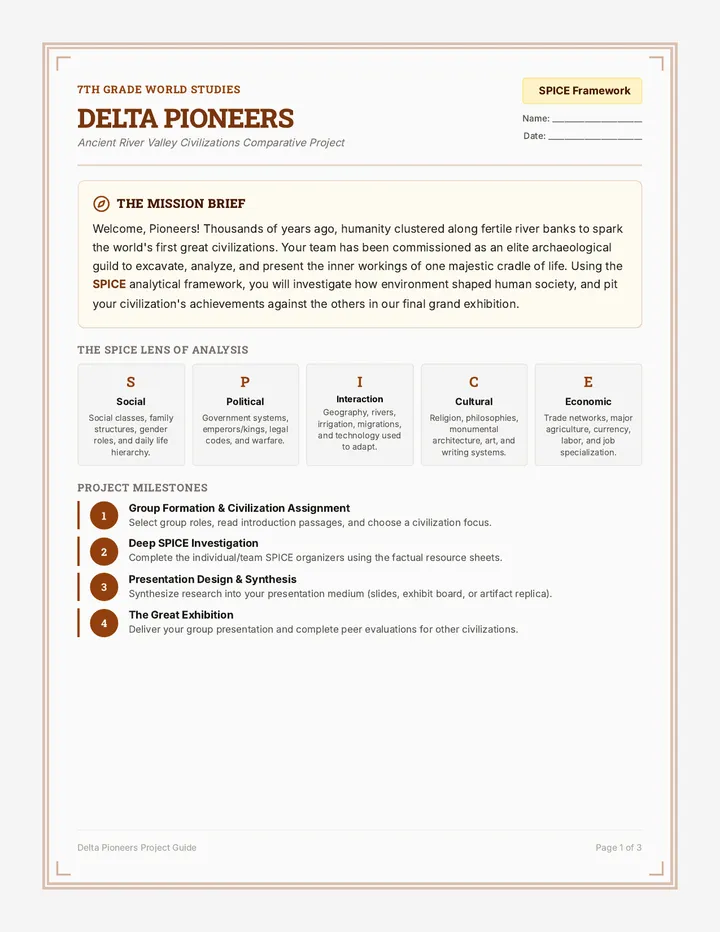
An immersive historical sequence guiding 7th-grade students through the excavation, comparison, and long-term legacy of the world's four primary river valley civilizations using the SPICE framework.

NE

Nicole Elder

9
Landscapes Student Worksheet

China Crossroads

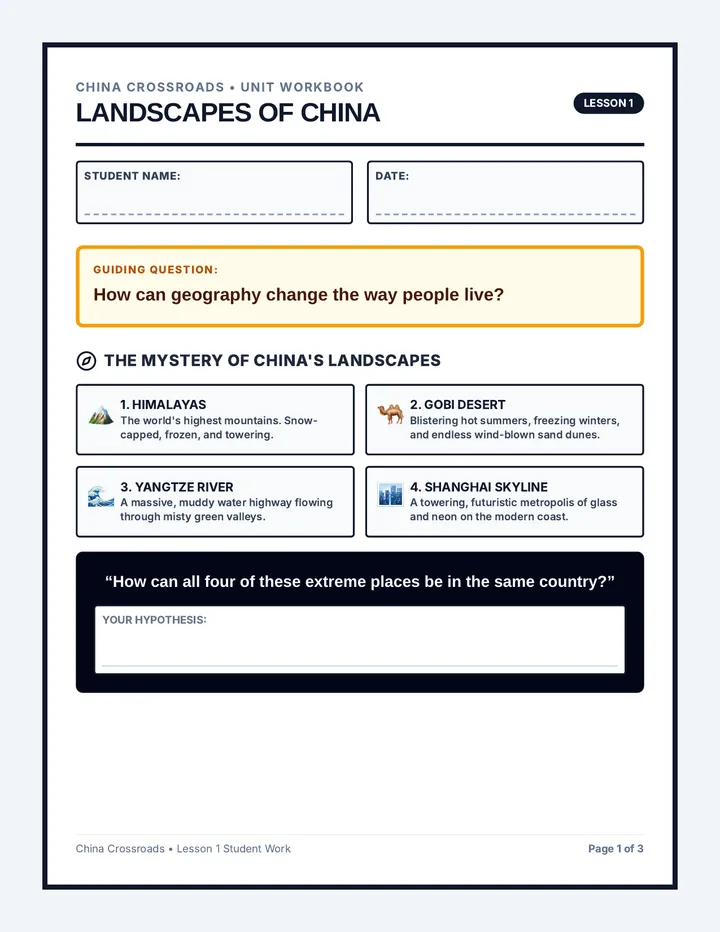
An engaging, multi-sensory, and highly structured unit exploring China's geography, the construction of the Great Wall, river engineering, and modern daily life. Designed with high-contrast, large-print, and scaffolded math and writing frameworks for enhanced accessibility.

LK

Lisa Kmetz

5
Mapping the Sand Slides

Desert Discoveries

A differentiated social studies unit covering the geography, cultures, and empires of the Middle East and North Africa, adapted for 3rd-grade readability based on the DESE Investigating History Grade 6 curriculum.

JS

Janette Sullivan

43
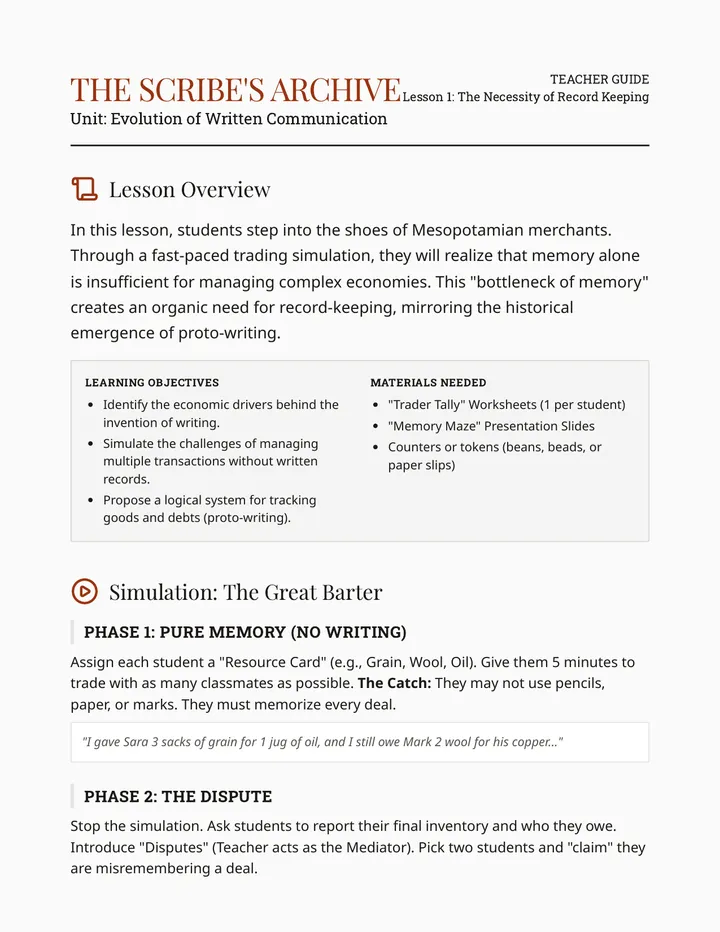
Scribe Origins Teacher Guide

Evolution of Written Communication and Technology

A workshop-style sequence exploring how the economic and administrative needs of ancient river civilizations led to the invention of writing. Students engage in simulations and hands-on activities to understand the evolution from pictographs to abstract scripts.

11
Mandate Cycle Slides

Dynastic China Continuity

This sequence examines the political evolution and cultural achievements of China's Golden Ages through the Tang, Song, and Ming dynasties. Students will analyze how the Civil Service Examination system created a meritocratic bureaucracy that sustained stability and fostered technological innovation.

14

Lessons

Explorer Epochs Wall Chart

Early World Explorers

A comprehensive lesson on early world exploration from 300 BCE to 1500 CE, focusing on the geographical, cultural, and religious impacts of key explorers across different continents.

J

jcasey

14
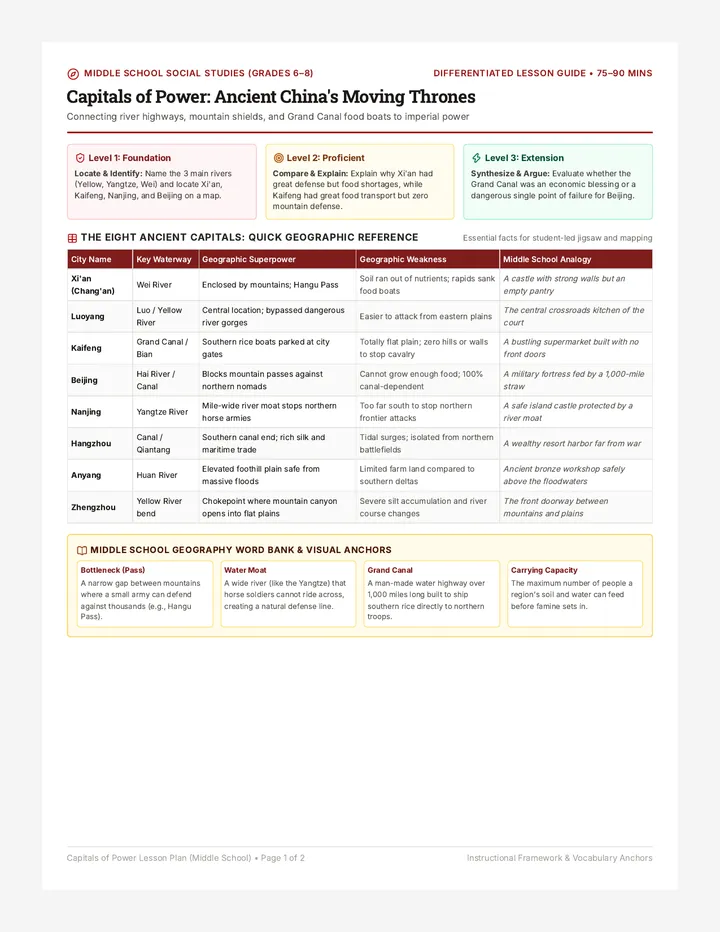
Capitals of Power Lesson Plan

Capitals of Power

An immersive geography and history investigation exploring China's eight ancient capitals, examining how river systems, mountain barriers, and agricultural heartlands dictated imperial power centers over four millennia. Students trace spatial shifts across China's major geographic zones through interactive mapping, comparative trade-off analysis, and strategic case studies.

DB

Danielle Burham

6
Silk Road Slides

Desert Caravans

A comprehensive exploration of the Silk Road's geography, challenging terrain, and the vital role of trade routes connecting East and West. Students will analyze physical barriers and key trading hubs.

WM

Wilberto Mejias

7
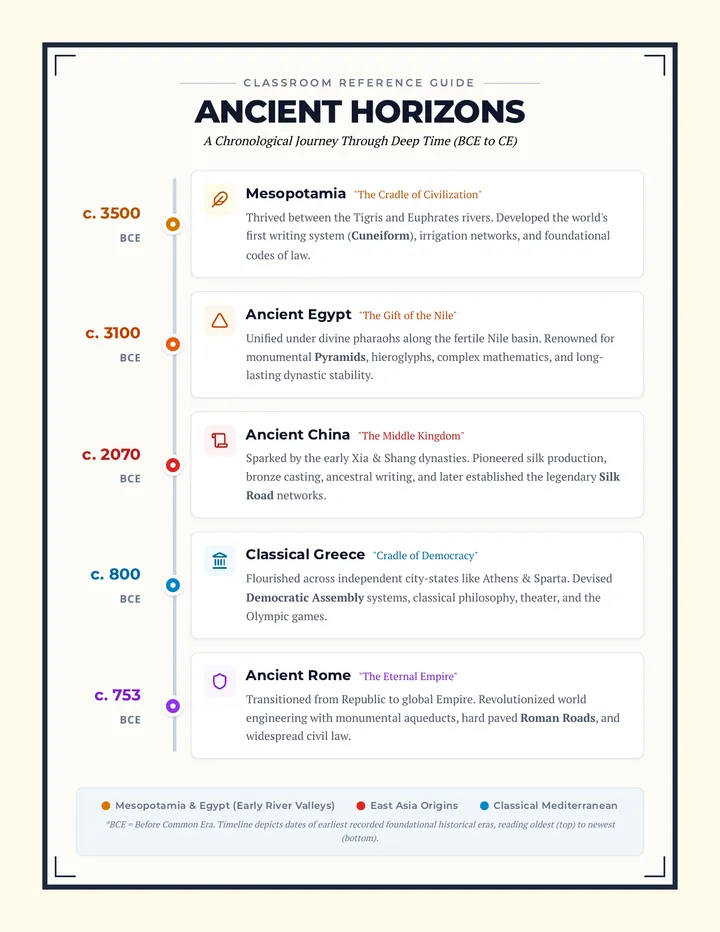
Ancient Horizons Timeline Poster

Ancient Civilizations Timeline

A lesson package designed to introduce the chronology of five fundamental ancient civilizations. It includes a high-impact master reference poster and printable large-scale timeline cards for classroom display.

SZ

Sandra Zoerhoff

2
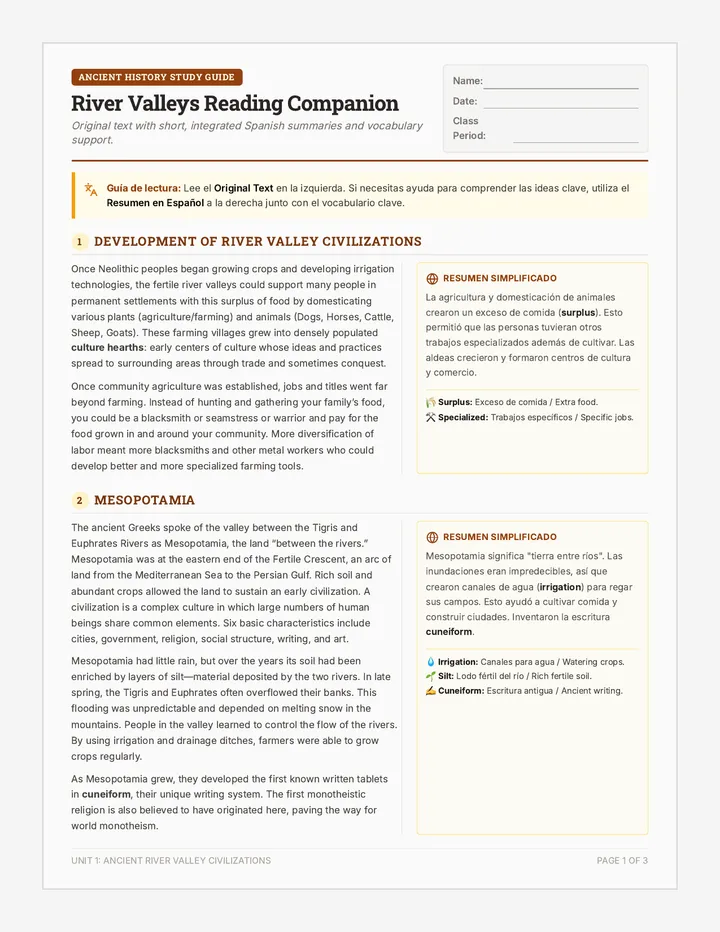
Civilizations Reading Companion

River Valley Civilizations

A comprehensive history lesson focusing on the development of the four major ancient river valley civilizations, featuring differentiated text and scaffolded reading supports for ESL students.

JO

Jacob Obannon

1
River Valley Pioneers Slides

River Valley Pioneers

A high school world history lesson focusing on the geographic factors of the Neolithic Revolution. Students participate in a station rotation activity, analyzing maps, data, and geographical details of four major river valleys (Nile, Tigris-Euphrates, Indus, and Yellow Rivers) to determine why agriculture began in these specific regions.

AH

Ashley Hopf

4