Lenny.com
Explore
Create
ActivitiesNewMathEnglish Language ArtsScience & EngineeringSocial StudiesGlobal LanguagesHealth & Physical EducationSpecial EducationCounseling & Life SkillsArts & CreativityESL
Lenny.com
Lenny.com
Explore
Create
ActivitiesNewMathEnglish Language ArtsScience & EngineeringSocial StudiesGlobal LanguagesHealth & Physical EducationSpecial EducationCounseling & Life SkillsArts & CreativityESL
Lenny.com
Social StudiesSocial Studies PracticesLocation WordsMapsOrder EventsChronology and CausationEvaluating SourcesHistorical ThinkingGeography, Humans, & the EnvironmentAmerican Symbols and LandmarksCitiesStatesState CapitalsRegions of the United StatesGeographic SkillsPhysical GeographyHuman GeographyRegional GeographyGeography of AfricaGeography of AsiaGeography of EuropeGeography of OceaniaGeography of the AmericasSociety and Environment of EuropeSociety and Environment of AsiaSociety and Environment of The AmericasSociety and Environment of the Middle EastSociety and Environment of AfricaHistoryPrehistoryComparing Ancient River CivilizationsAncient MesopotamiaAncient Egypt and KushAncient South AsiaEarly ChinaGreeceRome and the Byzantine EmpireAncient World HistoryNative Peoples of North AmericaNative Peoples of Mesoamerica and South AmericaAfrican EmpiresMedieval AsiaMedieval EuropeThe Silk RoadMedieval HistoryIslamic EmpiresWorld ReligionsRenaissance PeriodAge of ExplorationThe Thirteen ColoniesThe American RevolutionUS History Early RepublicFounding of the United StatesUS History AntebellumUS Civil WarReconstruction PeriodThe Gilded AgeUS ImperialismWorld ImperialismWorld War IUS History 1920sGreat DepressionWorld War IIThe Cold WarUS History 1950-60sUS History 1960s-70sWorld History 20th CenturyContemporary US HistoryContemporary World HistoryHolidaysCivics and GovernmentCitizenshipGovernment FoundationsThe ConstitutionUS ConstitutionExecutive BranchLegislative BranchJudicial BranchState and LocalPolitical ParticipationPublic PolicyPolitical SystemsPower and AuthoritySocial MovementsDefining DevianceTheories of DevianceCrime and Criminal JusticeEconomicsBasic Economic PrinciplesSupply and DemandWhat is MoneyEconomic FundamentalsMicroeconomicsMacroeconomicsBanking and FinanceEconomic SystemsGlobal EconomicsCorporations and PowerThe Changing WorkplaceUnemployment and LaborClass and InequalitySocial MobilityGlobal InequalityPsychologyHistory of PsychologyPsychology as a ScienceBrain and Nervous SystemNeuroscience and BehaviorGenetics and BehaviorSleep and ConsciousnessSensory ProcessesPerceptual OrganizationClassical ConditioningOperant ConditioningObservational LearningCognitive LearningMemory ProcessesThinking and Problem SolvingLanguage and CognitionTheories of MotivationStress and CopingPrenatal and Infant DevelopmentChildhood DevelopmentAdolescent DevelopmentAdulthood and AgingSelf and IdentitySocial CognitionSocial InfluenceAttraction and RelationshipsGroup BehaviorPrejudice and DiscriminationAnxiety and Mood DisordersClinical PsychologyForensic PsychologyPhilosophy & EthicsIntroduction to PhilosophyMajor Philosophers & IdeasMind and Body ProblemFree Will vs DeterminismEthics & MoralityReligion & PhilosophyPolitical Philosophy
Lenny.com

Solutions

Lenny for EducatorsLenny for SchoolsLenny for Districts

Product

ExploreSign inCreateSupportAbout

Resources

Getting startedMTSS Acceleration Program

Newsletters

School Funding Newsletter

© 2026 Lenny Learning Inc.

TermsPrivacyAccessibility
LinkedInInstagramX
Lenny

Contemporary US History

Analyzes American political, social, and economic developments from the mid-20th century to the present. Examines the Civil Rights Movement, Cold War dynamics, and modern globalization.

Videos

The War on Terror: Balancing National Security and Civil Liberties

The War on Terror: Balancing National Security and Civil Liberties

This educational video provides a comprehensive overview of the United States' "War on Terror" following the September 11 attacks, utilizing a virtual museum tour format to explore complex historical and political themes. The video is structured around three main exhibits: defining the tactics of the War on Terror, examining foreign policy decisions in Afghanistan and Iraq, and analyzing domestic policy changes within the US. It breaks down key strategies such as counterterrorism, preemptive strikes, and intelligence sharing, while also addressing the controversial invasion of Iraq regarding Weapons of Mass Destruction and the hunt for Osama bin Laden.

Miacademy & MiaPrep Learning ChannelMiacademy & MiaPrep Learning Channel

12mins 15s

How Religion in America Evolved Through History

How Religion in America Evolved Through History

This educational video provides a comprehensive overview of the evolution of the religious landscape in the United States, tracing its roots from a predominantly Protestant colonial society to a diverse modern nation. The narrator uses relatable analogies to explain complex social dynamics before diving into key historical periods, specifically focusing on how the Great Awakening reinforced early Christian dominance and how subsequent waves of immigration introduced Catholicism, Judaism, and Eastern philosophies to the American cultural fabric. Key themes explored include the tension between the constitutional promise of religious freedom (the Free Exercise Clause) and the historical reality of discrimination faced by minority groups. The video presents case studies on Jewish immigrants fleeing antisemitism and Chinese immigrants arriving during the Gold Rush, highlighting both their contributions and the systemic barriers they encountered, such as the Immigration Act of 1924. It defines important concepts like "religious revival," "secularism," and "antisemitism" within their historical contexts. For educators, this video serves as an excellent resource for U.S. History and Civics units. It connects abstract constitutional rights to concrete historical events, allowing students to analyze demographic shifts and discuss the social impacts of immigration. The video features built-in pause points for document analysis activities, making it a ready-to-use tool for teaching about the First Amendment, the history of immigration policy, and the value of cultural diversity.

Miacademy & MiaPrep Learning ChannelMiacademy & MiaPrep Learning Channel

11mins 56s

How the Cold War Shaped America

How the Cold War Shaped America

This fast-paced educational video provides a comprehensive overview of the Cold War, framing it not just as a geopolitical struggle but as an era that fundamentally reshaped the United States between 1945 and 1990. Hosted by John Green, the video explores the origins of the conflict, contrasting the post-WWII positions of the United States and the Soviet Union. It explains the ideological battle between capitalism and communism and details key American strategies like the policy of containment, the Truman Doctrine, and the Marshall Plan, which aimed to stop the spread of Soviet influence in Europe and Asia. The narrative digs deep into how foreign policy decisions impacted domestic life in America. It covers the creation of the national security state (CIA, NSC), the nuclear arms race, and the cultural impact of living under the constant threat of annihilation. Significant attention is given to the "Red Scare" and McCarthyism, illustrating how the fear of communism led to loyalty oaths, espionage trials (the Rosenbergs), and a political climate where dissent was often equated with disloyalty. The video also highlights unintended domestic benefits, such as the construction of the interstate highway system and increased funding for education and science. For educators, this resource serves as an excellent anchor for units on 20th-century history, foreign policy, or civics. It challenges students to think critically about the definition of "war," the trade-offs between security and liberty, and how international relations can dictate domestic social agendas. The video includes primary source analysis (NSC-68) and connects historical events to modern concepts of freedom and government responsibility, making it a versatile tool for stimulating high-level classroom discussion and analysis.

CrashCourseCrashCourse

13mins 34s

Push and Pull: The Story of Internal Migration in the U.S.

Push and Pull: The Story of Internal Migration in the U.S.

This educational video explores the dynamics of internal migration within the United States during the 19th and 20th centuries through the lens of "push and pull" factors. The narrator uses a relatable opening scenario about moving for college to introduce the concepts of why people leave their homes (push factors) and what draws them to new locations (pull factors). The video then dives into three major historical case studies: the migration of the Latter-day Saints to Utah, the First Great Migration of Black Americans from the South to the North and West, and the Dust Bowl migration of "Okies and Arkies" to California. The content examines the specific social, economic, and political drivers for each group. For the Mormon migration, it highlights religious persecution and the search for a "promised land." For the Great Migration, it frankly discusses the impact of Jim Crow laws, KKK violence, and the economic allure of industrial jobs in the North, alongside cultural explosions like the Harlem Renaissance. Finally, it details the environmental and economic devastation of the Dust Bowl that forced families to travel Route 66 in search of agricultural work in the West. Teachers can use this video to help students understand that migration is rarely random; it is driven by specific historical forces. The video is particularly valuable for its interdisciplinary approach, connecting geography, sociology, and history. It encourages students to analyze primary sources, specifically highlighting the photography of Dorothea Lange, and fosters historical empathy by examining the human cost of displacement and the resilience required to start over.

Miacademy & MiaPrep Learning ChannelMiacademy & MiaPrep Learning Channel

10mins 49s

From Isolation to Intervention: How US Foreign Policy Changed After WWII

From Isolation to Intervention: How US Foreign Policy Changed After WWII

This educational video provides a comprehensive overview of the dramatic shift in United States domestic and foreign policy from the post-World War I era through the Cold War. It explores how the United States transitioned from a nation favoring isolationism and a small peacetime military to a global superpower with an interventionist foreign policy and a large standing army. The narrator explains the historical context behind these changes, highlighting how public opinion evolved due to the devastation of global wars, the rise of communism, and the threat of nuclear annihilation.

Miacademy & MiaPrep Learning ChannelMiacademy & MiaPrep Learning Channel

10mins 59s

How Women Transformed the Progressive Era

How Women Transformed the Progressive Era

This installment of Crash Course US History explores the pivotal role of women during the Progressive Era, challenging the notion that the 19th Amendment was the sole achievement of the period. Host John Green argues that the years between 1890 and 1920, often called the "Women's Era," saw women actively reshaping the United States through participation in the workforce, consumer activism, and social reform movements like temperance and settlement houses. The video illustrates how economic independence and education were crucial prerequisites to political power. The content covers a wide range of topics including the Women's Christian Temperance Union (WCTU), the rise of mass consumerism and the National Consumers League, the birth control movement led by Margaret Sanger, and the diverse strategies within the suffrage movement itself. It highlights key figures such as Jane Addams, Florence Kelley, Charlotte Perkins Gilman, and Alice Paul, providing a nuanced look at the internal conflicts regarding race, class, and tactics (militant vs. moderate) that defined the struggle for equality. For educators, this video serves as an essential resource for teaching the complexity of social change. It moves beyond a simple timeline of voting rights to examine the intersectionality of labor, gender, and civil liberties. Teachers can use this video to spark discussions on how social movements build power, the concept of "private" vs. "public" spheres for women, and the historical context of modern debates surrounding reproductive rights and the Equal Rights Amendment.

CrashCourseCrashCourse

13mins 31s

Materials

History Inquiry Guided Worksheet

History Inquiry Guided Worksheet

3-page scaffolded student inquiry packet fully aligned to lesson objectives (why learn history, classroom procedures, and historical thinking skills) streamlined for native English students with clear procedural guides, stacked-traits analogies, and IDCV graphic organizers.

SP

Sheridan Pickett

Space Race Snapshots Summary Guide

Space Race Snapshots Summary Guide

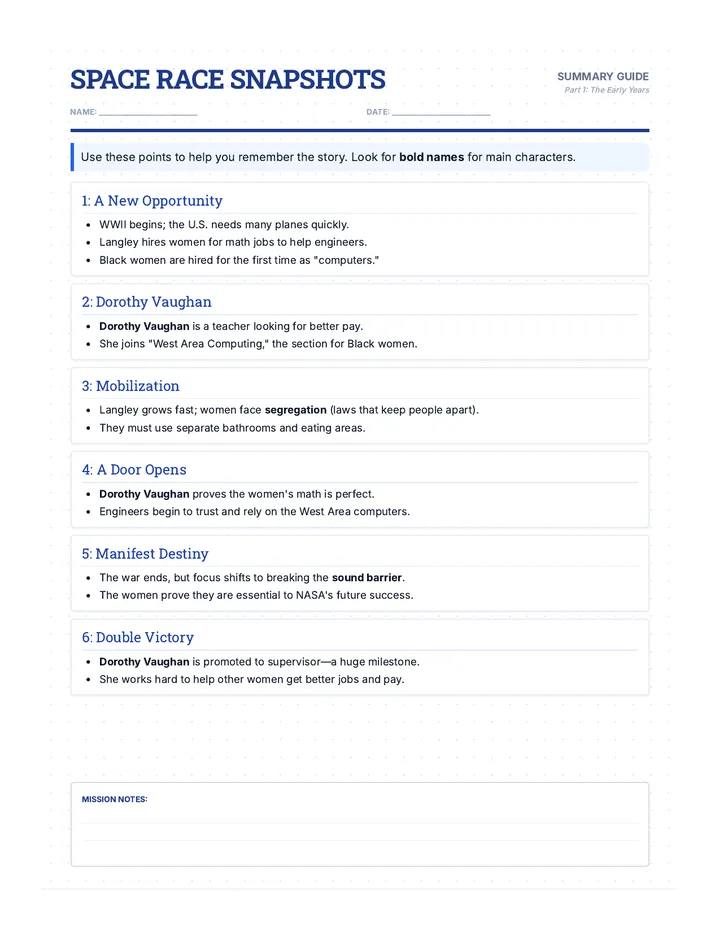
A four-page chapter-by-chapter summary guide for "Hidden Figures" (Young Readers Edition), designed specifically for struggling readers. It features bulleted main points, bolded character names, and a clean, high-contrast NASA-inspired layout to support comprehension and tracking of the narrative.

M

mattiea

Trump Era Fact Sheet

Trump Era Fact Sheet

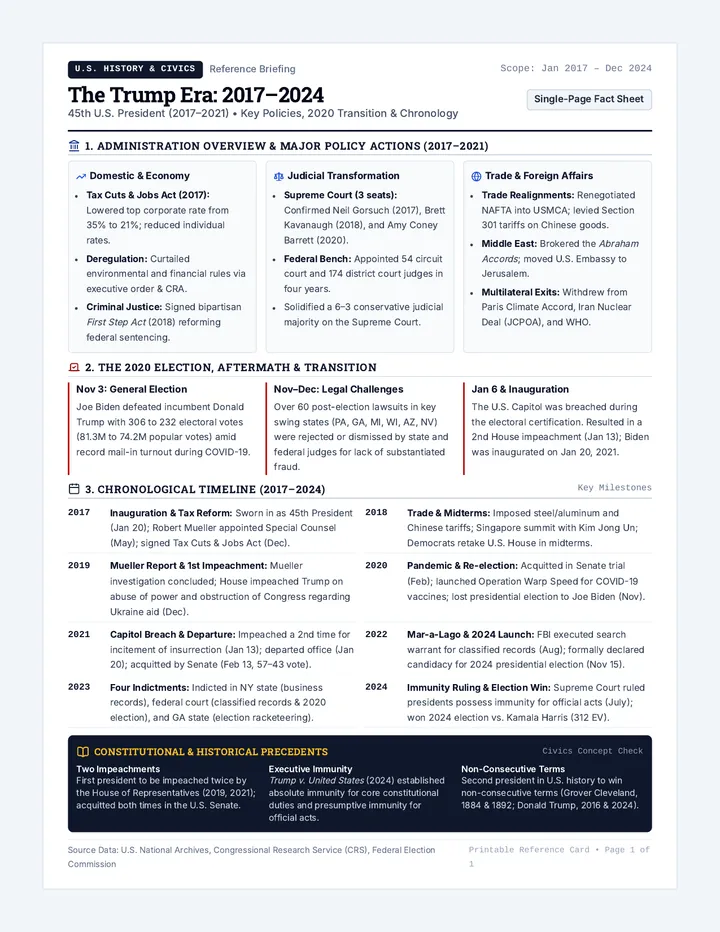
A concise, one-page printable fact sheet surveying the Trump presidency (2017–2021), the 2020 election and transition, and a comprehensive historical timeline through 2024 for high school and civics classrooms.

YP

Yovanna Plummer

Gettysburg Address Webquest Worksheet

Gettysburg Address Webquest Worksheet

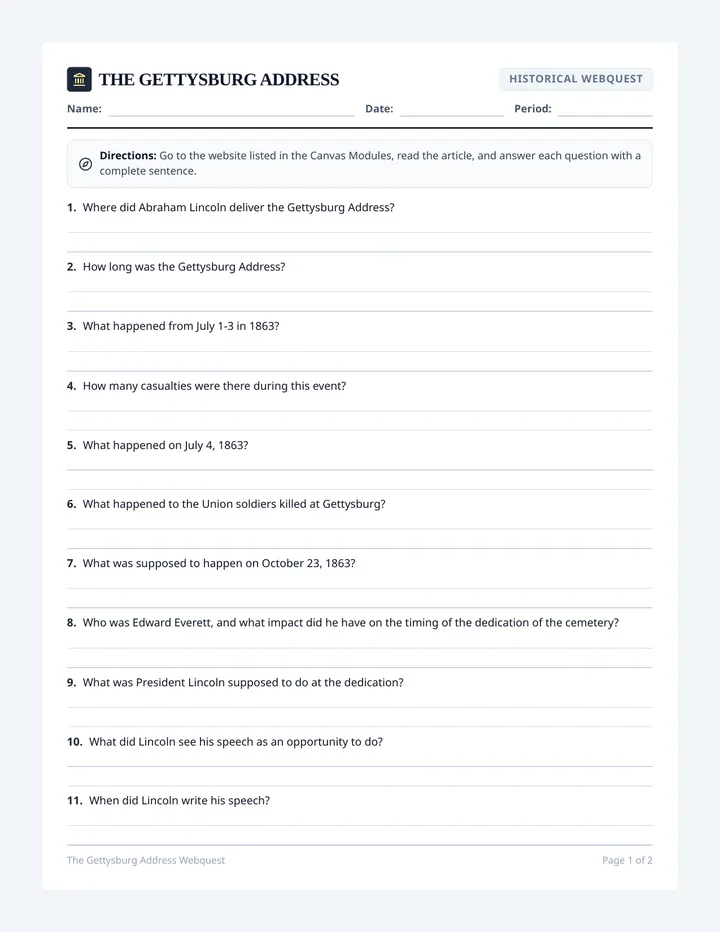
A beautifully formatted, printable two-page webquest worksheet on Abraham Lincoln's Gettysburg Address with directions updated to reference Canvas Modules, clear student metadata fields, and dedicated handwriting response lines.

C

Camille.Keys

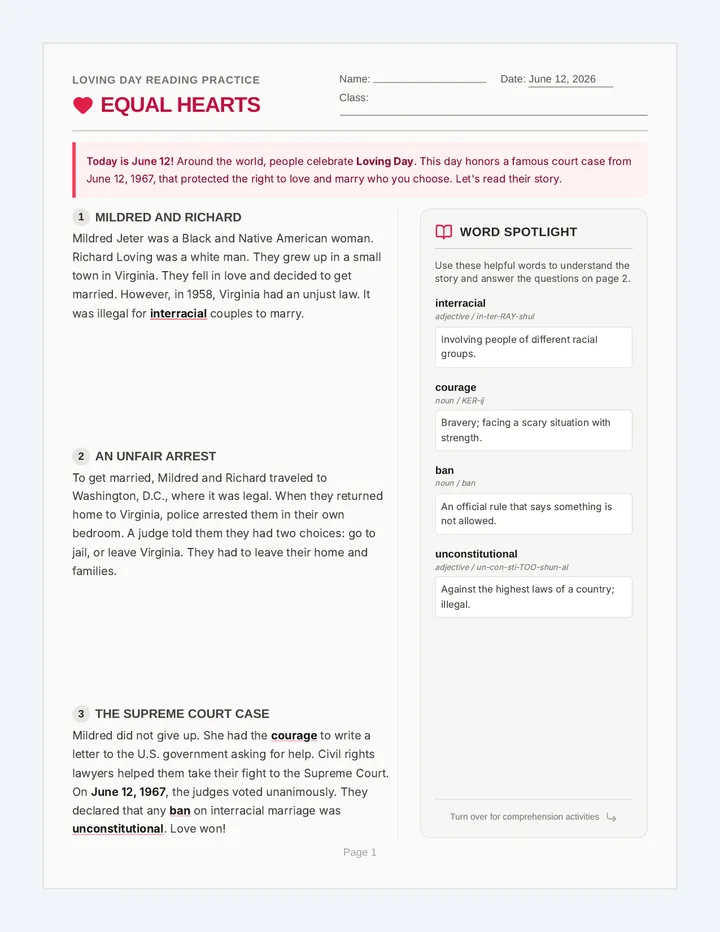
Equal Hearts Worksheet

Equal Hearts Worksheet

A standalone, double-sided printable reading worksheet designed for English Language Learners (ELL) focusing on Loving Day (June 12, 1967). Includes an accessible, scaffolded reading passage, a visual vocabulary spotlight, text-dependent comprehension questions with writing frames, and a creative reflection activity.

KO

Kelly Oshinnaiye

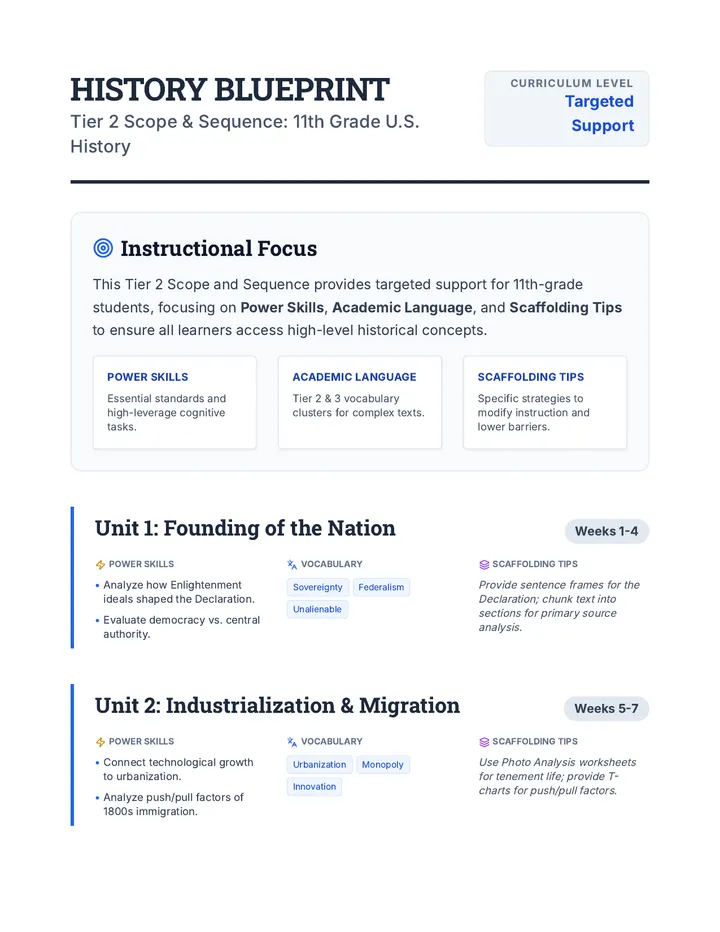
History Blueprint Scope and Sequence

History Blueprint Scope and Sequence

An updated Tier 2 Scope and Sequence for 11th Grade U.S. History, now including specific scaffolding tips for each unit alongside power skills and academic vocabulary. The layout is optimized for teacher reference with instructional strategies tailored for targeted support.

D

dfleisch

Sequences

Invention Boom Slides

Modern Era Odyssey

A 13-day journey through modern American history, from the Industrial Revolution to the present day, focusing on key historical figures and major conflicts as outlined in the 5th Grade TEKS. Each lesson is designed for a quick 30-minute block, integrating multimedia and primary source analysis.

CH

Courtney Holdren

49
Soulful Cyphers Lesson Plan

We Gon’ Be Alright- A Century of Black Excellence

A comprehensive 6-lesson Black History Month curriculum for 5th-8th graders, exploring historical excellence, emotional expression, and community through the lens of five core values: Virtus, Kenkyo, Sankofa, Ubuntu, and Ganas. Inspired by a century of resilience and brilliance.

JS

Joleen Shillingford

18
Thirteen Friends Worksheet

Democratic Foundations

A series of lessons exploring the foundational documents and processes of the United States government, from the birth of the nation to the creation of modern laws.

SB

Stephanie Bizeur

40
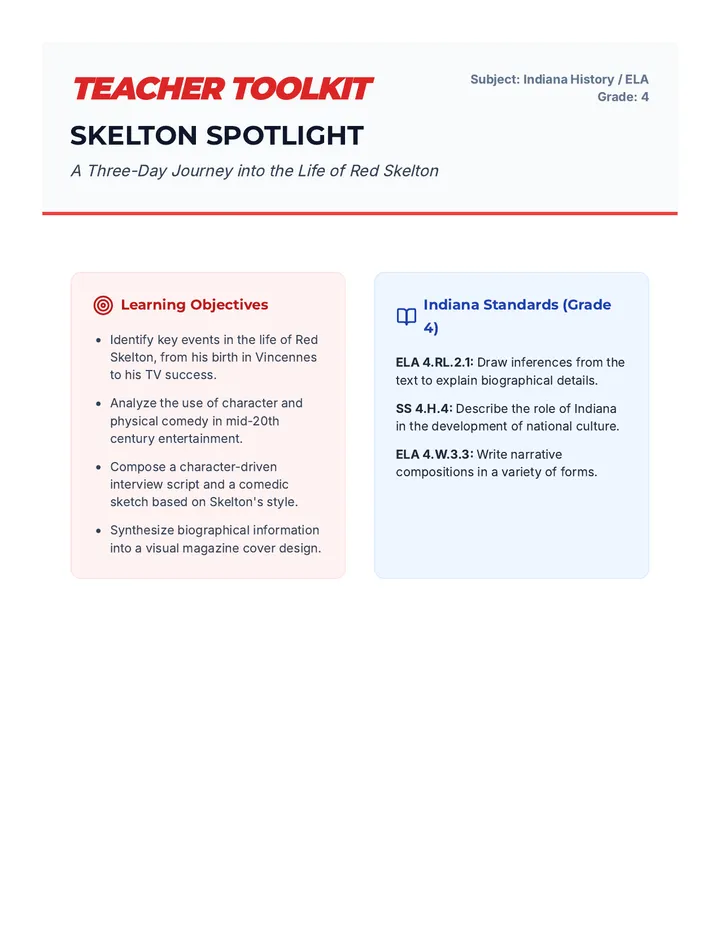
Skelton Spotlight Teacher Guide

Skelton Spotlight

A three-day exploration of the life and legacy of Indiana-born comedian Red Skelton, presented in a vibrant magazine format. Students explore his early life in Vincennes, his iconic characters, and his lasting impact on American comedy through reading and creative performance activities.

MG

Matthew Gaudin

8
Unity Roadmap Teacher Guide

Unity and Growth

A modified Modern US History curriculum (Founding to Present) for Tier 2 and 3 special education students, based on Grade 11 Social Studies standards. Focuses on government, industrialization, world wars, and civil rights.

D

dfleisch

26
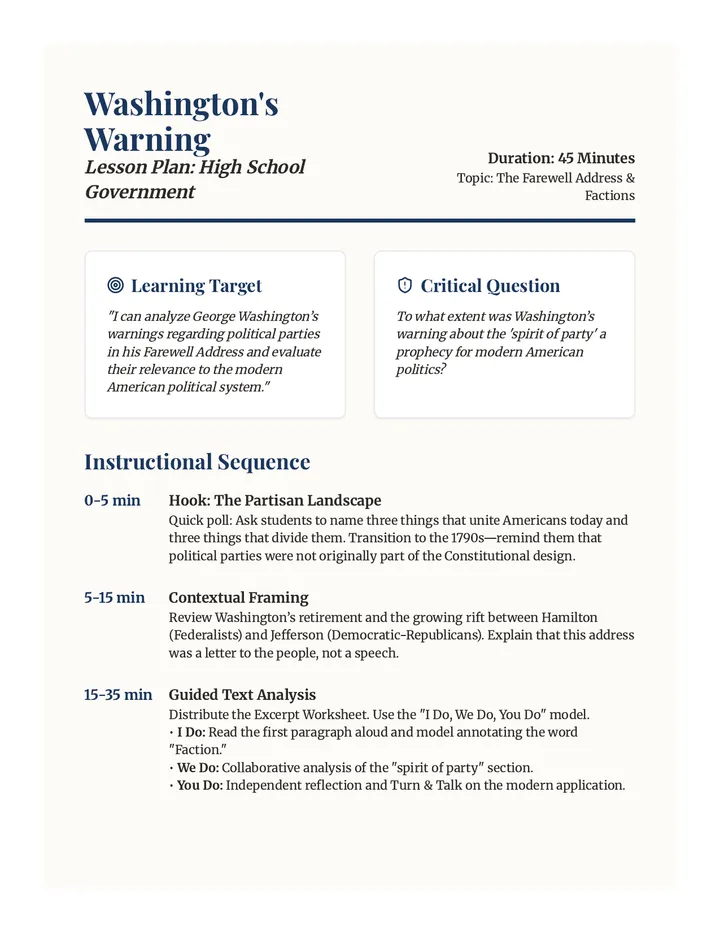
Washingtons Warning Lesson Plan

Washington's Farewell Legacy

A two-part sequence that takes students from a deep-dive analysis of George Washington's Farewell Address to a modern-day evaluation of his warnings regarding political parties, media bias, and national unity.

CE

Chelsea Elliott

24

Lessons

History Sprint Pacing Guide

STAAR History Sprint

A comprehensive pacing guide and activity resource designed to cover the remaining 11th Grade US History TEKS before the STAAR test on April 16th. This lesson provides a day-by-day calendar for A/B block schedules and high-engagement activities for each remaining historical era.

BB

Bridgette Burdick

51
Modern Era Reader Part 1

The Modern Ledger

A comprehensive exploration of the 1990s through the modern day, covering technological shifts, political milestones, military conflicts, and cultural evolution in the United States.

CE

Chelsea Elliott

20
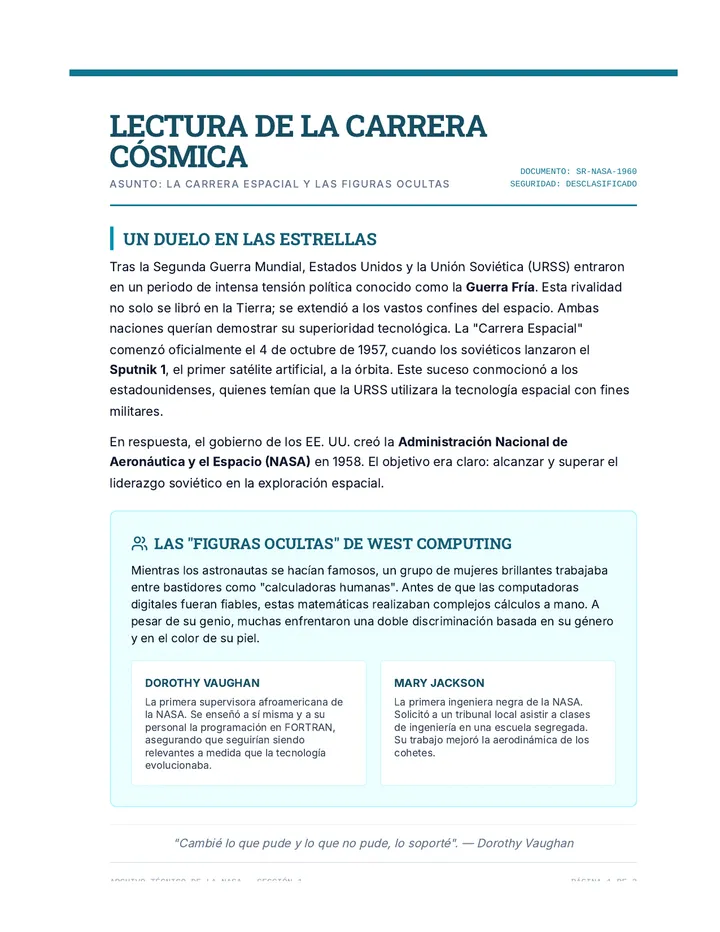
Cosmic Race Reading Text

Stellar Rivalry

A comprehensive exploration of the Space Race, highlighting the technological competition between the US and USSR, the essential contributions of African American women at NASA, and the international agreements that keep space a peaceful frontier.

RM

Robyn MacDonald

16
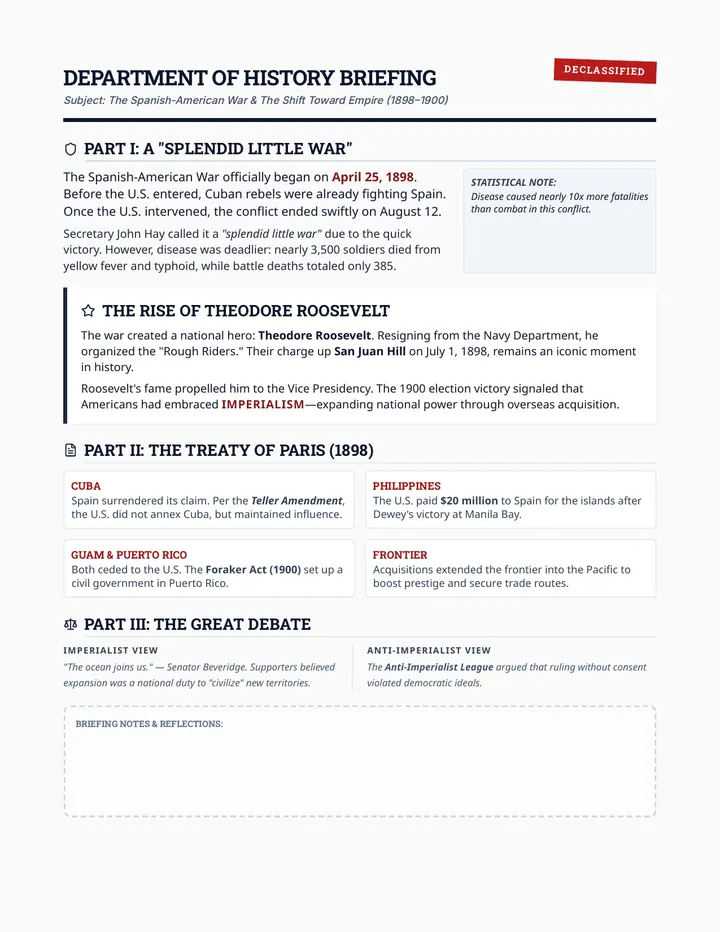
Imperial Shift Briefing Handout

Splendid Little War

This lesson explores the Spanish-American War, focusing on Theodore Roosevelt's rise, the Treaty of Paris, and the United States' transition from isolationism to an imperial power. Students will analyze the motives and arguments surrounding the annexation of the Philippines and other territories.

GE

Genevieve Eubanks

12
Forrest Gump Lesson Plan

Forrest Gump's America

A 90-minute history lesson using the film Forrest Gump to explore key 20th-century American events, from the Civil Rights Movement to the tech boom. Students analyze the intersection of personal narrative and national history.

AB

Alex Bryant

4
Black History Scavenger Hunt Lesson Plan

Black History Scavenger Hunt

A game-based lesson where students solve clues to discover significant figures and events in Black history, promoting cultural awareness and teamwork.

JH

Jade Hodge

5