Lenny.com
Explore
Create
ActivitiesNewMathEnglish Language ArtsScience & EngineeringSocial StudiesGlobal LanguagesHealth & Physical EducationSpecial EducationCounseling & Life SkillsArts & CreativityESL
Lenny.com
Lenny.com
Explore
Create
ActivitiesNewMathEnglish Language ArtsScience & EngineeringSocial StudiesGlobal LanguagesHealth & Physical EducationSpecial EducationCounseling & Life SkillsArts & CreativityESL
Lenny.com
Lenny.com

Solutions

Lenny for EducatorsLenny for SchoolsLenny for Districts

Product

ExploreSign inCreateSupportAbout

Resources

Getting startedMTSS Acceleration Program

© 2026 Lenny Learning Inc.

TermsPrivacyAccessibility
LinkedInInstagramX
Lenny

Banking and Finance

Interest rates, credit systems, and the functions of central banking within global markets. Equips learners with foundational knowledge of personal finance, investment strategies, and monetary policy.

Social StudiesSocial Studies PracticesLocation WordsMapsOrder EventsChronology and CausationEvaluating SourcesHistorical ThinkingGeography, Humans, & the EnvironmentAmerican Symbols and LandmarksCitiesStatesState CapitalsRegions of the United StatesGeographic SkillsPhysical GeographyHuman GeographyRegional GeographyGeography of AfricaGeography of AsiaGeography of EuropeGeography of OceaniaGeography of the AmericasSociety and Environment of EuropeSociety and Environment of AsiaSociety and Environment of The AmericasSociety and Environment of the Middle EastSociety and Environment of AfricaHistoryPrehistoryComparing Ancient River CivilizationsAncient MesopotamiaAncient Egypt and KushAncient South AsiaEarly ChinaGreeceRome and the Byzantine EmpireAncient World HistoryNative Peoples of North AmericaNative Peoples of Mesoamerica and South AmericaAfrican EmpiresMedieval AsiaMedieval EuropeThe Silk RoadMedieval HistoryIslamic EmpiresWorld ReligionsRenaissance PeriodAge of ExplorationThe Thirteen ColoniesThe American RevolutionUS History Early RepublicFounding of the United StatesUS History AntebellumUS Civil WarReconstruction PeriodThe Gilded AgeUS ImperialismWorld ImperialismWorld War IUS History 1920sGreat DepressionWorld War IIThe Cold WarUS History 1950-60sUS History 1960s-70sWorld History 20th CenturyContemporary US HistoryContemporary World HistoryHolidaysCivics and GovernmentCitizenshipGovernment FoundationsThe ConstitutionUS ConstitutionExecutive BranchLegislative BranchJudicial BranchState and LocalPolitical ParticipationPublic PolicyPolitical SystemsPower and AuthoritySocial MovementsDefining DevianceTheories of DevianceCrime and Criminal JusticeEconomicsBasic Economic PrinciplesSupply and DemandWhat is MoneyEconomic FundamentalsMicroeconomicsMacroeconomicsBanking and FinanceEconomic SystemsGlobal EconomicsCorporations and PowerThe Changing WorkplaceUnemployment and LaborClass and InequalitySocial MobilityGlobal InequalityPsychologyHistory of PsychologyPsychology as a ScienceBrain and Nervous SystemNeuroscience and BehaviorGenetics and BehaviorSleep and ConsciousnessSensory ProcessesPerceptual OrganizationClassical ConditioningOperant ConditioningObservational LearningCognitive LearningMemory ProcessesThinking and Problem SolvingLanguage and CognitionTheories of MotivationStress and CopingPrenatal and Infant DevelopmentChildhood DevelopmentAdolescent DevelopmentAdulthood and AgingSelf and IdentitySocial CognitionSocial InfluenceAttraction and RelationshipsGroup BehaviorPrejudice and DiscriminationAnxiety and Mood DisordersClinical PsychologyForensic PsychologyPhilosophy & EthicsIntroduction to PhilosophyMajor Philosophers & IdeasMind and Body ProblemFree Will vs DeterminismEthics & MoralityReligion & PhilosophyPolitical Philosophy

Videos

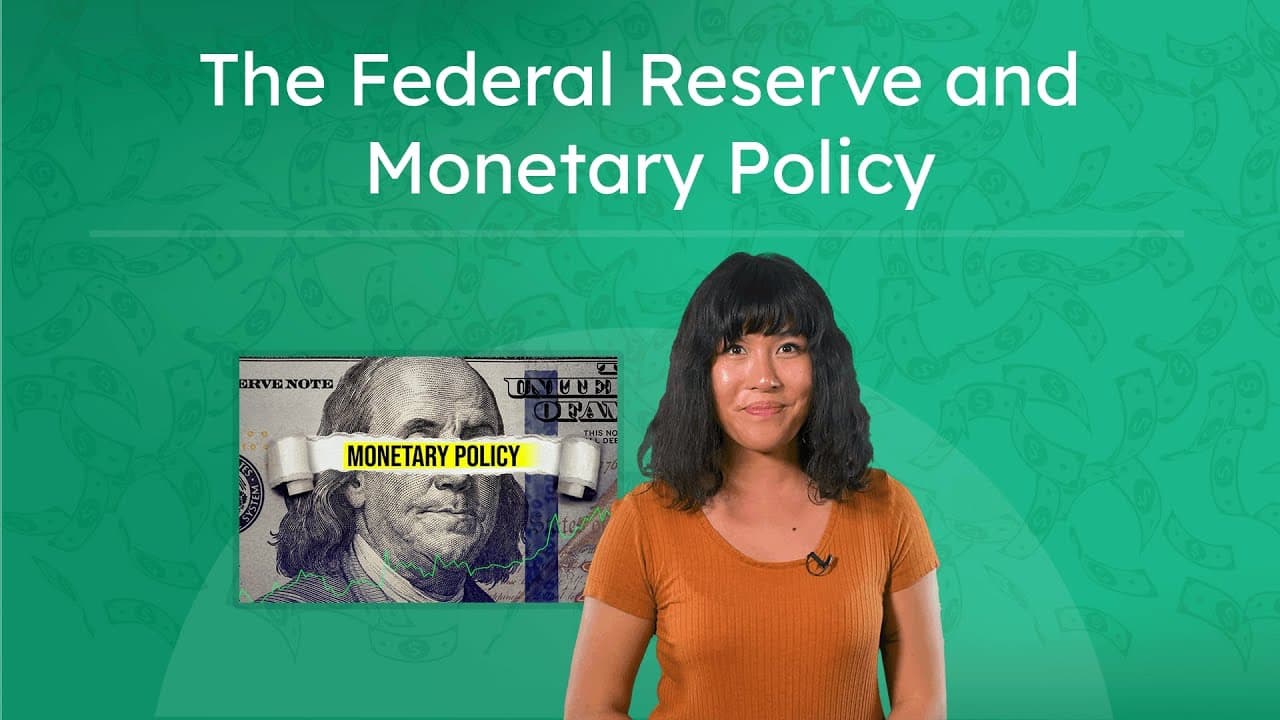
How the Federal Reserve Steers the Economy

How the Federal Reserve Steers the Economy

This informative video uses an extended analogy of a car to explain the complex functions of the Federal Reserve and its role in the United States economy. It demystifies how the "Fed" acts as the central bank, regulating the money supply and clearing financial transactions to keep the economic "engine" running smoothly. The narration breaks down how the Federal Reserve monitors economic health through key indicators like inflation, GDP, and unemployment data. The core of the video focuses on Monetary Policy, detailing the three specific tools the Federal Reserve uses to steer the economy: reserve requirements, the discount rate, and open market operations. Through clear visual flowcharts, the video demonstrates the cause-and-effect relationship between these tools and the broader economy, explaining how the Fed decides whether to "hit the gas" (stimulate growth) or "pump the brakes" (slow down inflation). Ideally suited for high school economics and civics curricula, this video transforms abstract financial concepts into concrete, relatable examples. Teachers can use it to scaffold lessons on government intervention, financial literacy, and macroeconomics. It provides a solid foundation for understanding how central banking decisions impact everyday life, from interest rates on car loans to the price of goods at the store.

Miacademy & MiaPrep Learning ChannelMiacademy & MiaPrep Learning Channel

12mins 29s

How 21st Century Economics and Identity Shaped Modern Europe

How 21st Century Economics and Identity Shaped Modern Europe

This educational video from Crash Course European History explores the tumultuous first two decades of the 21st century in Europe. Host John Green contrasts the initial optimism of the new millennium—characterized by EU expansion and technological innovation—with the series of economic and social shocks that followed. The narrative covers the global impact of financial crises starting in the 1990s, the Great Recession of 2008, and how economic instability fueled social unrest and identity politics across the continent. The video provides a critical examination of the rise of populism and authoritarianism in modern Europe, specifically profiling Vladimir Putin in Russia and Viktor Orbán in Hungary. It connects these political shifts to the refugee crisis triggered by the Syrian Civil War and the subsequent rise in xenophobia and nationalism, culminating in the Brexit vote. The content also highlights cultural shifts, discussing how globalization and migration have diversified European society, influencing everything from sports to literature. For educators, this resource serves as a vital tool for connecting contemporary current events with historical trends. It helps students understand complex concepts like "illiberal democracy," the domino effects of global economics, and the distinction between patriotism and nationalism. By presenting modern history through both macro-economic lenses and individual human stories (via Nobel Prize winner Svetlana Alexievich), the video encourages students to analyze how systemic shocks influence human behavior and political systems.

CrashCourseCrashCourse

12mins 46s

The Progressive Presidents: Roosevelt, Taft, and Wilson

The Progressive Presidents: Roosevelt, Taft, and Wilson

In this installment of Crash Course US History, John Green explores the Progressive Era through the lens of three key presidents: Theodore Roosevelt, William Howard Taft, and Woodrow Wilson. The video examines how the role of the federal government expanded significantly during the early 20th century, moving away from laissez-faire economics toward active regulation of big business and protection of social welfare. It contrasts the differing political philosophies of the time, such as Roosevelt's "New Nationalism" versus Wilson's "New Freedom," while highlighting the chaotic four-way election of 1912. The video delves deeply into the foreign policies of these presidents, challenging the notion that Progressivism was solely a domestic movement. It details the "Big Stick" diplomacy of Roosevelt, the "Dollar Diplomacy" of Taft, and the "Moral Diplomacy" of Wilson, showing how each led to increased U.S. intervention in Latin America and the Caribbean. Specific historical events like the construction of the Panama Canal, the occupation of Veracruz, and the pursuit of Pancho Villa are used to illustrate the contradictions between American ideals of freedom and its imperialistic actions abroad. This resource is highly valuable for high school history classrooms, particularly AP US History, as it synthesizes complex political and economic concepts into an engaging narrative. It provides concrete examples of federal legislation (like the Clayton Antitrust Act and the Federal Reserve Act) and constitutional amendments (16th, 17th, 18th, 19th) that reshaped American society. Teachers can use this video to spark discussions on the definition of the "modern presidency," the balance between liberty and government control, and the historical roots of American foreign policy.
CrashCourseCrashCourse

15mins 7s

How the Declaration of Independence Sparked a Continuous Revolution

How the Declaration of Independence Sparked a Continuous Revolution

This educational video explores the concept of the "unfinished revolution" in American history, arguing that the principles embedded in the Declaration of Independence created a framework for continuous social and political change. The narrator, Caroline, guides viewers through three major historical movements—the abolition of slavery, the labor movement, and the civil rights movement—demonstrating how each utilized the Declaration's ideals to challenge the status quo and expand democratic rights.

Miacademy & MiaPrep Learning ChannelMiacademy & MiaPrep Learning Channel

8mins 2s

How the Consumer Price Index Measures Inflation

How the Consumer Price Index Measures Inflation

This educational video provides a comprehensive introduction to the Consumer Price Index (CPI), a critical economic indicator used to measure inflation. The host breaks down complex economic concepts into digestible segments, starting with a definition of inflation and moving into the specific mechanics of how the CPI is calculated using a theoretical "basket of goods." The video uses clear visuals and relatable examples to explain how economists track price changes across over 200 categories of goods and services, from housing and healthcare to food and transportation. The content goes beyond simple definitions to critically analyze the limitations of the CPI. It discusses nuances such as quality improvements in products, the introduction of new goods, income inequality, and the relationship between price hikes and wage growth. The narrator explains why CPI might not perfectly reflect an individual's personal cost of living and how different demographics experience inflation differently. This critical lens encourages students to look at economic statistics as useful but imperfect tools that need context. Finally, the video connects these macroeconomic concepts to personal finance and government policy. It explains how understanding CPI affects individual budgeting, career choices, and long-term planning like saving for college. It also touches on how governments use this data to enact policies like interest rate adjustments. This makes the video highly applicable for high school Economics, Civics, and Financial Literacy classrooms, bridging the gap between abstract economic theory and real-world decision-making.

Miacademy & MiaPrep Learning ChannelMiacademy & MiaPrep Learning Channel

12mins 23s

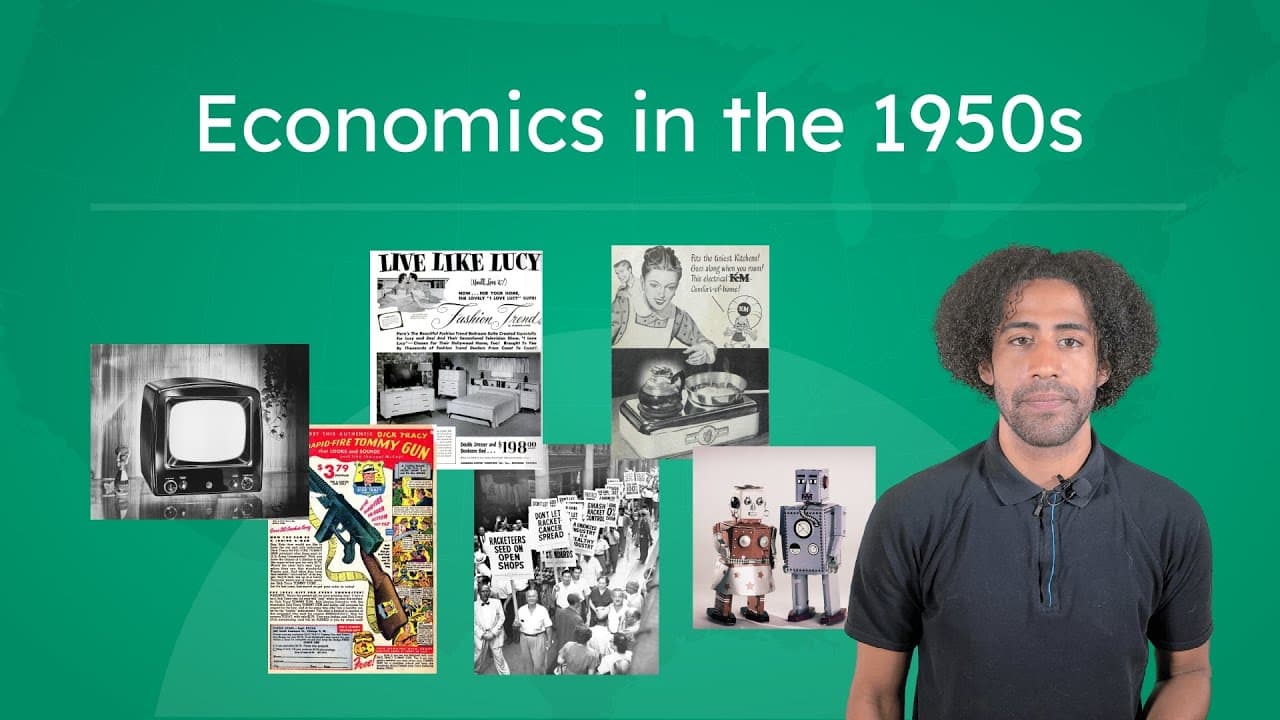
How the 1950s Created the Modern American Consumer

How the 1950s Created the Modern American Consumer

This educational video explores the dramatic economic and social shifts in the United States during the 1950s that led to the rise of a massive consumer economy. It details how post-war government policies, technological innovations, and the expansion of credit transformed American life, creating a booming middle class. The narrator explains the economic cycle where higher wages and union membership fueled spending, which in turn created more jobs, establishing a self-sustaining loop of prosperity for many Americans.

Miacademy & MiaPrep Learning ChannelMiacademy & MiaPrep Learning Channel

12mins 10s

Materials

Tier 2 History Blueprint

Tier 2 History Blueprint

A comprehensive teacher-facing curriculum blueprint for a high school Economics course, featuring power skills, targeted vocabulary, and scaffolding strategies across five key units. The design uses a professional "blueprint" aesthetic with clear sectioning and visual icons.

D

dfleisch

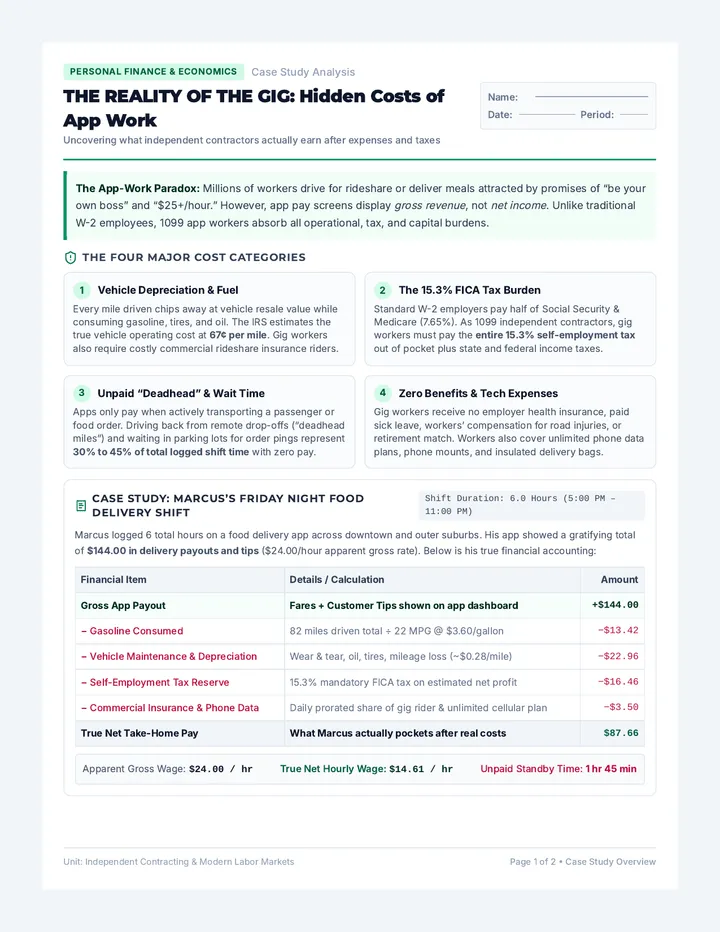
Gig Economy Costs Worksheet

Gig Economy Costs Worksheet

A two-page personal finance and labor economics worksheet analyzing the hidden costs of app-based gig work, featuring a shift financial case study, wage calculation exercise, and analytical response questions.

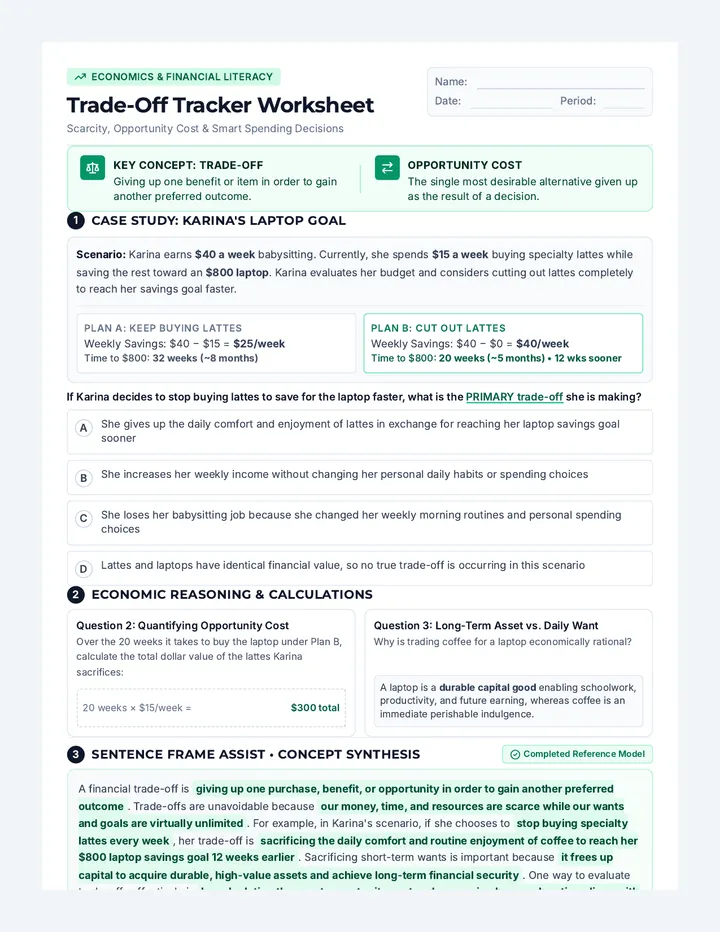
Trade Off Tracker Worksheet

Trade Off Tracker Worksheet

An economics and financial literacy worksheet centered on Karina's laptop savings dilemma, featuring scenario math, multiple choice analysis, opportunity cost calculations, and a complete sentence frame synthesis without fill-in lines.

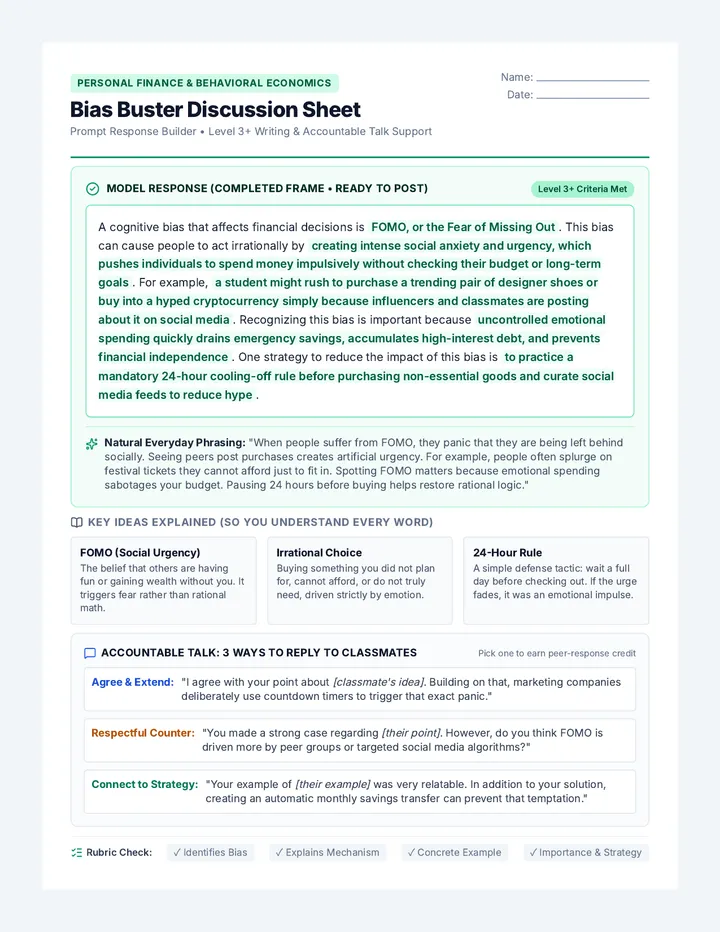
Bias Buster Discussion Sheet

Bias Buster Discussion Sheet

A structured discussion prep and sentence-frame response guide for students addressing how cognitive biases like FOMO drive irrational financial decisions, complete with Level 3+ exemplar models, vocabulary support, and Accountable Talk reply stems.

Mercaderes Medievales Slides

Mercaderes Medievales Slides

Presentación de diapositivas sobre la expansión comercial en la Baja Edad Media (siglos XI-XIV) para secundaria avanzada. Explora los motores del crecimiento económico, las grandes rutas marítimas y terrestres, el nacimiento de la banca y la consolidación de la burguesía y las ciudades.

Ralph Lauren Express Slides

Ralph Lauren Express Slides

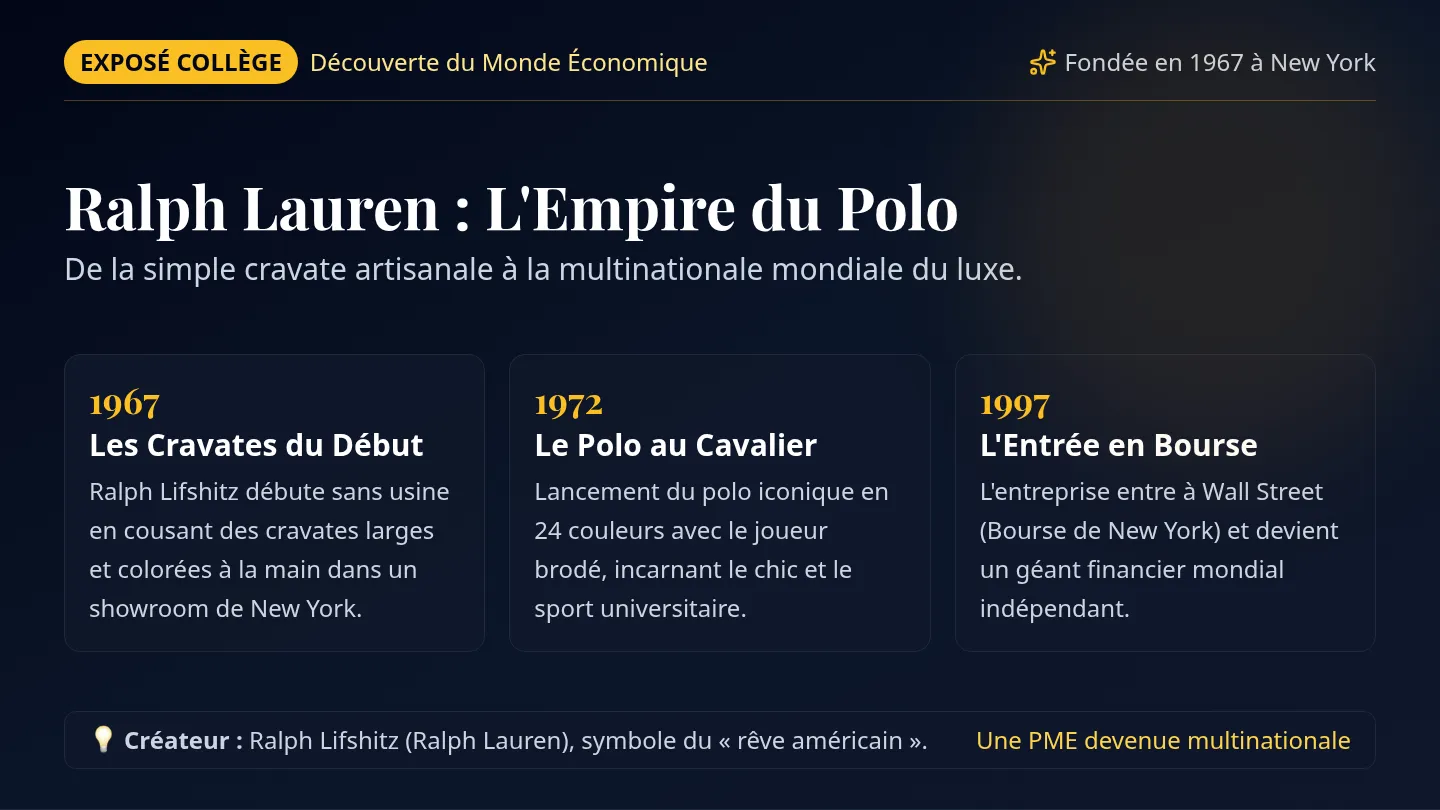
Diaporama concis et complet de 5 diapositives sur Ralph Lauren pour collégiens, intégrant l'histoire, la carte d'identité, les 3 finalités de l'entreprise (économique, sociale, environnementale/RSE), les 4 ressources et le champ mondial.

Sequences

Mobilization Intro Slides

Global Conflict WWII

A comprehensive 2-day unit covering World War II for 11th Grade US History, aligned with TEKS. It focuses on the transition from isolationism to total war, the home front experience, major turning points in both the European and Pacific theaters, and the strategic decisions that ended the conflict.

BB

Bridgette Burdick

17
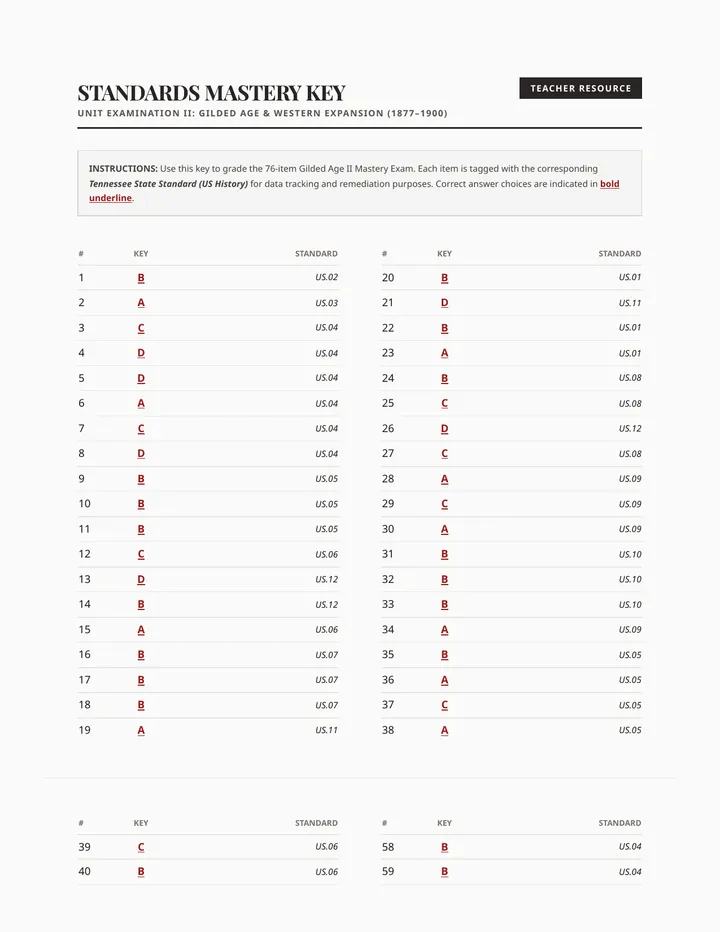
Gilded Age II Standards Key

Modern America Mastery

A comprehensive curriculum sequence covering late 19th and early 20th-century American history, focusing on economic transformation, Western expansion, global imperialism, and the impact of the Great War.

A

Andrew

29
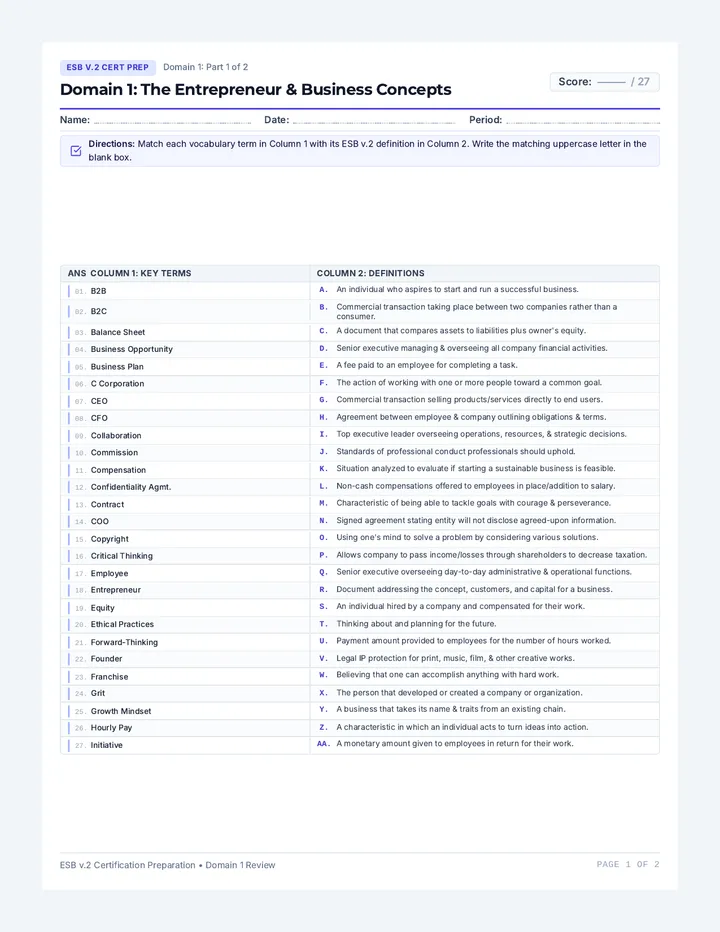
Domain One Match Worksheet

ESB Exam Edge

A targeted ESB v.2 certification prep curriculum covering core exam domains with aligned vocabulary matching worksheets and complete teacher answer keys.

RP

Rafael Paredes

8
Legislative Leader Unit Guide

Capitol Insiders

A comprehensive one-week unit on the Legislative Branch tailored for Pennsylvania high school students. The unit covers the structure of the US Congress and the PA General Assembly, the law-making process, and the influence of interest groups, culminating in a simple, independent legislative proposal project.

M

morgan.mcgough

12
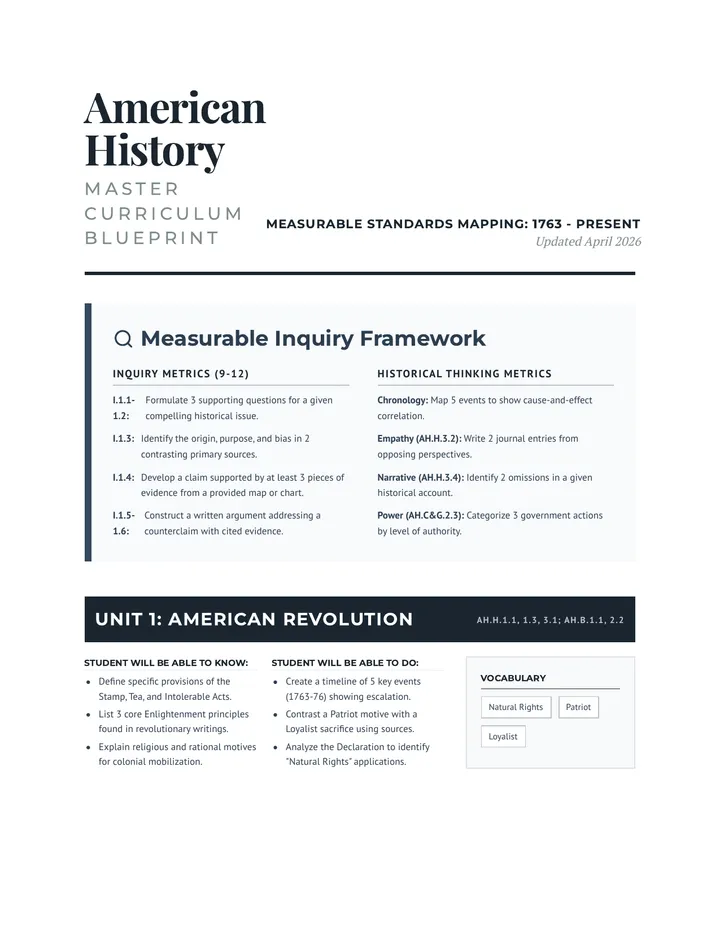
Curriculum Blueprint Document v2

History Horizon Sequence

A comprehensive high school curriculum plan for American History, covering 13 units from the American Revolution to the modern era, aligned with North Carolina Social Studies standards.

AK

Amity Kea

21
Depression and New Deal Mastery Test Document v2

Depression and New Deal Era

A comprehensive unit covering the economic boom of the 1920s, the Great Depression, and the New Deal. Includes lessons on the Prosperity Paradox, the Stock Market Collapse, the Dust Bowl, and government responses.

A

Andrew

18