Lenny.com
Explore
Create
ActivitiesNewMathEnglish Language ArtsScience & EngineeringSocial StudiesGlobal LanguagesHealth & Physical EducationSpecial EducationCounseling & Life SkillsArts & CreativityESL
Lenny.com
Lenny.com
Explore
Create
ActivitiesNewMathEnglish Language ArtsScience & EngineeringSocial StudiesGlobal LanguagesHealth & Physical EducationSpecial EducationCounseling & Life SkillsArts & CreativityESL
Lenny.com
Lenny.com

Solutions

Lenny for EducatorsLenny for SchoolsLenny for Districts

Product

ExploreSign inCreateSupportAbout

Resources

Getting startedMTSS Acceleration Program

Newsletters

School Funding Newsletter

© 2026 Lenny Learning Inc.

TermsPrivacyAccessibility
LinkedInInstagramX
Lenny

Judicial Branch

Structure and function of the federal court system, emphasizing the Supreme Court and the power of judicial review. Analyzes constitutional interpretation and the legal procedures governing the American justice system.

Social StudiesSocial Studies PracticesLocation WordsMapsOrder EventsChronology and CausationEvaluating SourcesHistorical ThinkingGeography, Humans, & the EnvironmentAmerican Symbols and LandmarksCitiesStatesState CapitalsRegions of the United StatesGeographic SkillsPhysical GeographyHuman GeographyRegional GeographyGeography of AfricaGeography of AsiaGeography of EuropeGeography of OceaniaGeography of the AmericasSociety and Environment of EuropeSociety and Environment of AsiaSociety and Environment of The AmericasSociety and Environment of the Middle EastSociety and Environment of AfricaHistoryPrehistoryComparing Ancient River CivilizationsAncient MesopotamiaAncient Egypt and KushAncient South AsiaEarly ChinaGreeceRome and the Byzantine EmpireAncient World HistoryNative Peoples of North AmericaNative Peoples of Mesoamerica and South AmericaAfrican EmpiresMedieval AsiaMedieval EuropeThe Silk RoadMedieval HistoryIslamic EmpiresWorld ReligionsRenaissance PeriodAge of ExplorationThe Thirteen ColoniesThe American RevolutionUS History Early RepublicFounding of the United StatesUS History AntebellumUS Civil WarReconstruction PeriodThe Gilded AgeUS ImperialismWorld ImperialismWorld War IUS History 1920sGreat DepressionWorld War IIThe Cold WarUS History 1950-60sUS History 1960s-70sWorld History 20th CenturyContemporary US HistoryContemporary World HistoryHolidaysCivics and GovernmentCitizenshipGovernment FoundationsThe ConstitutionUS ConstitutionExecutive BranchLegislative BranchJudicial BranchState and LocalPolitical ParticipationPublic PolicyPolitical SystemsPower and AuthoritySocial MovementsDefining DevianceTheories of DevianceCrime and Criminal JusticeEconomicsBasic Economic PrinciplesSupply and DemandWhat is MoneyEconomic FundamentalsMicroeconomicsMacroeconomicsBanking and FinanceEconomic SystemsGlobal EconomicsCorporations and PowerThe Changing WorkplaceUnemployment and LaborClass and InequalitySocial MobilityGlobal InequalityPsychologyHistory of PsychologyPsychology as a ScienceBrain and Nervous SystemNeuroscience and BehaviorGenetics and BehaviorSleep and ConsciousnessSensory ProcessesPerceptual OrganizationClassical ConditioningOperant ConditioningObservational LearningCognitive LearningMemory ProcessesThinking and Problem SolvingLanguage and CognitionTheories of MotivationStress and CopingPrenatal and Infant DevelopmentChildhood DevelopmentAdolescent DevelopmentAdulthood and AgingSelf and IdentitySocial CognitionSocial InfluenceAttraction and RelationshipsGroup BehaviorPrejudice and DiscriminationAnxiety and Mood DisordersClinical PsychologyForensic PsychologyPhilosophy & EthicsIntroduction to PhilosophyMajor Philosophers & IdeasMind and Body ProblemFree Will vs DeterminismEthics & MoralityReligion & PhilosophyPolitical Philosophy

Videos

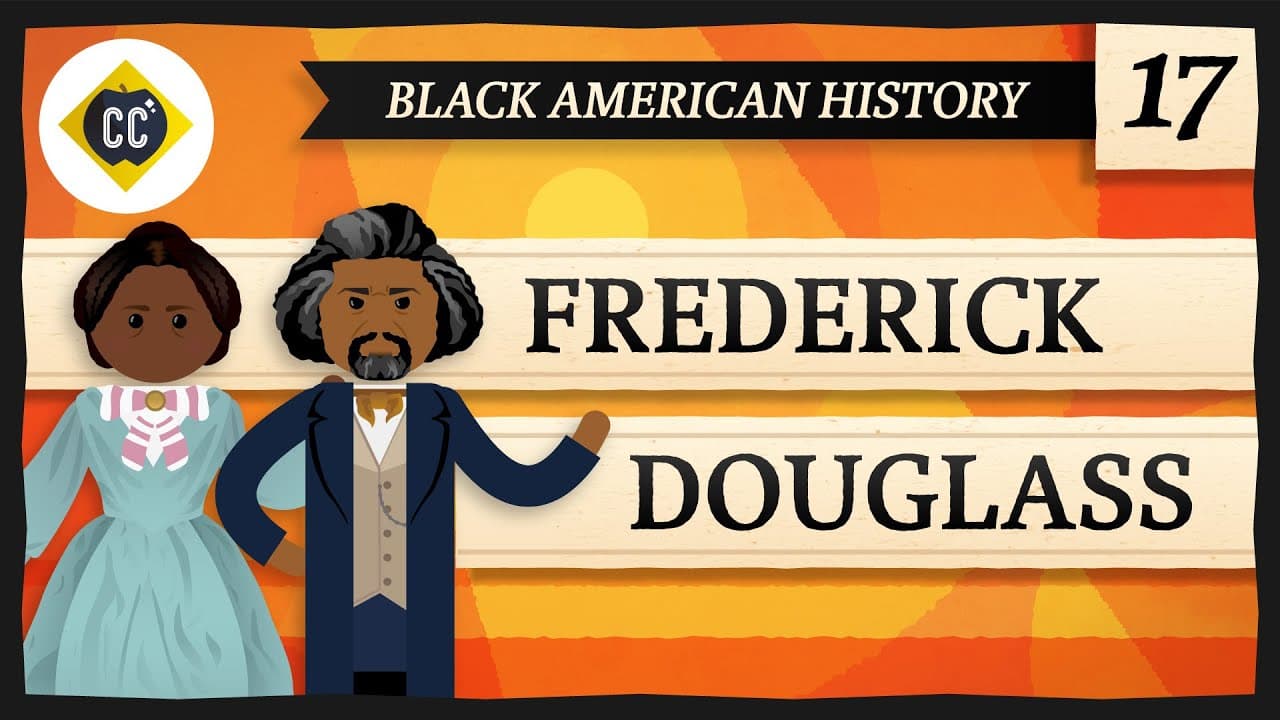
The Extraordinary Life and Legacy of Frederick Douglass

The Extraordinary Life and Legacy of Frederick Douglass

This episode of Crash Course Black American History explores the extraordinary life and legacy of Frederick Douglass, one of the most influential figures in American history. Hosted by Clint Smith, the video traces Douglass's journey from his birth into slavery in Maryland to his escape and subsequent rise as a world-renowned orator, writer, and abolitionist. It details the pivotal moments that shaped his worldview, including his covert education, his physical resistance against a "slave-breaker," and his escape to the North with the critical assistance of Anna Murray. The video delves into key themes such as the power of literacy as a tool for liberation, the strategic use of rhetoric to shift public opinion, and the complex political landscape of the mid-19th century. It highlights Douglass's career as an editor of *The North Star*, his advocacy for women's rights, and his influential relationship with Abraham Lincoln during the Civil War, where he pushed for Black enlistment as a path to citizenship. For educators, this resource serves as a powerful anchor for units on the Civil War, the abolitionist movement, or American literature. It humanizes a historical icon, moving beyond simple facts to explore his internal motivations, his partnership with his wife Anna, and his unwavering faith in the face of systemic oppression. The content naturally sparks discussions about resistance, the importance of education, and the definition of American citizenship.
CrashCourseCrashCourse

12mins 19s

Thomas Jefferson's Presidency and Contradictions

Thomas Jefferson's Presidency and Contradictions

This episode of Crash Course US History explores the complex presidency of Thomas Jefferson, the third President of the United States. Host John Green examines the election of 1800, often called the "Revolution of 1800," and contrasts Jefferson's idealized agrarian vision for America with the pragmatic realities he faced in office. The video navigates through significant events including the Louisiana Purchase, the Barbary Wars, and the Embargo Act of 1807, while analyzing how these actions often contradicted Jefferson's own strict constructionist philosophy. A major focus of the video is the deep moral contradiction at the heart of Jefferson's life and legacy: his authorship of the Declaration of Independence and rhetoric about liberty versus his status as a lifelong slave owner who held racist views. The video details Gabriel's Rebellion to illustrate the enslaved people's desire for freedom and discusses the landmark Supreme Court case Marbury v. Madison, which established the principle of judicial review. This resource is highly valuable for high school American History and Civics classrooms. It moves beyond a simple biography to challenge students to think critically about historical figures who are "revered and reviled." It provides excellent entry points for discussions on the role of the Supreme Court, the elasticity of the Constitution, and the unintended economic consequences of foreign policy.

CrashCourseCrashCourse

13mins 19s

Using Revolutionary Traditions to Create Social Change

Using Revolutionary Traditions to Create Social Change

This educational video explores how the core principles of the United States' founding documents—the Declaration of Independence and the Constitution—created a "revolutionary tradition" that has been utilized by marginalized groups to effect social change. It defines key concepts like popular sovereignty, natural rights, and the distinction between suffrage (voting) and mass democracy (participation outside the voting booth). The video argues that these founding ideals provide a "measuring stick" against which society can be judged and improved.

Miacademy & MiaPrep Learning ChannelMiacademy & MiaPrep Learning Channel

12mins 18s

How the New Deal Transformed the Role of Government

How the New Deal Transformed the Role of Government

In this installment of Crash Course US History, John Green explores the complex legacy of Franklin D. Roosevelt's New Deal. The video breaks down the massive set of government programs initiated during the Great Depression into two conceptual frameworks: the "Three Rs" (Relief, Recovery, and Reform) and the chronological division between the First and Second New Deals. It examines how these programs fundamentally shifted the relationship between the American citizenry and the federal government, moving from a laissez-faire approach to one where economic security became a guaranteed liberty.

CrashCourseCrashCourse

14mins 57s

How Cases Reach the Supreme Court

How Cases Reach the Supreme Court

This episode of Crash Course Government and Politics demystifies the complex procedural journey a legal case takes to reach the Supreme Court of the United States. Host Craig Benzine breaks down the rigorous screening process, explaining that out of thousands of petitions, only a tiny fraction are actually heard by the nine justices. The video moves beyond simple definitions to illustrate the mechanical steps of the judicial system, from the initial appeal to the final written opinion.

CrashCourseCrashCourse

6mins 54s

Affirmative Action: History and Supreme Court Rulings

Affirmative Action: History and Supreme Court Rulings

This episode of Crash Course Government and Politics provides a comprehensive overview of affirmative action in the United States, exploring its definition, legal history, and the intense political debate surrounding it. Host Craig Benzine navigates the complex topic by focusing on how the Supreme Court has interpreted affirmative action policies through the lens of the 14th Amendment's Equal Protection Clause. The video distinguishes between "equality of opportunity" and "equality of outcome" and uses analogies to explain the differing perspectives on these policies. The content dives deep into landmark Supreme Court cases that have shaped current laws, specifically Regents of the University of California v. Bakke (1973), Adarand Constructors v. Peña (1995), and the 2003 Michigan cases (Gratz v. Bollinger and Grutter v. Bollinger). It explains critical legal concepts like "strict scrutiny," "compelling government interest," and "narrowly tailored" policies. Additionally, it covers state-level reactions, such as California's Proposition 209, and analyzes the statistical impact of these bans on university enrollment. For educators, this video is an invaluable resource for teaching the judicial branch, civil rights, and constitutional interpretation. It models civil discourse on a polarized issue by presenting legal facts and historical context without taking a partisan stance. It serves as an excellent primer for classroom debates on admissions policies, discussions on the role of government in correcting historical wrongs, and lessons on how the Supreme Court balances individual rights against state interests.

CrashCourseCrashCourse

7mins 14s

Materials

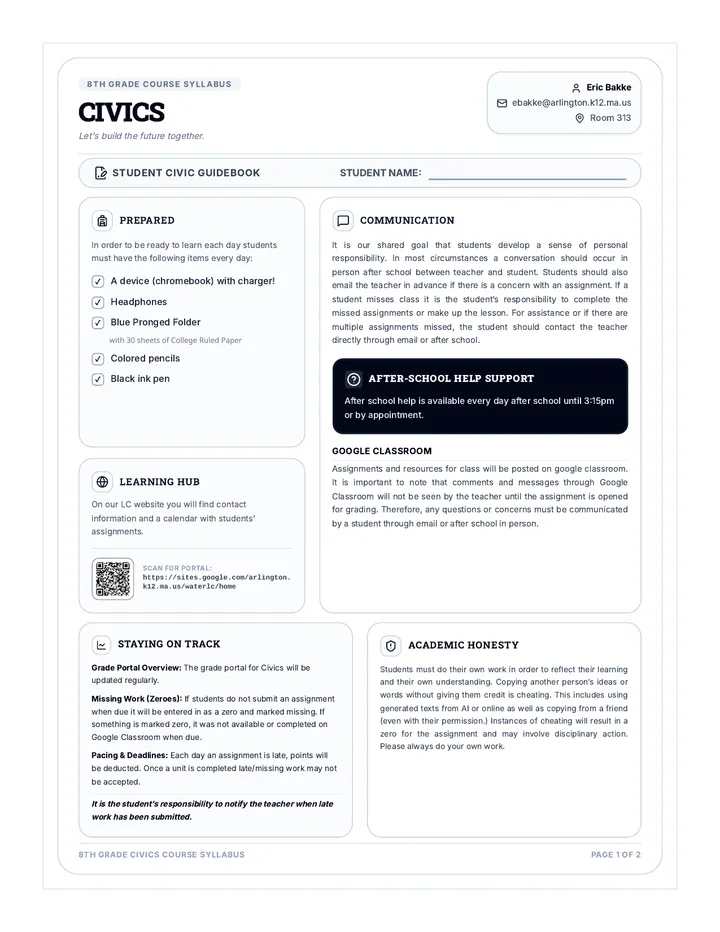
Civics Class Syllabus

Civics Class Syllabus

Civics Class Syllabus updated with an extra large QR code filling approximately half of the Digital Spaces container for maximum visibility and effortless scanning.

E

ebakke

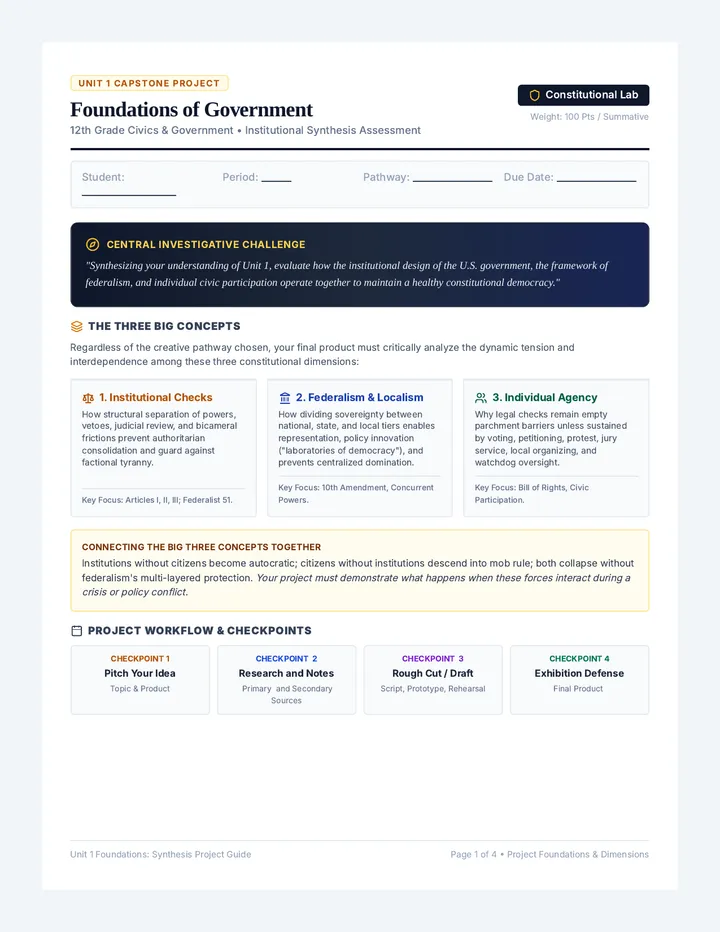
Democracy Design Project Guide

Democracy Design Project Guide

A comprehensive 4-page student project assignment guide for 12th-grade Civics and Government, detailing 5 creative project pathways (podcast, documentary, interview simulation, reader's theater drama, and board/card game), an analytical rubric across the three core constitutional dimensions, and a student planning blueprint.

JG

Joshua Griffith

Government Civics Bilingual Reader

Government Civics Bilingual Reader

A 5th-grade bilingual Spanish-English reading guide exploring the fundamentals of government, the three branches, active citizenship, and constitutional rights. Features side-by-side text, labeled photos of the White House and Capitol, simple civic illustrations, and an illustrated picture-vocabulary section.

M

mngillis

Loving Legacy Worksheet

Loving Legacy Worksheet

A comprehensive, two-page student worksheet and reading comprehension guide about the landmark Supreme Court case Loving v. Virginia (1967). Designed for 8th-grade civics, it utilizes a clean legal-docket theme and includes deep reading passages on the 14th Amendment, followed by critical-thinking analysis prompts with dedicated writing areas.

T

tsundstrom

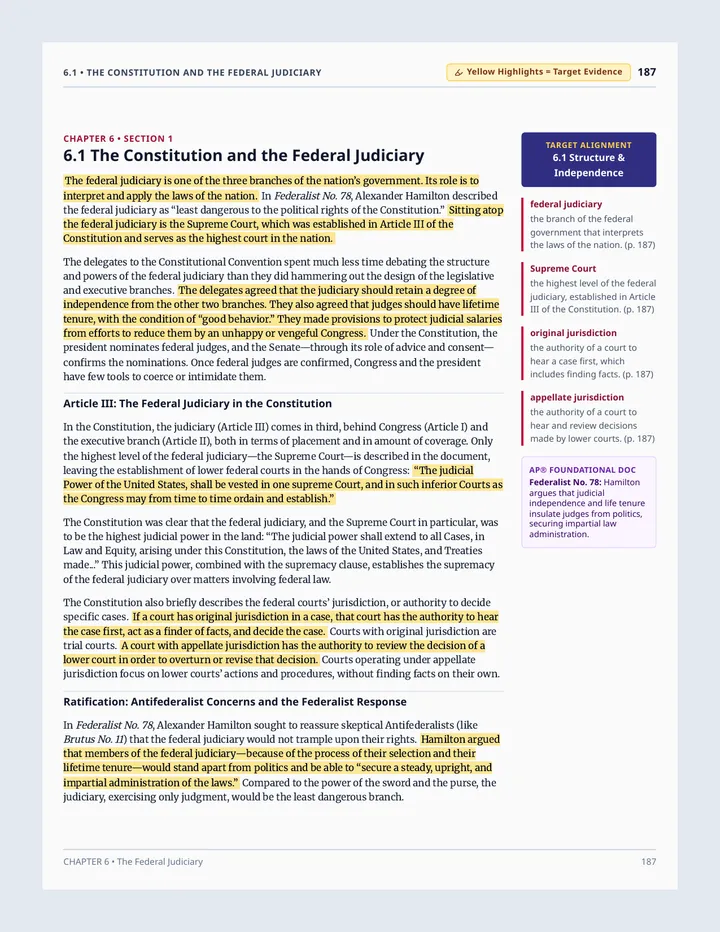
Judicial Targets Reading Guide

Judicial Targets Reading Guide

An authentic textbook-formatted reproduction of Chapter 6 (Sections 6.1, 6.2, and 6.3) from American Government: Stories of a Nation, featuring the original prose, two-column and margin-notes layout, and highlighted text mapped directly to Learning Targets 6.1, 6.2, and 6.3.

T

timothy.nixon

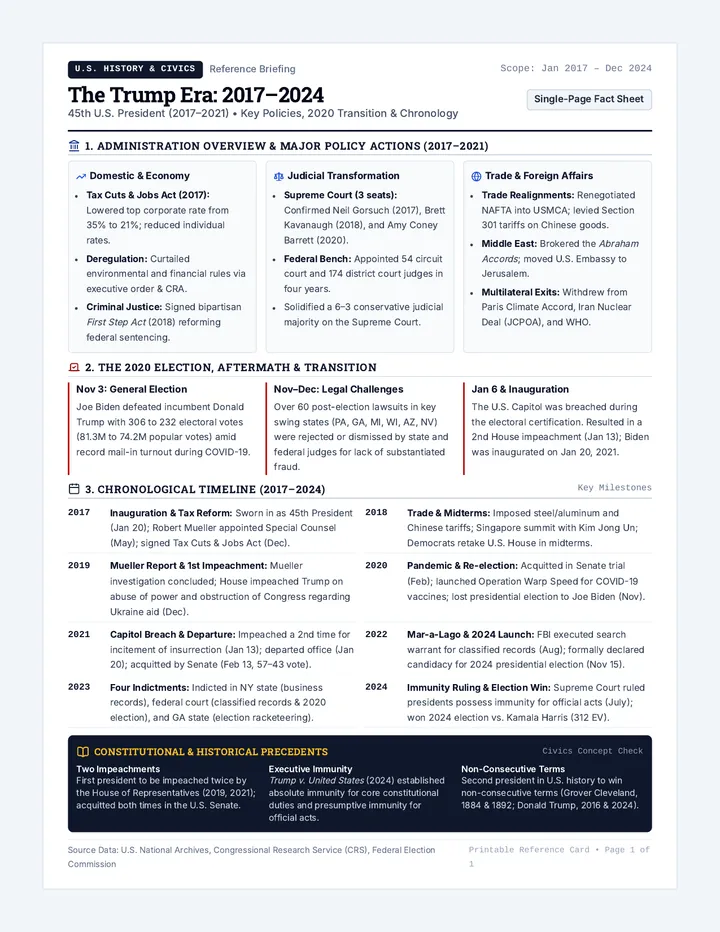
Trump Era Fact Sheet

Trump Era Fact Sheet

A concise, one-page printable fact sheet surveying the Trump presidency (2017–2021), the 2020 election and transition, and a comprehensive historical timeline through 2024 for high school and civics classrooms.

YP

Yovanna Plummer

Sequences

Thirteen Friends Worksheet

Democratic Foundations

A series of lessons exploring the foundational documents and processes of the United States government, from the birth of the nation to the creation of modern laws.

SB

Stephanie Bizeur

40
Unity Roadmap Teacher Guide

Unity and Growth

A modified Modern US History curriculum (Founding to Present) for Tier 2 and 3 special education students, based on Grade 11 Social Studies standards. Focuses on government, industrialization, world wars, and civil rights.

D

dfleisch

26
Amendment Evolution Slides

Constitutional Crossroads

A deep dive into the foundations of American government, covering the evolution of constitutional amendments and the structure and power of the judicial system.

GM

Geneva Manus

11
Master Plan Slides

Power Players

A 5-week unit exploring the foundations of the United States government, the three branches of power, and the responsibilities of citizenship, specifically tailored for 4th-grade learners in Illinois.

KC

Kady Carter

8
Conflict Cards Activity

Century Crossroads

A comprehensive assessment sequence covering the pivotal moments of 20th-century US history, from the build-up to World War II through the height of the Cold War and the diverse Civil Rights movements.

AH

Ashley Hopf

16
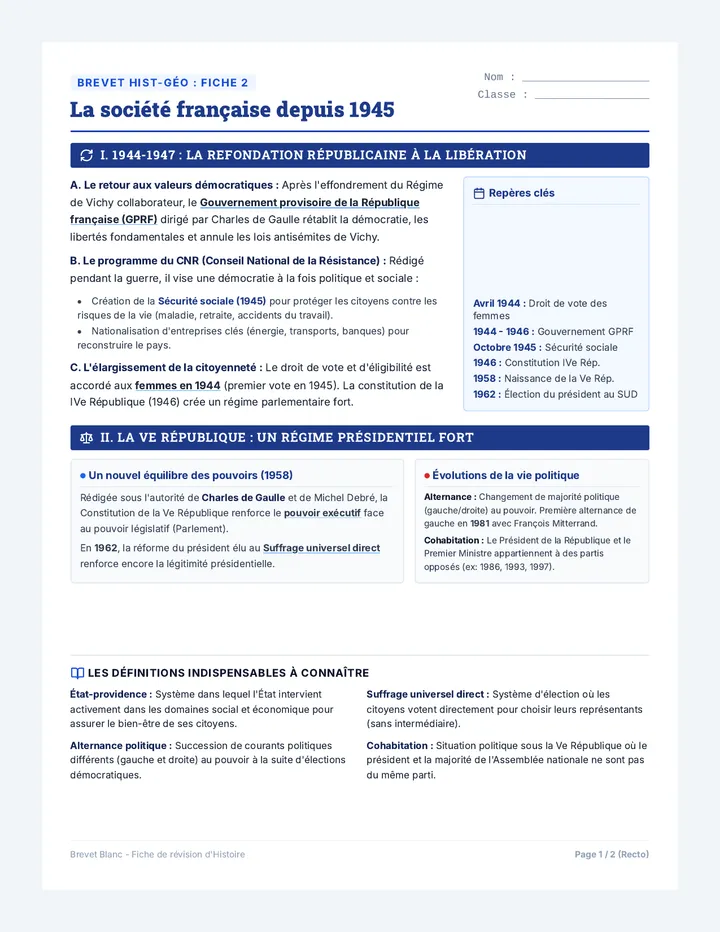
Societe Francaise Depuis 1945 Fiche

Brevet Fiches : Hist-Géo, EMC & Physique-Chimie

Une collection complète de fiches de révision classiques (recto-verso A4) très ciblées pour préparer les élèves de Troisième aux épreuves d'Histoire, de Géographie, d'EMC et de Physique-Chimie du DNB. Chaque fiche traite d'une leçon précise des programmes officiels.

MW

Myriam Wb

16

Lessons

History Sprint Pacing Guide

STAAR History Sprint

A comprehensive pacing guide and activity resource designed to cover the remaining 11th Grade US History TEKS before the STAAR test on April 16th. This lesson provides a day-by-day calendar for A/B block schedules and high-engagement activities for each remaining historical era.

BB

Bridgette Burdick

51
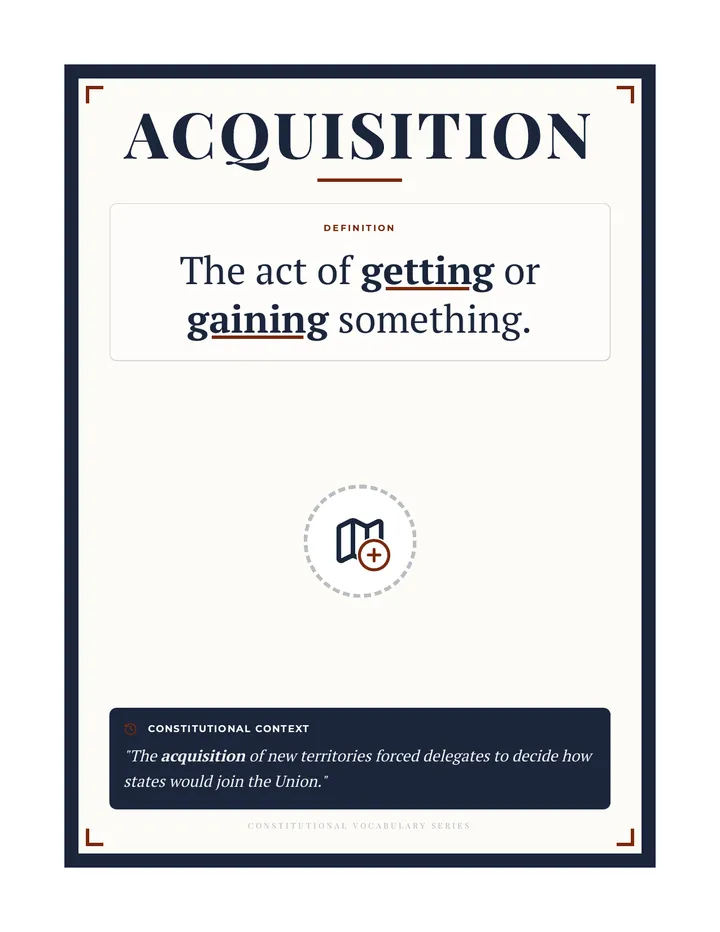
Constitutional Vocabulary Poster Set

Constitutional Vocabulary

A set of vocabulary posters focused on key terms from the Constitutional Convention, including government structures, legislative roles, and foundational principles like compromise and federalism.

SA

Senta Agnello-Shelton

21
Modern Era Reader Part 1

The Modern Ledger

A comprehensive exploration of the 1990s through the modern day, covering technological shifts, political milestones, military conflicts, and cultural evolution in the United States.

CE

Chelsea Elliott

20
Branch Breakdown Reading

Branch Builders

A comprehensive introduction to the three branches of the U.S. government, focusing on the roles and responsibilities of the Legislative, Executive, and Judicial branches.

GM

Geneva Manus

10
Reason for Revolution Worksheet V4 Refined Final

Architects of Liberty

A lesson exploring how Enlightenment philosophers like Locke, Montesquieu, and Voltaire influenced the founding documents and structure of the United States government.

KB

Kenneth Brown

10
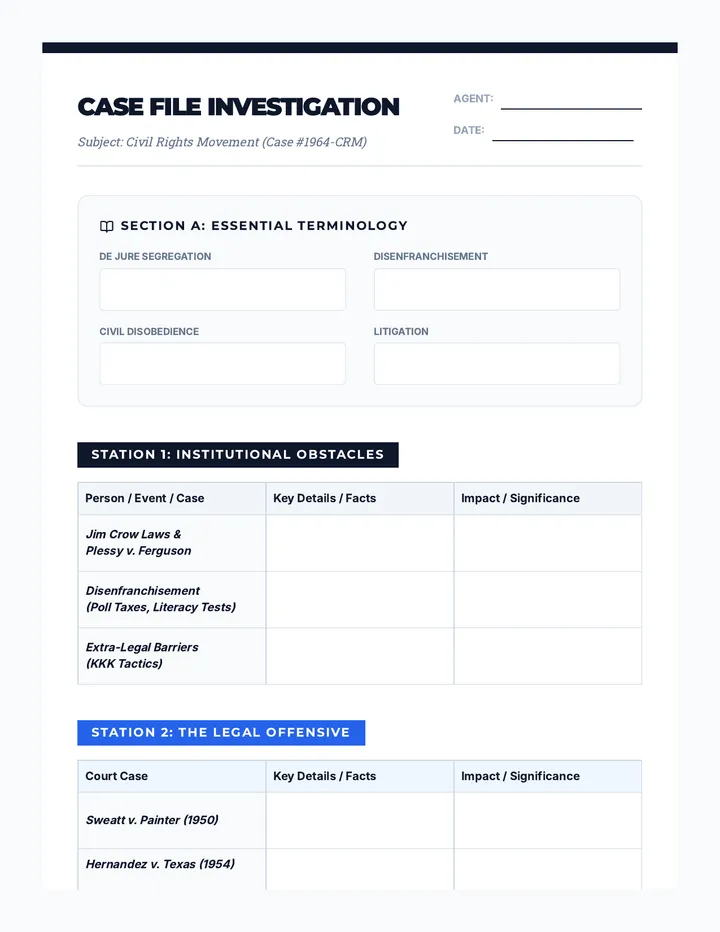
Justice Gallery Investigation Worksheet

Justice Gallery Case Files

A comprehensive lesson on the Civil Rights Movement featuring gallery stations and a guided investigation worksheet. Students analyze institutional obstacles, legal strategies, non-violent and militant tactics, and the expansion of the movement to other marginalized groups.

CE

Chelsea Elliott

25