Atomic structure, quantum models, and periodic trends establish the fundamental nature of matter. Stoichiometry, gas properties, and equilibrium constants facilitate quantitative analysis of chemical reactions and molecular interactions.
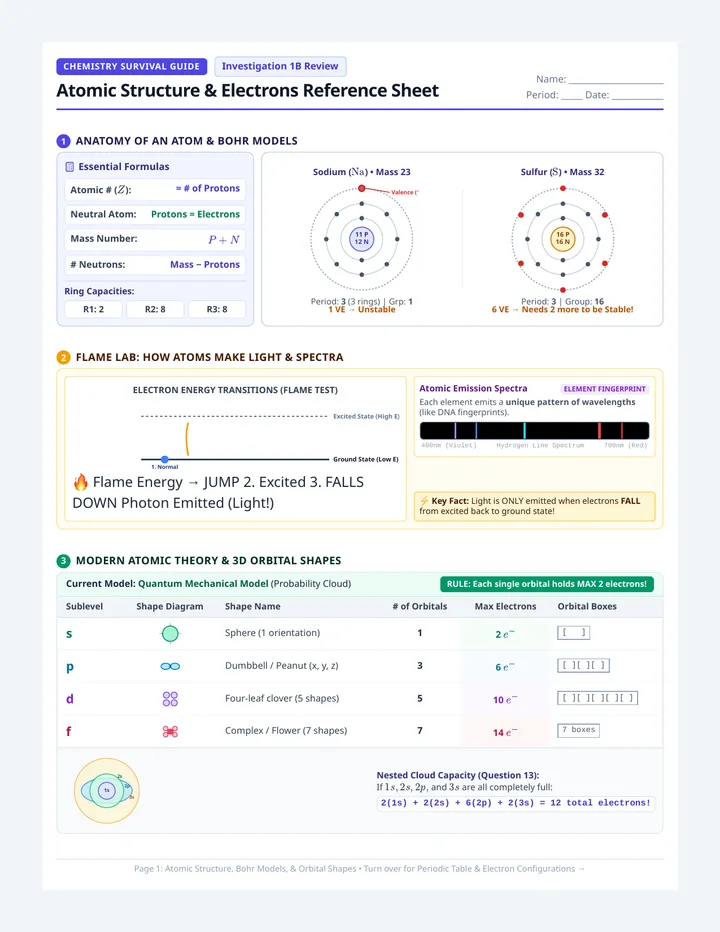
A highly visual 2-page assessment reference sheet for high school sophomore co-taught chemistry students, featuring detailed diagrams of Bohr models, flame test energy transitions, 3D orbital shapes (s, p, d, f), nested orbital shells, a full periodic table block map, electron configuration guides, orbital box diagrams, and Lewis dot structures.
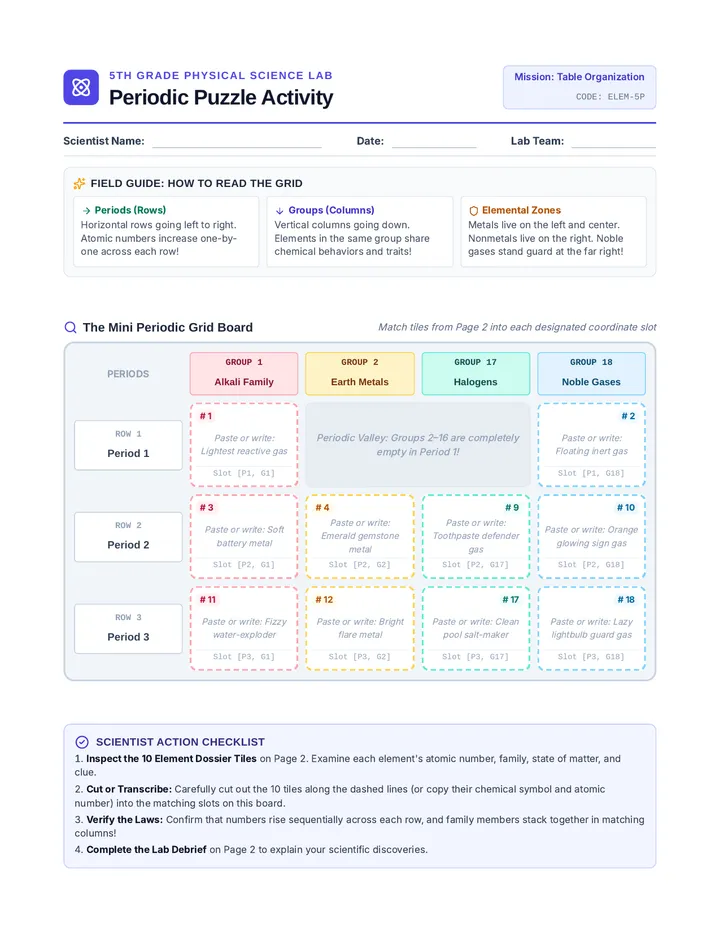
A hands-on, two-page 5th-grade periodic table investigation where students decode and assemble a mystery mini-periodic table. Features 10 illustrated element dossier cut-out tiles, guided pattern recognition across rows and columns, and critical thinking debrief prompts.
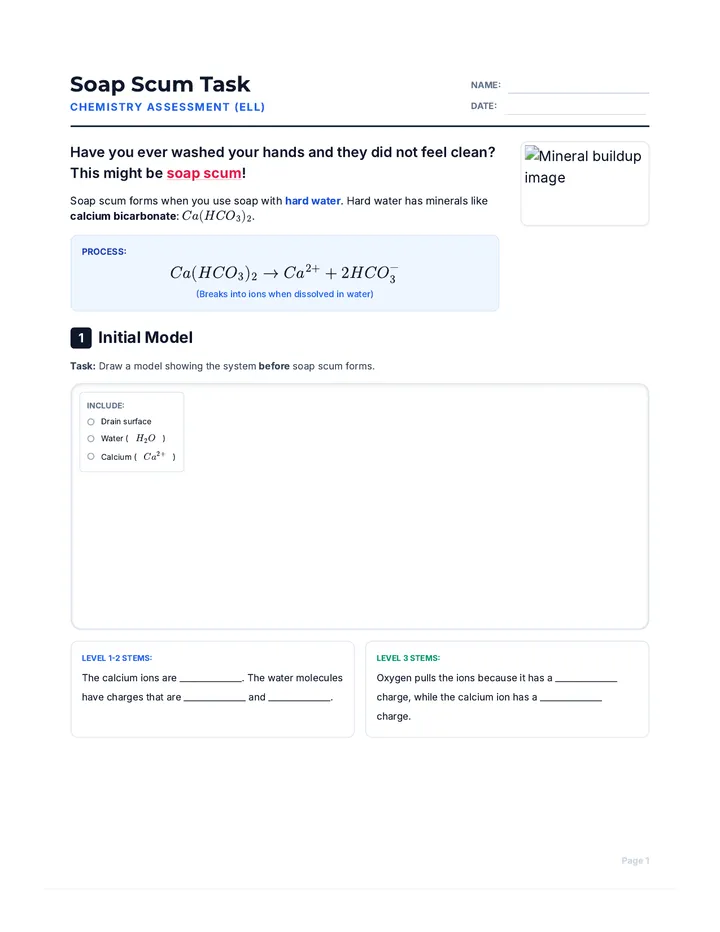
A 6-page scaffolded chemistry assessment designed for 10-11th grade English Language Learners (Entering, Emerging, Developing). It features simplified language, visual aids, and differentiated sentence stems for modeling, chemical balancing, and reasoning tasks.
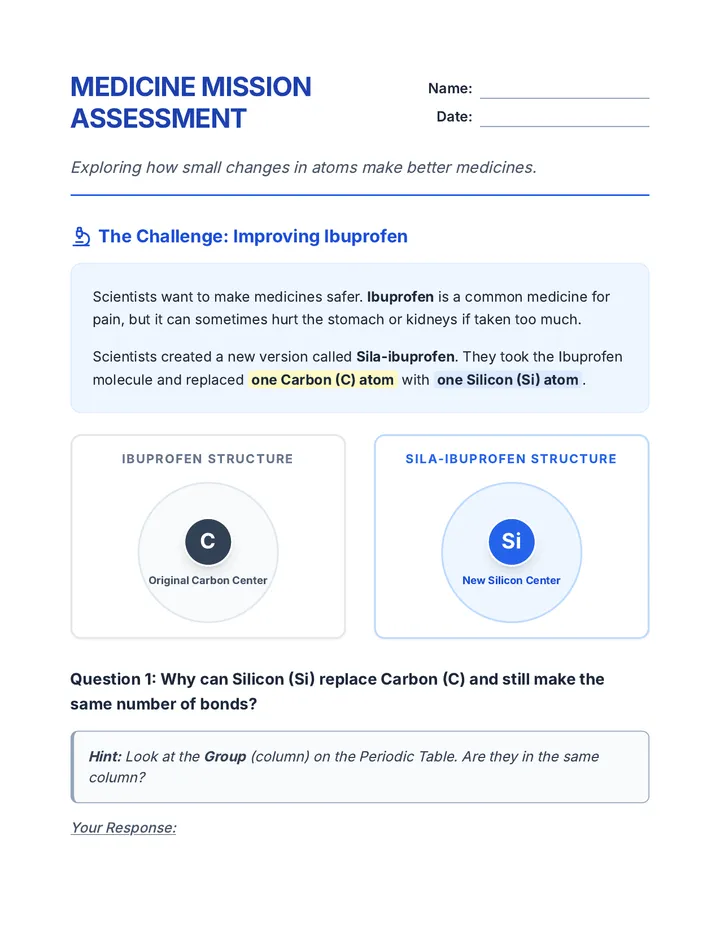
Modified chemistry assessment on Sila-ibuprofen for 10th-grade ESL students, featuring synthesized text, sentence starters, labeled atom diagrams, and a word bank to support scientific communication.
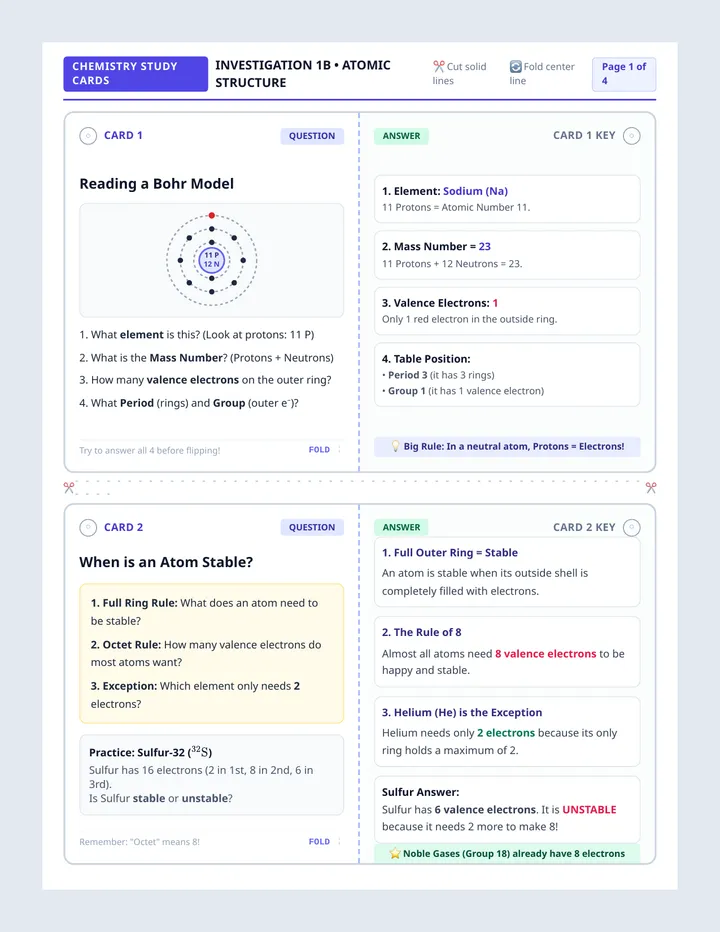
An accessible, dyslexia- and LD-friendly 4-page set of 8 large study flashcards tailored for a high school sophomore with a reading disability. Features 2 large cards per page, 14-16px high-contrast typography, bite-sized bullet points, step-by-step visual arrows, memory analogies, and clear cut/fold guides.
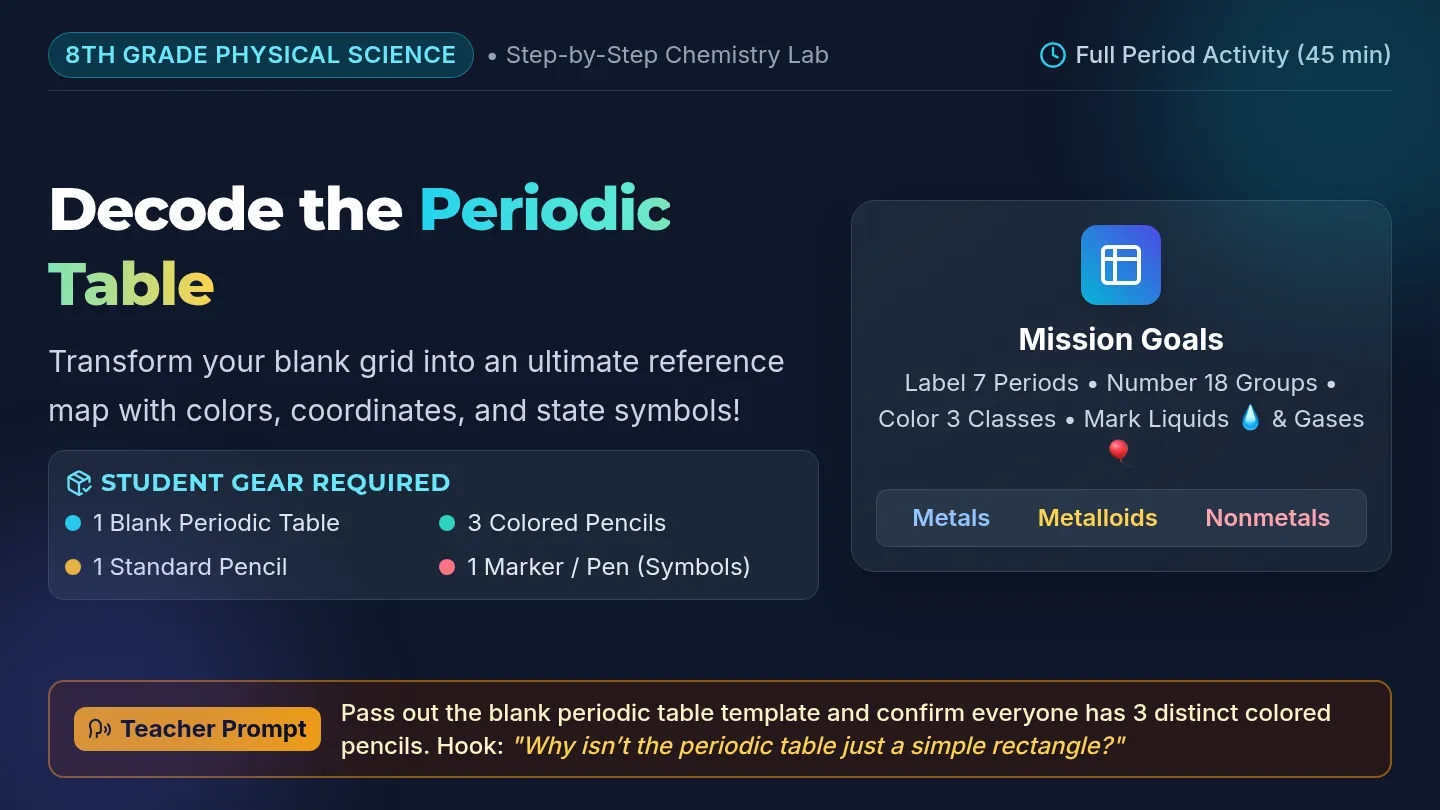
An 8-slide instructional presentation for 8th-grade science that guides students step-by-step through labeling, color-coding, and annotating a blank periodic table with metals, nonmetals, metalloids, periods, groups, and physical state symbols, complete with teacher presenter notes on each slide.
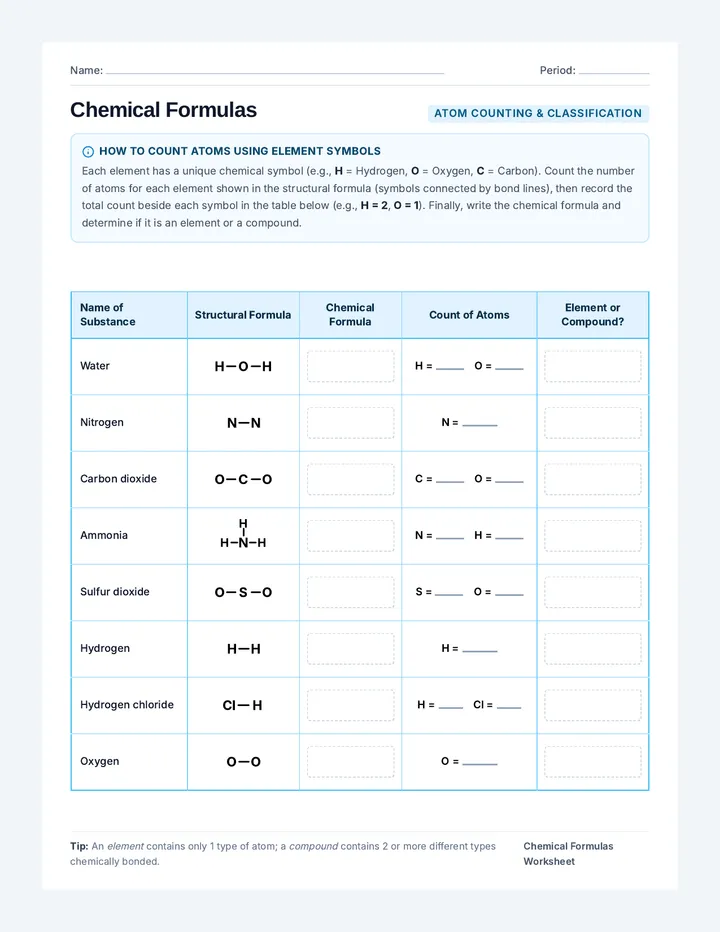
A chemistry worksheet for identifying chemical formulas, counting atoms beside element symbols using structural formulas with bond lines, and classifying substances as elements or compounds.
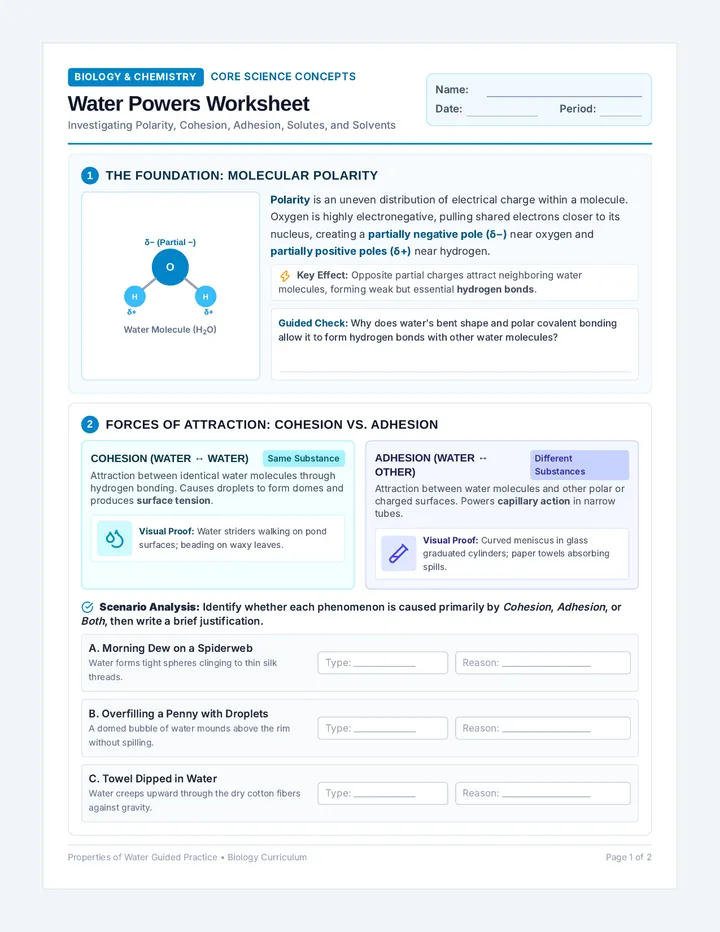
A comprehensive two-page guided practice worksheet exploring the unique properties of water, updated with crystal-clear concrete solute/solvent examples, an explicit modeled anchor row, and labeled hydration diagrams.
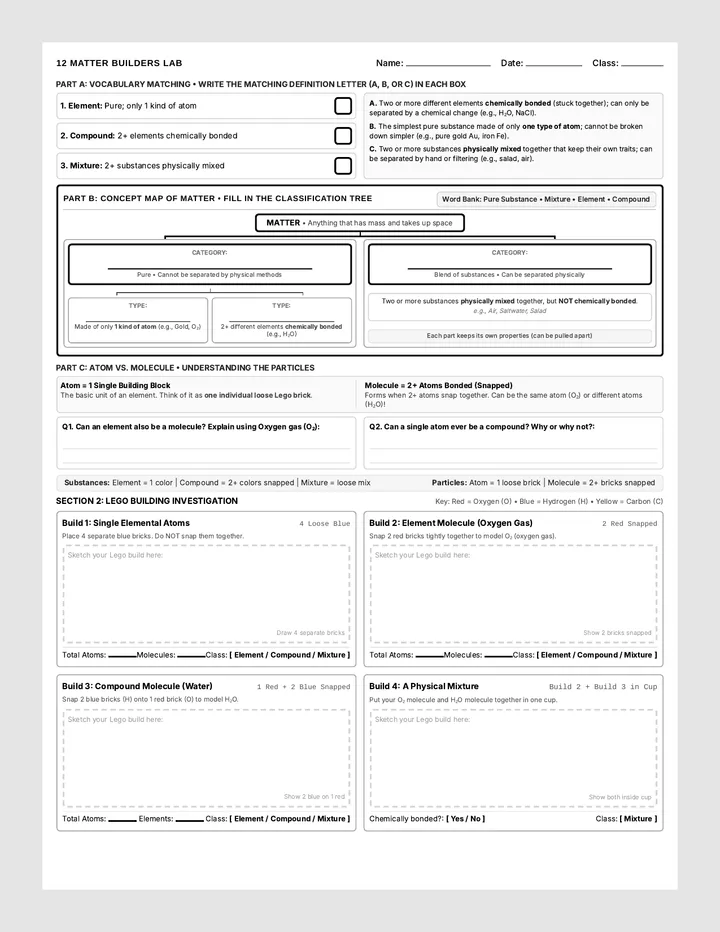
A 6th-grade friendly 2-page science lab worksheet on matter, featuring doubled student response line spacing in Question 3, Question 4 CER boxes, and Question 5 synthesis, perfectly fitted to printable page bounds with zero overflow.
A 3-slide projected bell work presentation tailored for a Biology class, reviewing ionic, covalent, hydrogen, and carbon bonding through cellular examples, macromolecule structures, and living phenomena.
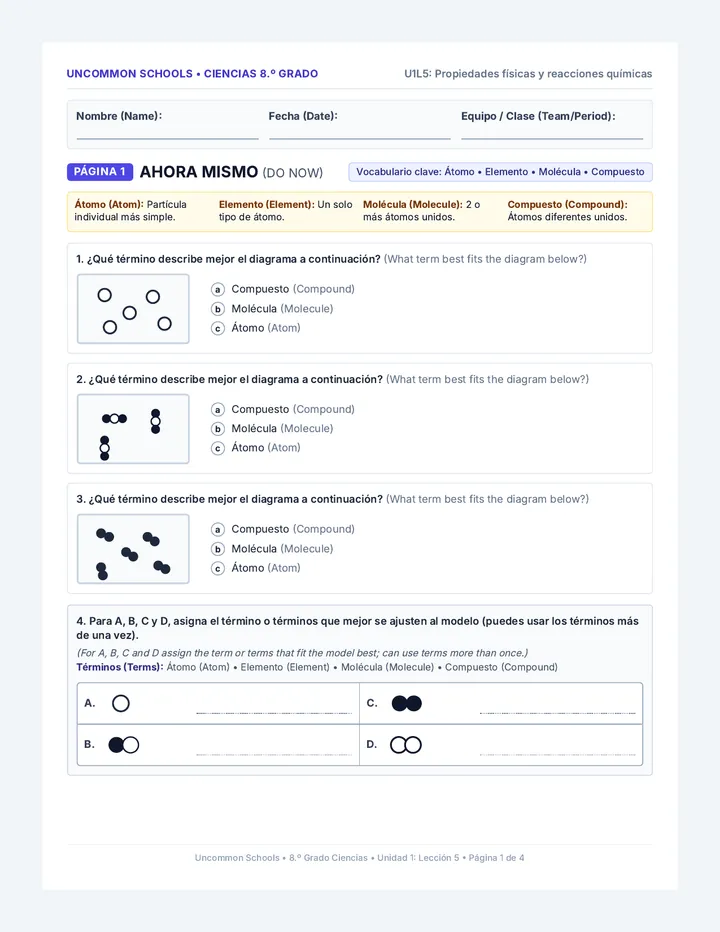
A bilingual Spanish-first 4-page science packet covering physical and chemical properties, particle models, and chemical reactions with English parenthetical supports for ELL students, featuring clear vector illustrations for the scientific phenomena.
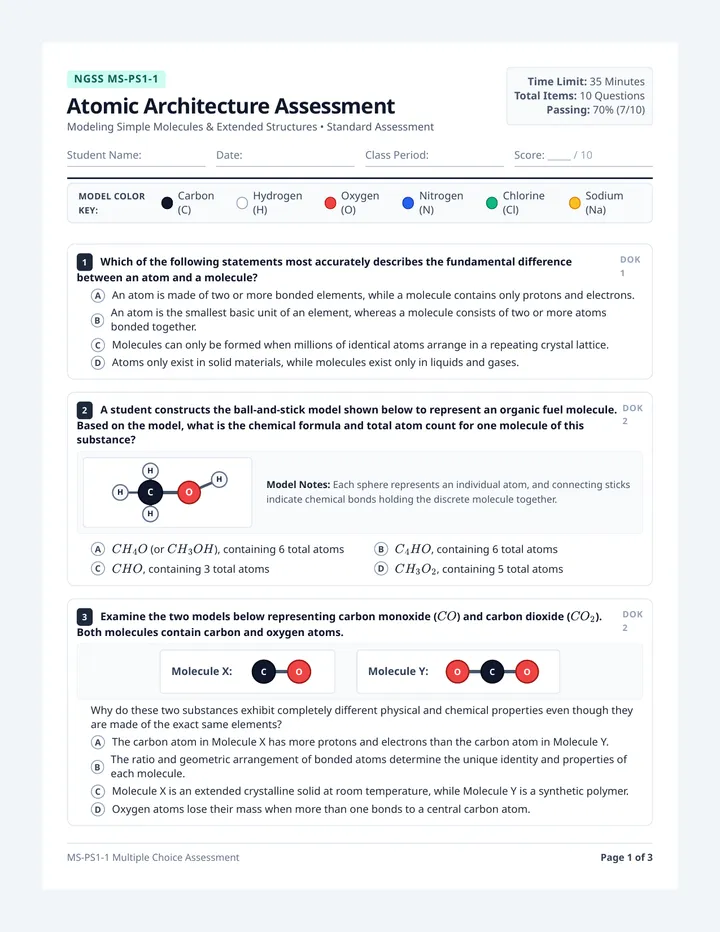
A 10-question multiple-choice assessment aligned to MS-PS1-1 covering simple molecules and extended structures. Emphasizes DOK Level 2 conceptual analysis, visual model interpretation, and subunit classification with print-ready formatting.
A 10-day exploration of the Behavior of Gases using Kinetic Molecular Theory, various gas laws, and real-world phenomena to understand gas behavior at both molecular and macroscopic scales. Students will investigate compressibility, gas variables, ideal behavior, and mixtures.
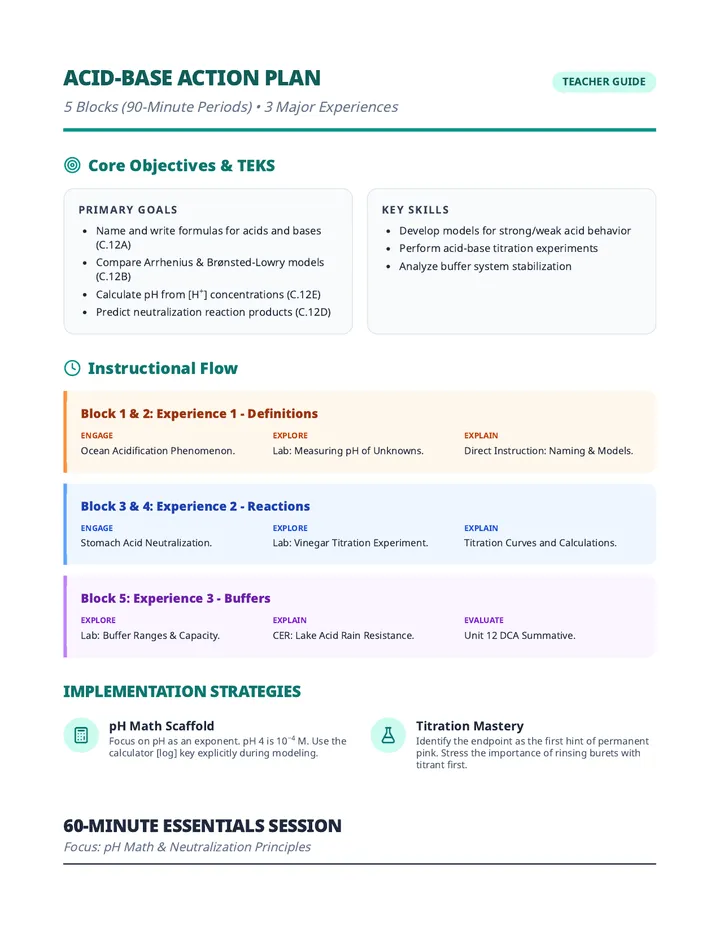
A comprehensive unit exploring the properties, reactions, and mathematical relationships of acids and bases, featuring pH calculations, titrations, and buffer systems.
A comprehensive review of CHEM 1406 introductory chemistry lab concepts, including safety, measurement, atomic structure, bonding, and chemical reactions.
A specialized curriculum designed to prepare students for introductory chemistry laboratory examinations, focusing on practical applications, quantitative calculations, and organic structure identification.
A Grade 5 PBL sequence focused on the hydrosphere and human impact, partnered with Zoo New England. Students investigate the connection between the particulate nature of matter and the survival of fostered endangered turtles in the Nashoba Brook Watershed.
A unit focused on the quantitative relationships in chemical reactions, covering everything from basic molar mass to complex limiting reactant and percent yield calculations.
A 5-day intensive exploration of magnetic forces and fields, focusing on atomic-level causes, field interactions, and mathematical modeling of forces on charged particles. Students progress from anchoring phenomena to complex mathematical applications and a comprehensive unit review.
A partner-based research project for 9th-grade conceptual physics students focusing on diverse topics from celestial mechanics to the physics of dance. Students move through a structured research process with mandatory teacher checkpoints for source reliability.
A comprehensive collection of core science units covering Environmental Science, Biology, and Physical Science. This sequence provides high-impact instructional slides, hands-on lab experiences, guided notes, and differentiated assessments for five major scientific domains.
A five-day high school chemistry unit exploring thermochemistry, collision theory, enthalpy diagrams, and calorimetry through the lens of body heat and chemical reactions. Students investigate the anchoring phenomenon of exercise-induced heat while mastering TEKS C.13 standards.
A comprehensive 5-day chemistry unit investigating the relationships between gas pressure, volume, temperature, and moles using lab inquiries, mathematical modeling, and real-world applications.