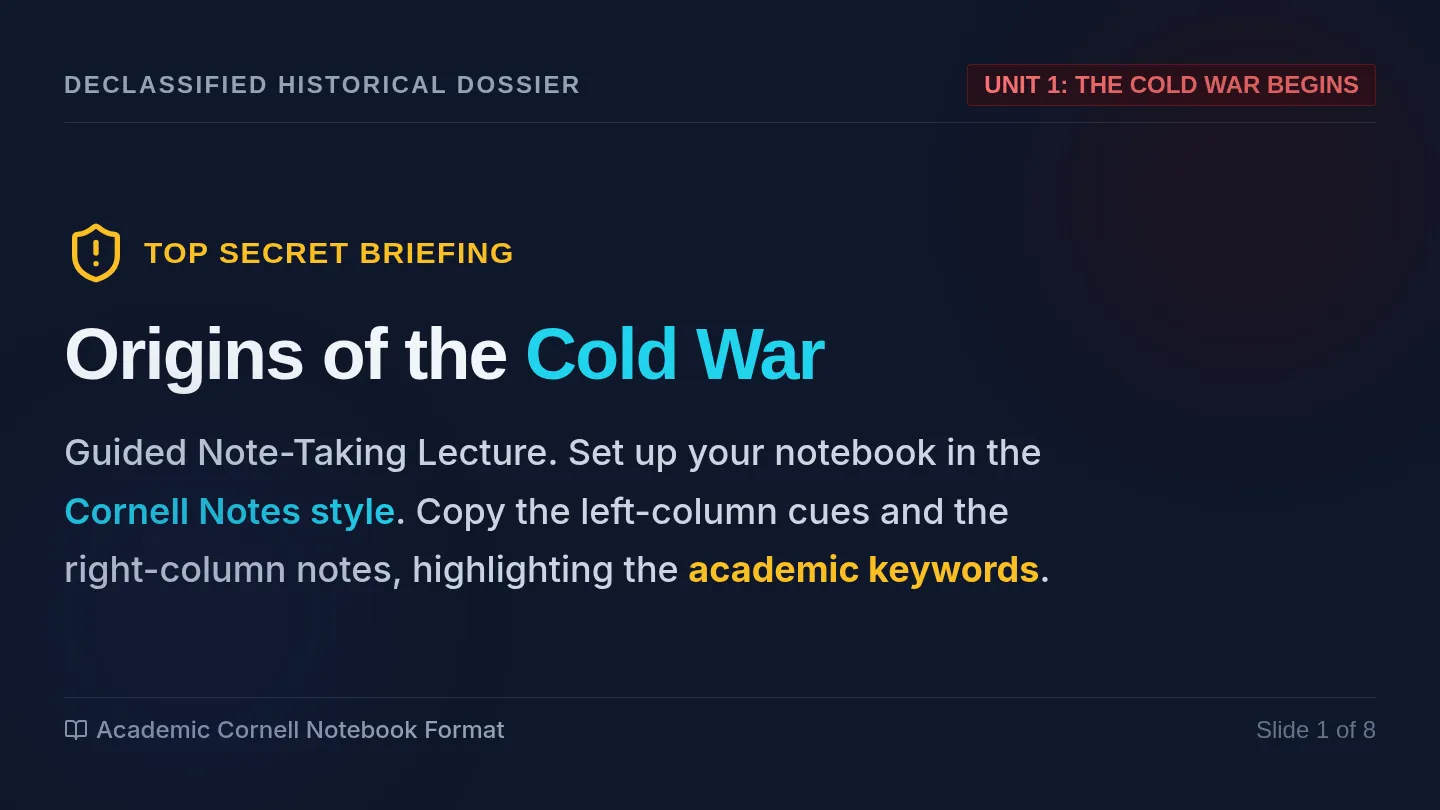
Thawing Ice Slides THAWING THE ICE
Détente and the Shift in Global Diplomacy
Defining Détente
"The relaxation of strained relations or tensions between nations."
Moving away from Brinkmanship (edge of war)
Focusing on Negotiation and treaties
Era: Late 1960s through the 1970s
"It is better to talk for ten years than to fight for one day."
The Week That Changed the World
Nixon's Visit to China (1972)
DIPLOMATIC MILESTONE
The Strategy
Nixon wanted to drive a wedge between the two largest communist powers: the USSR and China.
The Result
Formal relations opened. It pressured the Soviets to be more cooperative with the US, fearing isolation.
"Ping-Pong" Diplomacy
A simple exchange of table tennis players paved the way for top-secret meetings and a historic summit.
Limiting the Boom: SALT
SALT I (1972)
Strategic Arms Limitation Talks. Nixon and Brezhnev (USSR) agreed to limit the number of nuclear missiles they possessed.
SALT II (1979)
Further reductions. Though never formally ratified due to the Soviet invasion of Afghanistan, both sides mostly followed the rules.
Nuclear De-escalation
Recognition that a nuclear war had no winners.
Ice Returns
Why did the thaw end?
Afghanistan (1979)
The Soviet invasion shattered US trust and ended the SALT II ratification process.
Reagan Era
A new US focus on military strength and the "Evil Empire" rhetoric heated the Cold War back up.
SALT Analysis Worksheet SALT Analysis Worksheet
Strategic Arms Limitation Treaty Analysis
NAME:
DATE:
MISSION BRIEFING
The Strategic Arms Limitation Talks (SALT) represented a major shift from "brinkmanship" to "détente." Analyze the following primary source excerpts to understand how superpowers attempted to control the nuclear arms race.
SOURCE A
SALT I Treaty Excerpt (1972)
"The United States of America and the Union of Soviet Socialist Republics... considering that nuclear war would have devastating consequences for all mankind... have agreed as follows: Each Party undertakes to limit anti-ballistic missile (ABM) systems and to adopt other measures with respect to the limitation of strategic offensive arms."
1. Based on this excerpt, what was the primary motivation for both nations to sign this treaty?
2. Why would limiting "Anti-Ballistic Missiles" (defensive systems) actually help prevent a war?
SOURCE B
Nixon's Speech on SALT (1972)
"We are not doing the Soviet Union a favor by limiting our arms. They are not doing us a favor by limiting theirs. We are both doing the world a favor by reducing the danger of a nuclear holocaust."
3. How does Nixon justify the treaty to Americans who might be suspicious of the Soviet Union?
4. CONCEPT CHECK: How does the SALT treaty differ from the "Cold War" tactics used in the 1950s/early 60s (like the Cuban Missile Crisis)?
Diplomacy Guide Teacher Resource Diplomacy Guide
TEACHER RESOURCE
Lesson 1: Détente and Diplomacy
Learning Objectives
Define "Détente" in the context of the Cold War.
Explain the strategic goals of Nixon's visit to China.
Analyze the impact of the SALT treaties on global security.
Essential Vocabulary
Détente SALT Brinkmanship Sino-Soviet Split Ratification
The Hook: The Great Feud
"Imagine you and a neighbor have been in a loud, angry argument for years over a fence line. You both have cameras, high-power floodlights, and lawyers on speed-dial. One day, you realize you're both spending too much money on the feud and neither of you is happy. You agree to meet for coffee—not to become best friends, but to agree on how many floodlights you're allowed to have."
Discuss: Why is coffee better than a lawyer? What is the "fence" in the Cold War?
Instructional Pacing
Time Activity 0-10 min Hook Discussion & Vocabulary Introduction 10-25 min Visual Slides: The Rise of Détente and Nixon in China 25-45 min Document Analysis: SALT Worksheet (Pairs) 45-50 min Exit Ticket: One reason the "Ice" began to melt.
Discussion Prompts
Critical Thinking: If Nixon was known as a fierce anti-communist, why was he the perfect person to visit China? (Concept of "Nixon to China" political credibility).
Synthesizing: How did the space race and economic competition contribute to the need for Détente?
Cracks in the Iron Slides CRACKS IN THE IRON
Gorbachev and the Reforms of the 1980s
The USSR in Trouble
Economic Crisis: Shortages of food and basic goods.
Military Drain: Spending 25% of GDP on the military (vs. 6% in US).
Technology Gap: Falling behind the West in computers and industry.
"You wait in line for bread, then you wait in line for milk, then you find out they have neither."
The Reformer: Mikhail Gorbachev
New Leadership (1985)
Gorbachev realized that to save the Soviet Union, it had to change. He introduced two radical policies that would eventually lead to its end.
Young & Energetic
Unlike previous leaders, he was in his 50s and willing to admit the system was broken.
The Goal
Modernize, not destroy, Communism.
GLASNOST: "Openness"
The Policy
Allowed citizens to speak out, complain about the government, and read previously banned books.
The Intent
Gorbachev wanted people to help him identify and fix corruption in the government.
The Unintended Result
People used their new freedom to demand independence and the end of Communism altogether.
PERESTROIKA: "Restructuring"
Economic Change
Moving from a "Command Economy" toward a limited "Market Economy."
1. Local Control
Factory managers given more power to make decisions instead of Moscow.
2. Private Ownership
Small private businesses (like cafes and cooperatives) allowed for the first time.
Reform Ripple Worksheet Reform Ripple Effect
Cause and Effect Analysis of Gorbachev's Policies
NAME:
DATE:
MISSION: Mikhail Gorbachev introduced reforms to save the Soviet Union, but they acted like ripples in a pond—spreading further than he ever intended. For each policy below, describe the Direct Intent (what he hoped would happen) and the Unintended Consequence (what actually happened).
GLASNOST
Openness
"Allowing free speech and criticism of the government."
Direct Intent
Unintended Consequence
PERESTROIKA
Restructuring
"Introducing limited private ownership and market ideas."
Direct Intent
Unintended Consequence
END OF INTERVENTION
Diplomacy
"Stopping the use of force to control Eastern Europe."
Direct Intent
Unintended Consequence
Critical Analysis:
Why is it difficult for a superpower to reform "just a little bit" without losing control entirely?
Reform Roadmap Teacher Guide Reform Roadmap
TEACHER RESOURCE
Lesson 2: Cracks in the Iron Curtain
The Hook: Soviet Rock & Roll
Play a clip of a 1980s Soviet rock band (like Kino ) or show images of Soviet youth wearing blue jeans and listening to Western music on contraband cassettes.
The "Cultural Contraband": Why were blue jeans and rock music seen as threats to the communist government?
The Cracks: How does "pop culture" show that the wall was already starting to crumble before it physically fell?
Teacher Talking Points
01
The Stagnation: Remind students that by 1985, the USSR was a "superpower in name only." People were waiting in lines for hours for bread, but the government was still sending satellites into space. This disconnect is crucial.
02
Gorbachev's Gamble: He thought he could fix the engine while the car was moving. He didn't want the car to crash; he wanted it to win the race.
03
The Genie Out of the Bottle: Once Glasnost allowed people to criticize the government, they didn't just criticize—they demanded a whole new government.
Lesson Flow
05-10 min: Rock Music Hook & Cultural Discussion.
10-25 min: Slides: Economic Crisis & Gorbachev's Reforms.
25-45 min: Reform Ripple Worksheet (Independent or Partner).
Misconception Alert
"Students often think Gorbachev wanted to end Communism. It is important to emphasize that he was a committed Communist who wanted to save the system by modernizing it. The collapse was an unintended consequence of his reforms."
Wall Breakers Slides WALL BREAKER
November 9, 1989
More Than Just Bricks
"The Berlin Wall wasn't just a border—it was the physical manifestation of the Iron Curtain."
Divided families and friends for 28 years.
Guarded by soldiers, dogs, and mines.
Represented the gap between Democracy and Communism.
Berlin: An Island of Freedom in a Sea of Communism
The Year of Miracles
1989
Hungary Opens
Hungary removes its border fence with Austria. Thousands of East Germans flee to the West.
Protest Waves
Massive protests in East German cities (Leipzig, Berlin) demand freedom and travel rights.
The Soviet Shift
Gorbachev tells East German leaders he will not send Soviet tanks to stop the protests.
The Mistake That Changed History
The Press Conference
Günter Schabowski, an East German official, accidentally announces that travel restrictions are lifted "immediately, without delay."
The Rush
Thousands of people storm the checkpoints. Confused guards, having no orders to shoot, finally open the gates.
THE GATES OPEN
Reporting From the Scene
What did it feel like?
Disbelief and Joy
Dancing on the Wall
"Mauerspechte" (Wall Woodpeckers) chipping away bricks
Strangers hugging each other
Journalism Mission
Today, you are a reporter for the Berlin Times. Your job is to capture the chaos and emotion of this night in a breaking news report.
"History is being made in front of our eyes. The Wall is breathing."
Newsroom Dispatch Activity Exclusive International Dispatch
THE BERLIN TIMES
VOL. LXXXIX — NO. 313 FRIDAY, NOVEMBER 10, 1989 PRICE: FREE PRESS
REPORTER NAME:
ASSIGNMENT DESK:
Breaking News: The Wall Has Opened
"I am standing at Checkpoint Charlie, where the air smells of diesel fumes, sweat, and absolute freedom. The crowd is surging forward, and for the first time in 28 years, the gate is open."
The Live Broadcast Script
Draft your lead story below. Capture the sights, sounds, and emotions of the people.
Intro:
Body:
Quote:
Observation Checklist
Include at least three of these details in your report:
"Mauerspechte" (People with hammers)
Trabant cars crossing the border
The reaction of East Berlin guards
Bananas (given as welcome gifts)
Dancing at Brandenburg Gate
Headline Draft:
End of File — Berlin Press Corps — 1989
Reporting History Teacher Guide Reporting History
TEACHER RESOURCE
Lesson 3: The Wall Falls
Journalistic Writing
Simulation
Observation
LIVE BROADCAST HOOK
"Attention students. We are interrupting your daily schedule for a special report. This just in from East Berlin: The borders are open. I repeat, the borders are open effective immediately."
Action: Show a 2-minute montage of actual 1989 news footage (available on YouTube from BBC or ABC News) showing people on top of the wall.
Journalistic Guidelines
Explain to students that good reporting isn't just about facts—it's about "painting a picture." They should use the Five Ws (Who, What, Where, When, Why) but focus on the "How" (How does it feel? How do people look?).
Sensory Detail
The sound of hammers, the cold night air, the smell of exhaust from East German cars.
Emotional Core
Disbelief, reunion of family, the end of a long "nightmare."
"On Air" Presentations
In the last 15 minutes of class, have a few volunteers stand in front of the class (the "newsroom") and read their reports with a partner playing the "Anchor" in the studio. Encourage them to use a dramatic "reporter voice."
Connecting to the EQ: How does the fall of the wall prove that a superpower can collapse through "people power" rather than "missile power"?
Empire's End Slides EMPIRE'S END
The Collapse of the Soviet Union (1991)
The Satellite States Fly Away
Once the Berlin Wall fell, the "Iron Curtain" nations in Eastern Europe abandoned Communism rapidly.
Poland (Solidarity Movement)
Czechoslovakia (Velvet Revolution)
Romania
Hungary
Independence
"The chains are broken. The nations of Europe are returning to themselves."
The Final Gasp: The 1991 Coup
EMERGENCY STATE
The Attempt
Communist "Hardliners" (those who hated Gorbachev's reforms) tried to seize power by force and kidnap Gorbachev at his vacation home.
The Failure
Boris Yeltsin and thousands of citizens stood in front of tanks. Soldiers refused to fire on their own people. The coup collapsed in 3 days.
The Flag Comes Down
Christmas Day, 1991
"The Cold War is over. The Union of Soviet Socialist Republics has ceased to exist."
Gorbachev Resigns
15 New Nations Form
End of 74 Years of Communism
Shattered Pieces
The 15 Republics
Russia was the largest, but 14 other nations—from Ukraine to Kazakhstan—suddenly became independent. This transition would not be easy.
"The largest peaceful breakup of an empire in history."
Upcoming Activity:
Mapping the New World
Shattered Union Map Worksheet Shattered Union
Mapping the Breakup of the USSR
NAME:
DATE:
1. The Fifteen Republics
The Soviet Union dissolved into 15 independent countries in 1991. Categorize these nations based on their geographic location.
Baltic States
Estonia
Latvia
Lithuania
Eastern Europe
Belarus
Moldova
Ukraine
Central Asia
Kazakhstan
Uzbekistan
Kyrgyzstan
*Others include: Russia, Armenia, Azerbaijan, Georgia, Tajikistan, Turkmenistan.
A. The Geography of Power
Which country inherited the majority of the Soviet Union's territory, nuclear weapons, and seat at the United Nations?
B. Resource Distribution
Think about "Perestroika." Why might some republics (like oil-rich Kazakhstan or agricultural Ukraine) be eager to leave the centralized Soviet economy?
C. Looking Ahead
Based on the map of Eastern Europe today, what might be a major challenge for these 15 new nations as they move from a single "Superpower" to 15 different governments?
Synthesis: The Puzzle Metaphor
Explain why a jigsaw puzzle is a good way to describe the Soviet Union in 1991.
Collapse Chronicle Teacher Guide Collapse Chronicle
TEACHER RESOURCE
Lesson 4: End of an Empire
Political Mapping
Cause & Effect
Inquiry
THE HOOK: THE SHATTERED PUZZLE
Give each group of 4 students a simple map of the USSR printed on cardstock. Have them physically cut it into the 15 republics (or provide pre-cut pieces).
Teacher Script:
"For 74 years, this was one giant block of stone. Today, we're going to see how it broke into 15 pieces in a single afternoon. Once you cut your puzzle, try to put it back together without using tape. Notice how fragile the connections are."
Lesson Flow
<table class="w-full text-sm"><tbody><tr class="border-b border-slate-200"><td class="py-3 font-bold w-1/4">10 min</td><td class="py-3">Puzzle Hook & Initial Map Observation</td></tr><tr class="border-b border-slate-200"><td class="py-3 font-bold w-1/4">15 min</td><td class="py-3">Slides: The August Coup & The Christmas Resignation</td></tr><tr class="border-b border-slate-200"><td class="py-3 font-bold w-1/4">20 min</td><td class="py-3">Map Worksheet: Identifying the 15 Republics</td></tr><tr><td class="py-3 font-bold w-1/4">05 min</td><td class="py-3">Debrief: What happens to the nuclear weapons?</td></tr></tbody></table>
Background for Teachers
The "August Coup" is the pivotal moment. It showed that even the most powerful men in the Soviet Union (the KGB and military leaders) could no longer control the people. Boris Yeltsin, standing on a tank, became the symbol of this resistance. This lesson transitions the USSR from a "Communist State" to "Modern Russia and neighbors."
*Note: Ensure students understand that Russia inherited the USSR's permanent seat on the UN Security Council.
Differentiation
For advanced students, ask them to research why the Baltic states (Estonia, Latvia, Lithuania) were the first to leave (they were forced into the USSR in 1940 and always viewed themselves as occupied).
Modern Shadows Slides MODERN SHADOWS
The Legacy of the Cold War
Echoes of the Era
NATO Expansion
The military alliance created to stop the USSR still exists and has grown to include many former Soviet nations.
Nuclear Proliferation
The thousands of warheads created during the arms race are still a major global security concern today.
Modern Conflict
"You cannot understand today's news in Ukraine, China, or the Middle East without understanding the Cold War."
The New World Order
POST-1991
U.S. as "Hyperpower"
For a decade, the United States was the world's only superpower, leading to a period of American cultural and military dominance.
Rise of the "BRICS"
New powers (Brazil, Russia, India, China, South Africa) emerged to challenge the old Cold War hierarchy.
Final Challenge
The Museum of the Cold War
The Exhibit
Select 3 artifacts that best represent the Cold War's beginning, middle, and end.
The "Why"
Explain how each artifact still casts a shadow over the world we live in today.
Legacy Exhibit Project Guide MUSEUM EXHIBIT PROPOSAL
The Legacy of the Cold War
Project Code
CW-05
Lead Curator:
Submission Date:
The Mission
"Your task is to design a single exhibit room that captures the entire story of the Cold War. You must select three specific artifacts (objects, documents, or images) that represent the tension, the shift, and the lasting shadow of the era."
Sketch or Describe Artifact #1 Here
Artifact #1: The Symbol of Conflict
Select an object representing the height of Cold War tensions.
Sketch or Describe Artifact #2 Here
Artifact #2: The Turning Point
Select an object representing the shift (Détente or the 1989 Reforms).
Exhibit Summary: The Lasting Shadow
In 3-5 sentences, explain how the Cold War still influences global politics today. How does your exhibit prove that the Cold War never truly "disappeared," but simply changed form?
Legacy Lab Teacher Guide Legacy Lab
TEACHER RESOURCE
Lesson 5: Shadow of Superpowers
Sequence Objective
"Students will synthesize their understanding of the Cold War's end to evaluate its impact on modern global stability, nuclear safety, and international alliances."
The Hook: Trace the Roots
Show three modern headlines (e.g., "NATO Bolsters Defenses in Eastern Europe," "Russia and US Discuss Nuclear Treaty," "Tensions Rise in the Taiwan Strait").
Question 1: Which Cold War superpower (US or USSR) created the alliances mentioned in these headlines?
Question 2: Why do these "old" tensions still exist even though the Soviet Union is gone?
Project Facilitation Notes
The Museum Exhibit Proposal is a synthesis task. Encourage students to think "outside the box" with their artifacts. Examples of strong student choices:
Symbol of Conflict: A piece of the Berlin Wall, a fallout shelter sign, or a model of a Sputnik satellite.
The Turning Point: A pair of Levi's jeans (cultural shift), a hammer/chisel from 1989, or a SALT I treaty pen.
The Shadow: A modern map showing NATO's expansion or a photo of a modern protest in a former Soviet state.
Socratic Debrief
Prompt 1: Is it possible for a nation to be a "Superpower" today without a massive nuclear arsenal? (The rise of economic superpowers).
Prompt 2: Did the Cold War "end" or did it just enter a new phase?
Grading Focus:
Focus on the reasoning behind the artifacts. A student should be able to explain how the artifact represents the historical era, not just name the object.