Empire Chronicles Slides
Unit Sequence Inquiry Presentation
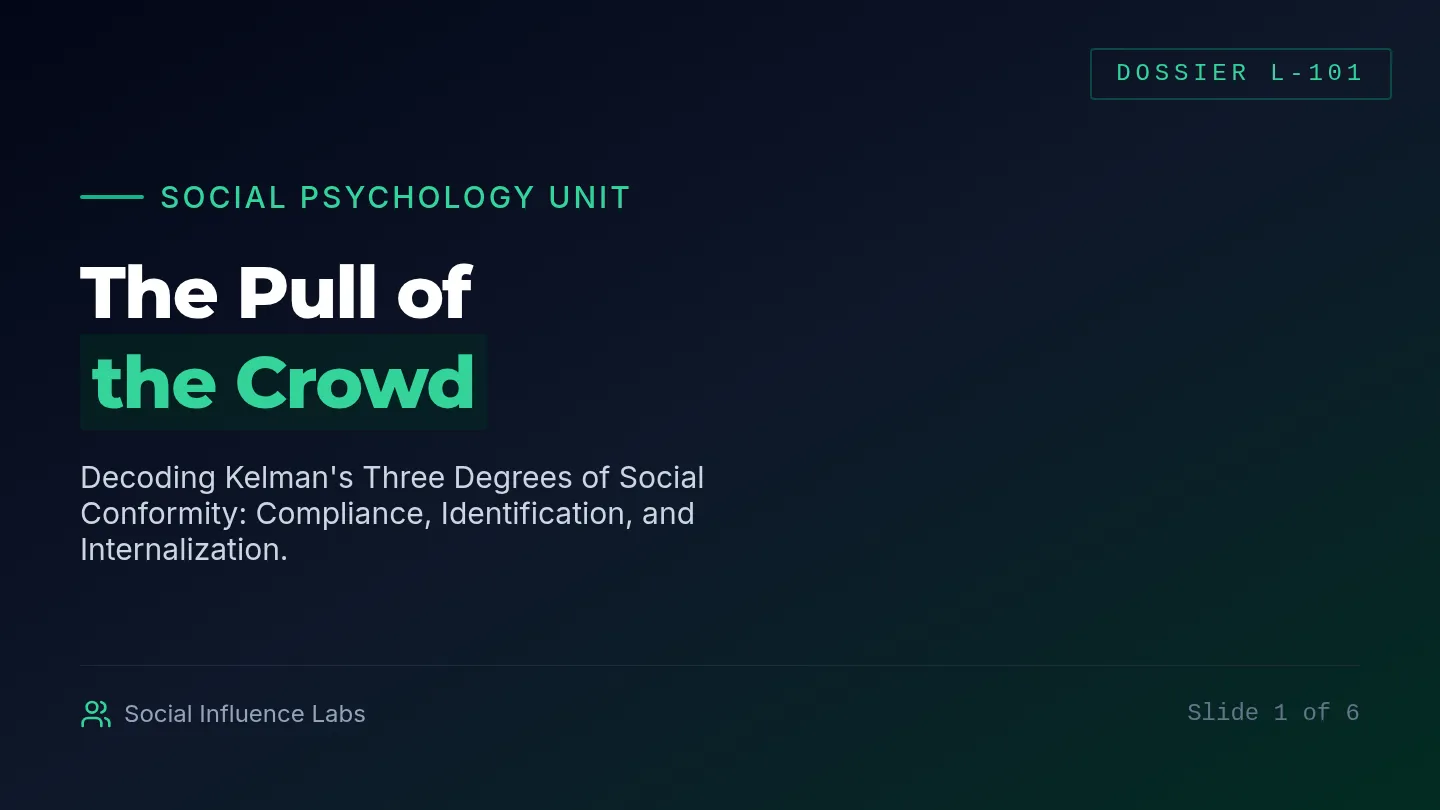
CRADLE CHRONICLES
River Valley Empires
Investigating geography, authority, and innovation across Mesopotamia, Ancient Egypt, the Indus Valley, and Early China.
Session 1: Geographic Determinism & Foundations
Slide 1 of 7
01. Mesopotamia
Tigris & Euphrates
"The Land Between Rivers"
Fierce, unpredictable seasonal flooding required high levels of collective organization. To manage water, independent Sumerian city-states built vast irrigation canals, leading directly to the birth of centralized administrative leadership.
Key Innovation: Cuneiform
One of the world's earliest writing systems, pressed into damp clay with reed styluses, starting as trade receipts and expanding to codify the rule of law.
Unpredictable Flooding
Rivers flooded wildly, shaping a religious worldview of volatile, capricious gods who demanded appeasement.
Ziggurats & Temples
Massive monumental mud-brick complexes serving as the economic, administrative, and spiritual hearts of city-states.
Fragmented Power
Sumer operated as independent, competing city-states until unified by external conquest (Akkadian & Babylonian empires).
Empire Chronicles Inquiry Deck Slide 2 of 7
02. Ancient Egypt
The Gentle Nile
"The Gift of the Nile"
Unlike Mesopotamia, the Nile’s yearly floods were highly predictable and life-giving. This regular cycle created rich agricultural silt, instilling a profound cultural sense of order, cosmic balance (Ma’at), and administrative stability.
Divine Kingship & Order
Pharaohs were not mere representatives of gods; they were considered living gods on Earth, responsible for preserving cosmic harmony and controlling the waters.
Natural Defenses
Bounded by vast deserts and dangerous cataracts, Egypt enjoyed natural isolation that protected it from frequent invasion.
The Concept of Ma'at
A foundational cosmic philosophy centered on truth, balance, and order. Justice was divine, maintaining the kingdom's prosperity.
Monumental Architecture
Great Pyramids and tombs built not just for vanity, but to secure the Pharaoh's safe transition to the afterlife, ensuring ongoing cosmic protection.
Empire Chronicles Inquiry Deck Slide 3 of 7
03. Indus Valley
The Planned Citadels
"Unparalleled Urban Planning"
Fed by the massive Indus and Ghaggar-Hakra river networks, Harappa and Mohenjo-Daro reveal a uniquely egalitarian layout. Cities featured rigorous grid iron streets, standard-sized fired bricks, and sophisticated plumbing infrastructure.
The Great Archeological Enigma
No massive palaces, towering royal monuments, or signs of large military forces have been excavated. Power seems remarkably decentralized and communal compared to Egypt or Babylon.
The Great Bath
A giant, beautifully sealed public water tank in Mohenjo-Daro, likely used for ritual purification, indicating complex shared social practices.
Standardization of Trade
Exact weights and measures across hundreds of miles, alongside intricately carved steatite trade seals depicting animals and an undeciphered script.
Advanced Sanitation
Almost every private home had its own indoor bathing area connected to a city-wide covered sewage network, unmatched in the ancient world.
Empire Chronicles Inquiry Deck Slide 4 of 7
04. Ancient China
The Dynamic Dynasties
"The Yellow & Yangtze Silt"
The Yellow River (Huang He) deposits fertile but dangerous yellow loess. Unpredictable flooding earned it the name "China’s Sorrow," driving early dynasties to construct massive levees and dikes, consolidating state power through hydro-engineering.
Mandate of Heaven
Introduced by the Zhou Dynasty: rulers were given the divine right to rule by heaven. If a ruler grew corrupt or failed to manage natural disasters, heaven withdrew its mandate, prompting revolution.
Ancestor Veneration
A core cultural concept that ancestors acted as powerful intercessors between humans and the spirit world, emphasizing deep filial piety and kinship lines.
Oracle Bones & Writing
Questions were carved on tortoise shells or ox bones and heated until they cracked. Interpreters read the fractures, creating an enduring, symbolic writing system.
Dynastic Cycle
A historical rhythm: a dynasty rises with the Mandate, rules prosperously, decays, faces a disaster (flood, famine), loses the Mandate, is overthrown, and a new dynasty starts.
Empire Chronicles Inquiry Deck Slide 5 of 7
Comparative Matrix
Synthesis & Analysis
| Empire | River System | Writing System | Nature of Authority | Major Legacy |
|---|
| Mesopotamia | Tigris & Euphrates | Cuneiform (Clay) | Competing City-States, Codes | Written legal codes, 60-min hour |
| Egypt | Nile River | Hieroglyphs (Papyrus) | Divine Pharaohs, Centralized | Monumental architecture, solar calendar |
| Indus Valley | Indus & Ghaggar-Hakra | Undeciphered Script (Seals) | Decentralized, Civic/Guilds | Standardized grids, advanced plumbing |
| Ancient China | Yellow & Yangtze | Oracle Bone Script (Logograms) | Dynastic, Mandate of Heaven | Hydraulic engineering, ancestor focus |
Empire Chronicles Inquiry Deck Slide 6 of 7
YOUR TASK Document Analysis & Synthesis
The Archeological Inquiry Begins
Rulers of these primary civilizations had to overcome extraordinary geographic and social hurdles to unify their empires. Your assignment is to complete the Guided Notes packet as we present, then analyze the Primary Source DBQ Packet.
Phase 1
Compare Notes
Ensure your 2x2 comparison matrix on the four empires is fully updated.
Phase 2
Analyze Sources
Read Hammurabi's Code, the Book of the Dead, Indus Seals, and China's Mandate.
Phase 3
Synthesize
Draft a clear, evidence-based essay explaining how rulers built absolute power.
Empire Chronicles Inquiry Deck Slide 7 of 7
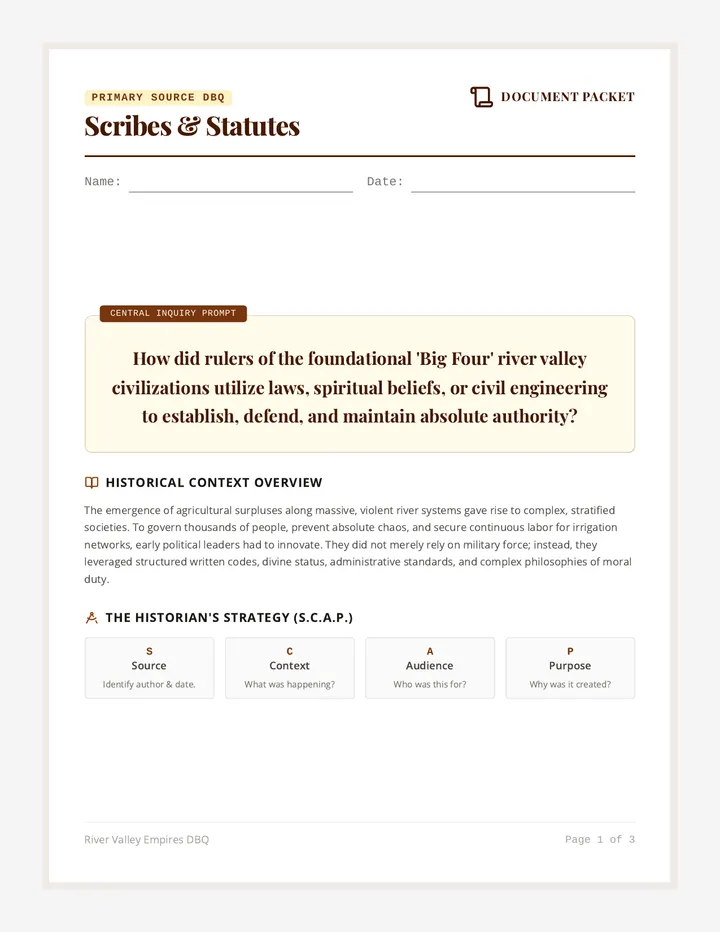
Scribes and Statutes DBQ
Primary Source DBQ
Scribes & Statutes
DOCUMENT PACKET
Name:
Date:
Central Inquiry Prompt
How did rulers of the foundational 'Big Four' river valley civilizations utilize laws, spiritual beliefs, or civil engineering to establish, defend, and maintain absolute authority?
Historical Context Overview
The emergence of agricultural surpluses along massive, violent river systems gave rise to complex, stratified societies. To govern thousands of people, prevent absolute chaos, and secure continuous labor for irrigation networks, early political leaders had to innovate. They did not merely rely on military force; instead, they leveraged structured written codes, divine status, administrative standards, and complex philosophies of moral duty.
The Historian's Strategy (S.C.A.P.)
S Source
Identify author & date.
C Context
What was happening?
A Audience
Who was this for?
P Purpose
Why was it created?
River Valley Empires DBQ Page 1 of 3
Part I: Document Analysis Mesopotamia & Egypt
Document A: The Code of Hammurabi (Babylon, c. 1750 BCE) Legal Code
"196. If a man put out the eye of another man, his eye shall be put out... 198. If he put out the eye of a freed man, or break the bone of a freed man, he shall pay one gold mina... 202. If any one strike the body of a man higher in rank than he, he shall receive sixty blows with an ox-tail whip in public."
1. How did Hammurabi treat social classes differently in the law?
2. Why would public punishments help a king preserve social control?
Document B: Egyptian Book of the Dead (The Papyrus of Ani, c. 1250 BCE) Religious Papyrus
"I have not committed sin. I have not robbed with violence. I have not stolen. I have not slain men and women. I have not stolen grain. I have not told lies... I am pure. I am pure. My purity is the purity of that Great Bennu bird which is in the city of Heracleopolis..."
1. What does this 'declaration of purity' reveal about Egypt's moral code?
2. How does divine judgment support the political power of the Pharaoh?
River Valley Empires DBQ Page 2 of 3
Part I: Document Analysis (Cont.) Indus & Early China
Document C: Harappan Steatite Seals (Indus Valley, c. 2300 BCE) Archaeological Source
Historical Context Note: Hundreds of identical, square steatite seals with carved animal imagery (often bulls or mythical unicorns) and a uniform script have been unearthed from Mesopotamia to India. They were pressed into clay to seal trade cargos.
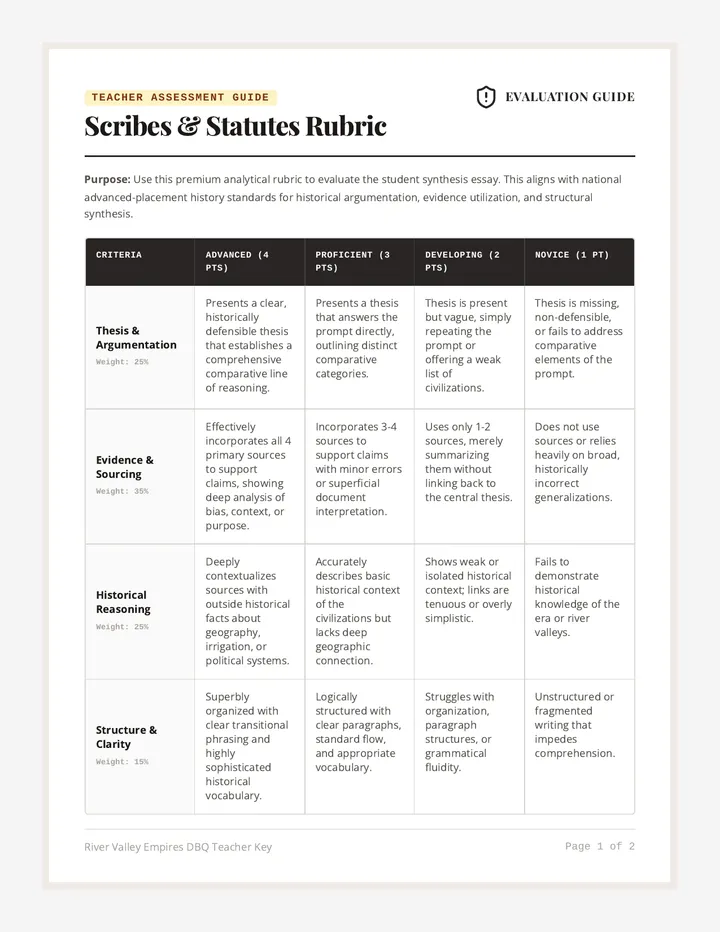
Scribes and Statutes Rubric
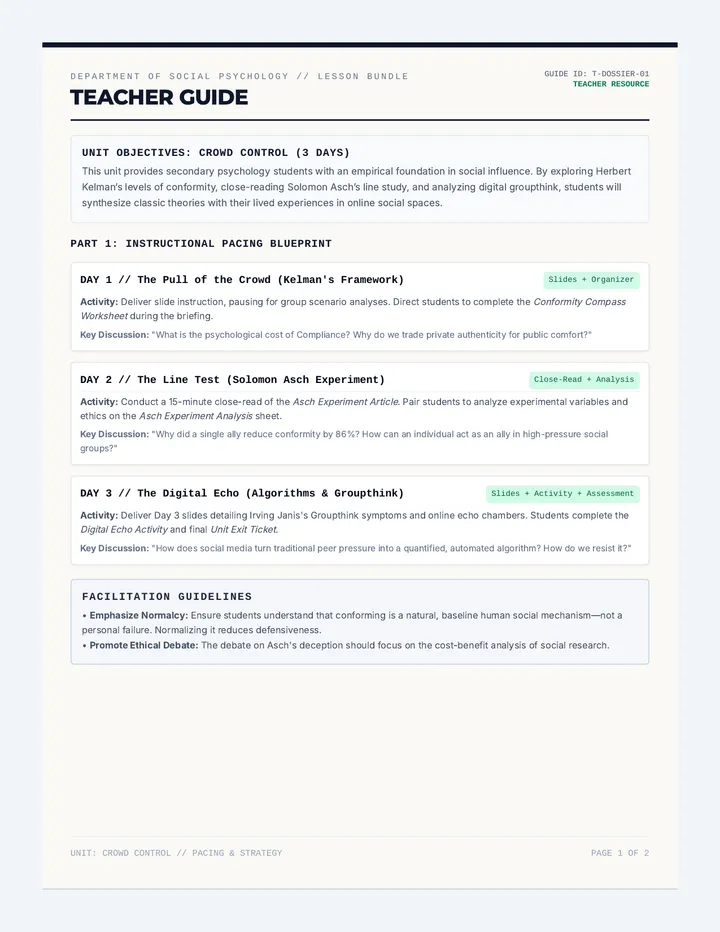
Teacher Assessment Guide
Scribes & Statutes Rubric
EVALUATION GUIDE
Purpose: Use this premium analytical rubric to evaluate the student synthesis essay. This aligns with national advanced-placement history standards for historical argumentation, evidence utilization, and structural synthesis.
Criteria
Advanced (4 pts)
Proficient (3 pts)
Developing (2 pts)
Novice (1 pt)
Thesis & Argumentation Weight: 25%
Presents a clear, historically defensible thesis that establishes a comprehensive comparative line of reasoning.
Presents a thesis that answers the prompt directly, outlining distinct comparative categories.
Thesis is present but vague, simply repeating the prompt or offering a weak list of civilizations.
Thesis is missing, non-defensible, or fails to address comparative elements of the prompt.
Evidence & Sourcing Weight: 35%
Effectively incorporates all 4 primary sources to support claims, showing deep analysis of bias, context, or purpose.
Incorporates 3-4 sources to support claims with minor errors or superficial document interpretation.
Uses only 1-2 sources, merely summarizing them without linking back to the central thesis.
Does not use sources or relies heavily on broad, historically incorrect generalizations.
Historical Reasoning Weight: 25%
Deeply contextualizes sources with outside historical facts about geography, irrigation, or political systems.
Accurately describes basic historical context of the civilizations but lacks deep geographic connection.
Shows weak or isolated historical context; links are tenuous or overly simplistic.
Fails to demonstrate historical knowledge of the era or river valleys.
Structure & Clarity Weight: 15%
Superbly organized with clear transitional phrasing and highly sophisticated historical vocabulary.
Logically structured with clear paragraphs, standard flow, and appropriate vocabulary.
Struggles with organization, paragraph structures, or grammatical fluidity.
Unstructured or fragmented writing that impedes comprehension.
River Valley Empires DBQ Teacher Key Page 1 of 2
Teacher Answer Key Document Analysis Exemplars
Document A: The Code of Hammurabi Key
1. Social Hierarchy Treatment: Punishments are based entirely on social status. Striking a higher-class person results in severe corporal punishment (whip), while harming a lower-class person is settled with monetary fines.