Thresholds Presence Slides Thresholds of Presence
Ritual Theory and Liminality
"Ritual is a transformative performance... it does not just reflect a social reality, it creates one."
The Essential Tension
What is the fundamental difference between a shaman entering a trance and an actor playing a shaman?
Is the difference located in the intent, the audience, or the efficacy of the movement itself?
Inquiry Task
Discuss with a partner: Can movement be "sacred" if no one is watching? Can it be "sacred" if everyone is watching and paying admission?
The Liminal Phase
Victor Turner (1920–1983)
Definition
From the Latin limen (threshold). A state of being "betwixt and between" normal social categories.
1
Separation
The ritual subject is detached from their previous social status or spatial reality.
2
Liminality (The Middle State)
Ambiguity, ordeal, and the suspension of hierarchy. This is where the dance/ritual occurs.
3
Aggregation
Re-entry into society with a new status (e.g., from child to adult, from sick to healed).
Ritual vs. Theater
Richard Schechner's Efficacy-Entertainment Braid
Efficacy (Ritual)
Results are consequential
Audience participates
Belief is necessary
Criticism is irrelevant
Sacred time / Eternal
Entertainment (Theater)
Results are symbolic
Audience observes
Appreciation is central
Criticism is essential
Linear time / Scheduled
"No performance is pure ritual or pure entertainment. It is a shifting braid."
Communitas
"The spontaneous, immediate, and concrete relationship between individuals... a bond of shared humanity that transcends social structure."
Spontaneous
The sudden flash of unity during high-intensity movement.
Ideological
The collective memory of shared liminal experience.
Normative
The attempt to capture that spirit in institutional forms.
Seminar Discussion Prep
Apply these concepts: When a classical ballet company performs The Rite of Spring, is there any liminality left? Or has it been entirely consumed by the 'performance frame'?
Key Reading Turner, "Betwixt and Between"
Key Reading Schechner, "From Ritual to Theater"
Ritual Theory Seminar Guide Ritual Theory Seminar Guide
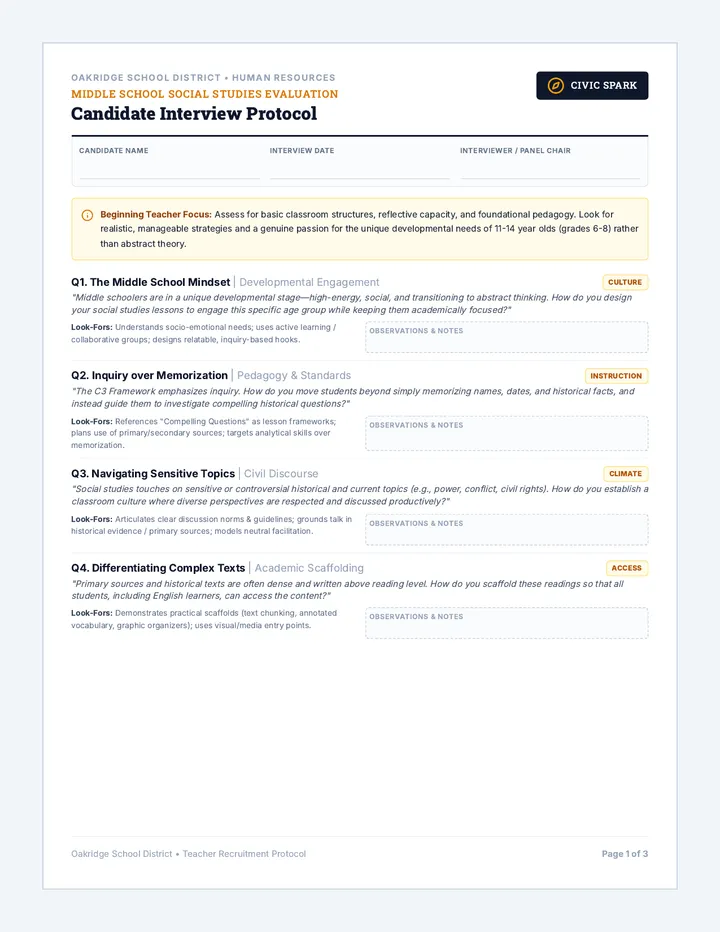
Instructor Resource: Lesson 1
Anthropology of Movement
Graduate Level
Instructional Objectives
Synthesize Turner’s concept of liminality with Schechner’s efficacy-entertainment braid.
Analyze the spatial and temporal shifts required to transition from a ritual frame to a performance frame.
Critically evaluate the role of communitas in contemporary dance practices.
PART I
The Liminal Subject
Primary Prompt:
Turner describes the liminal personae as "threshold people." In the context of dance, does the physical rigor of technique act as a form of "ritual ordeal" that facilitates this threshold crossing?
Follow-up Questions
• How does the "stripping of identity" (uniforms, studio etiquette) mirror the loss of status in tribal rituals?
• If liminality is temporary, does the professional dancer live in a state of permanent liminality?
Instructor Note:
Encourage students to draw on their own training experiences. Look for mentions of "flow state" vs. "liminal state"—are they the same?
PART II
The Efficacy-Entertainment Braid
Primary Prompt:
Schechner argues that efficacy and entertainment are not binary opposites but a "braid." Can a performance be highly efficacious (transformative) for the performer but purely entertainment for the audience?
Key Theoretical Links
• The Performance Frame: Does the proscenium arch act as a containment for the "danger" of ritual?
• Transformative vs. Transportive: Does theater only transport us while ritual transforms us?
Seminar Activity:
Have students plot three specific dance forms (e.g., Krumping, Classical Ballet, Whirling Dervishes) on a spectrum between "Pure Efficacy" and "Pure Entertainment."
PART III
Communitas and the Modern Stage
Primary Prompt:
In a secularized society, where is communitas found? Does the communal experience of a modern dance performance satisfy the human need for ritual unity, or is it a "weak" substitute?
Discussion Trajectories:
Economic Lens
Does the purchase of a ticket negate the possibility of true communitas?
Sociological Lens
Is communitas easier to achieve in subcultural movement (e.g., ballroom, rave) than high art?
Aesthetic Lens
Does excessive "polish" and technical perfection distance us from the collective human bond?
Threshold Mapping Worksheet Threshold Mapping Task
Conceptual Analysis / Lesson 1
Name:
Date:
1
Mapping the Efficacy-Entertainment Braid
Using Schechner's theory, select a specific movement form you have witnessed or practiced. Map its attributes across the spectrum. For each point, provide a brief justification based on the intent of the performance.
Pure Efficacy (Ritual / Transformation)
Pure Entertainment (Theater / Transport)
Movement Form Selected
Justification of Placement
Consider these "Braid" variables in your analysis:
Outcome (consequential vs symbolic)
Audience Role (participatory vs observant)
Spatio-Temporal Frame (sacred vs linear)
Critique (irrelevant vs essential)
2
The Tripartite Structure of the Dance Frame
Deconstruct a professional dance performance (stage) or a communal ritual (participatory) using Turner’s processual stages. Identify the specific moments or actions that define the transition.
1. Separation
Detachment from social status/mundane world.
2. Liminality
Betwixt and between; the "antistructure."
3. Aggregation
Re-entry into mundane world with new status.
3
Synthesis Inquiry
If "communitas" is the primary goal of the ritual liminal phase, can it ever truly exist within a capitalist performance framework where performers and audience are separated by a financial transaction?
Internal Reference: ANTH-MOV-1.3 / Threshold Mapping / Graduate Core
Altered States Slides Altered States
Possession, Trance, & The Psychosomatic Body
"The body is not just a container for the spirit; in trance, the body becomes the spirit's architecture."
Efficacy or Placebo?
Can a dance actually cure a disease, or is the performance a collective psychological placebo?
Consider Tarantism in Southern Italy: The rhythmic cure for the bite of the spider.
The Neuro-Shift
Is "Possession" simply the brain switching from the prefrontal cortex to the limbic system?
Taxonomy of Transcendence
Trance (Enstasy)
The soul leaves the body. Internal focus, withdrawal of senses, "Self-less" movement (e.g., Shamanic journey).
Possession (Ecstasy)
A deity or spirit enters the body. Hyper-activity, change in persona, "Self-more" movement (e.g., Vodou, Candomblé).
Biological Markers
Elevated Dopamine levels
Decreased self-awareness (Default Mode Network)
Rhythmic Entrainment (Theta waves)
Mounting the Horse
Haitian Vodou Rituals
In Vodou, the practitioner is the "horse" and the spirit (Lwa) is the "rider." Possession is a communal necessity—the Lwa provides counsel, healing, and social correction.
• The Yanvalou dance: undulating spine mirroring the serpent (Damballa).
• Displacement of the 'Gros Bon Ange' (The Ego).
"The Lwa does not come to dance; he comes to work through the dance."
Social Safety Valve
Trance rituals often provide a space for structural inversion.
Catharsis
Releasing tensions built up by rigid social hierarchies.
Resistance
Possession by "forbidden" spirits allows for political or social critique without punishment.
The "Sick" Body
In Tarantism, the woman is "ill" until she dances. The dance is the pharmakon—both the poison and the cure.
Key Concept
Ernesto de Martino's "Crisis of Presence"
The Ethical Gaze
As researchers, can we analyze "possession" without reducing it to a neurological pathology? How do we balance scientific observation with spiritual respect?
Case Study Activity: Tarantism vs. Vodou
Psychosomatic Analysis Packet Psychosomatic Analysis Packet
Cross-Cultural Case Studies / Lesson 2
Case Study Matrix: ANTH-MOV-2.2
"The body is the primary site of both cultural inscription and spiritual transcendence. In this activity, we compare the mechanical and sociological functions of trance and possession across three distinct movement systems."
Variable Tarantism (Italy) Vodou (Haiti) Sufi Whirling (Turkiye) Primary Movement Characteristic The "Trigger" (Sonic/Rhythmic) Theological / Social Intent Role of the Onlooker
1. The Neuro-Centric Argument
Neuroscientists argue that "spirit possession" is a culturally-sanctioned dissociation state involving the temporoparietal junction. To what extent does this scientific "flattening" of the experience rob the movement of its cultural efficacy?
2. The Sociological Valve
Ernesto de Martino defined Tarantism as a response to the "crisis of presence" (the inability to endure the hardships of history). How does dance specifically resolve this crisis in a way that speech cannot?
Required Reading: De Martino, "The Land of Remorse" | Deren, "Divine Horsemen"
Freezing Sacred Slides Freezing the Sacred
Codification & The Sanskritization of Dance
"What happens to a sacred gesture when it is performed for applause rather than for the deity?"
The Devadasi
Servants of the Deity
For centuries, the Sadir dance was performed by Devadasis—women dedicated to Hindu temples.
"Their movement was a form of ritual service (Upachara), existing within a sacred economy, not a presentational one."
Colonial Stigma
The Anti-Nautch movement (late 19th c.) led by British colonialists and Indian social reformers labeled the dance as "immoral" and "degraded."
The Erasure
The traditional practitioners were marginalized, their status stripped, and the ritual context dismantled.
Sanskritization
The Invention of "Bharatanatyam"
Cleaning the Dance
The 1930s "revival" led by Rukmini Devi Arundale removed erotic elements (Shringara) to make the dance acceptable to the Brahmin middle class.
Ancient Pedigree
The dance was linked to the Natya Shastra (an ancient Sanskrit text) to provide it with a "pure" classical and nationalistic history.
The Proscenium Shift
Movement was reorganized for the front-facing stage, standardizing mudras (hand gestures) for visual clarity over ritual efficacy.
Standardizing the Sacred
Ritual Mudra
Esoteric / Secret knowledge
Addressed to the Deity
Functional (invokes energy)
Performance Mudra
Exoteric / Visual storytelling
Addressed to the Audience
Aesthetic (creates beauty)
"Does the freezing of the gesture into a 'perfect' classicism kill its spiritual life?"
Loss and Gain
The Loss
The hereditary community (Isai Vellalar) lost their livelihood and cultural ownership. The ritual "heart" of the dance was traded for technical brilliance.
The Gain
Global recognition, institutional support, and a prestigious "classical" status that protected the form from extinction.
Whose history is it?
Post-Colonial Critique Prompt Post-Colonial Critique: The Revival
Graduate Seminar Essay Prompt / Lesson 3
Word Count Target
2,500 – 3,000
The Theoretical Framework
"The reconstruction of Sadir into Bharatanatyam was not merely an aesthetic choice, but a project of national identity-making that required the systematic erasure of the Devadasi’s social reality."
Option I: The Sanitation of Shringara
Analyze the role of Rukmini Devi Arundale’s Kalakshetra movement in the removal of Shringara (erotic love) from the classical repertoire. Argue whether this "sanitation" was a necessary survival strategy under Victorian colonial morality or an act of cultural violence against the hereditary community.
Key Scholar: Amrit Srinivasan, "The Hindu Temple-Dancer: An Anthropological View"
Theoretical Focus: Sanskritization vs. Social Reform
Option II: The Proscenium as a Filter
Investigate the transition from the temple (garbhagriha) to the proscenium stage. How does the front-facing geometry of the theater alter the ontological relationship between the dancer and the divine? Focus specifically on the "standardization" of mudras for audience legibility.
Key Scholar: Janet O’Shea, "At Home in the World"
Theoretical Focus: Spatial Hegemony and Global Legibility
Submission Guidelines
Primary Sources
Must include at least one analysis of the Natya Shastra or Abhinaya Darpana in relation to contemporary practice.
Post-Colonial Lens
Utilize Spivak’s "Can the Subaltern Speak?" to address the erasure of the hereditary dancer's voice.
Interdisciplinary
Connect movement analysis with the political history of the Indian Independence Movement.
Conceptual Scaffolding / Notes
Lesson 3 / Freezing the Sacred / © 2026 Lenny University Press
Tourist Gaze Slides AUTHENTIC?
The Tourist Gaze
Commodification & The Performance of Culture
"Tourism does not just see culture; it produces it. It demands a specific kind of 'authentic' performance that can be consumed."
The Gaze Defined
"The tourist gaze is a way of seeing that seeks out the exotic, the primitive, and the historically static."
— John Urry
When a dance ritual is performed for a paying audience, the meaning of the movement shifts from communal efficacy to aesthetic transaction.
The Transaction
The audience pays for a "glimpse into the sacred." Does the act of payment automatically desecrate the sacred?
The Luau Filter
Hawaiian Hula & Soft Power
Hula Kahiko
Ancient, percussion-based, focused on genealogy and land rights. Often politically potent.
Hula ʻAuana
Modern, melodic, Western-influenced. The version popularized by the tourism industry.
"Staged Authenticity"
To satisfy tourists, indigenous groups often "invent" traditions that match the tourist's expectations (e.g., grass skirts vs. traditional textiles).
MacCannell's Theory
Cultural Survival vs. Commodification
The Survival Argument
• Provides funding for heritage preservation.
• Creates pride in the younger generation.
• Protects the language and movement from total erasure.
The Degradation Argument
• Rituals are shortened to fit a 30-minute show.
• Spiritual taboos are broken for visual impact.
• The culture becomes a "caricature" of itself.
The Ethical Challenge
"Can a movement form remain sacred if its primary function is to pay the rent?"
The Performer
The Tourist
The Anthropologist
Tourist Gaze Debate Cards The Tourist Gaze: Ethics Simulation
Dilemma Cards for Seminar Debate
Instructions: Cut out the cards below. Assign one card to each small group. Each group must defend the perspective of their stakeholder using ritual theory (Turner/Schechner) and economic critique.
THE TRADITIONALIST
Perspective
"Our ritual is for the ancestors, not for cameras. When we perform for tourists, the youth stop learning the prayers and only learn the steps. We are losing the efficacy of the dance."
Key Theory: Spiritual Degradation / Secret Knowledge
THE TOUR OPERATOR
Perspective
"Without this show, the community has zero income. Tourism has single-handedly funded the new language school. If the show isn't 'exciting' or 'short', nobody comes. We are saving the culture through business."
Key Theory: Economic Survival / Cultural Preservation
THE CONSCIOUS TOURIST
Perspective
"I want to see the real thing. I'm willing to pay more and stay longer to see a full ritual. But I also feel like an intruder. Is my presence as a witness destroying the very thing I came to admire?"
Key Theory: Staged Authenticity / The Gaze
THE ANTHROPOLOGIST
Perspective
"Culture is never static. What you call 'degradation' is actually 'adaptation'. These people are using the tourist stage to exert agency and maintain their visibility in a globalized world. It's a performance of resistance."
Key Theory: Hybridity / Strategic Essentialism
Seminar Debrief Questions
• Can a community use the tourist gaze as a shield to hide their "true" sacred practices?
• Is there such a thing as "pure" authenticity, or is all performance a form of staging?
© 2026 Ritual Systems & Movement / Ethics Module 4.2
Rave Ritual Slides Digital Communitas
The Ritual Systems of Rave Culture
"The dance floor is not just a place for recreation; it is a site of collective effervescence."
Collective Effervescence
Emile Durkheim (1912)
"A state in which a group of individuals comes together to simultaneously communicate the same thought and participate in the same action."
Does the rhythmic unity of a techno festival create a sacred time that mirrors the tribal rituals of the past?
The Modern Church?
The DJ as shaman? The soundsystem as altar? The lighting as divine manifestation?
Secular Pilgrimage
The Architecture of the Rave
The Space
Often "found" spaces (warehouses, forests) that are transformed into Heterotopias—places outside the normal logic of work and surveillance.
The Time
Continuous rhythm (4/4 beat) that dissolves linear time into a "perpetual now." The ritual often lasts from dusk until dawn.
The Ethos
P.L.U.R. (Peace, Love, Unity, Respect) acts as a moral code for the liminal state, creating a normative communitas.
Techno-Trance
Compare the physiology of a techno dance floor to that of a shamanic ritual:
Sonic Drive: High-decibel, low-frequency sound.
Sensory Overload: Strobe lights and visual intensity.
Physical Ordeal: Prolonged movement leads to endorphin release.
"The rave is the industrial society's way of reclaiming the body from the machine."
The Return of the Ritual?
As traditional religious participation declines in the West, is the "sacred dance floor" a replacement ritual or merely a simulated experience of unity?
Key Reading
Graham St John, "The Rave Ritual"
Key Theory
Bey's "Temporary Autonomous Zone"
Contemporary Ritual Project Guide The Modern Ritual Project
Final Culminating Research / Lesson 5
Project Code
ANTH-MOV-FINAL
Final Objective
Select a contemporary secular movement space (e.g., Crossfit, Club Culture, Protest Marches, Sports Fandom, Ballroom Culture) and analyze it through the lens of Ritual Theory. Argue whether the movement practices in this space constitute a "Ritual System" or merely a "Performance Frame."
I. The Ethnographic Analysis
Conduct a "virtual" or "physical" field study of your chosen space. Identify the specific movement codes that signal the transition from mundane time to ritual time.
• What are the "threshold markers" (dress, language, entry protocols)?
• How is physical exhaustion or rhythmic repetition used to facilitate transition?
II. Theoretical Synthesis
Apply at least two core theories from the course (Turner, Schechner, Durkheim, or De Martino) to your findings.
• Does the space facilitate communitas or is it a space of individualistic performance?
• Where does this space sit on the "Efficacy-Entertainment Braid"?
Required Deliverables
Research Paper
4,000 words. Critical analysis of movement as a ritual system.
Movement Map
A visual or video essay deconstructing the choreography of the space.
Seminar Defense
15-minute presentation followed by instructor interrogation.
Assessment Rubric
Anthropological Rigor 40%
Theoretical Application 30%
Movement Deconstruction 20%
Academic Synthesis 10%
Ritual Systems & Movement Sequence / Culminating Task / © 2026 Lenny Resources