Dynamics of Development Slides Principles of Developmental Psychopathology
Dynamics of Development
Understanding psychopathology as a deviation from normal developmental pathways.
The Paradigm Shift
Traditional Model
Static diagnosis, focuses on current symptoms as "fixed" traits within the individual.
DP Perspective
Pathology is a **dynamic process** occurring over time. It is a deviation from typical development.
Key Clinical Question
"How did this child get to this point, and where is this path likely to lead?"
Equifinality
Early Neglect
Genetic Predisposition
Prenatal Toxin Exposure
Conduct Disorder
Common Outcome
Definition: Different early experiences or pathways can lead to the same clinical diagnosis.
Clinical Implication: A diagnosis does not tell you the cause.
Multifinality
Childhood Trauma
Same Initial Condition
PTSD
Depression
Resilient/Thriving
Definition: The same initial risk factor can result in a variety of different developmental outcomes.
Clinical Implication: Risk is not destiny. Protective factors matter.
The Dynamic Balance
Risk Factors
Individual (Genetic vulnerability, temperament)
Family (Abuse, parental psychopathology, poverty)
Community (Violence, lack of resources)
Resilience Factors
Individual (Self-regulation, high IQ, easy temperament)
Supportive relationship with at least one caregiver
Community (Strong school connection, extracurriculars)
"Resilience is not a trait; it is a process of positive adaptation despite adversity."
Pathway Analysis Worksheet Pathway Analysis Worksheet
Dynamics of Development | Clinical Case Formulation
Name: ________________________________
Date: ________________________________
Instructions: Review the provided clinical vignette. Use the principles of equifinality and multifinality to map the child's developmental trajectory. Identify specific risk and resilience factors that influence the outcome.
Case Vignette: Leo (Age 8)
Leo was born into a high-poverty environment. His father has a history of substance abuse and was incarcerated when Leo was 4. His mother works two jobs and struggles with chronic depression. Despite these significant environmental risks, Leo shows high levels of executive functioning and verbal ability.
Currently, Leo is thriving academically and has a strong bond with a local basketball coach who acts as a mentor. However, his younger brother, who has experienced the same home environment, is beginning to show early signs of Conduct Disorder (aggression, fire-setting).
1. Analyzing Multifinality
The vignette describes two siblings with the same initial risk factors but different outcomes. Identify the diverging pathways below.
Outcome: Leo (Resilience)
Identify factors contributing to this outcome:
Outcome: Younger Brother (Pathology)
Identify factors contributing to this outcome:
2. Clinical Factor Matrix
Domain Risk Factors (Leo) Resilience Factors (Leo) Individual Family/Relational Community/Macro
3. Synthesis and Application
Based on the concept of equifinality, what are three other possible developmental origins for the younger brother's Conduct Disorder signs, even if they aren't mentioned in the text?
Clinical Intervention: If you were the clinician, which resilience factor would you target for strengthening to ensure Leo remains on a thriving trajectory? Why?
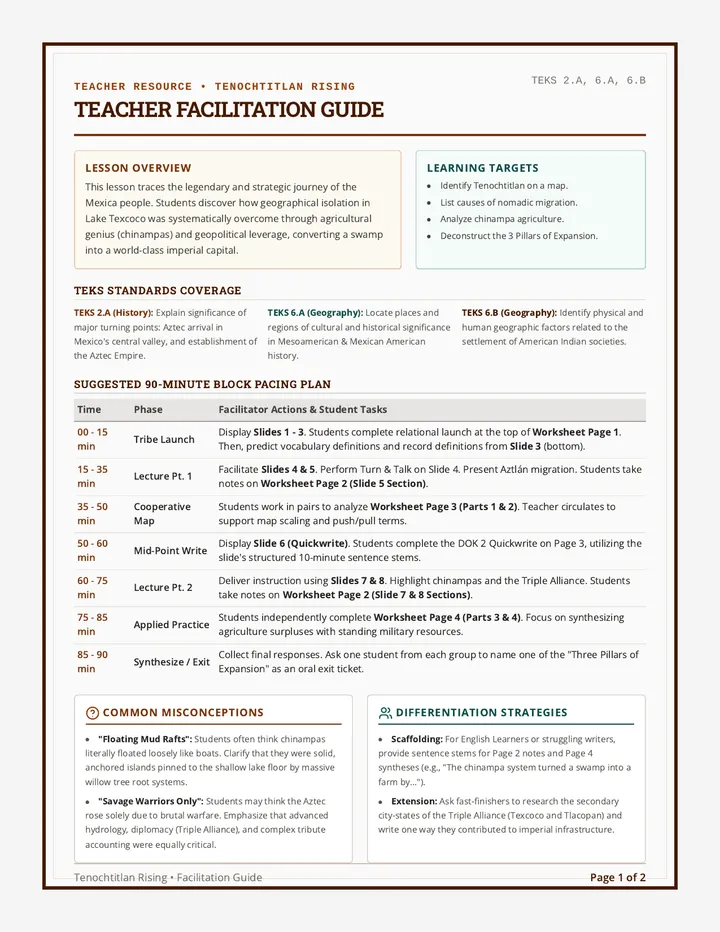
Dynamics of Development Teacher Guide Facilitation Guide
Dynamics of Development | Lesson 1
TEACHER ONLY
Instructional Focus
This lesson shifts students from a medical "disease" model to a developmental "pathway" model. The goal is to understand that a child's current clinical state is a snapshot in time of a long, branching developmental journey.
Learning Objectives
Define equifinality and multifinality.
Identify risk and resilience factors.
Apply the DP framework to a case study.
The Hook: Two Paths, One Start
Scenario to present
"Imagine two 6-year-old girls, Maya and Sophie. Both live in the same neighborhood and both lose their mother to a sudden illness within the same month. Two years later, Sophie is struggling with severe separation anxiety and school refusal. Maya is excelling in school and shows no clinical symptoms. Why? "
Discussion Prompts:
Internal Factors: What genetic or temperamental differences might exist? (Explore the "Orchid vs. Dandelion" child theory).
Environmental Buffers: What might have been present in Maya's life that Sophie lacked? (e.g., a supportive aunt, a stable school environment).
Defining Success: Is Maya's lack of symptoms "health," or could it be a different form of adaptation (e.g., parentification)?
Clinical Nuances
Equifinality Pitfall
Students often assume one cause = one disorder. Challenge them: "If three children have ADHD, why might their treatment plans need to look completely different based on their developmental history?"
Resilience Misconception
Clarify that resilience is not an internal trait. It's an interaction. A child isn't "tough"—the child has access to systems that support toughness.
Leo Case Analysis: Key Findings
Resilience Factors in Leo
Biological: High IQ, strong executive functioning (regulatory capacity).
External: Mentor/Coach relationship (the "one caring adult" rule).
Psychological: Verbal ability allows for better emotional processing.
Systemic: Academic success provides a "safe haven" and sense of mastery.
Risk Factors for the Brother
Shared Environment: Poverty, paternal incarceration, maternal depression.
ADHD Neurobiology Slides Neurodevelopmental Disorders
Focus and the Frontal Lobe
The Neurobiology of ADHD and Executive Dysfunction.
The Delay Hypothesis
ADHD is increasingly understood as a **delay** in cortical maturation, rather than a lack of structure.
Shaw et al. (2007) Findings:
Peak cortical thickness delayed by ~3 years.
Delay most prominent in the Prefrontal Cortex (PFC).
Prefrontal Cortex
"The CEO of the Brain"
Responsible for: Inhibition, working memory, planning, and emotional regulation.
Motor Cortex
In contrast, the motor cortex often matures **earlier** in ADHD children, contributing to hyperactivity.
Chemical Dynamics
ADHD involves dysregulation of **Dopamine** and **Norepinephrine** in the PFC and Basal Ganglia.
Dopamine (DA)
The "Reward" signal. Helps determine **priority** of stimuli. Low tonic DA leads to "stimulus seeking" to boost levels.
Norepinephrine (NE)
The "Alertness" signal. Increases the **signal-to-noise ratio** in the PFC, helping filter out distractions.
Stimulant Medication Goal: Return to the "Optimal Zone" (inverted-U function)
The EF Deficit Profile
Inhibition
The ability to stop an automatic response or resist interference.
Working Memory
Holding information "on line" while processing or manipulating it.
Shifting
Cognitive flexibility; moving fluidly between tasks or mental sets.
"ADHD is not a disorder of knowing; it is a disorder of doing (Barkley)."
Two Perspectives
Medical Model
Focus: Dysfunction & Deficit
Goal: Normalization & Treatment
Locus: Inside the brain/child
Neurodiversity
Focus: Variation & Adaptation
Goal: Accommodations & Support
Locus: Person-Environment Fit
Critical Reflection: Can they coexist?
Models of Difference Worksheet Models of Difference
Critical Analysis: ADHD & Neurodiversity
Doc ID: PSY-ADHD-ND-02
Patient/Subject: Student Analysis
1
The Medical vs. Neurodiversity Lens
Review the definitions provided in the lecture. In the table below, evaluate how each model would interpret the specific behavioral manifestations of ADHD.
Behavioral Manifestation Medical Model Interpretation Neurodiversity Perspective Hyperactivity / Fidgeting Hyperfocus (Flow state) Struggles with Linear Admin Tasks
2
Case Conceptualization & Ethical Implications
Q1: Clinical Labeling
Advocates for neurodiversity argue that ADHD is only a "disorder" because of its interaction with modern industrial environments (e.g., the 8-hour workday, rigid school seating).
If we removed these environmental pressures, does the biological delay in the PFC still constitute a "pathology"? Why or why not?
Q2: Ethical Intervention
Stimulant medication aims to normalize catecholamine levels to improve executive functioning. From a Neurodiversity standpoint, is pharmacological "normalization" a form of erasing individual difference?
How do you balance providing clinical relief for a struggling child with respecting their unique neurobiological profile?
"The orchid child hypothesis suggests that certain children are highly sensitive to their environment; in poor conditions they wither (disorder), but in ideal conditions they thrive more than 'dandelion' peers. How does this research influence your choice of model for ADHD?"
ADHD Neurobiology Teacher Guide Teacher Guidance
Lesson 2: Neurobiology & ADHD
GRADUATE LEVEL
MODULE 02 // NEURODEVELOPMENT
The Hook: fMRI Visual Comparison
Prompting the Visual Analysis:
Instruct students to visualize (or project) standard fMRI imaging showing a Go/No-Go task (inhibitory control).
Neurotypical Profile
Consistent activation in the right inferior frontal gyrus and dorsal anterior cingulate cortex.
ADHD Profile
Hypoactivation in the frontal regions; compensatory activation in the posterior regions (visual cortex).
Key Discussion Questions:
Efficiency: If the ADHD brain is using posterior regions to do a frontal job, what does that tell us about "cognitive effort" vs. "academic output"?
Inhibition: Why is the lack of activation more clinically significant than over-activation in these cases?
Diagnostic Validity: Can fMRI ever be a diagnostic tool for ADHD? (Lead them to: No, due to high individual variance—it's a research tool, not a clinical one).
Clinical Nuances
1. The "Barkley" Perspective
Emphasize Russell Barkley's core theory: ADHD is a disorder of self-regulation caused by inhibitory deficits. It's not that they "can't pay attention"—it's that they can't inhibit attention to irrelevant stimuli.
2. Catecholamine Balance
Use the Goldilocks Principle : Too little DA/NE leads to boredom/distractibility. Too much leads to anxiety/perseveration. Medication aims for the "Just Right" middle.
Worksheet Guide: Interpretation Key
Hyperfocus (Flow State)
Medical: "Perseveration; an inability to shift attention flexibly; a deficit in task-switching."
Neurodiversity: "A cognitive strength; deep immersion; the 'Superpower' of intense interest-based engagement."
Intervention Strategy
When students argue for the Neurodiversity model, push back with the "Impairment" criteria . In the DSM, symptoms must cause clinically significant impairment. If a child's "difference" prevents them from eating, sleeping, or maintaining safety, does the ND model still suffice, or is the Medical model necessary for life-saving intervention?
ASD Etiology Slides Autism Spectrum Disorder
The Spectrum Shift
Etiology, Phenotypes, and Dimensional Diagnosis
The DSM-5 Evolution
DSM-IV: Categorical
Autistic Disorder
Asperger's Disorder
PDD-NOS
Problem: Low diagnostic reliability; boundaries too blurry.
DSM-5: Dimensional
A single umbrella diagnosis: **ASD**
Defined by two core domains:
1. Social-Communication Deficits
2. Restricted/Repetitive Interests (RRBIs)
Plus: Severity Levels (1, 2, or 3)
The Camouflage Effect
Autism research has historically centered on male presentation. Girls and women often display a different **phenotype**.
Social Camouflaging:
Forcing eye contact despite discomfort
Mimicking social scripts from peers/TV
Suppressing repetitive behaviors (stimming) in public
Clinical Impact
1
Late diagnosis or misdiagnosis (Anxiety/ED)
2
Extreme "Autistic Burnout" from constant masking
3
Internalized distress vs. externalizing behavior
Complex Origins
Genetic Architecture
Highly heritable (60-90%). Primarily **polygenic**: hundreds of common small-effect genes combined with rare de novo mutations.
Synaptic Pruning
Hypothesis: Failure of typical synaptic pruning leads to "noisy" brain connectivity. Over-connectivity (local) vs Under-connectivity (long-range).
Enviro Factors
Advanced parental age, prenatal immune activation, and certain medications (e.g., valproate) are significant correlates.
NO evidence for "refrigerator mothers" or vaccines.
Differential Diagnosis:
ASD vs. Social Anxiety
How do we tell them apart in the clinical room?
Social Motivation
Reciprocity
RRBIs
Transition to: Clinical Matrix Activity
ASD Differential Diagnosis Worksheet Differential Diagnosis Matrix
ASD (Level 1) vs. Social Anxiety Disorder (SAD)
Clinical Diagnostic Series: 03-ASD
Distinguishing between ASD and Social Anxiety can be complex, as many individuals with ASD also experience anxiety. The key lies in the underlying mechanism and the history of social development .
1. Clinical Comparison Matrix
Clinical Feature ASD (Level 1) Social Anxiety Disorder Social Motivation Eye Contact Social "Faux Pas" Repetitive Behaviors / Stimming
2. Complex Case Scenario: Chloe (Age 15)
Chloe is referred for an evaluation due to "school refusal" and extreme anxiety in social settings. She reports that she "doesn't know what to say" to peers and feels like they are all following a script she wasn't given. Her parents note she has always been "particular" about her routines and spent her early childhood obsessively collecting and cataloging detailed information about marine biology.
In the clinical interview, Chloe makes eye contact, but it feels rigid and practiced. When she talks about her interests, she often misses the clinician's subtle cues to move on to a different topic.
Identify one piece of evidence for SAD and one piece for ASD from this vignette:
SAD Evidence:
ASD Evidence:
The "Camouflage" Inquiry: How might Chloe's gender be impacting her clinical presentation? How would you probe for "masking" in your follow-up interview?
Final Clinical Determination
Note: These are often comorbid. However, for treatment planning (e.g., Social Skills Training vs. Exposure Therapy), which diagnosis takes priority here? Explain your rationale.
ASD Phenotypes Teacher Guide Facilitator Notes
Lesson 3: ASD Etiology & Phenotypes
INSTRUCTOR FILE
Opening Discussion: The Masking Hook
"Ask the class: Have you ever been to a party where you didn't know anyone, and you spent the whole time mimicking how others were standing, what they were drinking, and how they were laughing just to fit in? Now imagine doing that every second of every day just to survive high school. "
Discussion Goals:
Evoke empathy for the cognitive load of social camouflaging.
Transition to why girls are often diagnosed 8-10 years later than boys.
Introduce the concept of "Autistic Burnout" as a result of sustained masking.
Clinical Research Brief
The "Female Protective Effect"
Some research suggests that females require a higher "mutational load" (more genetic risk) to manifest ASD symptoms than males. This implies that biological resilience in females might be masking underlying neurodivergence until environmental demands exceed coping capacity (e.g., during puberty).
Extreme Male Brain Theory (Critique)
Be prepared to discuss Baron-Cohen's theory (high systemizing, low empathizing). Critical point: Modern scholars critique this for reinforcing gender stereotypes and failing to account for the highly empathic (though overwhelmed) "Hyper-systemizers" found in female cohorts.
Matrix Key: ASD vs. SAD
Social Motivation
ASD: Often high motivation but low skill/reciprocity. May fail to initiate appropriately.
SAD: High motivation, but inhibited by fear of judgment. Skilled, but "frozen."
Repetitive Interests
ASD: Present and often used for self-regulation (RRBIs).
SAD: Absent. Interests are typically socially conventional.
The "Chloe" Debrief
Students should identify the marine biology obsession and routine particularity as strong ASD indicators. The "rigid and practiced" eye contact is a hallmark of masking. Chloe's "school refusal" is likely sensory/social overload , not just "fear of being judged" (though the two are now intertwined).
Rules and Risk Slides Externalizing Disorders
Rules and Risk
From Oppositional Defiance to Conduct Disorder: Navigating Behavioral Trajectories.
The Diagnostic Ladder
ODD
Oppositional Defiant Disorder
Angry/Irritable mood
Argumentative/Defiant behavior
Vindictiveness
Key: Does not involve violation of basic rights or major social norms.
Conduct Disorder (CD)
More Severe Trajectory
Aggression toward people/animals
Destruction of property
Deceitfulness or theft
Key: Repetitive and persistent pattern of violating societal norms/rights.
Callous-Unemotional (CU) Traits
A specific specifier in the DSM-5: **"With Limited Prosocial Emotions."**
The CU Profile:
Lack of remorse or guilt
Callous lack of empathy
Unconcerned about performance
Shallow or deficient affect
Why it matters:
Children with CU traits represent a distinct subgroup. They show **reduced physiological arousal** to others' distress and are less responsive to punishment.
Clinical Prediction: Stronger predictor of adult psychopathy and chronic offending.
The Patterson Coercive Cycle
Child's Action
Increased Aggression / Tanrum
Parent's Action
Parent gives in to stop the behavior
"Negative reinforcement trap: The child learns that aggression works, and the parent learns that giving in provides temporary peace."
Intervention Focus
Parent Management Training (PMT)
The gold standard. Focuses on breaking the coercive cycle through consistent discipline and positive reinforcement.
Multisystemic Therapy (MST)
Intensive, home-based intervention for severe CD. Addresses family, peer, and school systems simultaneously.
Primary Goal:
Stop the "Training for Criminality"
Coercive Cycle Mapping Worksheet The Coercive Cycle Map
Behavioral Analysis & Trajectory Planning
PSYCH-L4-EXT
1. Analyzing the "Negative Reinforcement Trap"
In the Patterson model, both the parent and the child are being reinforced for maladaptive behaviors. Identify the reinforcing consequence for each party in a typical oppositional encounter.
Reinforcement for Child:
Explain what the child gains by escalating...
Reinforcement for Parent:
Explain what the parent gains by giving in...
2. Step-by-Step Cycle Breakdown
Read the scenario: "A mother tells her 7-year-old son, Noah, to turn off the TV. Noah begins screaming and kicks the coffee table. The mother, wanting to avoid a full meltdown, says 'Fine, five more minutes,' and walks away."
Step 1: Directive
"Turn off the TV."
Step 2: Escalation
Step 3: Submission
Step 4: Outcome
3. Prosocial Emotions & Prognosis
Contrast: If Noah also exhibits "Callous-Unemotional" traits (Limited Prosocial Emotions), how does this change the likely success of a standard Parent Management Training (PMT) intervention?
Breaking the Cycle: Where is the most effective point to intervene in the cycle above? What specific behavior should the mother be coached to do instead of giving in?
Clinical Insight
"The parent isn't just raising a child; they are unintentionally training a professional in coercion."
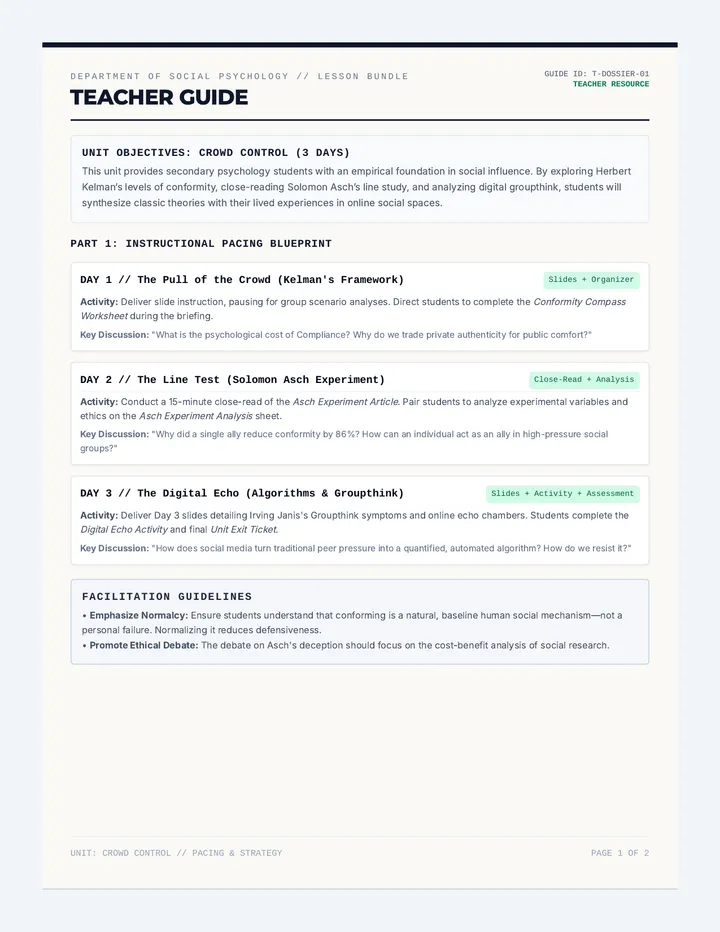
Rules and Risk Teacher Guide Simulation Script
Lesson 4: Externalizing Disorders
GRADUATE CLINICAL SIM
MODULE 04 // EXTERNALIZING
Role-Play: The Patterson Cycle
Facilitation Notes:
Select two students. Student A is the Parent (exhausted, stressed). Student B is the Child (oppositional).
Stage 1: The Directive
Parent: "Clean up your toys, we have to leave in 5 minutes."
Child: Ignores parent.
Stage 2: The Escalation
Parent: (Louder) "I said clean them up now!"
Child: (Screaming) "NO! I hate you! You're mean!"
The Critical Pivot (Submission)
"Parent: (Sighs, rubs temples) 'Fine. Just keep them out. I'm too tired to deal with this right now.'"
Post-Sim Debrief Questions:
Relief: Ask the "Parent" student: How did you feel the moment you gave in? (Identify the negative reinforcement—temporary relief from the screaming).
Learning: Ask the "Child" student: What did you learn about your parents' 'No'? (It means 'Keep pushing until I get a Yes').
Clinical Shift: How would this role-play look different if the child had Callous-Unemotional traits? (Likely less emotional screaming, more cold manipulation/threats).
Instructional Nuances
Targeting the specifier
Ensure students understand that ODD is often a prerequisite for CD, but CD *with* limited prosocial emotions has a distinct genetic and physiological profile (low heart rate, low skin conductance).
Effective Command Training
The intervention for the "Parent" student above is teaching "Alpha Commands" (Clear, direct, short) vs. "Beta Commands" (Vague, multiple directives, questions).