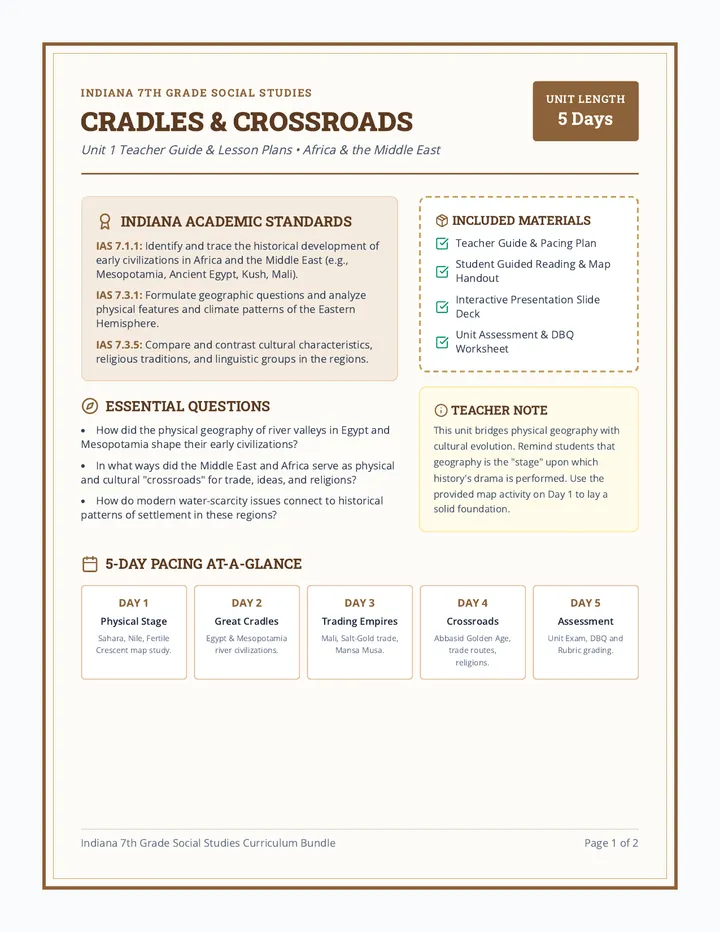
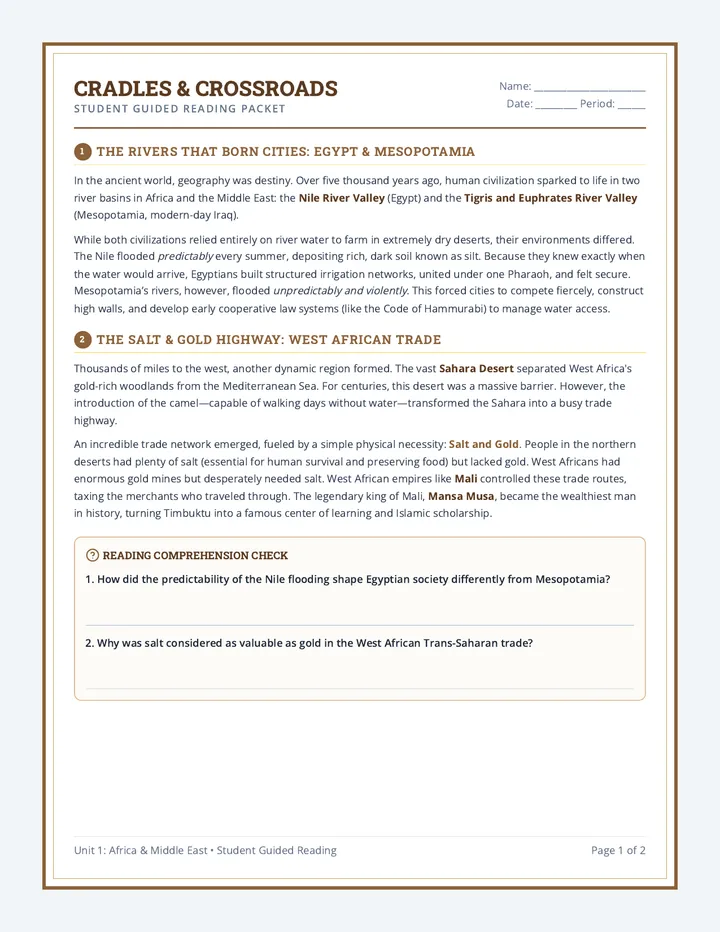
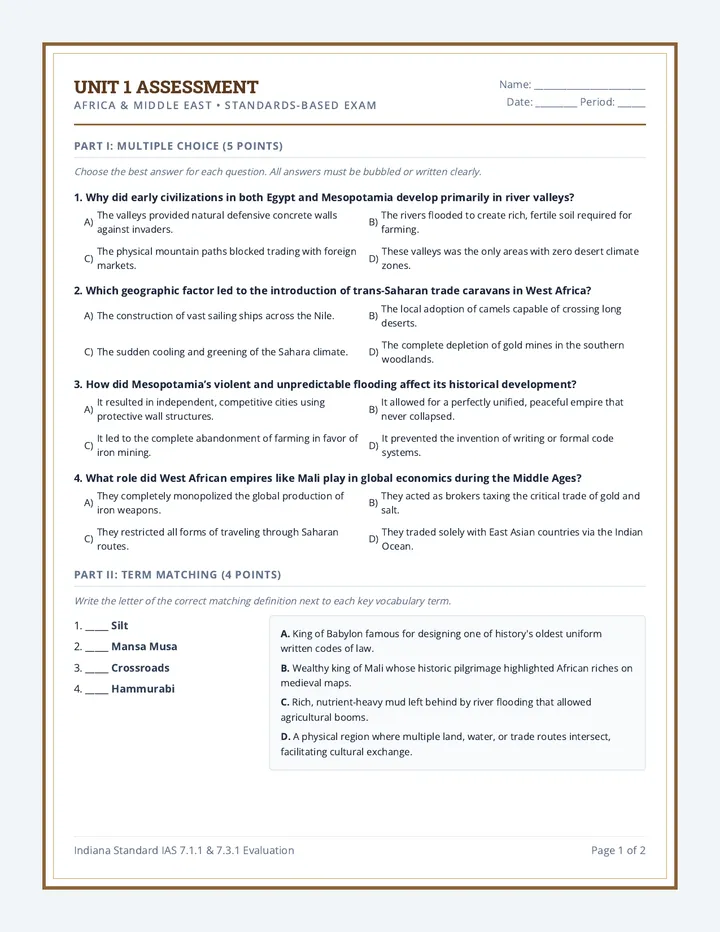
River Valley Roots Slides River Valley Roots
Geographic Determinism in the Ancient World
Geography
Society
Survival Challenge
"You have been dropped in a desert with a river. You must survive for the next 10 years."
Where do you build your shelter?
Where do you plant your crops?
Where do you build your walls?
Constraints:
The river floods every year. Sometimes it's a trickle, sometimes it's a torrent. The surrounding land is pure sand.
Discuss with your partner for 2 minutes.
Defining the Term
Geographic Determinism
The theory that the physical environment of a region (climate, terrain, water) determines its social, cultural, and political development.
The River
Source of life, silt, and destruction.
Natural Barriers
Desert, mountains, or open plains?
Climate
Predictable cycles vs. chaotic storms.
Mesopotamia
"The Land Between the Rivers"
Tigris & Euphrates
Unpredictable Flooding
Floods arrived without warning, washing away whole villages. The rivers often changed course, leaving cities stranded in the desert.
"The rivers are like angry gods that must be appeased." — Sumerian Proverb
Defense
Flat plains made Mesopotamia easy to invade. Constant war was the norm.
Culture
A gloomy, pessimistic view of life and the afterlife. Gods were seen as temperamental.
Egypt
"The Gift of the Nile"
The Nile River
Natural Barriers
Surrounded by vast deserts and the sea. Invaders had a hard time getting in.
Culture
Optimistic worldview. A cycle of life and death that mirrored the river.
Predictable Flooding
The Nile flooded at almost the same time every year. This "Gentle Flood" brought rich black silt (Kemet) for farming.
"The Nile has a soul, and it brings joy to the hearts of all men." — Egyptian Hymn
Comparative Inquiry
Feature Mesopotamia Egypt River Flooding Unpredictable, violent, destructive. Predictable, gentle, consistent. Geography Flat plains, no natural barriers. Desert and sea barriers. Social Outcome City-states, frequent conquest, pessimistic religion. Centralized empire, stability, optimistic religion.
How did the water dictate the power?
River Valley Analysis Worksheet River Valley Analysis
Investigating Origins of Civilization
Name:
Date:
Part 1: The Survival Challenge
"You have been dropped in a desert with a river. You must survive for the next 10 years."
Plan Your Settlement
Identify where you will build and why.
Shelter Location:
Farming Location:
Defense Strategy:
Settlement Sketch
Part 2: Comparative Inquiry
Based on the lesson and map data, complete the comparison table below.
Feature Mesopotamia Egypt River Characteristics Natural Barriers Social Outlook
Part 3: Critical Thinking
1. How did the predictability of the Nile's flooding affect the Egyptian's view of their gods compared to the Sumerians in Mesopotamia?
2. Predict: Why would a centralized, powerful government be more likely to emerge in Egypt than in the fragmented city-states of Mesopotamia?
Surplus and Status Slides Surplus & Status
The Birth of Social Hierarchy
Surplus
Specialization
Status
The Grain Game
The Scenario:
Your village has a harvest surplus. You have 10 extra bags of grain.
But... you don't have walls, you don't have tools, and you don't know the will of the gods.
The Problem:
Who gets the grain? The person who builds the wall? The person who prays for rain? Or the person who stored the grain?
The person who controls the surplus controls the society.
From Water to Wealth
Irrigation
Managing the river water.
Food Surplus
Growing more than you eat.
Specialization
New jobs (not farming).
Social Class
Hierarchy and power.
The Non-Farmers
If you don't have to grow food, what do you do?
Artisans
Making tools, pottery, and jewelry to trade.
Priests
Connecting the people to the gods for rain/safety.
Soldiers
Protecting the surplus from neighboring raiders.
Scribes
Tracking who owes what to the grain store.
The Architecture of Power
Rulers & Priests
Government Officials & Scribes
Artisans, Soldiers & Merchants
Farmers & Laborers
Control of the grain = Control of the pyramid.
Grain Game Simulation Activity The Grain Game
Simulation Role Cards & Instruction Sheet
How to Play
Step 1: Each student is assigned a role and receives their "Grain Inventory".
Step 2: You must trade your grain to meet your "Life Requirements" listed on your card.
Step 3: Negotiate with others to ensure you survive and thrive!
Teacher Note:
Assign the "King" role to only one student. Give them the most grain bags to represent control over the communal store.
Role Card
The Farmer
You produce the lifeblood of the civilization.
Inventory: 4 Bags of Grain
Needs: 1 Tool (Artisan), 1 Protection (Soldier), 1 Blessing (Priest).
Trading Strategy: You need the others to survive. Don't give away all your grain at once!
Role Card
The Soldier
You protect the grain stores from raiders.
Inventory: 1 Bronze Spear (Trade for food)
Needs: 3 Bags of Grain (Food), 1 Blessing (Priest).
Trading Strategy: Without you, the Farmer loses everything. Use your strength to negotiate high prices.
Role Card
The Priest
You speak to the gods to ensure the river floods gently.
Inventory: "Divine Favor" (Trade for food)
Needs: 4 Bags of Grain (Food), 1 Protection (Soldier).
Trading Strategy: Remind them that without the gods, the river will destroy their crops.
Role Card
The Lugal (King)
You control the city's central granary.
Inventory: 10 Bags of Grain (Taxed from farmers)
Goal: Hire 2 Soldiers and 1 Priest to maintain your power.
Trading Strategy: You have the most power because you have the most grain. Use it to keep the others loyal.
Grain Token Cutouts (Quantity: 20 per sheet) Surplus and Specialization Worksheet Surplus & Specialization
From Fields to Social Classes
Name:
Date:
Part 1: The Causal Chain
Explain how each development led to the next. What was the *reason* for the change?
Irrigation & Rivers
Explain how irrigation creates surplus...
Food Surplus
Explain how surplus leads to job specialization...
Job Specialization
Explain how specialization creates social hierarchy...
Part 2: The Social Pyramid
Label the levels of the social pyramid and identify one key responsibility for each group.
Part 3: Reflection
1. Based on the Grain Game, why did the "King" or "Lugal" have the most power even though they didn't produce the food?
2. Critical Thinking: How does having a surplus change a society's priorities from "survival" to "culture"?
The Justice Code Slides The Justice Code
Law, Order, and Hierarchy in Ancient Babylon
Justice
Codification
Power
Justice or Vengeance?
The Scenario:
"A person accidentally knocks down the wall of their neighbor's house while trying to fix their own roof."
What is a fair punishment today?
What would the punishment be in 1750 BCE?
Lex Talionis
"An eye for an eye, a tooth for a tooth."
Is "equal harm" the same thing as "justice"? Why or why not?
The First Public Law
7-Foot Tall Basalt Stele
Who was Hammurabi?
The 6th King of the First Babylonian Dynasty. He claimed the gods gave him the right to rule and enforce justice.
Why a stone monument?
Public visibility (no excuses).
Permanence (cannot be changed).
Divine authority (shows the King with a God).
Inequality by Design
Hammurabi’s Code did NOT treat everyone equally. Punishments depended on your social class and gender.
Awilu
Free-born Elites
Mushkenu
Commoners
Wardu
Enslaved People
"If a man put out the eye of another man, his eye shall be put out. If he put out the eye of a commoner... he shall pay one gold mina."
Why codify law?
Stability
Prevents blood feuds and constant revenge between families.
Social Control
Reinforces the social hierarchy and keeps the powerful in power.
"The law was written to protect the weak from the strong... as long as the weak knew their place."
The Justice Code Primary Source Analysis The Code of Hammurabi
Primary Source Analysis
Name:
Date:
Historical Context
Hammurabi ruled the Babylonian Empire from roughly 1792 to 1750 BCE. He ordered 282 laws to be carved into a massive black stone (a stele) and placed in a public square. This was one of the first times laws were written down and made permanent for everyone to see.
Selected Laws
Law 8:
"If any one steal cattle or sheep, or an ass, or a pig or a goat, if it belong to a god or to the court, the thief shall pay thirtyfold; if they belonged to a freed man of the king he shall pay tenfold; if the thief has nothing with which to pay he shall be put to death."
Law 196 & 199:
196: "If a man put out the eye of another man, his eye shall be put out."
199: "If he put out the eye of a man’s slave, or break the bone of a man’s slave, he shall pay one-half of its value."
Law 202 & 205:
202: "If any one strike the body of a man higher in rank than he, he shall receive sixty blows with an ox-whip in public."
205: "If the slave of a freed man strike the body of a freed man, his ear shall be cut off."
Analysis Questions
1. Class Distinctions: Compare Laws 196 and 199. How does the punishment change based on the victim’s social status? What does this tell you about the value of different human lives in Babylon?
2. Property vs. Life: Look at Law 8. Why do you think stealing from a "god" or the "court" results in a higher fine (30x) than stealing from a common person (10x)? Who is the law really protecting?
3. The Power of Writing: Why was it so important for Hammurabi to have these laws carved in stone and placed in public? How would this help him maintain control over his empire?
Monuments of Might Slides Monuments of Might
The Architecture of Absolute Power
Construction
Authority
Labor
Visual Communication
"If you are a regular person in the year 2500 BCE, and you see a mountain of stone built by your King, what do you think?"
Implicit Messages:
"My King is closer to the Gods than I am."
"My King can control thousands of workers."
"Our society is rich enough to build for the dead."
The Ziggurat
"Mountain of God"
Structure
Terraced step pyramid built of mud-brick. A temple sat at the very top.
Function
A spiritual and administrative center. Used as a "waiting room" for the gods.
Centrality
Located at the center of the city-state. It was the visual anchor that reminded everyone who was in charge: the Priests and the King.
The Great Pyramid
"The House of Eternity"
Continuity
Unlike Ziggurats, Pyramids were primarily tombs. They ensured the Pharaoh's power continued into the afterlife, maintaining Ma'at (order) forever.
Scale
Built of massive limestone blocks. The Great Pyramid was the tallest building on Earth for 3,800 years.
Organization
Required a massive bureaucracy to feed, house, and pay thousands of seasonal laborers.
Monuments as Evidence
Monument Main Message State Power Ziggurat "The Gods live here in the center of our city." Centralized religion and administrative control. Pyramid "Our King is a God and will rule for eternity." Massive labor organization and centralized economy.
What happens when the King's "might" is carved in stone?
Monumental Math Worksheet Monumental Math
Calculating the Cost of Absolute Power
Name:
Date:
"Building a monument isn't just about stone and mud; it's about people, time, and food. To build big, a King must be able to control every part of his society."
Challenge 1: The Labor of Egypt
The Data:
Total Blocks: 2,300,000 stones
Construction Time: 20 years
Working Days: 7,300 days (approx.)
1. Rate of Work: Divide the total blocks by the total days. How many stones had to be set in place every single day for 20 years?
Answer:
stones per day
2. Logistics: If each block weighs 2.5 tons, and it takes a team of 20 men to pull one block, how many teams would be needed to move 10 blocks at the same time?
Show your work:
Challenge 2: The Mud of Mesopotamia
The Ziggurat of Ur was made of millions of mud-bricks. Unlike Egyptian stone, mud-bricks decay and need constant repair.
State Resource Control:
To build this, the King needed to control the water (for mud) and the surplus grain (to pay the workers).
The Reflection Problem:
If the crops fail one year due to unpredictable flooding, what happens to the construction of the Ziggurat? Why would this be a "political disaster" for the King?
The Power Equation
How do these monuments prove that Egypt and Mesopotamia were centralized societies rather than just small groups of farmers living near each other?
Final Thought
"Architecture is the physical shadow of political authority."
The Scribes Ledger Slides The Scribe's Ledger
Writing as a Tool of State Power
Accounting
Bureaucracy
Memory
Memory vs. Records
The Problem:
"Farmer A gave 5 bags of grain in Spring.
Merchant B traded 3 cows for 10 bags in Summer.
Priest C took 2 bags for the temple in Fall."
Who owes what? How much is left in the granary? What if the King asks tomorrow?
The Solution:
Writing did not start with poetry or stories. It started with receipts and taxes .
"The first writers were accountants, not poets."
Mesopotamia: Cuneiform
"Wedge-Shaped"
The Medium
Written on wet clay with a reed stylus. Once dried, the record was permanent.
Evolution
Pictograms (pictures of cows) → Ideograms (symbols for ideas) → Phonograms (symbols for sounds).
Visual of Clay Tablet
Egypt: Hieroglyphs
"Sacred Carvings"
Visual of Papyrus Scroll
The Medium
Written with ink on papyrus (reeds from the Nile). Portable, long-lasting, and easier to store than clay.
Access
Highly complex. Only professional Scribes could read and write. Knowledge was kept within the elite class.
Knowledge is Power
Status
Scribes were near the top of the social pyramid. They didn't farm, fight, or build. They managed the state.
Exemption
In many societies, Scribes were exempt from taxes and manual labor. Their minds were their service.
"Be a scribe! Your limbs will be sleek, your hands will be soft... and you will be the one who issues commands."
— Egyptian Satire of the Trades
Scribe Accounting Challenge Worksheet The Scribe's Challenge
Accounting for the Empire
Name:
Date:
The Transaction List
You are the Chief Scribe of Ur. You must record the following taxes and trades for the King's records:
12 Bags of Barley from Farmer Enki
4 Lapis Lazuli stones from Merchant Ishtar
3 Oxen from the Temple Herd
8 Bronze Plows for the Royal Fields
Step 1: Invent Your Script
Invent 4 simple symbols for the items above. Then, record the transactions on the "Clay Tablet" below using your symbols and numbers.
Barley Symbol
Stone Symbol
Oxen Symbol
Plow Symbol
Your Clay Tablet
Critical Analysis
1. Why is a symbolic script (like your invented symbols) more efficient for trade and taxes than writing out full sentences like "Farmer Enki brought twelve bags of barley to the city store today"?
2. How does the invention of writing change the balance of power? Who becomes more powerful once records can be kept permanently, and who might lose power?
Historical Synthesis:
"The state is not just a group of people; it is a system of information. Without writing, an empire can only be as large as the King's memory. With writing, it can be eternal."
Civilization Origins Synthesis Project The Artifact of Power
Sequence Synthesis Assessment
Ancient History
Summative Project
The Challenge
You have explored how geography, surplus, and law created the first hierarchies. Now, you must design a physical or digital artifact that represents the power of a River Valley Civilization. Your artifact must demonstrate how the environment led to social stratification.
Geography
Surplus
Hierarchy
Artifact Requirements
1
Environmental Roots
How does your artifact reflect the specific river valley it came from? (e.g., mud-brick for Mesopotamia, limestone/papyrus for Egypt).
2
The Social Link
Your artifact must contain a Social Pyramid showing who has power and why (who controls the surplus?).
3
The Power Mechanism
Include either a written law (Hammurabi-style) or an administrative record (Scribe-style) that justifies the King's authority.
Grading Rubric
Criterion Mastery (4) Developing (2) Causal Chain Clearly explains link from Geography → Surplus → Status. Mentions factors but doesn't explain the causal link. Historical Evidence Uses specific evidence from Hammurabi, Scribes, or Monuments. Historical details are vague or missing. Visual Clarity Artifact is polished and effectively communicates social hierarchy. Visuals are disorganized or confusing.
Initial Proposal (Teacher Signature Required)
Artifact Idea:
Region:
(Egypt or Mesopotamia)
How will it show power?