Planet Magnet Slides Planet Magnet
How the Earth Guides Our Way
Lost at Sea!
Imagine it is the year 1400. You are in the middle of the Atlantic Ocean. There are no landmarks, no stars visible through the clouds, and definitely no GPS.
"How do you know which way is North?"
A Giant Hidden Magnet
Deep inside Earth is a core of liquid **iron and nickel**. As Earth spins, this liquid metal moves, creating a massive magnetic field that stretches into space.
NORTH POLE
SOUTH POLE
N
S
How a Compass Works
The Needle
The needle is a small magnet that can spin freely.
The Pull
The needle's "North" end is attracted to Earth's magnetic North.
Alignment
No matter where you turn, the needle stays pointing North!
Lab Mission: The Water Compass
We are going to turn a regular sewing needle into a compass using the power of attraction!
MATERIALS
PROCEDURE
OBSERVE
Compass Quest Lab Sheet Compass Quest
LAB INVESTIGATION: BUILDING A WATER COMPASS
Name:
Date:
THE MISSION
Early explorers used Earth's magnetic field to navigate the open seas. Today, you will build a functional water compass using a needle and a magnet to find North in your classroom.
EQUIPMENT CHECKLIST
Sewing Needle
Bar Magnet
Small piece of cork or foam
Bowl of water
FLIGHT PLAN
Rub the magnet along the needle in one direction 50 times.
Push the needle carefully through the center of the cork.
Float the cork in the center of the water bowl.
Wait for the needle to stop moving. Which way is it pointing?
OBSERVATION DECK
Draw your water compass below. Label the needle, the cork, and the direction it points (North/South).
1. Why did we have to rub the magnet against the needle before floating it?
2. If you spin the bowl of water, what happens to the needle? Why?
3. How does this experiment prove that Earth has a magnetic field?
Gravity Defiers Slides Gravity Defiers
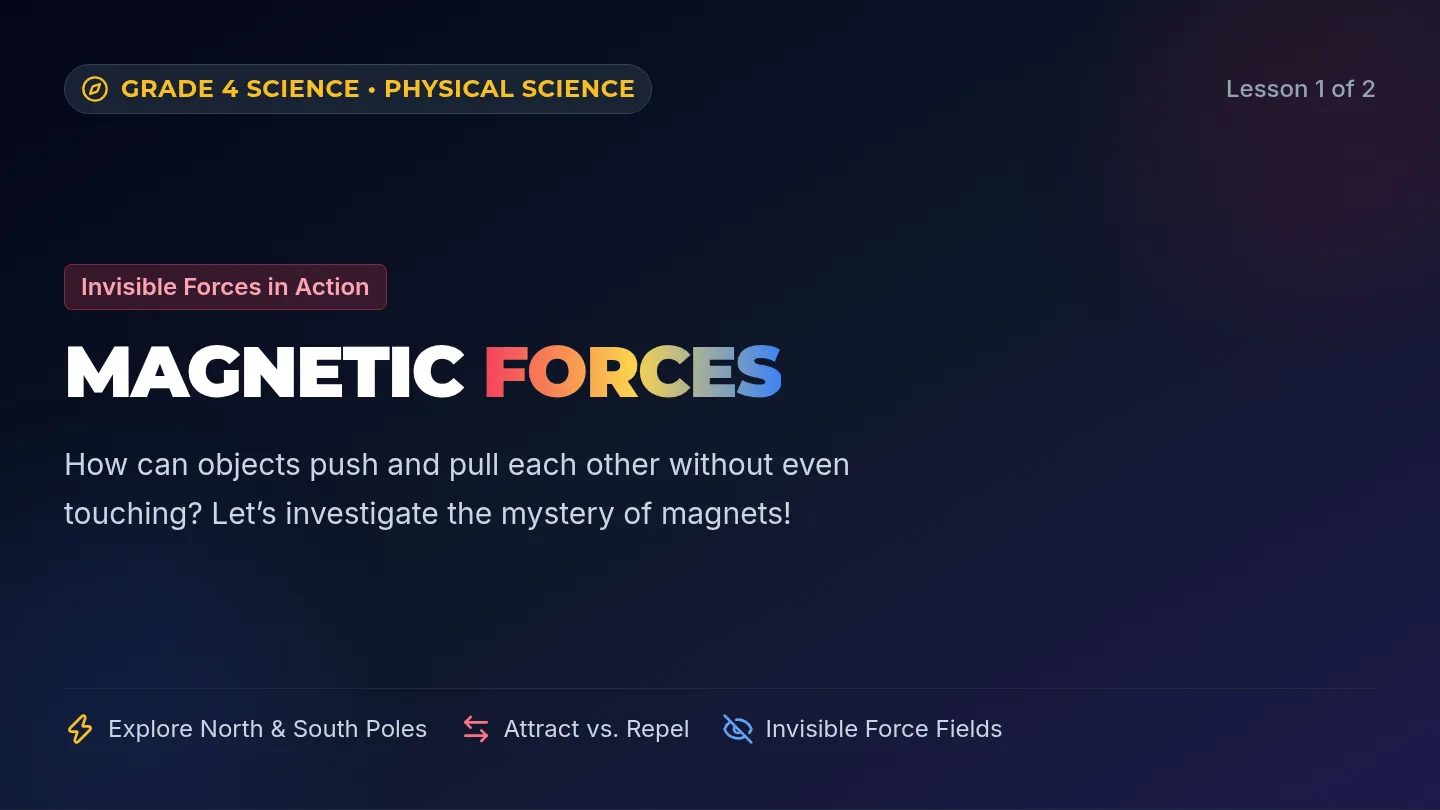
The Power of Repulsion
Can we make things float?
Maglev Trains
Imagine a train that **never touches the ground.**
No wheels. No tracks. Just magnets and air.
The Secret: Repulsion.
The Push Force
N
S
REPEL
S
N
When two of the **SAME** poles face each other, they push apart with incredible force!
The Speed Killer
What slows down a normal car or train?
FRICTION
Friction is the resistance created when two surfaces rub together. It creates heat and wastes energy!
Why Levitate?
INSANE SPEED
Without friction, trains can travel over 370 mph!
TOTAL SILENCE
No wheels means no grinding or clattering on tracks.
ENERGY SMART
Less force is needed to keep the train moving.
Hover Lab Investigation Hover Lab
Investigation: Defying Gravity
Engineer:
Station:
Scientific Inquiry
"How many grams of 'cargo' can a magnetic field hold before levitation fails?"
LAB SETUP
Place ring magnets on a pencil so they repel each other. Measure the gap!
Hypothesis
If I add more weight to the top magnet, then the gap will...
CARGO TESTING DATA
Test # Cargo Added (Washers/Paperclips) Levitation Gap (mm) 1 2 3 4
Post-Mission Debrief
1. What happened to the levitation gap as you added more weight? Why?
2. What was the "Breaking Point"? (The weight that finally closed the gap completely)
ENGINEERING CONNECTION
Real Maglev trains have to carry thousands of passengers. Based on your lab, how do you think engineers solve the problem of heavy weight?
Maglev Models Slides Maglev Models
Phase 3: Prototype & Test
The Engineering Hurdles
STABILITY
How do we stop the train from falling off the side of the track?
PROPULSION
How do we make the train move forward without wheels?
Lateral Stability
Maglev trains use **Guidance Magnets** on the sides of the track to "hug" the train and keep it centered.
REPEL SIDES
STAY ON TRACK
TRAIN
Moving Forward
By rapidly switching the poles of electromagnets in the track, the train is constantly **pulled from the front** and **pushed from the back**.
S
N
S
N
Push - Pull Action
Build & Refine
01
BLUEPRINT
Sketch your magnet layout on the track template.
02
PROTOTYPE
Build your model using magnetic strips and foam.
03
STRESS TEST
Can your train glide without hitting the walls?
Track Engineering Packet Engineering Division
Track Blueprint
PROJECT: MAGLEV PROTOTYPE v1.0
Lead Engineer
Team ID
Top-Down Layout
North Pole
South Pole
Scale: 1 square = 1 cm
Draw where you will place your magnetic strips on the track and the bottom of your train car.
Stress Test Results
Stability
Did the train wobble or fall off?
Solid
Wobbly
Levitation Gap
How high did it float?
mm
Propulsion
How far did it travel?
cm
Engineering Iteration
Engineers never get it right the first time. What is ONE change you will make to your layout for Version 2.0 to improve stability?
Motor Makers Slides Motor Makers
Magnetic Spin
Change the Motion
LINEAR (Maglev)
Pushing and pulling in a straight line.
ROTATIONAL (Motors)
Pushing and pulling in a circle.
The Chase
Inside a motor, magnets are arranged in a circle. One magnet is "chasing" the other!
"North chases South, but just as it gets close, the poles switch!"
ROTOR
The Switcher
To keep the rotor spinning, we need magnets that can **change their poles** instantly.
Electromagnets
Magnets created by electricity. Turn the power off, the magnetism dies. Flip the current, the poles flip!
Hidden Motors
Fans
EVs
Drills
Laundry
Appliance Anatomy Worksheet Appliance Anatomy
Field Guide: Household Motors
Technician:
Serial #:
4th-MOTOR-UNIT
Observation Mission
Magnets are hidden inside almost everything that plugs into a wall or uses a battery. Your job is to find them!
Section 1: The Hairdryer Schematic
A
Fan Blades
B
Magnetic Motor
A hairdryer works by spinning fan blades at high speed. Where does that spinning motion come from?
What would happen if we took the magnets out of the hairdryer?
The Energy Chain
Fill in the missing words to complete the energy conversion story.
Electricity
Motion
Hint 1 Electric current flows into coils of wire to create a temporary magnet.
Hint 2 The temporary magnet is either pushed or pulled by permanent magnets inside.
Section 3: Home Motor Hunt
Pick one electronic device in your house. In the space below, draw the device and draw an "X" where you think the motor is hidden.
Sketch area
Appliance Name:
Evidence of Motion:
(Does it spin? Vibrate? Blow air?)
Future Transit Slides The City Council Vote
Deciding the Future of Magnetics
PROPOSAL #452
The Transit Crisis
Our city's population is EXPLODING. Traffic is a nightmare.
We need a new way to move 50,000 people a day across the city. We have two choices, but we only have money for **one**.
"As a member of the City Council, your vote will change our city forever."
Option A: The Iron Rail
OLD RELIABLE
THE PROS
• Much cheaper to build
• Uses existing tracks
• Reliable in all weather
THE CONS
• Slower (Max 120 mph)
• High friction = Loud noise
• Parts wear out quickly
Option B: The Maglev
THE FUTURE
THE PROS
• Insanely fast (300+ mph)
• Zero friction = Whisper quiet
• Very little maintenance
THE CONS
• **VERY** expensive to build
• Needs totally new tracks
• Uses a lot of electricity
Your Mission
Use your **City Council Guide** to prepare a 30-second speech. You must convince the Mayor to choose your side!
TEAM MAGLEV
Focus on Speed & Tech
TEAM RAIL
Focus on Cost & Reliability
City Council Debate Guide Debate Guide
City Council: Proposal #452 (New Transit Line)
Council Member
Assigned Position
Team MAGLEV
Team TRADITIONAL RAIL
Goal
Your goal is to convince the Mayor that your transportation system is the best use of the city's money and will help the most citizens.
Building Your Case
Claim: Why is your system the best choice?
I believe the city should build the ________ because...
Reason 1 (Speed/Efficiency)
Reason 2 (Cost/Reliability)
Anticipating the Opposition
What will the other side say is the **biggest problem** with your plan? How will you prove them wrong using science or facts?
Their Attack:
Your Defense:
Opening Statement
Prepare your 30-second speech below.
Magnetic Motion Teacher Guide Magnetic Motion
Teacher Facilitation & Answer Key
4th Grade Science / Physics
Unit Strategy
This unit transitions students from understanding Earth's natural magnetism to engineering complex transportation systems. Each lesson builds on the last: from Alignment (Lesson 1) to Repulsion (Lesson 2), Stability (Lesson 3), Rotation (Lesson 4), and finally Evaluation (Lesson 5).
Key Vocabulary
• Magnetic Field
• Repulsion / Attraction
• Friction
• Maglev (Levitation)
• Electromagnet
Lesson 1: Planet Magnet
Teaching Tip
Ensure needles are rubbed in ONE direction (not back and forth) to align magnetic domains.
Answer Key (Lab)
Q1: To align the atoms in the metal. Q2: It stays pointing North (Earth's pull is stronger than the water's friction).
Lesson 2: Gravity Defiers
Teaching Tip
Use strong neodymium ring magnets for the best visual "hover" effect on pencils.
Answer Key (Lab)
The gap decreases as weight increases because gravity is fighting the magnetic repulsion force.
Lesson 3: Maglev Models
Teaching Tip
Students often struggle with "tipping." Remind them that guidance magnets must repel the sides of the track.
Engineering Goal
Achieve at least 5cm of glide with zero contact between the train bottom and track floor.
Lesson 4: Motor Makers
Teaching Tip
Use a "Battery + Wire + Magnet" simple motor (Homopolar) demonstration to show rotation in real-time.
Answer Key (Schematic)
Energy Chain: Electricity -> Magnetism -> Motion. Without magnets, the motor wouldn't spin.
Lesson 5: Future Transit Debate
Teaching Tip
Focus on "Evidence-Based" claims. Students must use speed or cost data to support their side.
Assessment Rubric
4pts: Strong claim + 2 scientific reasons. 3pts: Claim + 1 reason. 2pts: Claim only.
Avoid These Pitfalls
"Earth's Core is a Solid Magnet": It is actually liquid motion creating the field. It is a "Geodynamo," not a permanent bar magnet.
"Maglev uses Attraction": While some systems do use "EMS" (attraction), most classroom models use repulsion (EDS) as it's easier to demonstrate.