Mixture Showdown Worksheet TEKS 4.6(B) Matter & Its Properties
Mixture vs. Solution Showdown
Science Lab Notes
Name:
Date:
Team:
Simple Mixture
Two or more ingredients mixed together. Each part keeps its own properties (shape, color, taste). You can still see the separate parts and take them apart easily!
Special Mixture: Solution
A special mixture where one ingredient dissolves (breaks into tiny, invisible pieces) and spreads evenly in a liquid. It looks the same throughout!
1 Compare Features: Clue Sorting Organizer
Pick clues from the box below
Science Clue Bank:
Parts spread out evenly Can be separated You can see the separate parts Made of 2 or more ingredients Separated by evaporating the liquid Physical mix (no new substance made) One ingredient dissolves completely Separated with hands, strainer, or filter
ONLY Simple Mixtures (Things that don't dissolve)
Write 2 clues that belong only to simple mixtures:
BOTH Share (True for mixtures & solutions)
Write 2 traits that both of them share:
ONLY Solutions (Dissolved mixtures)
Write 2 clues that belong only to solutions:
2 Think Like a Scientist: The Golden Rule
“All solutions are mixtures, but not all mixtures are solutions.”
TRUE / FALSE
Why is this true? Explain why lemonade is both a mixture and a solution, but trail mix is not a solution:
TEKS 4.6(B) • Mixture vs. Solution Showdown • Page 1 of 2 Turn over to classify everyday samples
Classify Everyday Samples & Separation Lab
TEKS 4.6(B): Test and identify mixtures vs. solutions
Page 2 of 2
3 Classify Everyday Samples
Check the box, give your clue, and name how to separate it!
Everyday Sample
What is it?
How do you know? (Clue)
Separation Tool
1. Trail Mix Peanuts, raisins, chocolate candies
Mixture Solution
2. Ocean Saltwater Salt stirred into clear water
Mixture Solution
3. Fresh Fruit Salad Cut strawberries, grapes, melon
Mixture Solution
4. Sweet Lemonade Sugar and lemon juice stirred in water
Mixture Solution
5. Sand & Water Sand stirred into water (sinks to bottom)
Mixture Solution
6. Clear Apple Juice Natural fruit sugars dissolved evenly
Mixture Solution
4 Separation Challenge: The Mystery Beaker Spill
Lab Mishap: Someone accidentally dumped sand , table salt , and water into the same glass beaker! Your mission: write a 2-step plan to get all three ingredients back separately.
Step 1: Trap the Sand
What tool will catch the sand? (filter paper, screen, strainer)
What liquid pours through into the new cup?
Step 2: Collect the Dry Salt
Why won't a paper filter catch the salt?
What method (using heat or the sun) leaves dry salt behind?
TEKS 4.6(B) • Physical Science Lab Record • Page 2 of 2 Mixtures & Solutions Investigation
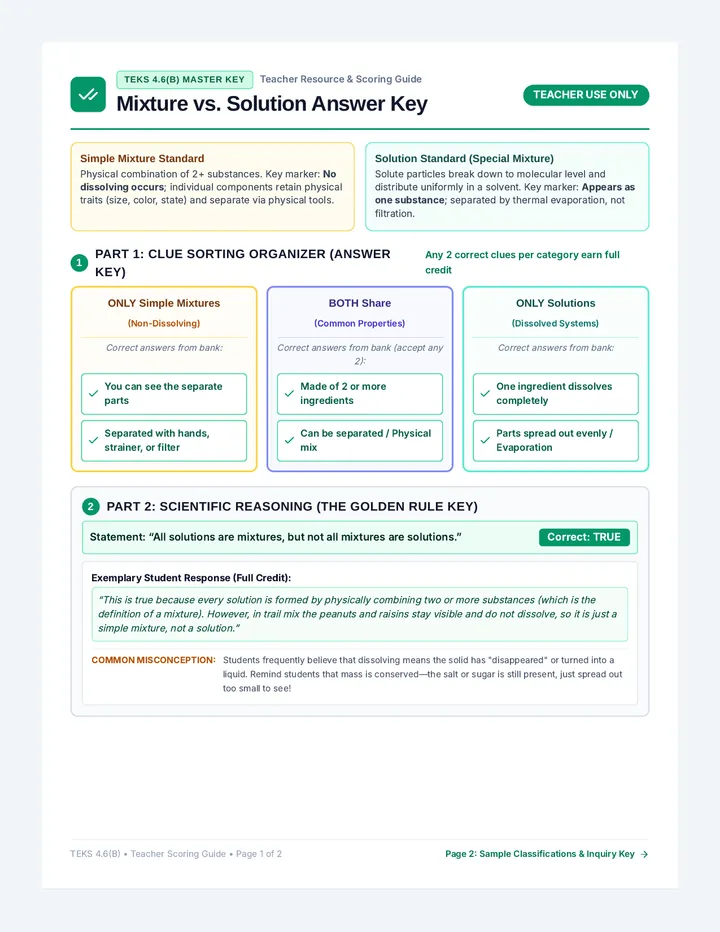
Mixture Showdown Answer Key TEKS 4.6(B) Master Key Teacher Resource & Scoring Guide
Mixture vs. Solution Answer Key
TEACHER USE ONLY
Simple Mixture Standard
Physical combination of 2+ substances. Key marker: No dissolving occurs ; individual components retain physical traits (size, color, state) and separate via physical tools.
Solution Standard (Special Mixture)
Solute particles break down to molecular level and distribute uniformly in a solvent. Key marker: Appears as one substance ; separated by thermal evaporation, not filtration.
1 Part 1: Clue Sorting Organizer (Answer Key)
Any 2 correct clues per category earn full credit
ONLY Simple Mixtures (Non-Dissolving)
Correct answers from bank:
You can see the separate parts
Separated with hands, strainer, or filter
BOTH Share (Common Properties)
Correct answers from bank (accept any 2):
Made of 2 or more ingredients
Can be separated / Physical mix
ONLY Solutions (Dissolved Systems)
Correct answers from bank:
One ingredient dissolves completely
Parts spread out evenly / Evaporation
2 Part 2: Scientific Reasoning (The Golden Rule Key)
Statement: “All solutions are mixtures, but not all mixtures are solutions.” Correct: TRUE
Exemplary Student Response (Full Credit):
“This is true because every solution is formed by physically combining two or more substances (which is the definition of a mixture). However, in trail mix the peanuts and raisins stay visible and do not dissolve, so it is just a simple mixture, not a solution.”
Common Misconception: Students frequently believe that dissolving means the solid has "disappeared" or turned into a liquid. Remind students that mass is conserved—the salt or sugar is still present, just spread out too small to see!
TEKS 4.6(B) • Teacher Scoring Guide • Page 1 of 2 Page 2: Sample Classifications & Inquiry Key
Classification & Separation Lab Answer Key
Complete solutions and scoring guidance for Page 2
Page 2 of 2
3 Part 3: Everyday Sample Classification Master Key
1 pt each: Type, Evidence, Separation
Sample
Correct Type
Expected Student Evidence
Valid Separation Method
1. Trail Mix
Mixture
Parts keep shape; easily seen; didn't dissolve
Hands, tongs, or sorting by size
2. Ocean Saltwater
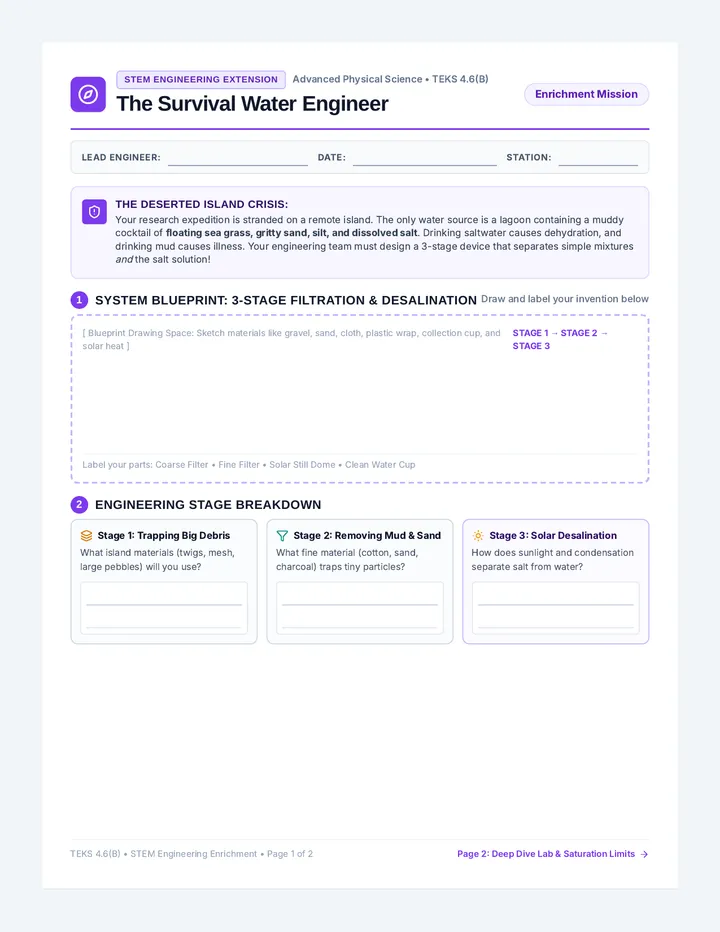
Mixture Engineer Enrichment Activity STEM Engineering Extension Advanced Physical Science • TEKS 4.6(B)
The Survival Water Engineer
Enrichment Mission
Lead Engineer:
Date:
Station:
The Deserted Island Crisis:
Your research expedition is stranded on a remote island. The only water source is a lagoon containing a muddy cocktail of floating sea grass, gritty sand, silt, and dissolved salt . Drinking saltwater causes dehydration, and drinking mud causes illness. Your engineering team must design a 3-stage device that separates simple mixtures and the salt solution!
1 System Blueprint: 3-Stage Filtration & Desalination
Draw and label your invention below
[ Blueprint Drawing Space: Sketch materials like gravel, sand, cloth, plastic wrap, collection cup, and solar heat ] Stage 1 → Stage 2 → Stage 3
Label your parts: Coarse Filter • Fine Filter • Solar Still Dome • Clean Water Cup
2 Engineering Stage Breakdown
Stage 1: Trapping Big Debris
What island materials (twigs, mesh, large pebbles) will you use?
Stage 2: Removing Mud & Sand
What fine material (cotton, sand, charcoal) traps tiny particles?
Stage 3: Solar Desalination
How does sunlight and condensation separate salt from water?
TEKS 4.6(B) • STEM Engineering Enrichment • Page 1 of 2 Page 2: Deep Dive Lab & Saturation Limits
Deep Dive Science: Saturation & Beyond Liquids
Exploring the limits of dissolving and unexpected solutions
Page 2 of 2
3 The Breaking Point: Saturation Investigation
Deep Concept
When you stir sugar into water, it dissolves. But what happens if you keep adding more and more spoonfuls? Eventually, the water cannot hold any more sugar, and extra crystals pile up at the bottom! Scientists call this a saturated solution .
A. Temperature & Dissolving:
Will hot tea or ice cold tea hold more dissolved sugar before reaching its saturation point? Why?
B. The Mystery Pile:
If undissolved sugar is sitting at the bottom of a saturated glass, is the whole cup a solution, a simple mixture, or both? Explain:
4 Mind-Blowing Science: Solutions That Aren't Liquids!
Did you know?
Most kids think solutions are only liquids. But scientists classify any evenly blended physical mixture as a solution—even gases and solids!
Air: A Solution of Gases
Earth's air is 78% Nitrogen gas mixed evenly with Oxygen, Carbon Dioxide, and Argon.