Social Contract Slides Modern Social Contract
Evaluating the invisible agreement between the citizen and the state.
Lesson 01
Civics & Government
The Safety Algorithm
"If a government algorithm could prevent 100% of violent crimes but required total, real-time surveillance of your phone and private communications, would you agree to the terms?"
I Accept
I Decline
The Architects of the Contract
Thomas Hobbes
"Life is nasty, brutish, and short."
Humans are naturally selfish and violent.
We need a strong leader (Leviathan) to keep order.
John Locke
"Natural Rights: Life, Liberty, Property."
Humans are reasonable and cooperative.
Government exists solely to protect rights; if it fails, rebel.
J.J. Rousseau
"Man is born free, and everywhere he is in chains."
The "General Will" is the ultimate authority.
Citizens must participate directly in the collective good.
Modern Trading Cards
How much liberty are we trading for these "benefits"?
Biometric Data
Face ID for borders and airports. Faster travel vs. permanent government database of your identity.
Public Health
Mandatory vaccination or quarantines. Collective safety vs. bodily autonomy.
Predictive Policing
Patrolling neighborhoods based on algorithms. Efficiency vs. racial profiling and due process.
Digital Content
Moderating "harmful" speech online. Civil discourse vs. government-defined censorship.
The Citizen's Audit
Take your worksheet and analyze a modern case study. Are you getting a fair deal from the State?
Contract Compromise Teacher Guide Contract Compromise
Teacher Discussion & Facilitation Guide
Unit: Liberty & Loyalty
Lesson 1: The Social Contract
Instructional Focus
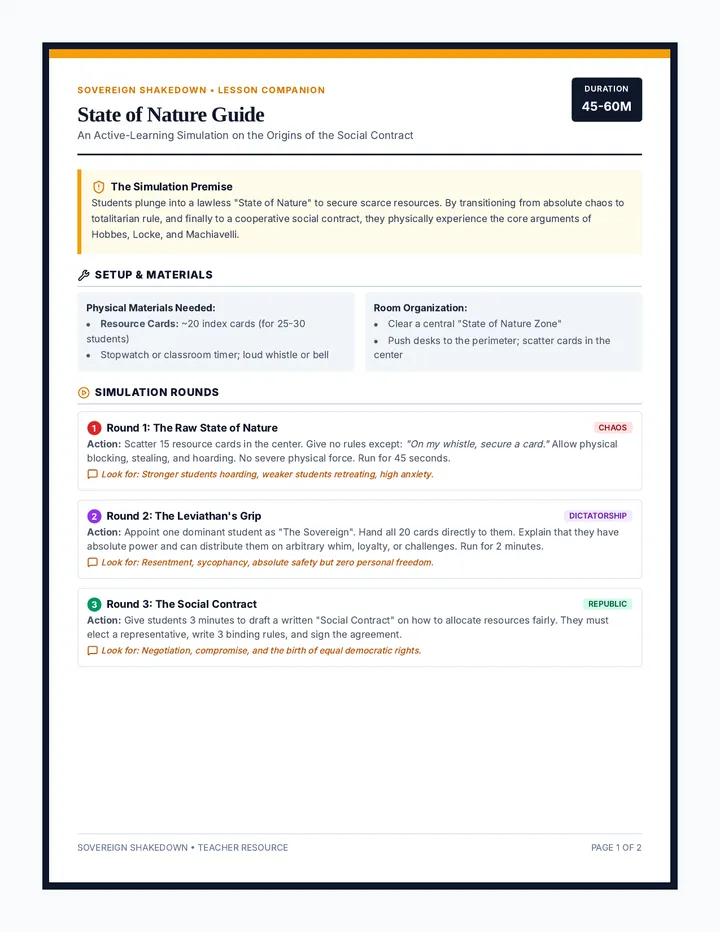
This lesson moves students from abstract enlightenment philosophy to concrete 21st-century dilemmas. The goal is for students to recognize that the "Social Contract" isn't a historical artifact, but a living, breathing negotiation they participate in every time they use a smartphone or walk past a security camera.
Essential Question:
At what point does the obligation to the community override the rights of the individual?
Target Skills
Philosophical Application
Comparative Analysis
Ethical Reasoning
Socratic Discussion Framework
Phase 1: The State of Nature (Opening)
Goal: Establish the stakes of having no government.
If there were no laws starting tomorrow, what is the first thing you would do to protect yourself?
Hobbes says humans are "monsters" to each other without a King. Is he being realistic or pessimistic?
Phase 2: The Digital Exchange (Modern Application)
Goal: Connect philosophical trade-offs to modern life.
You "sign" a contract every time you click "I Agree" on Terms of Service. Is this a legitimate social contract if you don't read it?
If the government can stop a terror attack by reading everyone's private DMs, has the contract changed from "protecting rights" (Locke) to "enforcing order" (Hobbes)?
Phase 3: The Right to Breach (Conclusion)
Goal: Identify the limits of government power.
Locke says we can rebel if the government fails us. In 2026, what does a "failed" contract look like?
Can a citizen "opt-out" of the social contract while still living in the country?
Case Study Crib Sheet
Scenario: Contact Tracing
During a pandemic, the state tracks GPS data to slow the virus.
Hobbesian view: Necessary for survival.
Lockean view: Overreach of property/privacy rights unless strictly temporary.
Scenario: TSA Scanning
Full-body scans at airports.
Rousseau view: A "General Will" decision for collective travel safety.
Individualist view: Violation of dignity for questionable security gains.
Trading Liberty Worksheet Trading Liberty
Student Audit: The Modern Social Contract
Name:
Date:
Part 1: Philosophical Alignment
Briefly summarize how each philosopher would view the role of the State in one sentence.
Hobbes (Order)
Locke (Rights)
Rousseau (General Will)
Part 2: The Liberty Audit
Choose ONE modern scenario (Surveillance, Public Health Mandates, or AI Moderation). Analyze the trade-offs.
My Chosen Scenario:
The Protection (Benefit)
What does the state provide me in this exchange?
The Liberty (Price)
What freedom do I give up or compromise?
Part 3: The Verdict
Is this a "Fair Contract"? Why or why not? Use the reasoning of at least one philosopher from Part 1 to justify your answer. Duty Calls Slides Duty Calls
The non-negotiable price of a functioning democracy.
Lesson 02
Mandatory Obligations
Official Summons
"You are hereby commanded to appear for Jury Service at the County Courthouse..."
Failure to appear may result in fines or imprisonment.
Can you get out of it?
Today, we simulate Voir Dire—the process of selecting a jury for a high-profile case.
Justice is blind (but selected carefully)
The Dual Pillars
Jury Duty
Direct participation in the 6th Amendment right to a fair trial.
Peer judgment (not government only)
Community representation
Taxation
The financial fuel for the "general welfare" promised in the Preamble.
Infrastructure & Public Safety
Education & Social Services
Vocabulary of Justice
Voir Dire
"To speak the truth." The preliminary examination of a juror by a judge or counsel.
For Cause
Removing a juror because they have an actual bias or connection to the case.
Peremptory
Removing a juror without giving a reason. (Limited number per side).
"Is a fair trial even possible if the jury is 'manufactured'?"
Audit Your Community
We are going to track exactly where $1.00 of your property tax goes in our city. You might be surprised what you're paying for.
Jury Selection Simulation Guide The Mock Voir Dire
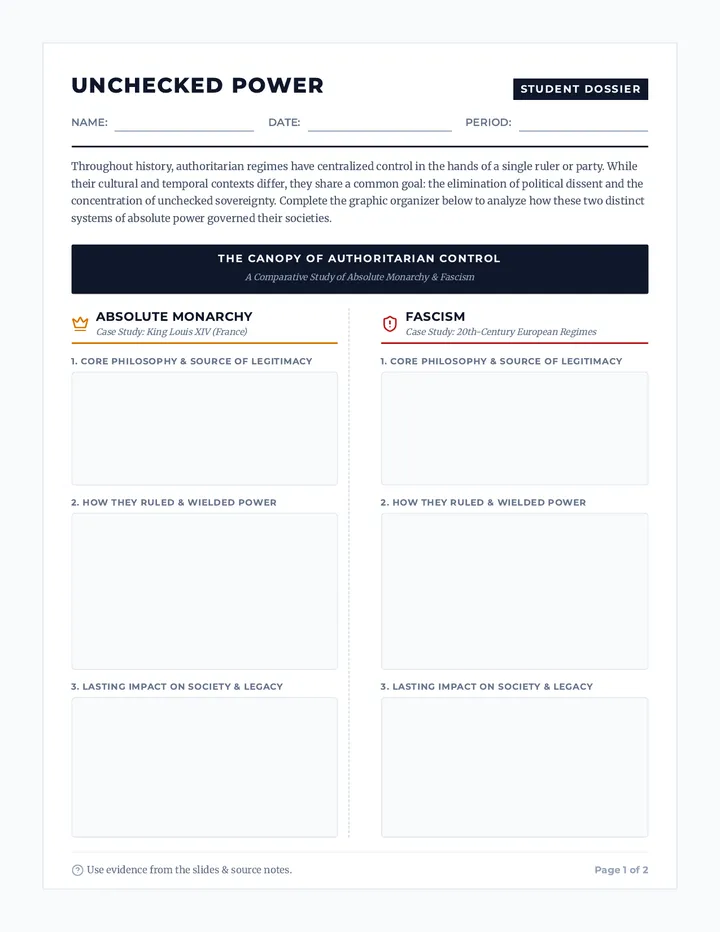
Teacher Guide & Simulation Script
Simulation Setup
Roles:
1 Judge (Teacher)
2 Prosecution Attorneys
2 Defense Attorneys
12-15 Jurors (Rest of Class)
The Case:
State vs. Logan. A high-profile case involving a popular local athlete accused of a hit-and-run after a championship game.
Simulation Script & Prompts
Phase 1: General Screening (Judge)
"Does anyone here personally know the defendant, Alex Logan, or anyone in the Logan family? Does anyone work for the local high school athletic department?"
Logic: Establishes 'For Cause' removal immediately.
Phase 2: Adversarial Questioning (Attorneys)
Prosecution Goal:
Find people who are 'law and order' focused. Ask: "Do you believe a person's status in the community should ever influence how the law applies to them?"
Defense Goal:
Find people who are skeptical of authority. Ask: "Have you or a loved one ever had a negative interaction with the police that changed your view of the justice system?"
Phase 3: The Peremptory Strike
Allow each team 2 'Peremptory Strikes'. They can remove anyone without explanation. Afterward, ask the removed students how it felt to be 'rejected' for no reason. Connect this to the civic duty of service—is it still a duty if the state can reject your participation?
Debrief & Critical Thinking
1. If everyone "avoids" jury duty, what happens to the demographic makeup of juries? Who is left to serve?
2. In our simulation, did we create a jury that was "impartial," or just a jury that both sides could "live with"? What's the difference?
3. Should we move to a professional jury system (paid employees) instead of citizens? What are the dangers of that?
Civic Receipt Activity Civic Receipt
Mandatory Duty Audit: Taxation & Services
Summons ID: #CIV-2026-DUTY
Date: ________ / ________ / 2026
1
Where does the dollar go?
Based on our local county budget data, break down how ONE DOLLAR ($1.00) of local property tax is spent. Shade the boxes to represent the percentage.
Public Schools
48¢
Police & Fire
22¢
Parks & Roads
15¢
Debt & Admin
15¢
The Value Proposition
In 2-3 sentences, identify one service listed above that you use daily. If taxes were made "voluntary," how would that service realistically be funded or maintained?
2
The Moral Summons
Imagine you are summoned for jury duty. You have a job that doesn't pay for "jury days," and you have to pay for parking at the courthouse. It will cost you money to serve.
Should the state compel you to serve even if it causes personal financial hardship? Why?
If the law only required people who "volunteered" for jury duty to serve, what kind of people do you think would make up our juries? Would they be representative of the community?
Analyze the risk of a "volunteer-only" jury:
"Taxes are what we pay for civilized society." — Oliver Wendell Holmes Jr.
Ballot Box Slides The Ballot Box
Right, privilege, or mandatory obligation?
Lesson 03
Ethical Governance
The Fine
$20 AUD
The cost of staying home on Election Day in Australia.
Compulsory Voting
Australia consistently sees 90%+ voter turnout. In the US, a "good" turnout for a local election is often below 25%.
"If you are forced to vote, is it still a 'free' choice?"
Who Speaks for the Absent?
The Cycle of Apathy
Low turnout leads to policies that don't reflect the youth or marginalized groups, leading back to even lower turnout.
Concentrated Power
In local elections, a few hundred votes might decide $100M budgets for schools or police.
Voter Turnout by Age (US Average)
18-24 Year Olds~48%
65+ Year Olds~74%
Whose priorities will a politician listen to first?
Barriers to the Box
Historical Suppression
• Poll Taxes & Literacy Tests (Jim Crow)
• Gerrymandering (Diluting votes)
• Voter ID laws (Modern debate)
Integrity Measures
• Signature verification
• Voter roll maintenance
• Paper trail requirements
When does a "security measure" become a "barrier to entry"?
The Ethics Audit
Analyze our own precinct. If 75% of your neighbors stay home, is the winner truly representative of your community?
Compulsory Voting Debate Guide Compulsory Voting
Debate & Facilitation Guide
Teacher Resource
The Core Conflict
This lesson asks students to reconcile the right to vote with the duty to participate. If a democracy depends on the consent of the governed, does that consent exist if only a small fraction of the governed speak?
The Case FOR Mandatory Voting
1. Legitimacy: Governments would have a true mandate from the majority, not just the "loudest" few.
2. Modernization: It would force the state to make voting extremely easy (weekends, holidays, online).
3. Civic Habit: Like jury duty or taxes, it reinforces the "social contract" daily.
The Case AGAINST Mandatory Voting
1. Free Speech: The right to speak includes the right to remain silent (abstain).
2. Quality of Choice: Forced voters might "donkey vote" (pick names at random), diluting informed choices.
3. Penalty Equity: Fines disproportionately affect the poor; it becomes a "tax on the marginalized."
Socratic Probes
If 20% of people vote and candidate X wins with 11% of the total population's support, is that candidate a legitimate leader?
Should we have a "None of the Above" option on every ballot to protect the right to dissent?
Does the government have the right to punish you for "not being interested" in politics?
Guiding the Data Audit
During the student activity, emphasize that Turnout Disparity is a form of power imbalance. If 18-24 year olds voted at the same rate as 65+ year olds, what specific issues (student loans, climate change, housing) might look different today?
Check: Local Precinct Totals
Check: Voter Registration Deadlines
Voter Turnout Audit Worksheet The Turnout Audit
Data Interpretation & Ethical Analysis
Voter ID:
Precinct:
I. The Statistics of Silence
Analyze the following hypothetical data from a typical mid-sized American city's local election. Then answer the interpretation questions below.
Demographic Group Registered Voters Actual Turnout Turnout % Youth (18-25) 12,000 2,160 18% Professionals (35-50) 18,500 8,325 45% Retirees (65+) 14,200 10,224 72%
Analysis: Power Disparity
Based on this data, if a candidate is running for Mayor, which group's concerns (e.g., property tax vs. education funding) are they most likely to prioritize in their platform? Explain why.
Analysis: The Mandate
The winning candidate received 51% of the actual votes cast. Calculate what percentage of the TOTAL registered voters actually voted for the winner. Does this feel like a "mandate"?
II. The Compulsory Compromise
If you were tasked with designing a "Mandatory Voting" policy for the US, how would you address these two challenges?
1. The Penalty
What should the penalty be for not voting? (Fine, community service, loss of tax rebate?) How do you ensure it is fair to all income levels?
2. The "None of the Above" Option
Should there be a "right to abstain" on the ballot itself? If "None of the Above" wins an election, what should happen next?
Principled Protest Slides DISSENT
Principled Protest
When the highest law is your conscience.
Lesson 04
Civil Disobedience
"Is breaking the law ever the most patriotic thing a citizen can do?"
Henry David Thoreau
Refused taxes for war.
Rosa Parks
Refused to give up a seat.
Mahatma Gandhi
Salt March against empire.
All three were "criminals" under the law of their time. Are they heroes today?
What makes it "Civil"?
The Requirements
Non-Violence
Action must be peaceful to distinguish it from rebellion or riot.
Publicity
Done in the open to appeal to the community's sense of justice.
Accepting Punishment
Willingness to go to jail shows respect for the existence of law while opposing a specific law.
"An individual who breaks a law that conscience tells him is unjust, and who willingly accepts the penalty of imprisonment... is in reality expressing the highest respect for law."
— Dr. Martin Luther King Jr.
Criminality or Civil Disobedience?
Case A: Environmental
Activists chain themselves to logging equipment to stop a forest from being cleared.
01
Case B: Whistleblowing
An employee leaks classified documents showing illegal government spying.
02
Case C: Property Damage
Protesters smash windows of a bank to protest corporate greed.
03
Which of these meet MLK's criteria? Which do not?
The Moral Compass
Take your framework worksheet. You are the judge: determine the difference between a riot and a revolution.
Dissent Framework Teacher Guide Dissent Framework
Teacher Guide & Case Key
Ethical Reasoning
Teaching Dissent
This lesson is sensitive. The goal is not to encourage law-breaking, but to analyze the philosophical tradition of civil disobedience as a "stress test" for democracy. We distinguish between ordinary crime (done for personal gain or malice) and civil disobedience (done for the improvement of the social contract).
The MLK / Rawls Framework
Pillar 1: Conscientious
The law being broken must be truly "unjust" (violates human dignity or natural rights).
Pillar 2: Non-Violent
Violence suggests a breakdown of the social contract entirely; civil disobedience seeks to fix it.
Pillar 3: Public
Secrecy implies guilt; publicity implies a message meant for the public conscience.
Pillar 4: Punishment
By accepting the penalty, the citizen affirms the overall authority of the legal system.
Case Discussion Guide
Scenario 1: Suffragettes (Window Smashing)
Did they meet the criteria?
Teacher Note: Often failed the "non-violent" pillar in some branches, but were highly public and accepted punishment. Debate: Is property damage "violence" in this context?
Scenario 2: Edward Snowden
Did he meet the criteria?
Teacher Note: Failed "publicity" (initially) and "punishment" (fled). Debate: Is fleeing necessary when the punishment is life in prison/death? Does that change the "civil" nature?
Scenario 3: Rosa Parks
Did she meet the criteria?
Teacher Note: The "Perfect Case." Entirely non-violent, public, conscientiously opposed to dignity violation, and accepted arrest.
"One who breaks an unjust law must do so submissively, lovingly, and with a willingness to accept the penalty." — Gandhi
Patriotic Law Breaking Worksheet Breaking the Law
Student Inquiry: The Limits of Obedience
Name:
Date:
I. The 4 Pillars Checklist
According to the theories of Thoreau and King, an act is only "Civil Disobedience" if it checks these four boxes. Define each in your own words.
1. Just Cause
2. Non-Violence
3. Public Visibility
4. Acceptance of Penalty
II. The Case Analysis
Choose a modern protest movement or a specific individual (e.g., climate activists, 2nd Amendment protesters, a whistleblower). Audit their actions against the 4 pillars.
Movement/Person:
Analysis: Does it qualify?
The Verdict
If this act fails even one of the 4 pillars, is it "criminal" or "revolutionary"? Justify your stance based on the Social Contract (Lesson 1).
III. Synthesis
Can a "good citizen" break the law? How does breaking a law potentially improve the community for everyone else?
Charter Workshop Slides Charter Workshop
Designing the perfect balance of liberty and loyalty.
Lesson 05
Capstone Project
Terra Nova
You have been granted a charter for a new, self-governing community. You have a population of 5,000 diverse citizens.
Your task: Write the Code of Obligations.
Project Parameters
Define 5 Guaranteed Rights
Define 3 Mandatory Duties
Establish a Dispute Process
The Civic Equilibrium
Individual Rights
What "Natural Rights" (Locke) are so important that the community can never infringe on them?
Privacy Speech Property Bodily Autonomy
Social Obligations
What must the citizen "give back" (Rousseau) to ensure the community survives?
Taxation National Service Voting Education
"Too much liberty leads to chaos; too much duty leads to tyranny. Where is your center?"
The Safety Valve
Your Charter must include a section on Principled Dissent. If a citizen believes your community's law is unjust, what is their recourse?
Legal Appeal
A court system to challenge laws.
Referendum
Direct vote by the citizens to repeal.
Protected Protest
Rules for civil disobedience.
Founders' Forum
At the end of the workshop, you will "pitch" your Charter to the class. We will vote on which community we would actually want to live in.
Charter Evaluation Rubric Guide Charter Evaluation
Teacher Assessment Rubric & Facilitation Guide
Final Capstone
Instructional Objective
Students will synthesize their learning from the entire "Liberty & Loyalty" sequence to create a cohesive governing document. They must prove they understand the trade-offs of the social contract, the necessity of civic duties, and the role of dissent in a healthy society.
Grading Rubric
Criteria Advanced (4) Proficient (3) Developing (2) Philosophical Foundation Explicitly cites Locke/Hobbes/Rousseau in justifications. Mentions social contract concepts without naming authors. Lacks clear philosophical reasoning. Rights/Duties Balance Duties directly support the rights (e.g., taxes fund rights enforcement). List of rights and duties is logical but disconnected. List is random or entirely one-sided. Dissent Framework Includes clear, multi-step process for principled dissent. Mentions right to protest or appeal without process details. No mechanism for changing or challenging laws. Synthesis & Presentation Document is cohesive, professional, and logically structured. Document is complete but lacks thematic unity. Fragmented or incomplete ideas.
Workshop Strategy
The "Stress Test"
During group work, walk around and pose a crisis: "Your community has been hit by a virus. Does your Charter allow for mandatory quarantine? If so, which 'Guaranteed Right' is temporarily suspended?"
Peer Voting
Create a "Visa Application" where students write which hypothetical community they would move to based on the charters presented. They must explain why that specific balance of duty/right appealed to them.
Founding Charter Template Charter of Terra Nova
Founded ________ 2026 Ratified by: __________________________
I. Philosophical Foundation
State the core belief of your community. Are you more Lockean (Protecting rights) or Hobbesian (Maintaining security)? Justify your stance.
"We, the founders, believe that the primary purpose of our State is to..."
II. Guaranteed Rights
The Non-Negotiables
III. Mandatory Duties
The Social Cost
Duty Alpha:
Duty Beta:
Duty Gamma:
IV. Clause of Dissent
When a citizen believes a law is unjust, what is the specific civil process for them to object? (Reference MLK's pillars from Lesson 4).