Philosophical Foundations Slides Lecture Series: Foundations of Psych
Philosophical Precursors
"I think, therefore I am." — "No man's knowledge here can go beyond his experience."
Rationalism vs. Empiricism
The Persistent Paradox
If the mind is immaterial (thoughts, feelings) and the body is material (neurons, chemicals), how do they interact?
"How can a physical event (a stubbed toe) cause a mental event (pain)? How can a mental event (the will to walk) cause a physical event (leg movement)?"
The Ghost in the Machine
Does modern neuroscience solve this, or just map it?
Rationalism: Rene Descartes
The Way of Reason
Innate Ideas
Descartes argued that certain truths (God, the Self, Geometry) are inborn. We do not learn them through the senses; we discover them through logic.
Dualism
The soul (res cogitans) and body (res extensa) are distinct substances. He famously suggested the pineal gland as the meeting point.
"Cogito, ergo sum."
The foundation of certainty
Empiricism: Locke & Hume
The Way of Experience
Tabula Rasa
John Locke (1632-1704)
The mind at birth is a "white paper, void of all characters." All knowledge comes from Sensation and Reflection.
The Bundle Theory
David Hume (1711-1776)
The "self" is just a collection of fleeting perceptions. There is no core "soul," only a stream of impressions.
Observation is King
If it can't be observed, it shouldn't be part of science.
Associationism
Complex ideas are just simple ideas linked together by experience.
The Philosophical Impasse
Why Philosophy wasn't enough for Psychology
The Problem of Subjectivity
How do we prove who is right? Locke says experience, Descartes says reason. Without data, it's just a battle of arguments.
The Need for Measurement
Philosophers debated the *nature* of the mind, but psychologists wanted to measure the *workings* of the mind.
Next Step: 1879 — The Laboratory
Philosophical Foundations Handout The Pre-Scientific Mind
Primary Source Analysis: Rationalism vs. Empiricism
Psychology 101: History & Systems
Name: ________________
Date: ________________
Instructions
Before psychology became a lab-based science, it was a branch of philosophy. The following excerpts represent the two dominant schools of thought that psychologists had to reconcile. Read each passage carefully, underline key claims, and answer the analysis questions.
SOURCE A
René Descartes, Meditations on First Philosophy (1641)
"I am a thing that thinks... What is a thing that thinks? It is a thing which doubts, understands, [conceives], affirms, denies, wills, refuses, which also imagines and feels... Although I have a body with which I am very closely conjoined... it is certain that I (that is, my soul, by which I am what I am), is entirely and truly distinct from my body, and may exist without it."
Concept focus
Dualism: The radical separation of mind and matter.
1. Based on this text, what is the defining characteristic of the "Self" for Descartes?
SOURCE B
John Locke, An Essay Concerning Human Understanding (1689)
"Let us then suppose the mind to be, as we say, white paper, void of all characters, without any ideas:—How comes it to be furnished? To this I answer, in one word, from EXPERIENCE. In that all our knowledge is founded; and from that it ultimately derives itself."
Concept focus
Tabula Rasa: The mind as a blank slate shaped by the environment.
2. Locke uses the metaphor of "white paper." How does this view of the mind differ from Descartes' view of "innate" (inborn) ideas?
SOURCE C
David Hume, A Treatise of Human Nature (1739)
"I may venture to affirm... that [humans] are nothing but a bundle or collection of different perceptions, which succeed each other with an inconceivable rapidity, and are in a perpetual flux and movement... The mind is a kind of theatre, where several perceptions successively make their appearance."
Concept focus
Bundle Theory: The denial of a unified, permanent self.
3. Hume describes the mind as a "theatre." If the mind is just a stream of perceptions, can it be studied "objectively" through reason alone?
Synthesis Question
Psychology was born out of the need to solve these disagreements. If you were Wilhelm Wundt in 1879, why would these philosophical debates make you want to open a laboratory?
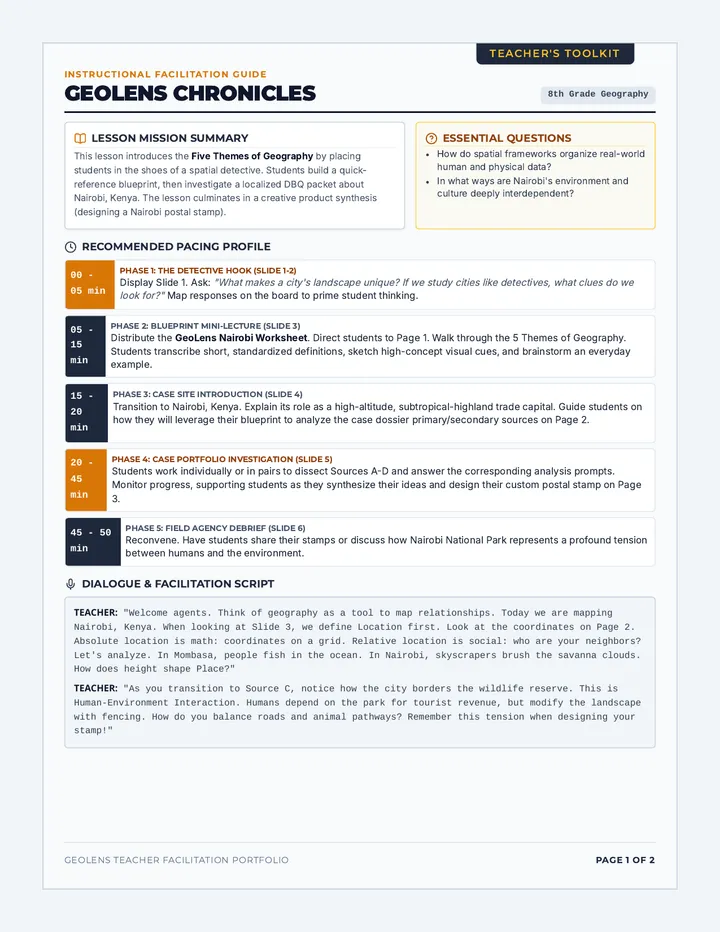
Philosophical Foundations Teacher Guide Teacher Facilitation Guide
Lesson 1: Philosophical Precursors
Duration
60-90 Minutes
Objective
Students will deconstruct the transition of psychology from philosophical speculation to empirical science. By analyzing the Rationalist (Descartes) and Empiricist (Locke/Hume) traditions, learners identify the methodological impasse that necessitated the laboratory revolution of 1879.
Key Materials
Philosophical Foundations Slides
Primary Source Handout
Whiteboard/Markers
The Hook: The Modern Paradox
Start the class with a thought experiment. Tell students: "Imagine we can perfectly map every neuron in your brain. We know exactly which chemical fires when you feel 'sadness.' Does that neural map become the sadness? Or is the experience of sadness something separate from the chemistry?"
Discussion Prompt:
"If I can see your brain, but I can't feel your pain, is psychology the study of the brain or the study of the feeling?"
Instructional Sequence
1
Lecture: The Great Debate (20 mins)
Use the Philosophical Foundations Slides to introduce Rationalism and Empiricism. Emphasize that this wasn't just "opinion"—these were competing theories on how we can know anything for certain.
Pro-Tip: Use the metaphor of a computer. Descartes thinks we are born with the "OS" already installed (Innate Ideas). Locke thinks we are a "hard drive" with zero data (Tabula Rasa).
2
Analysis: Reading the Roots (30 mins)
Distribute the Primary Source Handout . Have students read silently for 10 minutes, then work in pairs to answer the three analysis questions.
Circulate: Look for students struggling with Hume's "Bundle Theory." Many find the idea that there is "no self" distressing. Ask them: "If your memories were wiped, who are you?"
3
Seminar Discussion (15 mins)
Bring the class together to address the "Synthesis Question" at the bottom of the handout.
Why can't we just think our way to a solution?
What happens when two philosophers disagree and both have perfect logic?
Conclusion: We need a referee. That referee is Data.
Common Student Misconceptions
Dualism as Simple
Students often think Dualism is just "Soul vs. Body." Emphasize that for Descartes, this was a logical necessity to explain free will.
Empiricism as Science
Wundt and Structuralism Slides 1879: The Birth of Science
Wundt's Lab
The transition from the armchair to the apparatus. How Wilhelm Wundt measured the "atoms of the mind."
Structuralism & Introspection
Wilhelm Wundt (1832-1920)
Founded the first psychological laboratory at the University of Leipzig in 1879.
The Goal:
"To mark out a new domain of science."
He wanted to analyze the structure of the mind into its most basic components—just as a chemist analyzes water into H2O.
1879
The year psychology separated from philosophy and biology.
Primary Method
Introspection
Structuralism
Mental Chemistry
Objective
Identify the fundamental "atoms" of conscious experience (sensations, feelings, images).
Key Figure
Edward Titchener (Wundt's student) brought the system to the USA.
Constraint
Avoid the "Stimulus Error"—don't describe the object, describe the experience of the object.
Structuralists asked: WHAT are the components of the mind?
The Reaction Time Experiment
Wundt measured the time lag between a stimulus (hearing a ball hit a platform) and a response (pressing a key).
Two Conditions:
Simple Reaction: Press the key as soon as you hear the sound (0.1 seconds).
Apperception: Press the key as soon as you are conscious of perceiving the sound (0.2 seconds).
Discovery
Conscious awareness takes time. The mind can be measured.
The Problem with Introspection
Unreliability
Results varied too much between people. How can we have a science if two people experience the same light differently?
Subjectivity
There is no way to check if someone's report is true. It remains trapped inside the "black box" of the mind.
Psychology needed a method that was observable to everyone.
Introspection Lab Report University of Leipzig: Laboratory Report
Simulation: Structuralism & Trained Introspection
Psychology Laboratory 101
Name: ________________________
Phase 1: Avoiding the "Stimulus Error"
Instruction: Your instructor will provide a stimulus (e.g., a slice of lemon or a visual object). You must describe your conscious experience without using the name of the object or its common associations. Focus on the raw atoms: intensities, durations, qualities, and locations of sensation.
Primary Sensations (e.g., sharpness, brightness, pressure):
Affective Qualities (e.g., pleasantness, tension, excitement):
Phase 2: Mental Chronometry
Record the results of the class reaction time experiment. We are measuring the "time of apperception" (the time required for a perception to enter consciousness).
Condition Trial 1 (sec) Trial 2 (sec) Average Simple Reaction (Focus on the response) Apperception (Focus on the perception)
Calculate the difference (Apperception Average - Simple Reaction Average):
According to Wundt, what does this "leftover" time represent?
Critical Inquiry
1. How difficult was it to avoid the "stimulus error" in Phase 1? Why is this a problem for scientific replication?
2. If two students have wildly different descriptions of the same lemon, whose description is "correct"? How did this issue eventually lead to the downfall of Structuralism?
Wundt's Lab Teacher Guide Teacher Facilitation Guide
Lesson 2: Wundt's Laboratory
Duration
60-90 Minutes
Objective
Students will evaluate the rigors and limitations of Structuralism. By attempting to quantify consciousness through introspection and reaction-time experiments, they will discover why psychology eventually abandoned purely subjective reports.
Setup Required
Lemon slices (or any strong-smelling fruit)
Stopwatches (or phone timers)
Wundt's Lab Slides
Introspection Lab Reports
The Hook: The Lemon Challenge
Place a slice of lemon on each student's desk (or hold one up). Ask them to describe it. When they say "Yellow" or "Sour," stop them.
The Rule:
"You cannot use the word 'lemon.' You cannot use nouns. You can only describe the raw sensory atoms of your consciousness right now. If you say 'lemon,' you have committed the Stimulus Error—you are describing the object, not the mind."
Simulation: Reaction Time
To simulate Wundt’s experiment without complex equipment, use a Ruler Drop Test or a Class Response Chain.
Condition A: Simple Reaction
Students stand in a circle holding hands. When the teacher says "Go," the first student squeezes the next student's hand. Time how long it takes for the squeeze to return to the teacher. Divide by the number of students.
Condition B: Apperception
Same setup, but tell students: "Do not squeeze the next person's hand until you have named the sensation you felt (e.g., 'pressure')." This mimics the extra cognitive step Wundt was trying to isolate.
Discussion Facilitation
1
Data Check: Why was the second trial longer? (Answer: Because of 'mental chronometry'—thinking takes physical time). This proves the mind is part of the natural world.
2
The Breakdown: Ask students if they believe their lab reports are "scientific." Why or why not? Contrast their reports with a physics lab. (Highlight the lack of inter-observer reliability).
3
The Pivot: Introduce the idea that while Wundt was looking for the what, others were starting to ask why. This leads into William James and Functionalism.
Background for the Instructor
Wundt wasn't just a "reaction time guy." He also wrote extensively on Völkerpsychologie (cultural/social psychology), which he believed could not be studied in a lab. Titchener, however, stripped away Wundt's complexities to create a rigid, almost mechanical version of Structuralism in America. It's often Titchener's version that is critiqued as "failing."
William James and Functionalism Slides American Psychology
William James
"Consciousness... does not appear to itself chopped up in bits... It is nothing jointed; it flows."
The Functionalist Revolution
A Clash of Questions
The Turning Point
Structuralism (Wundt)
What is it?
Analytic, looking for static elements of the mind. Focused on Mental Chemistry.
Analogy
"Taking a car apart to see the gears."
Functionalism (James)
What is it for?
Holistic, looking at the purpose of consciousness. Focused on Evolutionary Adaptation.
Analogy
"Driving the car to see where it can go."
The Stream of Thought
Continuous: Thoughts flow into one another without gaps.
Ever-changing: You can never have exactly the same thought twice.
Selective: The mind picks and chooses what to focus on.
James's Logic:
"We can't freeze consciousness to analyze it. It's like trying to turn on the light to see what the darkness looks like."
Core Implication:
Psychology must study the living experience, not just its parts.
Psychology as Survival
James was deeply influenced by Charles Darwin. He believed that consciousness evolved because it was useful.
The Functionalist Question:
"Why do we think? Why do we feel? How does it help us adapt to our environment?"
Memory
Not just data storage, but a way to avoid past dangers.
Emotion
A rapid signaling system to prep the body for action.
Will
The ability to focus on specific survival-relevant goals.
The Legacy
Broadening the scope of Psychology
Developmental
Functionalists were the first to study children and how they adapt.
Animal Research
If minds are for survival, we can learn from other species.
Applied Psych
Using psychology to solve problems in education, business, and health.
Next: When the mind becomes too messy... Behaviorism arrives.
Functionalism Comparison Worksheet The Functionalist Shift
Synthesis: Wundt vs. James
History of Psychological Systems
Name: ________________
I. The Great Divergence
Complete the matrix below to differentiate the two founding schools of modern psychology.
Feature Structuralism (Wundt/Titchener) Functionalism (James) Central Question "What are the parts?" "What is the purpose?" View of Consciousness Methodology Primary Goal
II. Experiment: The Stream
James argued that the mind is a stream that cannot be frozen. For exactly three minutes, your instructor will time you. Write down every thought, sensation, or memory that enters your mind without stopping or editing.
[Capture the flow of your thoughts here...]
Reflection:
Does your writing above look like a collection of distinct "atoms" (sensations/feelings), or is it a continuous, messy flow? How does this experience support James's critique of Wundt?
III. Evolutionary Utility
Select one "internal experience" (e.g., Fear, Memory, Anger) and explain how its existence helps a human survive and adapt to their environment from a Functionalist perspective.
Experience: ___________________________________
William James Teacher Guide Teacher Facilitation Guide
Lesson 3: William James & Functionalism
Duration
60-90 Minutes
Objective
Students will articulate the core tenets of Functionalism as a holistic and evolutionary alternative to Structuralism. They will analyze how William James shifted psychology’s focus from mental "anatomy" to mental "adaptation."
Required Reading
Principles of Psychology (Excerpts)
Functionalism Comparison Worksheet
Timer/Stopwatch
The Hook: 3-Minute Stream
Use the prompt in the Comparison Worksheet . Students write continuously for 3 minutes.
Teacher Tip:
If students get "stuck," tell them to write "I am stuck" until the next thought arrives. The goal is to show that thoughts are never actually static or "chopped up."
Comparative Analysis
Walk through the William James Slides . Focus heavily on the "Why" vs. "What" distinction.
Structuralist View (Wundt)
If we want to understand "fear," we must identify the exact sensation in the stomach, the visual intensity of the threat, and the duration of the feeling.
Functionalist View (James)
If we want to understand "fear," we must understand how it preps the legs to run. It doesn't matter what the "atoms" are; it matters what the "result" is.
The Adaptation Exercise
Have students work on Part III of their worksheet. Facilitate a share-out using these specific examples:
Memory: Why don't we remember everything? (Survival benefit: Filtering out useless info like yesterday's breakfast to save "bandwidth" for predator locations).
Anger: Why is it "hot" and "fast"? (Survival benefit: Immediate mobilization for defense; a slow, reasoned anger would result in death).
Lesson Pacing
<table class="w-full text-left"><tbody><tr class="border-b border-slate-100"><td class="py-2 font-bold w-1/4">00-10 min</td><td class="py-2">Hook: Stream of Consciousness writing & debrief.</td></tr><tr class="border-b border-slate-100"><td class="py-2 font-bold">10-35 min</td><td class="py-2">Lecture: James, Darwin, and the "Function" of mind.</td></tr><tr class="border-b border-slate-100"><td class="py-2 font-bold">35-55 min</td><td class="py-2">Comparison Matrix completion (Collaborative).</td></tr><tr><td class="py-2 font-bold">55-75 min</td><td class="py-2">Evolutionary Case Study share-out & Exit Ticket.</td></tr></tbody></table>
Connecting to Lesson 4
Explain that Functionalism essentially "opened the door" for Behaviorism. If you care about utility and adaptation, you eventually stop caring about what the person says they are feeling and start only caring about what they are doing.
The Behaviorist Revolution Slides The Scientific Purge
Behaviorism
"The time has come when psychology must discard all reference to consciousness."
Watson & Skinner
The "Black Box" Problem
John B. Watson (1913) argued that Introspection was failed science.
Why Reject the Mind?
You can't see a thought.
You can't measure a feeling.
Subjective reports are untestable.
The New Definition:
Psychology is the study of Observable Behavior.
Period.
Conditioning Emotion
Experiment
"Little Albert" (1920)
1
A child is shown a white rat (Neutral Stimulus).
2
A loud hammer strike (Unconditioned Stimulus) is paired with the rat.
3
The child cries at the rat alone (Conditioned Response).
Watson's Claim:
"Give me a dozen healthy infants... and I'll guarantee to take any one at random and train him to become any type of specialist I might select."
The Skinner Box
Reinforcement
Consequences that increase the likelihood of a behavior (Food, Praise).
Punishment
Consequences that decrease the likelihood of a behavior (Shock, Loss of Privileges).
Determinism
Skinner argued that "Free Will" is an illusion. We are simply the sum of our past reinforcements.
Environment
Controls
Behavior
Results In
Consequence
Feedback
What was Gained & Lost?
Gained (Science)
Objective, replicable data.
Effective therapies for phobias/autism.
Clear standards for psychological evidence.
Lost (Humanity)
The internal experience (thoughts/hopes).
The concept of human agency/choice.
Complexity of social interaction.
Discussion Question:
"Can you truly understand a person if you refuse to look inside their mind?"
Little Albert Case Study Case Study: The Conditioning of Fear
Analysis: Watson & Rayner (1920) — "Little Albert"
History & Ethics in Psychology
Name: ________________________
The Experiment
John B. Watson and Rosalie Rayner sought to prove that human emotions—specifically fear—could be "built in" using simple classical conditioning. Their subject was "Albert B.," a 9-month-old infant described as "stolid and unemotional." By pairing a neutral stimulus (a white rat) with a startling, unconditioned stimulus (the sound of a hammer striking a steel bar), they successfully induced a phobia in the child.
I. Methodological Rigor
1. Stimulus Generalization:
Albert eventually showed fear not just toward the rat, but toward a rabbit, a dog, and even a Santa Claus mask. How does this finding support the Behaviorist claim that environment is the primary driver of personality?
2. The "Black Box":
Watson refused to discuss Albert's "feelings." He only recorded the number of times the child turned away or cried. What is lost when a researcher ignores the internal mental state of the subject?
II. The Ethical Cost
Critically, Watson and Rayner never "de-conditioned" Little Albert. He left the hospital with these phobias intact. Applying the modern APA Ethical Principles, evaluate the following:
Beneficence and Nonmaleficence (Do No Harm):
Did the scientific gain of proving conditioning worth the psychological harm to the infant?
Informed Consent:
Albert's mother was a wet nurse at the hospital. Discuss how the power dynamic might have influenced her "consent" for her child to be used.
The Paradigm Shift
If Wundt was the father of Psychology as a Laboratory Science, Watson was the father of Psychology as a Social Engineering Tool. How does the Little Albert experiment demonstrate this shift in the ultimate "goal" of psychology?
Behaviorism Teacher Guide Teacher Facilitation Guide
Lesson 4: The Behaviorist Turn
Duration
60-90 Minutes
Objective
Students will critique the radical Behaviorist rejection of internal mental states. They will weigh the scientific benefits of objective measurement against the ethical and conceptual losses of "de-humanizing" the subject.
Setup Required
Behaviorism Revolution Slides
Little Albert Case Study
Access to YouTube (Little Albert footage)
The Hook: Archival Footage
Show 2-3 minutes of the original Little Albert film (available on YouTube). Ask students to watch the child's face and the researchers' movements.
Observation Prompt:
"Is what you are watching an act of science, or an act of cruelty? Where is the line?"
The "Purge" of the Mind
Use the Behaviorism Slides to explain Watson's 1913 manifesto. Emphasize that Behaviorism wasn't just "studying behavior"—it was actively banning the study of the mind.
Discussion Pivot: Ask students: "If a computer crashes, do you care how it 'feels' about crashing, or do you just look at the code? Watson argued that humans are essentially complex organic computers."
Case Study Facilitation
Distribute the Little Albert Case Study . After students complete Part II (Ethical Analysis), facilitate a class debate.
Team "Rigor"
Goal: Defend the methodology.
Argue that without Watson's cold, objective data, psychology would still be "guessing" at feelings. We now have treatments for phobias because of this experiment.
Team "Ethics"
Goal: Defend the human experience.
Argue that the cost (traumatizing a child) and the conceptual error (ignoring internal life) set psychology back in its understanding of human complexity.
Instructor's Toolbox: Skinner vs. Watson
Watson was interested in Classical Conditioning (reflexes and emotions). He was essentially trying to "re-wire" the body's natural reactions.
Skinner was interested in Operant Conditioning (voluntary behavior). He believed the consequences of an action (rewards/punishments) were the only thing that mattered. Skinner's radical determinism led him to write "Beyond Freedom and Dignity," where he argued that society should be designed to reinforce "good" behavior through engineering.
Exit Ticket Suggestion:
"If Watson were alive today, what would he say about modern AI? Is AI 'behaviorist' or 'structuralist'?"
Historiography & Modern Research Slides Final Synthesis
Genealogy of Ideas
Tracing the 19th-century DNA in 21st-century psychological science.
The "Living" Past
Psychology is not a "finished" building. It is a cumulative conversation.
"A science which hesitates to forget its founders is lost... but a science that doesn't know its founders doesn't know what it's looking for."
Today's Mission:
You will analyze a modern abstract (published within the last 5 years) and identify the "ghosts" of Wundt, James, or Watson lurking in the methodology.
Psychological Detective Work
Modern Case: Cognitive Neuro
2026 Research
The Study
Researchers use fMRI to map the components of the "Working Memory" system, breaking it down into phonological and visual sub-units.
Lineage: Structuralism
The goal is still to find the "atoms" or "structures" of a mental process.
"Wundt would recognize this quest to analyze the complex into the simple."
Modern Case: CBT/ABA
2026 Practice
The Study
A therapist uses reinforcement schedules to help a patient overcome a phobia by rewarding successive approximations of the feared behavior.
Lineage: Behaviorism
Focus on observable outcomes and environmental control.
"Skinner's operant conditioning is the foundational engine of this therapy."
The Project Task
1
Choose
Select one modern research abstract from the provided packet.
2
Map
Create a "Genealogy Map" connecting the research to a founding school (Structuralism, Functionalism, or Behaviorism).
3
Defend
Present your map and explain why the connection exists.
"History is the context that gives modern data its meaning."
Genealogy of Ideas Project Guide Project Guide: Genealogy of Ideas
Culminating Workshop: Historiography in Modern Research
Psychology Capstone Unit
Name: ________________________
The Mission
Modern psychological research doesn't exist in a vacuum. It is the descendant of the debates we’ve studied this semester. Your task is to select a contemporary research abstract and "reverse-engineer" its philosophical and methodological heritage.
Step 1: The Research Abstract
Read the following options and select ONE to analyze:
Abstract #1: Visual Cortex Mapping
"Using high-resolution fMRI, we identified specific neural clusters responsible for the perception of vertical vs. horizontal lines. By inhibiting these clusters, we demonstrate that complex visual objects are assembled from these basic sensory orientations."
Abstract #2: Adaptive Memory for Threats
"This study examines why participants recall the location of snakes faster than the location of flowers. We argue that memory systems prioritize information that enhances the organism's fitness and ability to navigate environmental dangers."
Abstract #3: Habit Loop Modification
"We tested a smartphone app that uses variable-ratio reward schedules to replace smoking behaviors with exercise. Results show that changing the environmental consequences of a behavior is more effective than 'willpower' or introspection."
Abstract #4: Consciousness in AI
"By analyzing the Large Language Model's 'internal state,' we compare its processing to human introspection. Can a digital system achieve 'trained introspection' similar to early laboratory standards?"
Step 2: Analysis & Mapping
Primary Heritage:
Which founding school (Structuralism, Functionalism, Behaviorism) is most evident here?
Methodological Link:
What specific method (e.g., breakdown into parts, focus on utility, rewards) is used?
The "Genealogy of Ideas" (Draft your connection here):
Explain the evolution: How did we get from the 19th-century debate to this modern experiment? Use at least one name (Wundt, James, Watson, or Skinner).
Presentation Checklist
Visual Map: A graphic representation showing the timeline from philosophy to the modern abstract.
Evidence: Specific quotes from the abstract that link to historical concepts.
Critique: One limitation of the modern study that its historical "ancestor" would have predicted.
Oral Defense: A 3-minute explanation of why this lineage matters for future researchers.