Anatomy of Affect Slides Clinical Social Communication
Anatomy of Affect
Introduction to Facial Action Units (FACS)
LAB-001
The Neuromuscular Challenge
Try this: Raise your inner eyebrows (Inner Brow Raise) without moving your outer eyebrows.
"This movement is controlled by the Frontalis, pars medialis. In FACS, we call this Action Unit 1."
Why is this specific muscle movement significant for clinical observation?
What is FACS?
Taxonomy
The Facial Action Coding System is a comprehensive, anatomically based system for describing all observable facial movement.
Action Units
Breaks down facial expressions into individual components called "Action Units" (AUs) based on specific muscle contractions.
Objective
Removes subjective interpretation (e.g., "he looks sad") and replaces it with objective data (e.g., "AU 1 + 4 + 15").
Anatomy: The Upper Face
01
Inner Brow Raise
Muscle: Frontalis (pars medialis)
02
Outer Brow Raise
Muscle: Frontalis (pars lateralis)
04
Brow Lowerer
Muscle: Corrugator supercilii
UPPER FACE ATLAS
Ready to Code?
Now that we've mapped the muscles, let's see them in action. Grab your Lab Sheets for the neuromuscular mapping workshop.
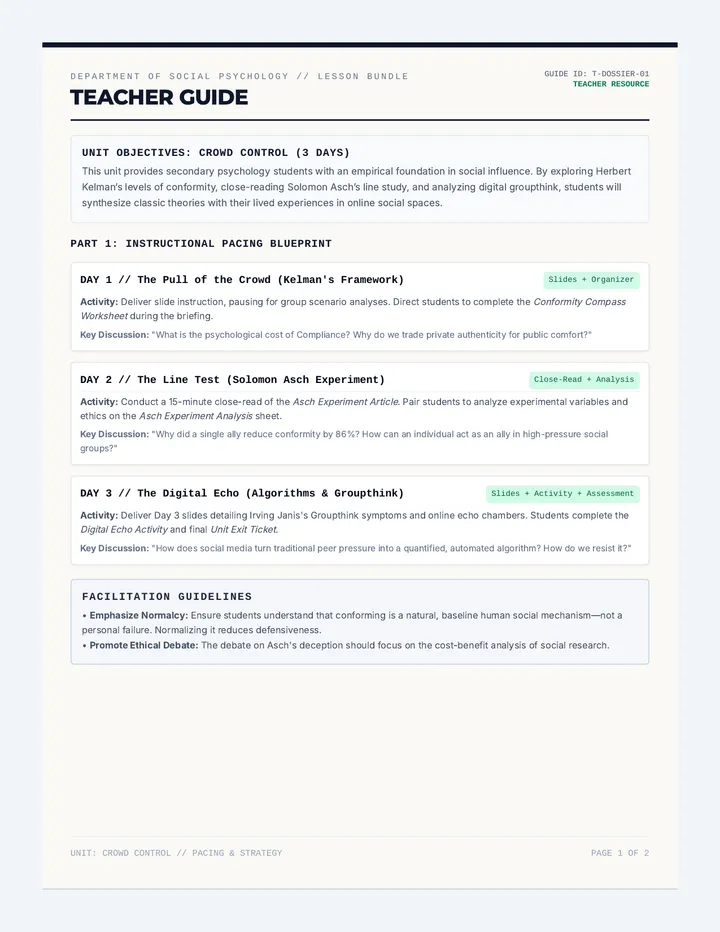
Neuromuscular Map Worksheet Neuromuscular Map
Lesson 01: Anatomy of Affect // Lab Component
Student Name:
Date:
Objective
Identify the specific facial muscles responsible for the primary Action Units (AUs) of the upper and lower face. For each Action Unit, name the muscle, describe the movement, and attempt the movement yourself.
1
Upper Face Action Units
AU Standard Name Muscle(s) Involved Anatomical Marker 01 Inner Brow Raise Central forehead wrinkling 02 Outer Brow Raise
| Lateral forehead wrinkling |
| 04 | Brow Lowerer |
| Vertical glabella lines |
| 05 | Upper Lid Raiser |
| Sclera visible above iris |
| 07 | Lid Tightener |
| Lower eyelid narrowing |
2
Lower Face Action Units
AU Standard Name Muscle(s) Involved Anatomical Marker 10 Upper Lip Raiser Nasolabial fold deepening 12 Lip Corner Puller
| Cheek raising, crow's feet |
| 15 | Lip Corner Depressor |
| Inverted U mouth shape |
| 20 | Lip Stretcher |
| Horizontal elongation |
Clinical Note
Which Action Unit was most difficult for you to isolate voluntarily? Why might this difficulty provide a "clue" to detecting involuntary emotional leakage in a client?
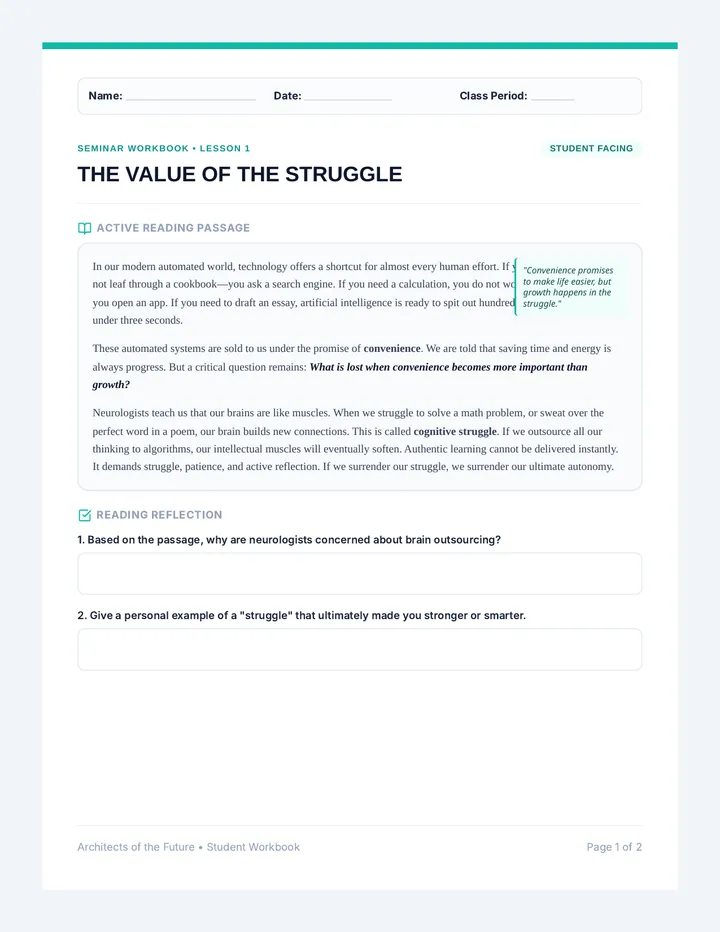
Anatomy Facilitator Guide Facilitator Guide
L1: Anatomy of Affect
Duration: 90 min
Instructional Focus
This lesson introduces students to the Facial Action Coding System (FACS) as a clinical tool. The goal is to move beyond emotional "guessing" and toward objective anatomical observation. Focus on the concept that complex emotions are merely combinations of discrete muscle movements (Action Units).
Key Talking Points
The Frontalis Paradox: Note that AU1 and AU2 are often combined, but clinical "sadness" specifically requires AU1 (inner brow) without AU2. Many people cannot do this voluntarily.
Anatomical Marker: When teaching AU4 (Corrugator), emphasize the "vertical glabella lines" (the '11' between the eyebrows) as the primary indicator for anger or intense concentration.
Pacing Guide
00-15m Hook & Intro to Neuromuscular Control
15-45m Lecture: Mapping the Upper & Lower Face AUs
45-75m Workshop: Lab Sheet Completion & Muscle Isolation
75-90m Clinical Reflection & Group Discussion
Differentiation Strategies
Support
Provide high-resolution anatomy photos of specific muscle contractions to assist students with poor proprioception.
Extension
Challenge students to identify "chimeric" expressions where the upper face and lower face show different AUs.
Universal Core Slides Module 02: Universal Affect
Decoding the Core
Morphological Signatures of the 7 Universal Emotions
The Universal Core
Happiness
Sadness
Fear
Anger
Surprise
Disgust
Contempt
Cross-Cultural
The Morphology Trap: Fear vs. Surprise
Fear (AU 1+2+4+5+20)
Brows: Raised AND Pulled Together
Eyes: Tense lower lids
Mouth: Horizontally stretched
Surprise (AU 1+2+5+26)
Brows: Raised and Curved
Eyes: Relaxed lower lids
Mouth: Jaw dropped (O-shape)
"The distinction lies in the tension of the lower eyelid (AU 7) and the lateral pull of the lips (AU 20)."
Upper Lip vs. Brow Lowerer
Disgust (AU 9 / 10)
Focus on the nose wrinkle and the raising of the upper lip. The eyes narrow, but the brows are pulled down by the nose action, not necessarily a brow lowerer.
Nose Wrinkler (AU 9)
Anger (AU 4+5+7+23)
Focus on the glabella (AU 4) and the narrowing of the lip margins (AU 23). Anger is "boxy" and tense throughout the whole face.
Lip Tightener (AU 23)
Morphology Lab Sheet Morphology Lab Sheet
L2: Decoding the Universal Core Emotions
Session ID
CORE-02
Investigator Name
Observation Date
Part I: AU Sequence Identification
Review the provided static expressions. Identify the primary Action Units present and determine the core emotion.
01
Visual Markers:
Brows raised/curved, sclera visible (all around), jaw slack/dropped.
AUs Present
Primary Emotion
02
Visual Markers:
Brows lower/together, upper lid raised, lower lid tense, lips tight/boxy.
AUs Present
Primary Emotion
03
Visual Markers:
Nose wrinkled, upper lip raised, lower lid pulled up/bunched.
AUs Present
Primary Emotion
Part II: Diagnostic Differentiation
1. The "Eyelid Differentiator"
Describe the specific neuromuscular difference in the lower eyelids between Surprise and Fear. Why is this critical for social communication assessment?
2. Asymmetry Analysis
You observe a client with a slight lip corner pull on only one side of the face (Unilateral AU 14). Which core emotion does this signal, and how does it differ from a true smile?
Morphology Lab Answer Key Answer Key
L2: Morphology Lab // CORE-02
Instructor Use Only
Part I: AU Sequence Identification
01
Surprise
AUs: 1 + 2 + 5 + 26 (or 27)
Markers: Curved brows (1+2), relaxed lower lids (lack of AU7), drop of the jaw (26/27).
02
Anger
AUs: 4 + 5 + 7 + 23 (or 24)
Markers: Lowered brows (4), tensed eyelids (7), and thinning/tightening of the lip margins (23/24).
03
Disgust
AUs: 9 or 10 (+ 17/25)
Markers: Nose wrinkle (9) or upper lip raiser (10) causing deepening of nasolabial folds.
Part II: Diagnostic Differentiation
1. The "Eyelid Differentiator"
In Surprise , the lower lid is relaxed. In Fear , the lower lid is tensed and pulled up (AU 7). This is critical because AU 7 signals genuine autonomic arousal/threat response, whereas Surprise is a simpler information-gathering reflex.
2. Asymmetry Analysis
Unilateral AU 14 (lip corner puller/dimpler) signals Contempt . Unlike a smile (AU 12), which is bilateral and pulls corners upward, Contempt pulls one corner tight toward the ear/jaw. Clinically, this signals social friction or perceived superiority.
Micro-Expression Slides Module 03 // temporal dynamics
The Fraction of a Second
Micro-Expressions and Emotional Leakage
Defining the 'Micro'
Duration
1/25 to 1/5 of a second.
Involuntary
Fast-pathway neural processing (amygdala) bypasses the motor cortex's conscious control.
"They are the result of a suppression failure. The true emotion 'leaks' before the cognitive mask can be applied."
Signals of Leakage
Interrupted Expression
A core emotion starts but is suddenly 'cut off' by a neutral mask or a false smile.
Fragmented Expression
Only one part of the face (e.g., just the brows) shows the true emotion while the rest is masked.
Incongruence
The facial expression does not match the verbal content or the vocal prosody.
Clinical Application
For clients with social-pragmatic deficits, micro-expressions are often missed entirely.
Our goal: Spot the leakage to understand the client's internal state—even when they can't verbalize it.
Diagnostics
Empathy
Unmasking
Intervention
Micro-Expression Log Observation Log
Temporal Analysis // LAB-03
Frame Rate: 60fps
Source: CLIN-SIM-04
Micro
< 0.5s
Macro
> 0.5s
Subtle
Low Intensity
Masked
False Over-expression
Timecode AUs Detected Duration Leaked Emotion Masking Action?
Incongruence Analysis
Based on the micro-expressions recorded above, describe the specific contradiction between the client's verbal statement and their facial leakage . What clinical hypotheses would you form?
End of Temporal Analysis // Confidential Clinical Data
Clinical Notes Template Confidential Observation Document
Clinical Note: Affective Incongruence
Session Reference: L3-MICRO Facilitated Observation
Clinician-in-Training
Target Client ID
Date of Analysis
Video Source Code
1. Baseline Presentation
Describe the client's neutral or 'masked' state prior to the stimulus or question.
2. Leakage Event Description
Identify the timestamp, specific AUs, and the core emotion that leaked through. Note the temporal speed.
3. Diagnostic Impression
What does this leakage suggest about the client's internal emotional state? Does it contradict their verbal report?
Electronic Signature of Clinician
Authenticity Slides Module 04 // Authenticity Markers
The Duchenne Smile
Distinguishing Genuine vs. Posed Affect
The Duchenne Marker
Genuine Joy (AU 6 + 12)
Requires the Orbicularis Oculi, pars orbitalis (AU 6). This muscle is not under voluntary control for most people.
Social/Posed Smile (AU 12)
Only involves the Zygomaticus Major. The lips pull up, but the eyes remain "cold" or uninvolved.
Key Indicator: Crow's Feet
Look for the narrowing of the eye aperture, the raising of the cheeks, and the skin bunching below the eyes.
Social Camouflage & Masking
What is Masking?
The intentional or semi-automatic suppression of genuine affect, often replaced by socially 'appropriate' posed expressions.
Commonly observed in individuals with Autism Spectrum Disorder (ASD) or high Social Anxiety.
Cognitive Load
Maintaining a 'posed' face requires significant executive function, often leading to burnout.
The 'Uncanny Valley'
Posed affect often feels "off" to neurotypical observers because it lacks the involuntary AU6 component.
Spot the Imposter
You will watch three video clips of individuals receiving a gift. Only one is feeling genuine joy. Analyze the eye aperture (AU6) and the timing of the lip pull (AU12).
Clip A
Clip B
Clip C
Authenticity Coding Lab Authenticity Coding Lab
L4: The Duchenne Marker // GEN-04
The Duchenne Equation
Genuine Joy = AU 12 (Zygomaticus Major) + AU 6 (Orbicularis Oculi). Look for the "twinkle" or "crow's feet" which indicate the involuntary contraction of the outer eye muscles.
Target A: Receiving Gift TIMECODE: 00:12:05
Action Units Detected
AU 12 AU 25
Are eye muscles (AU 6) involved?
Yes No
Diagnostic Conclusion
Genuine Affect Posed / Social Affect
Clinical Justification
Target B: Reunion TIMECODE: 00:45:12
Action Units Detected
AU 6 AU 12
Are eye muscles (AU 6) involved?
Yes No
Diagnostic Conclusion
Genuine Affect Posed / Social Affect
Clinical Justification
The 'Mask' of Social Safety
Why might a client with ASD use AU 12 without AU 6 in a social setting? Discuss the difference between 'deception' and 'social camouflage' in this context.
Clinical Synthesis Slides Final Synthesis // Module 05
Clinical Synthesis
Transforming Neuromuscular Observation into Therapeutic Action
The Assessment Project
You are given a 10-minute raw video observation of a new client (Case Study: Alex).
Phase 1: Observation
Conduct a full FACS-based audit of the client's facial production during a social interaction task.
Phase 2: Intervention
Draft a Goal Hierarchy to support the client in recognizing or producing specific AUs.
Clinical Report
Drafting a formal diagnostic document.
Goal Hierarchy
Establishing SMART therapeutic milestones.
Identifying the Breakdown
Production Deficits
Client exhibits 'Flat Affect' (limited AU range) or 'Incongruent Affect' (puzzling combinations).
Recognition Deficits
Client fails to identify subtle/micro expressions in others (e.g., missing AU4 in a partner).
Social Integration
Client understands the emotion but fails to adjust their behavior in response to the facial signal.
Building a Goal Hierarchy
Level 3
Production of congruent affect in natural conversation.
Level 2
Recognition of subtle/micro expressions in video modeling.
Level 1
Labeling discrete Action Units in static images.
Scaffolding from Foundational to Functional
Clinical Observational Report Template Observational Report
L5 Synthesis Project // PART A
Final Submission
Executive Summary
Provide a high-level overview of the client's facial production and recognition patterns observed in the dataset.
Draft Summary here...
Action Unit Audit
Region Dominant AUs Deficit / Absent AUs Upper Face Lower Face
Production Analysis
Discuss the client's ability to produce socially congruent affect. Are there instances of masking or micro-leakage?
Recognition Analysis
Based on the interaction, does the client seem to detect micro-expressions in their partner? Cite specific timestamps.
Diagnostic Impression
Synthesize observations into a clinical hypothesis...
Therapy Goal Hierarchy Worksheet Intervention Design
L5 Synthesis Project // PART B
Project Milestone GOAL-HIERARCHY-V1
Therapeutic Objective
Based on your Part A report, design a scaffolded intervention plan. Your goal is to move the client from discrete neuromuscular recognition to integrated social participation .
Level
Focus / Skill Area
SMART Goal Description (Client will...)
01
Foundational Recognition
Focus on discrete Action Units and static morphology.
02
Temporal Awareness
Focus on micro-expressions and dynamic video modeling.
03
Functional Integration
Focus on social response and congruent production.
Instructional Strategies
Video Modeling
How will you use high-speed or slowed-down video to train recognition?
Biofeedback
How will you support the client in monitoring their own neuromuscular production?