Bull Run Reading PacketBattlefield Dispatch First Bull Run (Manassas): The Great Realization DATE: JULY 21, 1861 LOCATION: VIRGINIA Strategic Context In 1861, both sides believed the war would be short. The Union public demanded a quick march on Richmond. President Lincoln pressured General McDowell to attack the Confederate railroad junction at Manassas. McDowell planned to cross Bull Run and turn the enemy flank. Lincoln told his raw troops, "You are green, but they are green also." The Engagement The battle began at dawn with Union artillery fire. McDowell’s flanking maneuver initially worked, pushing the Confederates back. However, at Henry House Hill, a brigade of Virginians held firm. General Bee shouted: "Look! There is Jackson standing like a stone wall!" This stand halted the Union momentum. The fighting was confused, as uniforms were not yet standardized, leading to several "friendly fire" incidents in the thick smoke of the Virginia summer. Fast Facts Union Commander Irvin McDowell Confed. Commanders P.G.T. Beauregard Joseph E. Johnston Victor Confederacy Casualties ~4,800 Total The Great Skedaddle Confederate reinforcements arrived via railroad—the first time in history rail was used to deliver troops directly into battle. The Union line snapped, and the retreat quickly turned into a panic. Soldiers fled toward Washington, colliding with civilian "spectators" whose carriages blocked the roads. This became known as the "Great Skedaddle." Union: The Panic "The road was filled with fugitives, soldiers, horses, wagons, and ambulances, all flying in the wildest confusion. The dust was so thick we could see but a short distance... everyone seemed to think only of his own safety. I saw one man crawling along the road, and piteously begging for help, but no one stopped." — Captain John D. Mussey, Union Officer Confederate: The Tactic "The enemy were advancing in force. I saw General Bee ride up to Jackson and say, 'General, they are beating us back.' Jackson replied, 'Then, sir, we will give them the bayonet.' This inspired Bee to point toward the hill and shout his famous rally cry. The men cheered and the line held firm." — Account from a Confederate Staff Officer Expert Analysis Task Compare the primary sources. How does the description of "panic" in the first account contrast with the "stand" described in the second? What do these sources reveal about why the battle's momentum shifted in the late afternoon?
Shiloh Reading PacketBattlefield Dispatch Shiloh: The Harvest of Death in the West DATE: APRIL 6–7, 1862 LOCATION: TENNESSEE The Western Campaign By 1862, Grant was gaining momentum. After capturing Forts Henry and Donelson, he pushed deep into Tennessee, camping at Pittsburg Landing. Confederate General Albert Sidney Johnston knew he had to strike Grant before reinforcements arrived. On April 6, he launched a surprise attack near a church called Shiloh. The Hornets' Nest The surprise caught Union camps off guard. However, a division under General Prentiss rallied along a sunken farm road. For six hours, they held their ground. The sound of bullets was so constant it sounded like swarming insects: the "Hornets' Nest." General Johnston was mortally wounded during the fight. Overnight, Union reinforcements arrived, and on April 7, Grant counterattacked. The victory was strategic, but the 23,000 casualties horrified the nation. Fast Facts Union Commander Ulysses S. Grant Confed. Commanders Albert Sidney Johnston P.G.T. Beauregard Victor Union Casualties ~23,700 Total Union: The Aftermath "I saw more of human agony than I trust I will ever see again. The dead were all around us... looking up at us. The wounded were piteously calling for water. We had to step over the bodies to move. This is the reality of war we never read in the papers." — Private Leander Stillwell, 61st Illinois Confederate: Death of Johnston "Our General was in the thickest of the fight. A ball struck him in the leg, but he wouldn't leave his post. He grew pale and faint, and at last he fell from his horse into the arms of his staff. He bled to death in minutes. We felt the loss as a death blow to our hopes." — Confederate Soldier's Account, April 1862 Expert Analysis Task Analyze the Confederate source regarding Johnston's death. How did the loss of a top commander impact the momentum of the army? How does this contrast with Grant's refusal to retreat ("Lick 'em tomorrow")?
Antietam Reading PacketBattlefield Dispatch Antietam: The Bloodiest Day and the Proclamation DATE: SEPTEMBER 17, 1862 LOCATION: MARYLAND The Maryland Campaign Following victories in Virginia, Lee decided to take the war North to gather supplies and seek foreign recognition. Luck favored the Union when soldiers found a copy of Lee's battle plans (Special Order 191) wrapped around cigars. General McClellan cornered Lee at Sharpsburg along Antietam Creek. Three Phases of Fury The battle was the bloodiest single day in history. It began in The Cornfield, where corn was cut as cleanly as if by a knife. Midday, the focus shifted to a sunken road known as "Bloody Lane," where corpses were piled high. The afternoon centered on Burnside’s Bridge. Lee was finally forced to retreat. This strategic victory gave Lincoln the strength to issue the Emancipation Proclamation, transforming the war into a crusade to end slavery. Fast Facts Union Commander George B. McClellan Confed. Commander Robert E. Lee Victor Union (Strategic) Casualties ~22,717 (One Day) Union: The Slaughterhouse "The slain lay in rows precisely as they stood in their ranks... I can compare it to nothing but a slaughterhouse. Men were lying in every conceivable position, some with their heads blown off. The air was heavy with the smell of blood." — Union Officer at the Sunken Road Confederate: Bloody Lane "We were in a sunken road... the fire was incessant and deadly. My comrades were falling on every side... we were literally being mowed down. The road was soon so full of dead and wounded that we could not move without stepping on them." — Soldier, 6th Alabama Infantry Expert Analysis Task Compare these accounts of the "Bloody Lane." What shared details do they provide? Why was the Emancipation Proclamation the most important strategic outcome of this battle, even though the fighting was technically a draw?
Fredericksburg Reading PacketBattlefield Dispatch Fredericksburg: The Slaughter at the Stone Wall DATE: DECEMBER 11–15, 1862 LOCATION: VIRGINIA The Heights of Despair Major General Ambrose Burnside took command with a plan for a race toward Richmond. However, delays in arrival of pontoon bridges allowed Lee to entrench his army on Marye’s Heights. When the Union finally crossed, they faced a nightmare: a wide field leading up to a stone wall packed with Confederate infantry. Fourteen Failed Assaults On December 13, Burnside ordered fourteen separate Union charges toward the stone wall. None reached it. The slaughter was so one-sided that Robert E. Lee remarked, "It is well that war is so terrible, or we should grow too fond of it." Union morale hit its lowest point. Lincoln stated, "If there is a worse place than Hell, I am in it." Amidst the carnage, Richard Kirkland brought water to dying Union soldiers. Fast Facts Union Commander Ambrose Burnside Confed. Commander Robert E. Lee Victor Confederacy Casualties Union: 12,653 | Conf: 5,377 Union: The Butchery "The air was filled with a constant 'whish, whish' of bullets... We were ordered to advance. We went up, but the fire was too heavy. It was like a sheet of flame from the stone wall. We fell back, what was left of us. The ground was blue with our dead." — Sergeant, 5th New Hampshire Volunteers Confederate: The Wall "General, if you put every man now on the other side of the Potomac on that field to approach me over the same line... I will kill them all before they reach my line. Look at them, General, they are being slaughtered." — Gen. James Longstreet to Robert E. Lee Expert Analysis Task Compare Longstreet's assessment with the Union sergeant's account. How did the geography of Marye's Heights turn a battle into a "butchery"? Why was the high ground such an insurmountable advantage in this engagement?
Chancellorsville Reading PacketBattlefield Dispatch Chancellorsville: Lee's Brilliant Risk and Bitter Loss DATE: APRIL 30 – MAY 6, 1863 LOCATION: VIRGINIA Audacity and Innovation Major General Joseph Hooker rebuilt Union morale and planned a catch Lee in a massive pincer movement. Lee, facing an army more than twice his size, took an enormous risk. He split his army twice. Stonewall Jackson led a 12-mile march through the "Wilderness" to strike the exposed Union right flank. The Tragedy of Jackson Jackson’s attack routed the Union XI Corps. However, that evening, Stonewall Jackson was accidentally shot by his own men. Lee wrote to him, "He has lost his left arm, but I have lost my right arm." Jackson died eight days later. Jackson's death fundamentally changed Lee's army; never again would he attempt such complex maneuvers. Yet the victory gave Lee the confidence to attempt a final invasion of the North, leading eventually to Gettysburg. Fast Facts Union Commander Joseph Hooker Confed. Commanders Robert E. Lee Stonewall Jackson Victor Confederacy Casualties ~30,500 Total Confederate: Lee's Letter "I have just received your note, informing me that you were wounded... Could I have directed events, I should have chosen for the good of the country to be disabled in your stead. I congratulate you upon the victory." — Robert E. Lee to Stonewall Jackson Union: The Panic "The first we knew of the enemy, they were in our rear. Men were flying in every direction... the woods were filled with them. There was no order, no command. It was a stampede of the wildest kind." — Union Soldier, XI Corps, 1863 Expert Analysis Task Contrast the Union soldier's account of "panic" with Lee's celebratory letter. How does the "success" of a military maneuver translate into the human experience of those caught in it? Why was Jackson's loss so catastrophic?
Gettysburg Reading PacketBattlefield Dispatch Gettysburg: The High Water Mark DATE: JULY 1–3, 1863 LOCATION: PENNSYLVANIA The Great Conflict Gettysburg was the largest battle ever fought in North America. Lee invaded Pennsylvania to take the war out of Virginia and win a victory on Northern soil that would shatter Union resolve. The battle began accidentally on July 1. By the end of the first day, the Union established a "fishhook" line. Pickett's Charge On Day 3, Lee ordered a frontal assault against the Union center. Known as Pickett's Charge, 12,500 Confederates marched across an open mile into Union fire. They were decimated. Only a few reached the Union line, and they were quickly captured. Lee retreated on July 4, never again to launch a major invasion of the North. Four months later, Lincoln redefined the war with the Gettysburg Address, speaking of a "new birth of freedom." Fast Facts Union Commander George G. Meade Confed. Commander Robert E. Lee Victor Union Casualties ~51,000 Total Union: The Address "We here highly resolve that these dead shall not have died in vain—that this nation, under God, shall have a new birth of freedom—and that government of the people, by the people, for the people, shall not perish from the earth." — Abraham Lincoln, Nov 1863 Confederate: The Charge "The fire was terrific. The shells burst all around us. When we got within 100 yards, the canister was like a hailstorm. I looked back and saw our lines melting away. It was a sight to make a man's heart bleed." — Account of a Confederate Captain Expert Analysis Task Contrast Lincoln's "new birth of freedom" with the Confederate captain's description of "melting away." How do these sources illustrate the shift in the war's momentum? Why is Gettysburg called the "High Water Mark"?
Vicksburg Reading PacketBattlefield Dispatch Vicksburg: The Key to the Mississippi DATE: MAY 18 – JULY 4, 1863 LOCATION: MISSISSIPPI The Fortress on the Bluff Abraham Lincoln remarked, "Vicksburg is the key! The war can never be brought to a close until that key is in our pocket." Vicksburg sat on bluffs overlooking the river. For the Confederacy, it was the link connecting eastern states with western resources. The Siege of Starvation For 47 days, Union artillery shelled the city. Residents dug caves to survive. John Pemberton surrendered on July 4, 1863. The Union gained control of the Mississippi, splitting the Confederacy in two. Vicksburg did not officially celebrate the Fourth of July for another 81 years. The victory secured Grant's reputation as a relentless commander and demonstrated the effectiveness of the "Anaconda Plan" to squeeze the South into submission. Fast Facts Union Commander Ulysses S. Grant Confed. Commander John C. Pemberton Victor Union Type Siege (47 Days) Civilian: Cave Life "I shall never forget that evening. We were all in the cave. The shells were falling around us like hail... We were so hungry, we had nothing but pea bread... It is impossible to describe the misery of those weeks." — Mary Loughborough, Resident Soldier: The Letter "General: If you can't feed us, you had better surrender us... we are starving. We are willing to fight as long as we can stand, but we can't fight on empty stomachs. Our men are eating mules and rats. We are done." — Starving Soldiers to Gen. Pemberton Expert Analysis Task Compare the civilian and soldier accounts of the siege. How did starvation break the "will to fight"? Why was the geographic location of Vicksburg both a "fortress" and a "trap"?
Wilderness Reading PacketBattlefield Dispatch The Wilderness: A Blind Fight in the Woods DATE: MAY 5–7, 1864 LOCATION: VIRGINIA The War of Attrition In 1864, Grant took command of all Union armies. His strategy was relentless: attack all Confederate forces simultaneously. The first clash occurred in the "Wilderness"—a forest so dense traditional battle lines were impossible. Lee hoped the terrain would neutralize Grant's numbers. The Charnel House The fighting was horrific; musketry ignited dry brush, starting fires that burned many wounded alive. Tactically it was a draw, but Grant made a historic decision. Instead of retreating, he ordered his army to move South, deeper into Virginia. Lee was running out of men he could not replace. The Wilderness began a relentless lock between the two armies that would last until the end of the war. Grant knew he could replace his losses, while Lee could not. Fast Facts Union Commander Ulysses S. Grant Confed. Commander Robert E. Lee Victor Inconclusive Casualties ~28,000 Total Union: Grant's Resolve "I propose to fight it out on this line if it takes all summer... The enemy are beginning to see that we are in earnest and that we will not turn back. There is no other way to end this rebellion." — General Ulysses S. Grant Confederate: The Fire "The fire was more terrible than the bullets. We could hear the poor fellows screaming as the flames reached them. The smoke was so thick we couldn't see our own hands. It was like fighting in a furnace." — Confederate Private, 1864 Expert Analysis Task Analyze the Confederate soldier's account of the fire. How did the environment transform combat? Why was Grant's decision to move "South" more important than the tactical outcome?
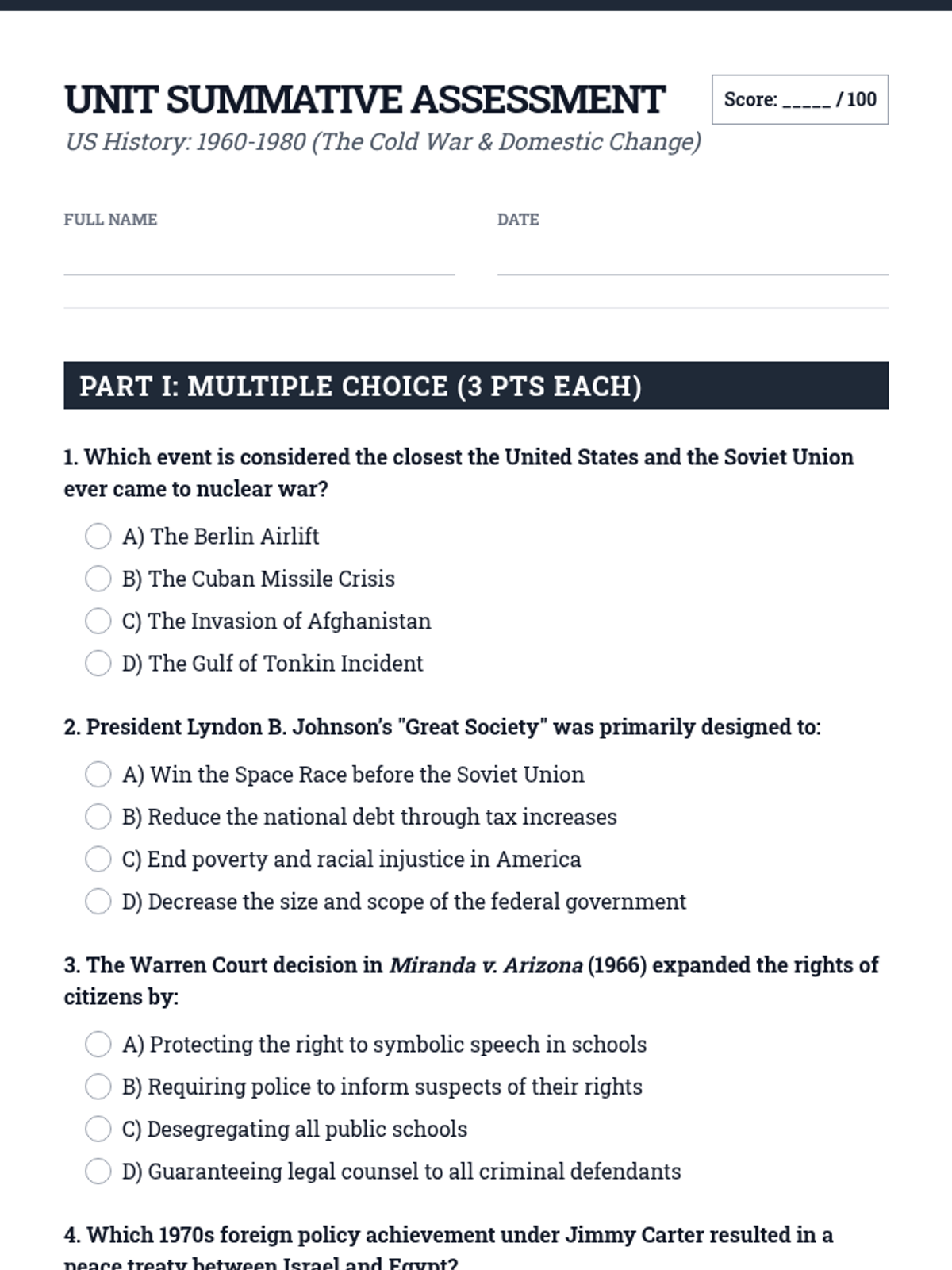
Battlefield Briefing OrganizerBattlefield Briefing Organizer Part I: The Early War (1861–1862) Name: ______________________ Date: _______________________ Battle & DateKey FiguresVictorStrategic SignificanceFirst Bull RunJuly 21, 1861ShilohApril 6-7, 1862AntietamSept 17, 1862FredericksburgDec 11-15, 1862 Battlefield Briefing Organizer Part II: Turning Points (1863–1864) Name: ______________________ Date: _______________________ Battle & DateKey FiguresVictorStrategic SignificanceChancellorsvilleMay 1-4, 1863GettysburgJuly 1-3, 1863VicksburgMay-July 1863The WildernessMay 5-7, 1864 Synthesis Question Identify one pattern in military leadership or technology that evolved from Part I to Part II. How did it change the nature of the war?
Primary Source Detective WorksheetPrimary Source Detective Evidence-Based Document Analysis Name: ______________________ Date: _______________________ Step 1: Identifying the Evidence Battle Name Author / Eyewitness Step 2: Decoding the Text Summary: In your own words, what is the main scene described in this source? Key Quote: Select one phrase that you find most informative. Why is it significant? Step 3: Point of View & Mood Who was the intended audience? What is the author's tone (mood)? Step 4: Historical Significance How does this account deepen your understanding of the battle's human or strategic cost?
Battlefield Intro SlidesTurning Points Major Battles of the Civil War A Collaborative Jigsaw Investigation into the Conflict that Defined a Nation Our Mission: The Jigsaw 1 Expert Phase You will be assigned one specific battle. Master the details and analyze its primary source. 2 Teaching Phase Join your home group. Teach your battle to others and learn about theirs. 3 Synthesis Phase Complete your graphic organizer to see the full "puzzle" of the war. The Battlefields Early War Bull Run Shiloh Antietam The Tide Turns Fredericksburg Chancellorsville The Turning Points Gettysburg Vicksburg The Final Push The Wilderness "The art of war is simple enough. Find out where your enemy is. Get at him as soon as you can. Strike him as hard as you can, and keep moving on." — Ulysses S. Grant
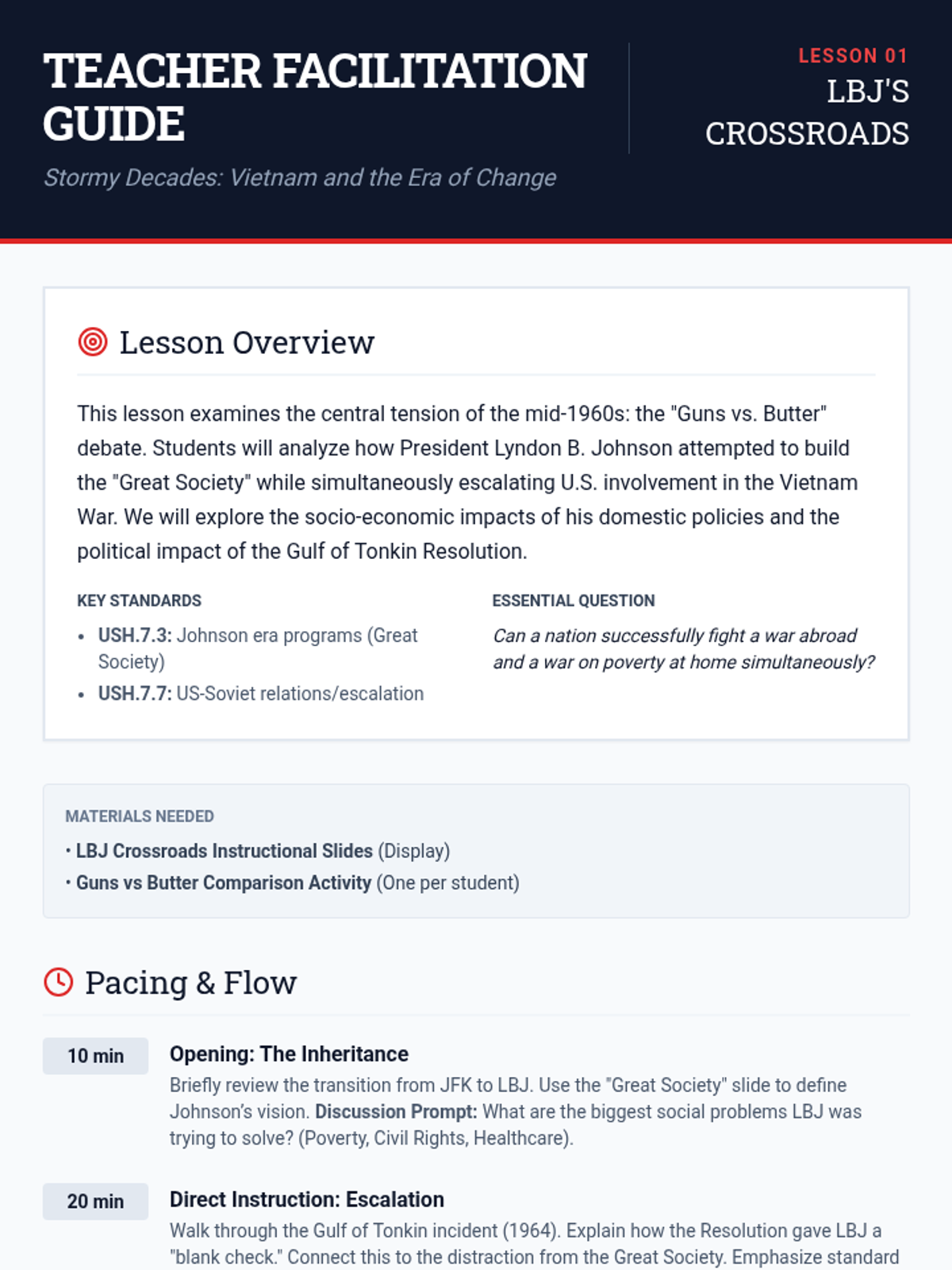
Jigsaw Facilitation GuideJigsaw Facilitation Guide Teacher Resource: Turning Points Lesson Lesson Objective Students will analyze the tactical details, casualty impacts, and primary source evidence of eight major Civil War battles to construct a comprehensive understanding of the war's military trajectory. Pacing Intro Slides: 10 mins Expert Groups (Read/Analyze): 25 mins Teaching Groups (Share): 30 mins Whole Class Debrief: 15 mins Grouping Divide the class into 8 "Expert Groups" (one for each battle). Later, regroup students so each "Home Group" has one representative from each battle. Quick Reference Key BattleVictorStrategic SignificanceBull RunConfederacyProved war would be long; ended hopes of a single-battle victory.ShilohUnionGrant's tenacity; massive casualties shocked both sides.AntietamUnion (Strat)Bloodiest day; enabled Lincoln to issue Emancipation Proclamation.FredericksburgConfederacyTactical disaster for Union; morale hit low point; high ground advantage.ChancellorsvilleConfederacyLee's "Perfect Battle"; Death of Stonewall Jackson; led to Gettysburg.GettysburgUnion"High Water Mark"; Lee's offensive capability destroyed; turning point.VicksburgUnionUnion takes control of Mississippi; Confederacy split in two.WildernessInconclusiveGrant's refusal to retreat; start of Overland Campaign; war of attrition. Debriefing Questions Geography: How did landscapes (forests, rivers, hills) dictate the tactics of these battles? Compare Vicksburg to the Wilderness. Leadership: Compare Grant’s style at Shiloh/Wilderness to Burnside’s at Fredericksburg. What made a commander "effective" in this era? Human Cost: Looking at the primary sources, what common themes emerge about the experience of the average soldier across different battles?