[10 Points Total]
A track of radius \(r = 90.0\text{ m}\) is banked at \(\theta = 15.0^\circ\). Tires on the roadway provide a static friction coefficient of \(\mu_s = 0.30\).
(a) Sketch the FBD when the car travels at maximum speed \(v_{max}\) (impending slip up the incline):
Show direction of f_s
(b) Write the coupled force balance equations along \(x\) and \(y\) for the \(v_{max}\) condition:
(c) Compute the maximum safe speed \(v_{max}\) without skidding up the incline:
AP Physics C: Mechanics • Unit 3: Circular Motion Page 2 of 5
AP Physics C: Mechanics • Practice Assignment Page 3 of 5
Part 3: Tethered & Cylindrical Systems Conical Pendulums & The Gravitron Rotor
[12 Points Total]
A pendulum bob of mass \(m = 0.80\text{ kg}\) is suspended by a light string of length \(L = 1.60\text{ m}\). The bob moves at constant linear speed \(v\) in a horizontal circle, with the string maintaining a steady angle of \(\theta = 35.0^\circ\) with the vertical.
Free-Body Diagram of Bob:
Draw T, mg, and angle θ
(a) Calculate the tension \(T\) in the suspension string:
(b) Determine the radius of the circular path \(r\) and the linear speed \(v\) of the bob:
(c) Derive and compute the revolution period \(T_p\):
(d) If the string snaps when \(T = 3.0\,mg\), find the maximum cone angle \(\theta_{max}\):
[10 Points Total]
In a Gravitron ride, riders stand against the inner vertical wall of a hollow cylinder of radius \(R = 4.80\text{ m}\). The static friction coefficient between clothing and the padded wall is \(\mu_s = 0.38\). The cylinder spins until its linear speed is sufficient to allow the floor to drop away without passengers slipping down.
FBD of Rider against Wall:
Show F_N, f_s, and mg
(a) State the force equations along the horizontal (\(x\)) and vertical (\(y\)) directions:
(b) Derive the symbolic formula for minimum tangential speed \(v_{min}\) and compute its value:
(c) Calculate the maximum allowable time period \(T_{max}\) for one complete revolution:
AP Physics C: Mechanics • Unit 3: Circular Motion Page 3 of 5
AP Physics C: Mechanics • Practice Assignment Page 4 of 5
Part 4: Vertical Circular Dynamics & Energy Ferris Wheels & Inverted Roller Coaster Loops
[10 Points Total]
A \(60.0\text{ kg}\) passenger rides a large Ferris wheel of radius \(R = 15.0\text{ m}\). An electric motor maintains a constant linear speed of \(v = 6.50\text{ m/s}\).
(a) Draw FBD and calculate normal force \(F_{N,top}\) on the passenger at the highest point (apex):
(b) Draw FBD and calculate normal force \(F_{N,bot}\) on the passenger at the lowest point (nadir):
(c) What tangential speed \(v\) would cause the passenger to experience momentary weightlessness (\(F_N = 0\)) at the apex?
[12 Points Total]
A coaster cart of mass \(m = 400\text{ kg}\) is released from rest at height \(h\) above the base of a frictionless circular loop of radius \(R = 12.0\text{ m}\).
FBD at Apex of Inside Loop:
Both forces point down
(a) Derive the minimum release height \(h_{min}\) (in terms of \(R\)) necessary to maintain track contact at apex:
(b) If released from \(h = 2.5R\), prove that the normal force at the bottom of the loop is \(F_{N,bot} = 6\,mg\):
(c) After exiting the loop, the cart goes over a convex circular hill of radius \(r_{hill} = 20.0\text{ m}\). What maximum speed can it have at the hill crest without becoming airborne?
AP Physics C: Mechanics • Unit 3: Circular Motion Page 4 of 5
AP Physics C: Mechanics • Practice Assignment Page 5 of 5
Part 5: AP Conceptual Analysis & Justifications Five Rigorous Theoretical Explanations
[5 Points]
A passenger in a car making a sharp left turn claims: "A strong centrifugal force threw me outward to the right against the car door." Explain from the perspective of an inertial ground observer why the passenger presses against the door, and clearly identify the actual physical force acting on the passenger and its direction.
[5 Points]
A mass attached to a string is swung in a vertical circle. At the instant the string is exactly horizontal (the 3 o'clock position while ascending): (a) Identify which force supplies the centripetal acceleration, and (b) identify which force supplies the tangential acceleration, and sketch the direction of the total acceleration vector \(\vec{a}_{net}\).
[5 Points]
A car traverses a frictionless banked curve of radius \(r\) at the exact ideal speed \(v_{ideal}\). Does the normal force \(F_N\) exerted by the tilted road do positive, negative, or zero mechanical work on the vehicle over a quarter-turn? Justify using the vector definition \(dW = \vec{F}_N \cdot d\vec{r}\).
[5 Points]
A student claims that with a sufficiently high motor speed, a conical pendulum bob can be made to spin so that the suspension string becomes completely horizontal (\(\theta = 90.0^\circ\)). Using Newton's second law along the vertical axis, prove mathematically why this condition is physically impossible.
[5 Points]
A person is pinned safely against the wall of a rotating Gravitron cylinder with the floor dropped. If the cylinder's linear speed \(v\) is doubled (\(v \to 2v\)): (a) by what factor does the wall normal force \(F_N\) change, and (b) by what factor does the vertical static friction force \(f_s\) change? Explain carefully.
AP Physics C: Mechanics • Unit 3: Circular Motion Page 5 of 5
12 Pts
Scored FBD [2 Pts]: F_N mg 1 pt: \(F_N \perp\) slope; 1 pt: \(mg \downarrow\)
(a) Derivation of \(\tan\theta = \frac{v^2}{gr}\) [4 Pts]: \(\Sigma F_y = F_N\cos\theta - mg = 0 \implies F_N = \frac{mg}{\cos\theta}\) [1.5 pts]
\(\Sigma F_x = F_N\sin\theta = m\,\frac{v^2}{r}\) [1.5 pts]
\(\frac{F_N\sin\theta}{F_N\cos\theta} = \frac{m v^2 / r}{mg} \implies \tan\theta = \frac{v^2}{gr}\) [1 pt]
(b) Angle Calculation [2 Pts]: \(\tan\theta = \frac{22.0^2}{(9.8)(140)} = \frac{484}{1372} \approx 0.3528 \implies \theta = \arctan(0.3528) \approx \mathbf{19.4^\circ}\) [2 pts]
(c) Normal Force \(F_N\) [2 Pts]: \(F_N = \frac{mg}{\cos\theta} = \frac{(1200\text{ kg})(9.8\text{ m/s}^2)}{\cos(19.4^\circ)} = \frac{11760}{0.9432} \approx \mathbf{12,470\text{ N}}\) [2 pts]
(d) Slow Speed on Ice (\(v = 12\text{ m/s}\)) [2 Pts]: At \(12\text{ m/s}\), the required centripetal force \(m v^2 / r\) is less than the inward normal force component \(F_N\sin\theta\). The excess inward force accelerates the car down the icy incline into the median. [2 pts]
10 Pts
(a) FBD at \(v_{max}\) [3 Pts]:
Impending slip is up the slope, so static friction \(f_s\) points down the incline:
1 pt: \(F_N \perp\) slope
1 pt: \(mg \downarrow\)
1 pt: \(f_s\) parallel to slope pointing downward
(b) Component Equations [3 Pts]: \(\Sigma F_x = F_N\sin\theta + f_s\cos\theta = m\,\frac{v_{max}^2}{r}\) [1.5 pts]
\(\Sigma F_y = F_N\cos\theta - f_s\sin\theta - mg = 0\) [1.5 pts]
(c) Computation of \(v_{max}\) [4 Pts]: With \(f_s = \mu_s F_N\): \(v_{max} = \sqrt{gr\,\left(\frac{\sin\theta + \mu_s\cos\theta}{\cos\theta - \mu_s\sin\theta}\right)}\) [2 pts]
\(\sin(15^\circ) = 0.2588\), \(\cos(15^\circ) = 0.9659\). Numerator: \(0.2588 + (0.30)(0.9659) = 0.5486\).
Denominator: \(0.9659 - (0.30)(0.2588) = 0.8883\). Ratio: \(0.5486 / 0.8883 \approx 0.6176\).
\(v_{max} = \sqrt{(9.8)(90.0)(0.6176)} = \sqrt{544.7} \approx \mathbf{23.3\text{ m/s}}\) (\(84.0\text{ km/h}\)) [2 pts]
AP Physics C: Mechanics • Teacher Solution Key Page 2 of 5
AP Physics C: Mechanics • Teacher Solution Guide Key • Page 3 of 5
Part 3 Solutions: Conical Pendulum & The Rotor Problems 5 & 6 Rubric [22 Points Total]
12 Pts
Scored FBD [2 Pts]: T mg 1 pt: \(T\) along string; 1 pt: \(mg \downarrow\)
(a) Cord Tension \(T\) [3 Pts]: \(\Sigma F_y = T\cos\theta - mg = 0 \implies T = \frac{mg}{\cos\theta}\) [1.5 pts]
\(T = \frac{(0.80\text{ kg})(9.8\text{ m/s}^2)}{\cos(35.0^\circ)} = \frac{7.84}{0.8192} \approx \mathbf{9.57\text{ N}}\) [1.5 pts]
(b) Radius \(r\) and Linear Speed \(v\) [3 Pts]: \(r = L\sin\theta = (1.60\text{ m})\sin(35.0^\circ) = \mathbf{0.918\text{ m}}\) [1 pt]
\(\Sigma F_x = T\sin\theta = m\,\frac{v^2}{r} \implies v = \sqrt{gr\tan\theta}\) [1 pt]
\(v = \sqrt{(9.8)(0.918)\tan(35.0^\circ)} = \sqrt{8.996 \times 0.7002} \approx \mathbf{2.51\text{ m/s}}\) [1 pt]
(c) Period \(T_p\) [2 Pts]: \(T_p = 2\pi\sqrt{\frac{L\cos\theta}{g}} = 2\pi\sqrt{\frac{(1.60)(0.8192)}{9.8}} = 2\pi\sqrt{0.1337} \approx \mathbf{2.30\text{ s}}\) [2 pts]
(d) Breaking Angle Limit [2 Pts]: \(T_{max} = \frac{mg}{\cos\theta_{max}} = 3.0\,mg \implies \cos\theta_{max} = \frac{1}{3} \approx 0.3333\)
\(\theta_{max} = \arccos(0.3333) \approx \mathbf{70.5^\circ}\) [2 pts]
10 Pts
Scored FBD [2 Pts]: F_N f_s mg 1 pt: \(F_N\) inward; 1 pt: \(f_s \uparrow\) and \(mg \downarrow\)
(a) Equations of Motion [3 Pts]: \(\Sigma F_x = F_N = m\,\frac{v^2}{R}\) [1.5 pts]; \(\Sigma F_y = f_s - mg = 0 \implies f_s = mg\) [1.5 pts]
(b) Minimum Linear Speed \(v_{min}\) [3 Pts]: \(f_s \le \mu_s F_N \implies mg \le \mu_s\left(m\,\frac{v^2}{R}\right) \implies v_{min} = \sqrt{\frac{gR}{\mu_s}}\) [1.5 pts]
\(v_{min} = \sqrt{\frac{(9.8)(4.80)}{0.38}} = \sqrt{123.79} \approx \mathbf{11.1\text{ m/s}}\) [1.5 pts]
(c) Maximum Revolution Period \(T_{max}\) [2 Pts]: \(T_{max} = \frac{2\pi R}{v_{min}} = \frac{2\pi(4.80\text{ m})}{11.13\text{ m/s}} \approx \mathbf{2.71\text{ s}}\) per revolution. [2 pts]
AP Physics C: Mechanics • Teacher Solution Key Page 3 of 5
AP Physics C: Mechanics • Teacher Solution Guide Key • Page 4 of 5
Part 4 Solutions: Vertical Circular Dynamics Problems 7 & 8 Rubric [22 Points Total]
10 Pts
(a) Normal Force at Apex \(F_{N,top}\) [4 Pts]: FBD: \(F_N \uparrow\), \(mg \downarrow\), \(\vec{a}_c \downarrow\) toward center. [1 pt]
\(\Sigma F_r = mg - F_{N,top} = m\,\frac{v^2}{R}\) [1.5 pts]
\(F_{N,top} = m\left(g - \frac{v^2}{R}\right) = 60.0\left(9.8 - \frac{6.50^2}{15.0}\right)\)
\(F_{N,top} = 60.0(9.8 - 2.817) = 60.0(6.983) \approx \mathbf{419\text{ N}}\) [1.5 pts]
(b) Normal Force at Nadir \(F_{N,bot}\) [4 Pts]: FBD: \(F_N \uparrow\), \(mg \downarrow\), \(\vec{a}_c \uparrow\) toward center. [1 pt]
\(\Sigma F_r = F_{N,bot} - mg = m\,\frac{v^2}{R}\) [1.5 pts]
\(F_{N,bot} = m\left(g + \frac{v^2}{R}\right) = 60.0(9.8 + 2.817)\)
\(F_{N,bot} = 60.0(12.617) \approx \mathbf{757\text{ N}}\) [1.5 pts]
(c) Apparent Weightlessness Condition [2 Pts]: \(F_{N,top} = 0 \implies m\left(g - \frac{v^2}{R}\right) = 0 \implies v = \sqrt{gR} = \sqrt{(9.8)(15.0)} = \sqrt{147} \approx \mathbf{12.1\text{ m/s}}\) [2 pts]
12 Pts
Apex Loop FBD [2 Pts]: F_N mg 1 pt: \(F_N \downarrow\); 1 pt: \(mg \downarrow\) (both down)
(a) Minimum Release Height \(h_{min}\) [4 Pts]: At loop apex: \(\Sigma F_r = F_{N,top} + mg = m\,\frac{v_{top}^2}{R} \implies F_{N,top} \ge 0 \iff v_{top}^2 \ge gR\) [2 pts]
Conservation of Energy: \(mgh = mg(2R) + \frac{1}{2}m v_{top}^2 = 2mgR + \frac{1}{2}mgR \implies \mathbf{h_{min} = 2.5\,R}\) [2 pts]
(b) The "6g" Bottom Normal Force [3 Pts]: From \(h = 2.5R\): \(v_{bot}^2 = 2gh = 2g(2.5R) = 5gR\) [1 pt]
\(F_{N,bot} - mg = m\,\frac{v_{bot}^2}{R} = \frac{m(5gR)}{R} = 5mg\) [1 pt]
\(F_{N,bot} = 5mg + mg = \mathbf{6\,mg}\) [1 pt] (Q.E.D.)
(c) Hill Crest Airborne Threshold [3 Pts]: Over convex hill: \(mg - F_N = m\,\frac{v^2}{r_{hill}}\) [1.5 pts]
Stay on track: \(F_N \ge 0 \implies v_{max} = \sqrt{g r_{hill}}\)
\(v_{max} = \sqrt{(9.8)(20.0)} = \sqrt{196} = \mathbf{14.0\text{ m/s}}\) [1.5 pts]
AP Physics C: Mechanics • Teacher Solution Key Page 4 of 5
AP Physics C: Mechanics • Teacher Solution Guide Key • Page 5 of 5
Part 5 Solutions: Conceptual Analysis & Rubrics Questions 1 – 5 Rubric [25 Points Total • 5 Pts Each]
Question 1: Inertial Reference Frame & Door Contact [5 Pts] 5 Pts
Ideal AP Response: According to Newton's first law, the passenger's body possesses inertia and tends to maintain its straight-line velocity tangent to the road. As the automobile initiates a left turn, the car body rotates underneath the passenger. The passenger continues forward along a straight line until the right door intercepts them. The door exerts an inward normal force directed to the left toward the turn center. This real contact force provides the required centripetal acceleration. There is no real outward force; the outward sensation is merely the subjective feeling of one's own inertia resisting curved motion in an accelerating reference frame.
• Rubric: 2 pts for Newton's 1st law / inertia explanation; 2 pts for identifying normal force of door to the left; 1 pt for denying centrifugal force as an agent.
Question 2: Total Acceleration Vector at 3 o'clock [5 Pts] 5 Pts
Ideal AP Response: At the 3 o'clock position (string horizontal, moving upward):
(a) The string tension \(\vec{T}\) points horizontally to the left toward the center, supplying the centripetal acceleration \(a_r = T/m = v^2/R\).
(b) The gravitational force \(m\vec{g}\) acts straight down, perpendicular to the string, supplying the tangential acceleration \(a_t = g\).
The total acceleration vector is the vector sum: \(\vec{a}_{net} = \vec{a}_r + \vec{a}_t = -\frac{v^2}{R}\,\hat{i} - g\,\hat{j}\), which points diagonally inward and downward.
• Rubric: 2 pts for identifying string tension as radial; 2 pts for gravity as tangential; 1 pt for vector sum pointing inward/downward.
Question 3: Mechanical Work Done by Normal Force [5 Pts] 5 Pts
Ideal AP Response: The normal force \(F_N\) does zero mechanical work (\(W = 0\)). By definition, the normal force is perpendicular to the surface of the banked track. The instantaneous velocity vector \(\vec{v}\) and displacement element \(d\vec{r}\) are tangent to the horizontal circular curve, lying entirely within the local plane of the track surface. Consequently, \(\vec{F}_N \perp d\vec{r}\) at every instant, giving an angle \(\phi = 90^\circ\) between force and displacement. Thus, \(dW = \vec{F}_N \cdot d\vec{r} = |\vec{F}_N|\,|d\vec{r}|\cos(90^\circ) = 0\).
• Rubric: 2 pts for stating work is zero; 3 pts for demonstrating \(\vec{F}_N \perp d\vec{r}\) via dot product.
Question 4: Horizontal Conical Pendulum Impossibility [5 Pts] 5 Pts
Ideal AP Response: For a conical pendulum, the bob undergoes zero vertical acceleration (\(\Sigma F_y = 0\)). The only vertical forces are the upward component of string tension \(T\cos\theta\) and downward gravity \(mg\), requiring \(T\cos\theta = mg \implies T = \frac{mg}{\cos\theta}\). If the string were completely horizontal (\(\theta = 90.0^\circ\)), \(\cos(90^\circ) = 0\), which yields \(T = \frac{mg}{0} \to \infty\). Because no physical string can sustain infinite tension, a purely horizontal string has zero vertical force component to counteract gravity. The string must always hang at an angle \(\theta < 90^\circ\).
• Rubric: 2 pts for vertical equilibrium equation; 2 pts for showing \(\cos(90^\circ) = 0 \implies T \to \infty\); 1 pt for physical interpretation.
Question 5: Dynamic Scaling in the Gravitron [5 Pts] 5 Pts
Ideal AP Response:
(a) The wall normal force provides centripetal acceleration: \(F_N = m\,\frac{v^2}{R}\). Because \(F_N \propto v^2\), doubling speed (\(v \to 2v\)) causes the normal force to quadruple (increase by a factor of 4): \(F_N' = 4F_N\).
(b) The vertical static friction force satisfies vertical equilibrium: \(\Sigma F_y = f_s - mg = 0 \implies f_s = mg\). Because the passenger's mass and gravitational acceleration remain unchanged, the actual static friction force remains unchanged (factor of 1). The maximum allowable friction capacity \(\mu_s F_N\) quadruples, providing a fourfold greater safety margin against sliding, but the actual force exerted by the wall remains exactly \(mg\).
• Rubric: 2.5 pts for proving \(F_N \propto v^2 \implies 4\times\); 2.5 pts for explaining that actual friction \(f_s = mg\) is unchanged (\(1\times\)).
AP Physics C: Mechanics • Teacher Solution Key Page 5 of 5
(D) \(|\vec{a}_{net}| = \sqrt{a_t^2 + a_t t^2 / R}\)
(E) \(|\vec{a}_{net}| = a_t + a_t^2 t^2 / R\)
AP Physics C: Mechanics • Circular Dynamics MCQ Review Page 1 of 5
AP Physics C: Mechanics • Unit 3 Assessment Page 2 of 5
5. Automobile Turning on a Flat Unbanked Curve [1 Pt]
A car of mass \(m\) negotiates an unbanked curve of radius \(r\) at speed \(v\). The static friction coefficient is \(\mu_s\). Which interaction directly supplies the inward centripetal acceleration?
F_N mg f_s (inward)
(A) Downward gravity of Earth.
(B) Upward road normal force.
(C) Static friction directed radially inward toward center of curvature.
(D) Backward kinetic friction.
(E) Outward centrifugal force.
6. Mass Comparison on Flat Circular Track [1 Pt]
Car A has mass \(m\) and Car B has mass \(2m\). Both vehicles enter the exact same unbanked turn of radius \(r\) at identical speed \(v\). Which statement correctly compares their motion?
m 2m
(A) Car B needs twice the friction force of Car A, but both share identical \(v_{max}\).
(B) Car B has higher maximum speed due to greater normal force.
(C) Car A requires twice the centripetal acceleration of Car B.
(D) Car A has twice the maximum safe speed because it is lighter.
(E) Both vehicles experience identical friction forces regardless of mass.
7. Critical Slipping Radius on a Rotating Turntable [1 Pt]
A turntable completes one revolution in period \(T\). A small coin rests on the turntable with static friction coefficient \(\mu_s\). What is the maximum radial distance \(r_{max}\) before slipping?
r_max
(A) \(r_{max} = \frac{\mu_s g T}{2\pi}\)
(B) \(r_{max} = \frac{\mu_s g T^2}{4\pi^2}\)
(C) \(r_{max} = \frac{4\pi^2 \mu_s g}{T^2}\)
(D) \(r_{max} = 2\pi\sqrt{\frac{\mu_s g}{T}}\)
(E) \(r_{max} = \frac{\mu_s T^2}{g}\)
8. Comparative Slipping of Two Coins on a Turntable [1 Pt]
Identical coins \(C_1\) and \(C_2\) are on a turntable at \(r_1 = d\) and \(r_2 = 2d\). As rotation speed gradually increases (period \(T\) decreases), which coin slips first and why?
C₁ (d) C₂ (2d)
(A) \(C_1\) slips first (tighter turn).
(B) \(C_2\) slips first because required \(a_c = 4\pi^2 r / T^2\) is twice as large.
(C) Both coins slip simultaneously.
(D) \(C_2\) slips first because \(\mu_s\) drops.
(E) \(C_1\) slips first due to speed.
AP Physics C: Mechanics • Circular Dynamics MCQ Review Page 2 of 5
AP Physics C: Mechanics • Unit 3 Assessment Page 3 of 5
9. Frictionless Banked Turn Design Speed [1 Pt]
A roadway curve of radius \(r\) is banked at angle \(\theta\). At what linear speed \(v_{ideal}\) can a vehicle negotiate the turn without relying on any friction?
θ F_N
(A) \(v_{ideal} = \sqrt{g r \sin\theta}\)
(B) \(v_{ideal} = \sqrt{g r \cos\theta}\)
(C) \(v_{ideal} = \sqrt{g r \tan\theta}\)
(D) \(v_{ideal} = \sqrt{\frac{g r}{\tan\theta}}\)
(E) \(v_{ideal} = g r \tan\theta\)
10. Direction of Static Friction on a Banked Curve [1 Pt]
A car traverses a banked curve of angle \(\theta\) at a speed \(v\) greater than ideal design speed (\(v > v_{ideal}\)). In which direction does static friction \(\vec{f}_s\) act?
f_s (down)
(A) Parallel to the road surface, pointing down the incline toward the inside of the curve.
(B) Parallel to the road surface, pointing up the incline toward the outside of the curve.
(C) Strictly vertically upward, directly opposing gravity.
(D) Perpendicular to the road surface, parallel to the normal force.
(E) Zero, because normal force alone supplies the centripetal acceleration.
11. Normal Force Magnitude on a Banked Road [1 Pt]
A vehicle of mass \(m\) travels at ideal speed \(v_{ideal}\) around a curve banked at angle \(\theta\). How does normal force \(F_N\) compare to rest weight \(mg\)?
F_N mg m v²/r
(A) \(F_N = mg\cos\theta < mg\)
(B) \(F_N = mg\)
(C) \(F_N = \frac{mg}{\cos\theta} > mg\)
(D) \(F_N = mg\tan\theta\)
(E) \(F_N = \frac{mg}{\sin\theta}\)
12. Slow Vehicle on a Frictionless Banked Track [1 Pt]
A car drives at speed \(v < v_{ideal}\) on a frictionless banked curve. Which describes the resulting motion and net force?
Slide ↓
(A) The car continues smoothly because inertia automatically increases to balance the turn.
(B) Inward normal force \(F_N\sin\theta\) exceeds required \(m v^2/r\), accelerating the car down the slope.
(C) Outward centrifugal force exceeds the inward force, pushing the car up the incline.
(D) The normal force drops to zero and the car flips over backwards.
(E) The car lifts vertically upward off the roadway surface.
AP Physics C: Mechanics • Circular Dynamics MCQ Review Page 3 of 5
AP Physics C: Mechanics • Unit 3 Assessment Page 4 of 5
13. Cord Tension in a Conical Pendulum [1 Pt]
A bob of mass \(m\) on a string of length \(L\) executes horizontal circular motion at cone angle \(\theta\) from vertical. What is the tension \(T\) in the string?
T mg
(A) \(T = mg\cos\theta\)
(B) \(T = mg\sin\theta\)
(C) \(T = \frac{mg}{\cos\theta}\)
(D) \(T = mg\tan\theta\)
(E) \(T = mg\)
14. Period Scaling of a Conical Pendulum [1 Pt]
The period is \(T_p = 2\pi\sqrt{\frac{L\cos\theta}{g}}\). If string length is quadrupled (\(L \to 4L\)) at constant angle \(\theta\), the period:
L 4L
(A) Decreases by factor 4.
(B) Decreases by factor 2.
(C) Remains completely unchanged.
(D) Doubles (increases by 2).
(E) Quadruples (increases by 4).
15. Minimum Safe Speed in the Carnival Rotor [1 Pt]
In a Gravitron cylinder of radius \(R\), riders are held by wall friction (\(\mu_s\)). What is minimum safe speed \(v_{min}\) when floor drops?
F_N f_s mg
(A) \(v_{min} = \sqrt{\mu_s g R}\)
(B) \(v_{min} = \sqrt{\frac{g R}{\mu_s}}\)
(C) \(v_{min} = \sqrt{\frac{\mu_s g}{R}}\)
(D) \(v_{min} = \frac{g R}{\mu_s}\)
(E) \(v_{min} = \mu_s \sqrt{g R}\)
16. Dynamic Scaling in the Rotor Ride [1 Pt]
A rider is pinned against the wall of a Gravitron. If cylinder speed \(v\) is doubled (\(v \to 2v\)), how do \(F_N\) and \(f_s\) change?
v F_N ∝ v² f_s = mg (const)
(A) Both \(F_N\) & \(f_s\) quadruple.
(B) Both \(F_N\) & \(f_s\) double.
(C) \(F_N\) quadruples, while \(f_s\) remains unchanged at \(mg\).
(D) \(F_N\) doubles; \(f_s\) is halved.
(E) Neither force changes.
AP Physics C: Mechanics • Circular Dynamics MCQ Review Page 4 of 5
AP Physics C: Mechanics • Unit 3 Assessment Page 5 of 5
17. Vertical String Tension Difference [1 Pt]
A mass \(m\) is whirled in a vertical circle of radius \(R\) on an unpowered string. Assuming energy conservation, the difference \(T_{bot} - T_{top}\) is:
T_top ↓ T_bot ↑
(A) \(2\,mg\)
(B) \(4\,mg\)
(C) \(6\,mg\)
(D) \(8\,mg\)
(E) Dependent on the specific apex speed \(v_{top}\).
18. Critical Speed to Prevent String Slacking [1 Pt]
What minimum speed \(v_{crit}\) must an object have at the apex of a vertical circle of radius \(R\) to complete the loop without string slacking?
Center O v mg
(A) \(v_{crit} = 0\)
(B) \(v_{crit} = \frac{1}{2}\sqrt{g R}\)
(C) \(v_{crit} = \sqrt{g R}\)
(D) \(v_{crit} = \sqrt{2 g R}\)
(E) \(v_{crit} = \sqrt{5 g R}\)
19. Ferris Wheel Apparent Weight Ratio [1 Pt]
A motorized Ferris wheel of radius \(R\) turns at \(v = \sqrt{gR / 2}\). What is the ratio of apparent weight at bottom to top (\(F_{N,bot} / F_{N,top}\))?
(A) \(1.5\)
(B) \(2.0\)
(C) \(3.0\)
(D) \(4.0\)
(E) \(1.0\) (apparent weight is identical since speed is constant)
20. Inverted Roller Coaster Normal Force [1 Pt]
A cart is released from rest at \(h = 2.5R\) on a frictionless circular loop of radius \(R\). What normal force acts on the cart at the lowest point?
2.5R F_N
(A) \(mg\)
(B) \(3\,mg\)
(C) \(5\,mg\)
(D) \(6\,mg\)
(E) \(7\,mg\)
AP Physics C: Mechanics • Circular Dynamics MCQ Review Page 5 of 5
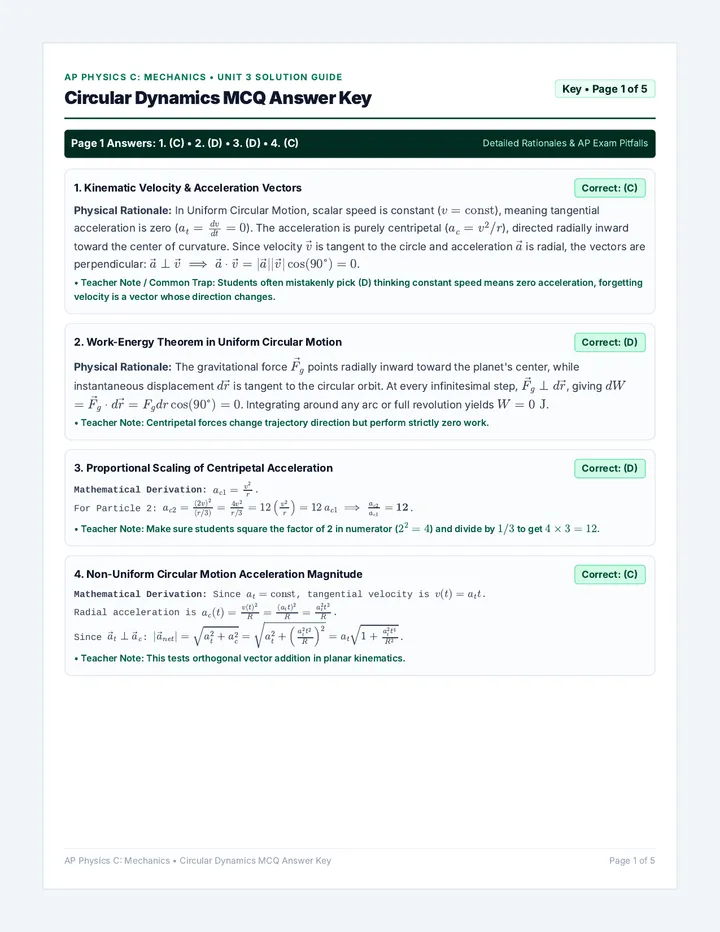
5. Automobile Turning on a Flat Unbanked Curve Correct: (C)
Physical Rationale: On a level surface, gravity and normal force are vertical and balance (\(F_N = mg\)). To accelerate horizontally toward the center of curvature, an unbalanced horizontal force must exist. Static friction between tire contact patches and pavement points radially inward, supplying \(\Sigma F_r = f_s = m v^2/r\).
• Teacher Note: Reiterate that tires roll without slipping laterally, so static (not kinetic) friction governs safe turning.
6. Mass Comparison on Flat Circular Track Correct: (A)
Mathematical Derivation: Required force is \(f_s = m v^2/r\). For Car B with mass \(2m\), required friction is \(2m v^2/r = 2 f_{s,A}\) (twice as large).
However, maximum static friction is \(f_{s,max} = \mu_s F_N = \mu_s mg\). Equating: \(m v^2/r = \mu_s mg \implies v_{max} = \sqrt{\mu_s gr}\). Mass cancels completely; both cars share the exact same speed limit!
• Teacher Note: This is an essential AP concept: vehicle mass does not change the maximum safe turning speed.
7. Critical Slipping Radius on a Rotating Turntable Correct: (B)
Mathematical Derivation: In terms of period \(T\) (\(v = 2\pi r / T\)), the required centripetal force is \(f_s = m \frac{v^2}{r} = \frac{4\pi^2 m r}{T^2}\).
Setting \(f_s \le \mu_s mg\): \(\frac{4\pi^2 m r_{max}}{T^2} = \mu_s mg \implies r_{max} = \frac{\mu_s g T^2}{4\pi^2}\).
• Teacher Note: If placed further out (\(r > r_{max}\)), static friction cannot meet demand and the coin slips outward.
8. Comparative Slipping of Two Coins on a Turntable Correct: (B)
Physical Rationale: Both coins have the same period \(T\). The required centripetal acceleration is \(a_c = 4\pi^2 r / T^2 \propto r\). Coin \(C_2\) at \(r = 2d\) requires twice as much centripetal acceleration (and twice as much static friction) as Coin \(C_1\) at \(r = d\). As \(T\) decreases, Coin \(C_2\) reaches its static friction limit (\(\mu_s g\)) first and slips.
• Teacher Note: This reinforces that at fixed rotation period, larger radius demands higher centripetal force.
AP Physics C: Mechanics • Circular Dynamics MCQ Answer Key Page 2 of 5
AP Physics C: Mechanics • Unit 3 Solution Guide Key • Page 3 of 5
Page 3 Answers: 9. (C) • 10. (A) • 11. (C) • 12. (B) Detailed Rationales & AP Exam Pitfalls
9. Frictionless Banked Turn Design Speed Correct: (C)
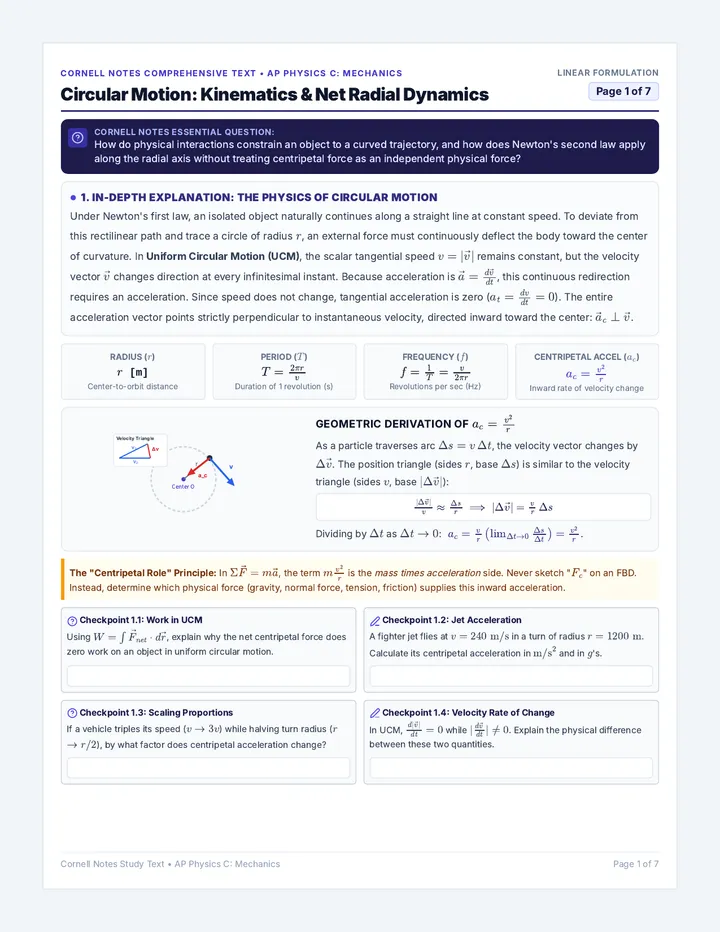
Mathematical Derivation: Vertical equilibrium: \(\Sigma F_y = F_N\cos\theta - mg = 0 \implies F_N = \frac{mg}{\cos\theta}\).
Horizontal centripetal balance: \(\Sigma F_x = F_N\sin\theta = m\,\frac{v^2}{r}\).
Dividing: \(\frac{F_N\sin\theta}{F_N\cos\theta} = \frac{m v^2 / r}{mg} \implies \tan\theta = \frac{v^2}{gr} \implies v_{ideal} = \sqrt{gr\tan\theta}\).
• Teacher Note: This is the rated design speed: the normal force alone provides the required centripetal acceleration.
10. Direction of Static Friction on a Banked Curve Correct: (A)
Physical Rationale: When traveling faster than ideal design speed (\(v > v_{ideal}\)), the horizontal normal force component \(F_N\sin\theta\) is insufficient to supply \(m v^2/r\). The vehicle tends to slide upward along the incline toward the outside of the turn. Static friction opposes this impending slip by pointing down the incline toward the inside of the curve.
• Teacher Note: Conversely, if \(v < v_{ideal}\), the car tends to slide down the slope, so friction points up the incline.
11. Normal Force Magnitude on a Banked Road Correct: (C)
Mathematical Derivation: Since there is zero vertical acceleration (\(a_y = 0\)):
\(\Sigma F_y = F_N\cos\theta - mg = 0 \implies F_N = \frac{mg}{\cos\theta}\).
Because \(\cos\theta < 1\) for any angle \(\theta > 0\), \(F_N > mg\). The road supports more than the car's rest weight!
• Teacher Note: Common trap: students confuse this with an object on a stationary inclined plane where \(F_N = mg\cos\theta\). On a flat horizontal turn, \(a\) is horizontal, requiring \(F_N = mg/\cos\theta\).
12. Slow Vehicle on a Frictionless Banked Track Correct: (B)
Physical Rationale: On a frictionless track with \(v < v_{ideal}\), the centripetal demand \(m v^2/r\) is less than the inward horizontal component \(F_N\sin\theta\). The net horizontal force exceeds what is needed to maintain the circular radius, accelerating the vehicle down the incline toward the inside of the curve.
• Teacher Note: Real-world engineering context: this explains why icy banked turns can cause slow cars to slide down into the median.
AP Physics C: Mechanics • Circular Dynamics MCQ Answer Key Page 3 of 5
AP Physics C: Mechanics • Unit 3 Solution Guide Key • Page 4 of 5
Page 4 Answers: 13. (C) • 14. (D) • 15. (B) • 16. (C) Detailed Rationales & AP Exam Pitfalls
13. Cord Tension in a Conical Pendulum Correct: (C)
Mathematical Derivation: The bob moves in a horizontal plane, so vertical acceleration is zero (\(a_y = 0\)).
\(\Sigma F_y = T\cos\theta - mg = 0 \implies T = \frac{mg}{\cos\theta}\).
Because \(\cos\theta < 1\), the cord tension always strictly exceeds the bob's rest weight: \(T > mg\).
• Teacher Note: As \(\theta \to 90^\circ\), \(\cos\theta \to 0\), meaning \(T \to \infty\). A conical pendulum string can never become perfectly horizontal.
14. Period Scaling of a Conical Pendulum Correct: (D)
Mathematical Derivation: The period is \(T_p = 2\pi\sqrt{\frac{L\cos\theta}{g}}\).
Since period scales with the square root of length (\(T_p \propto \sqrt{L}\)), quadrupling length (\(4L\)) gives:
\(T_p' = 2\pi\sqrt{\frac{(4L)\cos\theta}{g}} = \sqrt{4}\left(2\pi\sqrt{\frac{L\cos\theta}{g}}\right) = 2\,T_p\). The period doubles.
• Teacher Note: Notice the mathematical identity with a simple planar pendulum of length \(h = L\cos\theta\).
15. Minimum Safe Speed in the Carnival Rotor Correct: (B)
Mathematical Derivation: The wall normal force provides centripetal acceleration: \(F_N = m v^2/R\).
Vertical equilibrium prevents slipping: \(f_s = mg\).
Static friction limit: \(f_s \le \mu_s F_N \implies mg \le \mu_s\left(m\,\frac{v^2}{R}\right) \implies v_{min} = \sqrt{\frac{gR}{\mu_s}}\).
• Teacher Note: Mass \(m\) cancels completely: riders of any weight stick with identical safety margins.
16. Dynamic Scaling in the Rotor Ride Correct: (C)
Physical Rationale: The wall normal force scales quadratically with speed (\(F_N = m v^2/R \propto v^2\)), so doubling \(v\) quadruples \(F_N\) (\(4\times\)). However, vertical equilibrium strictly requires \(f_s - mg = 0 \implies f_s = mg\). Because the rider's weight is constant, the actual static friction force remains unchanged (\(1\times\)). The maximum possible friction capacity \(\mu_s F_N\) quadruples, but the actual force needed to hold the rider up remains \(mg\).
• Teacher Note: Classic AP trap: students often assume \(f_s = \mu_s F_N\) at all times, rather than \(f_s \le \mu_s F_N\).
AP Physics C: Mechanics • Circular Dynamics MCQ Answer Key Page 4 of 5
AP Physics C: Mechanics • Unit 3 Solution Guide Key • Page 5 of 5
Page 5 Answers: 17. (C) • 18. (C) • 19. (C) • 20. (D) Detailed Rationales & AP Exam Pitfalls
17. Vertical String Tension Difference Correct: (C)
Mathematical Derivation:
At apex: \(T_{top} + mg = m\,\frac{v_{top}^2}{R} \implies T_{top} = \frac{m v_{top}^2}{R} - mg\).
At nadir: \(T_{bot} - mg = m\,\frac{v_{bot}^2}{R} \implies T_{bot} = \frac{m v_{bot}^2}{R} + mg\).
Energy conservation: \(\frac{1}{2}m v_{bot}^2 = \frac{1}{2}m v_{top}^2 + mg(2R) \implies v_{bot}^2 - v_{top}^2 = 4gR\).
\(T_{bot} - T_{top} = \frac{m(v_{bot}^2 - v_{top}^2)}{R} + 2mg = \frac{m(4gR)}{R} + 2mg = 4mg + 2mg = \mathbf{6\,mg}\).
• Teacher Note: This \(6mg\) tension difference is constant for any free vertical circular motion, independent of radius or speed.
18. Critical Speed to Prevent String Slacking Correct: (C)
Mathematical Derivation: At the apex, \(\Sigma F_r = T_{top} + mg = m v_{top}^2 / R\).
The string remains taut as long as \(T_{top} \ge 0\). The minimum critical speed occurs when tension drops to zero (\(T_{top} = 0\)):
\(0 + mg = m\,\frac{v_{crit}^2}{R} \implies v_{crit} = \sqrt{gR}\).
• Teacher Note: At \(v_{crit}\), gravity alone provides the exact inward acceleration needed to maintain the circular arc.
19. Ferris Wheel Apparent Weight Ratio Correct: (C)
Mathematical Derivation: Here \(v^2 / R = (gR/2)/R = g/2\).
At top: \(mg - F_{N,top} = m(v^2/R) = mg/2 \implies F_{N,top} = mg - mg/2 = 0.5\,mg\).
At bottom: \(F_{N,bot} - mg = m(v^2/R) = mg/2 \implies F_{N,bot} = mg + mg/2 = 1.5\,mg\).
Ratio: \(\frac{F_{N,bot}}{F_{N,top}} = \frac{1.5\,mg}{0.5\,mg} = \mathbf{3.0}\).
• Teacher Note: The passenger feels three times heavier at the bottom than at the top!
20. Inverted Roller Coaster Normal Force Correct: (D)
Mathematical Derivation: Released from rest at \(h = 2.5R\):
Speed at bottom: \(\frac{1}{2}m v_{bot}^2 = mgh = mg(2.5R) \implies v_{bot}^2 = 5gR\).
Newton's 2nd law at lowest point: \(F_{N,bot} - mg = m\,\frac{v_{bot}^2}{R} = \frac{m(5gR)}{R} = 5mg\).
\(F_{N,bot} = 5mg + mg = \mathbf{6\,mg}\).
• Teacher Note: This severe \(6g\) load is why roller coaster designers use clothoid loops rather than pure circular loops.
AP Physics C: Mechanics • Circular Dynamics MCQ Answer Key Page 5 of 5
AP Physics C: Mechanics • Chapter 6: Work & Energy Page 1 of 11
AP Physics C: Mechanics • Chapter 6 Page 2 of 11
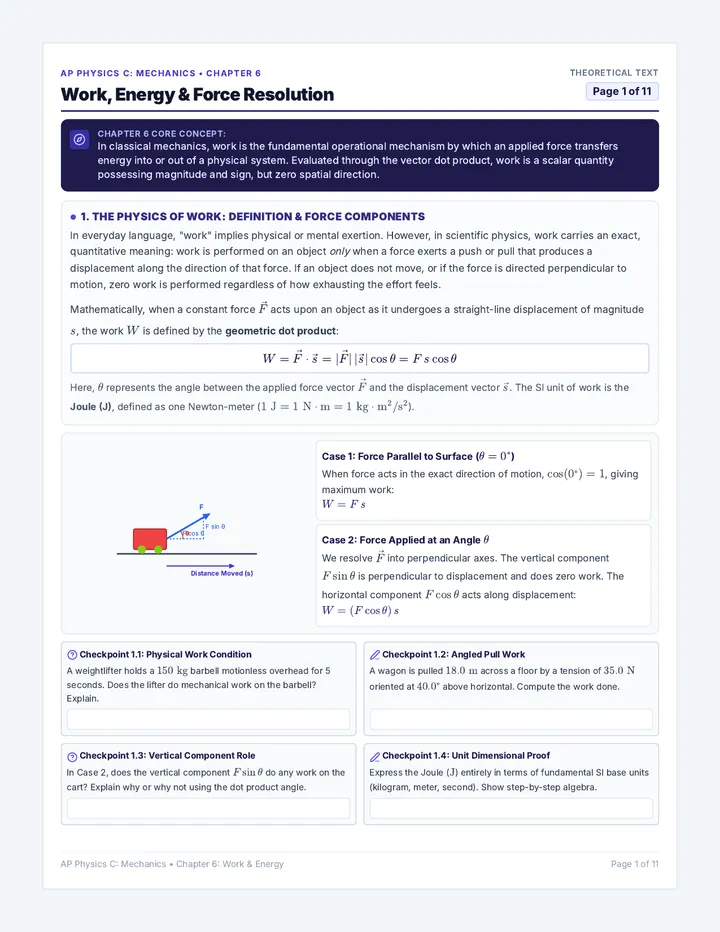
Because the dot product contains \(\cos\theta\), the algebraic sign of mechanical work is governed entirely by the relative angle \(\theta\) between the applied force vector \(\vec{F}\) and the displacement vector \(\vec{d}\).
(a) Positive Work (\(W > 0\)) d F θ \(-90^\circ < \theta < 90^\circ\) \(\cos\theta > 0\); energy added; speed increases.
(b) Zero Work (\(W = 0\)) d F \(\theta = \pm 90^\circ\) (\(\vec{F} \perp \vec{d}\)) \(\cos(90^\circ) = 0\); zero energy transferred.
(c) Negative Work (\(W < 0\)) d F θ \(90^\circ < \theta \le 180^\circ\) \(\cos\theta < 0\); energy removed; speed decreases.
Example 1: Carrying an Object Horizontally
When a person walks across a room carrying an object, their hands exert an upward supporting force (\(\vec{F}_{up}\)) to balance gravity. However, displacement \(\vec{d}\) is horizontal (\(\theta = 90^\circ\)): \(W = F\,d\cos(90^\circ) = 0\text{ J}\) The upward lifting force does no work on the object because it has zero component along the displacement.
Example 2: Centripetal Forces in Orbit
For a satellite or celestial body in a circular orbit, gravity acts radially inward toward the central mass, while instantaneous velocity is tangent to the circle (\(\vec{F}_g \perp \vec{v}\)): \(dW = \vec{F}_c \cdot d\vec{r} = F_c\,dr\cos(90^\circ) = 0\text{ J}\) Centripetal forces continually alter the trajectory direction, but do strictly zero work.
Apple Falling Downward (\(W_g > 0\)): Force \(m\vec{g}\) and displacement \(\vec{d}\) both point downward (\(\theta = 0^\circ\)). \(W_g = (mg)d\cos(0^\circ) = +mgh > 0\) Positive work adds kinetic energy; the falling apple speeds up.
Apple Tossed Upward (\(W_g < 0\)): Force \(m\vec{g}\) points downward while displacement \(\vec{d}\) is upward (\(\theta = 180^\circ\)). \(W_g = (mg)d\cos(180^\circ) = -mgh < 0\) Negative work extracts kinetic energy; the rising apple slows down.
Checkpoint 2.1: Horizontal Book Walk A student walks \(15.0\text{ m}\) at constant speed carrying a \(4.0\text{ kg}\) backpack horizontally. How much work do their arms do?
Checkpoint 2.2: Magnetic Field Work A proton enters a uniform magnetic field where the magnetic force is \(\vec{F}_B = q(\vec{v}\times\vec{B})\). Does the magnetic field do work?
Checkpoint 2.3: Upward Toss Work A \(0.15\text{ kg}\) baseball is tossed straight up to a peak height of \(12.0\text{ m}\). Calculate the work done by gravity during the ascent.
Checkpoint 2.4: Lowered Elevator Cable An elevator descends at constant speed. What is the algebraic sign (\(+\), \(-\), or \(0\)) of the work done by the upward cable tension?
AP Physics C: Mechanics • Chapter 6: Work & Energy Page 2 of 11
AP Physics C: Mechanics • Chapter 6 Page 3 of 11
Kinetic friction \(\vec{f}_k\) invariably opposes the instantaneous relative sliding motion between contacting surfaces. Because the angle between kinetic friction and displacement is always \(\theta = 180^\circ\), the work done by kinetic friction is inherently negative: \(W_f = f_k s\cos(180^\circ) = -f_k s\).
Recall that the magnitude of friction depends on the perpendicular contact normal force: \(f_k = \mu_k F_N\). When applied external forces possess vertical components, the normal force is altered, directly modifying the friction force and the mechanical energy dissipated:
Force Applied Parallel to Surface: Vertical balance: \(F_N = mg\). Friction: \(f_k = \mu_k mg\).
\(W_T = W_{app} + W_f = F\,s - \mu_k mg\,s\)
Friction work scales strictly with object rest weight \(mg\).
Force Applied at Angle \(\theta\) Above Horizontal: Vertical balance: \(F_N + F\sin\theta = mg \implies F_N = mg - F\sin\theta\).
\(W_T = (F\cos\theta)s - \mu_k(mg - F\sin\theta)s\)
The upward component lifts the box, reducing normal force and friction!
Motion (s) Applied F Friction f_k F_N mg
When friction does negative work on an object, mechanical energy is not conserved; it is dissipated into random thermal vibrations of the contacting atoms (internal thermal energy, or heat \(Q\)):
\(\Delta E_{thermal} = -W_f = +f_k\,s = +\mu_k F_N\,s\)
This thermal energy cannot be spontaneously recovered to do macroscopic mechanical work, illustrating the Second Law of Thermodynamics.
Checkpoint 3.1: Friction Angle Why is the angle \(\theta\) between kinetic friction and displacement always exactly \(180^\circ\) for any sliding motion?
Checkpoint 3.2: Downward Push Effect A box is pushed with force \(F\) angled at \(\theta\) below the horizontal. Express the normal force \(F_N\) and friction work \(W_f\).
Checkpoint 3.3: Incline Friction A crate of mass \(m\) slides distance \(d\) down a ramp of angle \(\phi\) with friction coefficient \(\mu_k\). Express \(W_f\) symbolically.
Checkpoint 3.4: Static Friction Work Can static friction ever perform positive mechanical work on an object? Give a clear real-world physical example.
AP Physics C: Mechanics • Chapter 6: Work & Energy Page 3 of 11
AP Physics C: Mechanics • Chapter 6 Page 4 of 11
In real physical systems, forces rarely remain constant over distance. When a force varies with spatial position \(F = F(x)\), simple multiplication fails. Work must be calculated as the definite integral—the geometric area under the curve of a Force versus Displacement graph.
Constant Force: Rectangle W = F · d x_m \(W = F \Delta x\)
Linear Spring: Triangle W = ½ k x² x_m \(W = \frac{1}{2}(F_0 + F)d\)
Arbitrary Force: Integral W = ∫ F(x)dx x_m \(W = \int_{x_0}^x F(x')dx'\)
Dividing the total path into infinitesimal displacements \(dx\), during which the force \(F(x)\) is approximately constant, the incremental work is \(dW = F(x)\,dx\). Integrating over the full path from initial position \(x_0\) to final position \(x\):
\(W = \int_{x_0}^x F(x')\,dx'\)
If the force changes at a constant linear rate from \(F_0\) to \(F\), the area is a trapezoid: \(W = \bar{F}\,d = \frac{1}{2}(F_0 + F)d\).
According to Hooke's Law, an ideal spring exerts a restoring force \(F_s = -kx\). An external agent stretching the spring must apply an opposing force \(F_{ext} = +kx\). The work done by this external agent from rest position (\(x = 0\)) to extension \(x\) is:
\(W_{ext} = \int_0^x (kx')\,dx' = \left[\frac{1}{2}k(x')^2\right]_0^x = \frac{1}{2}k x^2\)
This work is stored completely within the spring as elastic potential energy (\(U_s = \frac{1}{2}kx^2\)).
Checkpoint 4.1: Polynomial Force A 1D force \(F(x) = (6.0 x^2 - 4.0 x)\text{ N}\) acts from \(x = 0\) to \(x = 3.0\text{ m}\). Calculate the total work done.
Checkpoint 4.2: Spring Work Ratio How much more work is required to stretch a spring from \(x\) to \(3x\) compared to stretching it from \(0\) to \(x\)?
Checkpoint 4.3: Negative Area If an \(F\) vs \(x\) graph dips below the horizontal axis (\(F < 0\)), what does the enclosed area represent physically?
Checkpoint 4.4: Variable Spring A non-linear spring exerts \(F(x) = k_1 x + k_2 x^3\). Derive the work done by an external agent to stretch it to \(x = D\).
AP Physics C: Mechanics • Chapter 6: Work & Energy Page 4 of 11
AP Physics C: Mechanics • Chapter 6 Page 5 of 11
The Work-Energy Theorem forms the central bridge between Newtonian forces and energy conservation: the net mechanical work performed by all combined forces acting upon a body equals the net change in its kinetic energy: \(W_{net} = \Delta K\).
Using Newton's second law \(F_{net} = m a\) and expressing acceleration via the chain rule as \(a = \frac{dv}{dt} = \frac{dv}{dx}\frac{dx}{dt} = v\frac{dv}{dx}\):
\(W_{net} = \int_{x_0}^x F_{net}\,dx' = \int_{x_0}^x (m a)\,dx'\)
\(W_{net} = \int m\left(\frac{dv}{dt}\right)dx' = \int m\left(\frac{dx'}{dt}\right)dv = \int_{v_0}^v m v'\,dv'\)
\(W_{net} = \left[\frac{1}{2}m(v')^2\right]_{v_0}^v = \frac{1}{2}m v^2 - \frac{1}{2}m v_0^2 = K_f - K_i = \Delta K\)
This proves that Kinetic Energy is defined as \(K = \frac{1}{2}m v^2\). Kinetic energy is always non-negative (\(K \ge 0\)) and is a scalar.
v Kinetic Energy (K) v → K 2v → 4K
Because kinetic energy scales with the square of speed (\(K \propto v^2\)), doubling an automobile's speed requires four times as much work to accelerate and four times as much distance to stop under constant braking friction.
\(W_{brake} = -f_k\,d = 0 - \frac{1}{2}mv^2 \implies d = \frac{v^2}{2\mu_k g}\)
Checkpoint 5.1: Braking Distance A car traveling at speed \(v\) stops in distance \(D\). If the driver increases speed to \(3v\), what is the new stopping distance?
Checkpoint 5.2: Speed from Work A \(1200\text{ kg}\) car at rest has \(+150\text{ kJ}\) of net work done on it. Compute its final speed \(v\).
Checkpoint 5.3: Friction Applicability Does the Work-Energy Theorem hold true when non-conservative forces like friction or drag are present? Explain why.
Checkpoint 5.4: Base Runner Stopping A \(70\text{ kg}\) player slides at \(v_0 = 4.0\text{ m/s}\) to rest with \(\mu_k = 0.70\). Calculate the stopping distance \(d\).
AP Physics C: Mechanics • Chapter 6: Work & Energy Page 5 of 11
AP Physics C: Mechanics • Chapter 6 Page 6 of 11
Energy is defined as the capability of a physical system to perform mechanical work (Slide 14). In mechanics, we distinguish between Mechanical Energy—which can be directly recovered—and non-mechanical energy dissipated by friction into microscopic heat.
Mechanical Energy (\(E_{mech}\)) is the total macroscopic energy possessed by an object due to its motion or its spatial position relative to an interacting field. It consists of two constituent components:
\(E_{mech} = \text{Kinetic Energy} + \text{Potential Energy} = K + U\)
Kinetic Energy (\(K = \frac{1}{2}mv^2\)): Energy of motion; dependent purely on object mass and scalar speed.
Potential Energy (\(U\)): Stored energy of position; exists only when conservative interaction forces act.
When an object slides against a rough surface, kinetic friction performs negative work (\(W_f < 0\)). This negative work extracts macroscopic mechanical energy and converts it into non-mechanical thermal energy:
\(\Delta E_{mech} = E_{final} - E_{initial} = W_f = -f_k\,s = -\mu_k F_N\,s\)
The mechanical energy lost is quantitatively equal to the thermal energy generated: \(\Delta E_{thermal} = -W_f = +f_k s\). Consequently, the final total mechanical energy is always strictly less than initial: \((TME)_{final} = (TME)_{initial} - \mu_k F_N\,s\)
Checkpoint 6.1: Mechanical Energy Definition What two distinct physical forms comprise total mechanical energy? Express the governing formula.
Checkpoint 6.2: Friction Dissipation A \(4.0\text{ kg}\) block with \(50\text{ J}\) of mechanical energy slides \(3.0\text{ m}\) against \(f_k = 8.0\text{ N}\). Find final \(E_{mech}\).
Checkpoint 6.3: Energy Irreversibility Why cannot the thermal energy produced by friction spontaneously turn back into macroscopic kinetic energy?
Checkpoint 6.4: Sled Stopping Work A sled loses \(600\text{ J}\) of kinetic energy while sliding to rest on snow. How much thermal energy was generated?
AP Physics C: Mechanics • Chapter 6: Work & Energy Page 6 of 11
AP Physics C: Mechanics • Chapter 6 Page 7 of 11
Potential energy (\(U\)) is the stored energy of configuration possessed by an object due to its position within a conservative force field. Work done against a conservative force increases the system's potential energy: \(\Delta U = -W_{cons}\).
Gravitational Potential Energy (Slide 16)
For an object of mass \(m\) near Earth's surface lifted vertically through height \(h\):
\(U_g(h) = m\,g\,h\)
Height (h) U_g
Linear relation: \(U_g \propto h\). Doubling height strictly doubles stored energy.
Elastic Spring Potential Energy (Slide 17, 19)
For an ideal spring of stiffness constant \(k\) stretched or compressed by distance \(x\):
\(U_s(x) = \frac{1}{2}\,k\,x^2\)
x U_s
Parabolic relation: \(U_s \propto x^2\). Doubling stretch quadruples stored energy.
In an ideal mass-spring system oscillating with amplitude \(A\), mechanical energy continuously trades between potential and kinetic forms:
At \(x = \pm A\) \(E = U_{max} = \frac{1}{2}kA^2\)
\(K = 0\) (Turning points)
At \(x = 0\) \(E = K_{max} = \frac{1}{2}mv_{max}^2\)
\(U = 0\) (Equilibrium)
Between \(0 < |x| < A\) \(E = \frac{1}{2}mv^2 + \frac{1}{2}kx^2\)
\(E = \text{Constant}\)
Checkpoint 7.1: Datum Arbitrariness Does changing the reference height where \(U_g = 0\) alter the calculated physical acceleration or final speed of a falling object?
Checkpoint 7.2: Half-Amplitude Energy In SHM with amplitude \(A\), what percentage of total mechanical energy is kinetic when the position is \(x = A/2\)?
Checkpoint 7.3: Spring Constant Calculation A \(0.50\text{ kg}\) mass hanging vertically stretches a spring by \(0.10\text{ m}\). Calculate the spring constant \(k\) and stored energy.
Checkpoint 7.4: Compression vs Extension Does compressing a spring by distance \(x\) store more, less, or equal potential energy compared to stretching it by \(x\)?
AP Physics C: Mechanics • Chapter 6: Work & Energy Page 7 of 11
AP Physics C: Mechanics • Chapter 6 Page 8 of 11
In conservative systems, total mechanical energy \(E = K + U\) remains constant. Bar charts provide a powerful visual representation of how energy transfers between potential, kinetic, and dissipative friction channels.
State 1 (Top Left) PE KE = TME State 2 (Bottom) PE KE = TME State 3 (Conservative) PE KE = TME
Key Visual Takeaways: At State 1 (top), energy is \(100\%\) potential. As the cart descends into State 2 (bottom), all potential energy transforms into kinetic energy (\(PE \to 0\), \(KE \to \text{Max}\)). In a conservative system, the cart reaches the exact same height at State 3. The total bar (yellow) remains completely constant.
When track friction acts along distance \(s\), the total mechanical energy is reduced: \((PE + KE)_{initial} = (PE + KE)_{final} + |W_f| \iff E_{i} = E_{f} + \mu_k F_N\,s\) On the bar chart, the final total mechanical energy bar is shorter than the initial bar by an amount exactly equal to the thermal dissipation bar \(W_f\).
Checkpoint 8.1: Midpoint Bar Height At what height relative to the bottom is the kinetic energy bar exactly equal to the potential energy bar?
Checkpoint 8.2: Friction Runout Height If friction removes \(20\%\) of initial mechanical energy, what fraction of the release height \(h\) does the cart reach on the right?
Checkpoint 8.3: Bar Conservation Does the sum of \(PE + KE\) change when an object accelerates under gravity alone? Explain using the bar diagram.
Checkpoint 8.4: Bottom Speed A \(3.0\text{ kg}\) cart drops from height \(h = 4.9\text{ m}\) without friction. Calculate its speed at the bottom.
AP Physics C: Mechanics • Chapter 6: Work & Energy Page 8 of 11
AP Physics C: Mechanics • Chapter 6 Page 9 of 11
Potential energy curves \(U(x)\) provide a complete, powerful graphical landscape of 1D particle dynamics. By analyzing slopes, local extrema, and curvature, one can determine instantaneous forces, velocities, and stability.
Differential Relation \(F(x) = -\frac{dU}{dx}\)
Integral Relation \(U(x) = -\int_{x_0}^x F(x')\,dx'\)
The Negative Slope Principle: The physical force acting on a particle is the negative slope of the potential energy curve. If \(U(x)\) slopes downward to the right (\(\frac{dU}{dx} < 0\)), the force pushes to the right (\(F > 0\)). If \(U(x)\) slopes upward (\(\frac{dU}{dx} > 0\)), the force pushes to the left (\(F < 0\)).
When a particle with constant total mechanical energy \(E\) moves in a potential well:
Kinetic Energy \(K(x) = E - U(x)\)
Vertical gap between \(E\) and \(U\)
Turning Points \(E = U(x) \implies K = 0\)
Particle stops and reverses
Forbidden Zone \(E < U(x) \implies K < 0\)
Physically impossible classically
The particle's linear speed at any coordinate \(x\) is given directly by: \(v(x) = \sqrt{\frac{2(E - U(x))}{m}}\). Speed is maximal where the potential energy curve dips to its lowest point (deepest well).
Stable Equilibrium \(\frac{dU}{dx} = 0,\; \frac{d^2U}{dx^2} > 0\) Local Minimum. Small displacement creates restoring force.
Unstable Equilibrium \(\frac{dU}{dx} = 0,\; \frac{d^2U}{dx^2} < 0\) Local Maximum. Small displacement creates repelling force.
Neutral Equilibrium \(\frac{dU}{dx} = 0,\; \frac{d^2U}{dx^2} = 0\) Flat Plateau. Small displacement produces zero net force.
Checkpoint 9.1: Force from Potential Given \(U(x) = (4.0 x^3 - 12.0 x)\text{ J}\), derive the force function \(F(x)\) and find the equilibrium positions.
Checkpoint 9.2: Curvature Classification For the equilibrium coordinates in Checkpoint 9.1, evaluate \(\frac{d^2U}{dx^2}\) to classify each as stable or unstable.
Checkpoint 9.3: Kinetic Energy from Curve A \(0.50\text{ kg}\) particle has \(E = 25\text{ J}\). At coordinate \(x_1\), \(U = 9\text{ J}\). Find its linear speed at \(x_1\).
Checkpoint 9.4: Classical Turning Point Why cannot a classical particle enter a spatial region where the potential energy curve exceeds total energy (\(U(x) > E\))?
AP Physics C: Mechanics • Chapter 6: Work & Energy Page 9 of 11
AP Physics C: Mechanics • Chapter 6 Page 10 of 11
Slide 30 (Example 5.8c) presents a multi-well potential energy function \(U(x)\). Here is the full-page, comprehensive analysis evaluating force signs, zero-force points, and stability at every labeled location.
Potential Energy Graph (Slide 30: Example 5.8c) Grid units: PE in Joules, x in meters
0 10 20 30 40 50 60 PE (J) 0 1.0 2.0 3.0 4.0 x (m) Release point (x = 0.25 m) A B C D E F G H I
a) Force is Negative (\(F < 0\)): Occurs where slope is positive (\(dU/dx > 0\)):
• Points D, H, I. The force pushes to the left (\(-\hat{i}\)).
b) Force is Positive (\(F > 0\)): Occurs where slope is negative (\(dU/dx < 0\)):
• Points A, B, F. The force pushes to the right (\(+\hat{i}\)).
c) Force is Zero (\(F = 0\)): Occurs at horizontal tangents (\(dU/dx = 0\)):
• Points C, E, G. These are equilibrium points.
d & e) Stability Classifications: • Stable Points: C and G (Local minima, concave up).
• Unstable Point: E (Local maximum, concave down).
Checkpoint 10.1: Release Motion A particle is released from rest at Point A (\(U = 45\text{ J}\)). In which direction does it accelerate? Explain using slope.
Checkpoint 10.2: Barrier Crossing Can the particle released at Point A (\(E = 45\text{ J}\)) cross the hill at Point E (\(U = 20\text{ J}\))? Explain.
Checkpoint 10.3: Maximum Speed Coordinate At which labeled point on the entire curve will the particle achieve its absolute maximum linear speed?
Checkpoint 10.4: Right Turning Point At what approximate coordinate \(x\) on the right slope will the particle come to a momentary stop?
AP Physics C: Mechanics • Chapter 6: Work & Energy Page 10 of 11
AP Physics C: Mechanics • Chapter 6 Page 11 of 11
Power measures the instantaneous rate at which work is performed or energy is transformed across time (Slide 31). Running up stairs requires the exact same change in gravitational potential energy (\(\Delta U_g = mgh\)) as walking, but requires far greater power because the time interval \(\Delta t\) is smaller.
Average Power (Slide 31): \(\bar{P} = \frac{\Delta W}{\Delta t} = \frac{\Delta E}{\Delta t}\)
SI Unit: Watt (\(1\text{ W} = 1\text{ J/s} = 1\text{ kg}\cdot\text{m}^2/\text{s}^3\)); \(1\text{ hp} = 746\text{ W}\).
Instantaneous Power (Slide 32): \(P = \frac{dW}{dt} = \vec{F} \cdot \frac{d\vec{r}}{dt} = \vec{F} \cdot \vec{v} = F v\cos\theta\)
Dot product of applied force vector and instantaneous velocity vector.
F_drive F_R mg
When a car climbs an incline of angle \(\alpha\) at constant velocity \(v\), the engine must overcome both the gravitational component \(mg\sin\alpha\) and rolling resistance \(F_R\):
\(P = (mg\sin\alpha + F_R)\,v\)
| Physical Concept | Governing AP Calculus Formula | Key Constraint / Condition |
|---|---|---|
| Work (1D Variable) | \(W = \int F(x)\,dx\) | Area under \(F\) vs \(x\) curve |
| Work-Energy Theorem | \(W_{net} = \Delta K = \frac{1}{2}mv_f^2 - \frac{1}{2}mv_i^2\) | Applies to all forces (conservative & non-cons) |
| Conservative Force | \(F(x) = -\frac{dU}{dx} \iff \Delta U = -W_{cons}\) | \(\oint \vec{F}\cdot d\vec{r} = 0\); path-independent |
| Non-Conservative Energy | \(W_{nc} = \Delta E_{mech} = \Delta K + \Delta U\) | Friction, drag; dissipates into thermal heat |
| Instantaneous Power | \(P = \vec{F} \cdot \vec{v} = F v\cos\theta\) | Scalar rate of mechanical work transfer |
Checkpoint 11.1: Elevator Power An elevator of mass \(1200\text{ kg}\) rises vertically at \(2.5\text{ m/s}\) constant speed. Calculate the motor power in kW.
Checkpoint 11.2: Car Hill Climb Power A \(1500\text{ kg}\) car climbs a \(10.0^\circ\) incline at \(22.0\text{ m/s}\) against \(F_R = 350\text{ N}\). Compute required power in hp.
Checkpoint 11.3: Air Drag Scaling If aerodynamic drag force scales as \(F_{drag} \propto v^2\), prove that the power required to overcome drag scales as \(P \propto v^3\).
Checkpoint 11.4: Accelerating Engine A \(1000\text{ kg}\) car accelerates from rest at constant acceleration \(a = 2.5\text{ m/s}^2\). Express output power as a function of time \(P(t)\).
AP Physics C: Mechanics • Chapter 6: Work & Energy Page 11 of 11
(a) Calculate the elastic potential energy stored in the compressed spring:
(b) Find the speed \(v\) of the block at the exact moment it leaves the spring:
(c) Using the Work-Energy Theorem, calculate how far \(d\) the block slides along the rough floor before coming to rest:
AP Physics C: Mechanics • Chapter 6: Work & Energy Page 2 of 5
AP Physics C: Mechanics • Chapter 6 Assignment Page 3 of 5
Part 3: Energy Conservation & Simple Harmonic Motion Curved Tracks & Oscillator Energy Partitioning
[12 Points Total]
A sled and rider of combined mass \(m = 80\text{ kg}\) start from rest at height \(h = 45.0\text{ m}\) on a frictionless curved snow slope. At the bottom, the slope transitions smoothly into a level runout zone covered in unpacked snow with \(\mu_k = 0.25\).
(a) Using conservation of mechanical energy, calculate the sled's speed at the bottom of the slope:
(b) Sketch the segmented energy bars (PE, KE, Total) at the release point and at the bottom:
Draw bar charts for State 1 and State 2
(c) Using \(W_{nc} = \Delta E_{mech}\), determine the stopping distance \(s\) in the unpacked snow zone:
[10 Points Total]
A block of mass \(m = 0.40\text{ kg}\) attached to a horizontal spring oscillates frictionlessly with amplitude \(A = 0.25\text{ m}\). The spring constant is \(k = 160\text{ N/m}\).
(a) Compute the total mechanical energy \(E\) of the oscillator:
(b) Find the maximum linear speed \(v_{max}\) at the equilibrium position (\(x = 0\)):
(c) At position \(x = A / 2\), calculate: (1) the potential energy \(U\), (2) the kinetic energy \(K\), and (3) the instantaneous speed \(v\):
AP Physics C: Mechanics • Chapter 6: Work & Energy Page 3 of 5
AP Physics C: Mechanics • Chapter 6 Assignment Page 4 of 5
Part 4: Potential Energy Landscapes & Stability Calculus Derivations & Graph Interpretation
[10 Pts]
A particle moves in a conservative field with potential energy \(U(x) = (x^4 - 8.0 x^2 + 16.0)\text{ J}\), where \(x\) is in meters.
(a) Using \(F(x) = -\frac{dU}{dx}\), find all equilibrium positions:
(b) Evaluate \(\frac{d^2U}{dx^2}\) at each point to classify stability:
[12 Pts]
0 10 20 30 40 50 60 PE (J) 0 1.0 2.0 3.0 4.0 x (m) A B C D E F G H I
(a) Identify points where force is negative (\(F < 0\)) and positive (\(F > 0\)):
(b) Identify stable and unstable equilibrium points:
(c) A \(2.0\text{ kg}\) particle is released from rest at Point A (\(U = 45\text{ J}\)). Calculate its speed as it passes Point G (\(U = 5\text{ J}\)):
AP Physics C: Mechanics • Chapter 6: Work & Energy Page 4 of 5
AP Physics C: Mechanics • Chapter 6 Assignment Page 5 of 5
Part 5: Power Dynamics & Conceptual Justifications Instantaneous Rates & AP Deep-Dive
[8 Points]
A \(1400\text{ kg}\) automobile climbs a \(10.0^\circ\) incline at a constant speed of \(v = 25.0\text{ m/s}\). A constant rolling friction and air resistance force \(F_R = 450\text{ N}\) opposes motion.
(a) Draw an FBD of the vehicle and calculate the total engine driving force \(F_{drive}\):
(b) Using \(P = \vec{F}\cdot\vec{v}\), calculate the engine's power output in kilowatts (\(\text{kW}\)) and horsepower (\(\text{hp}\)):
Conceptual 1: Work by Internal Forces When a person jumps straight up from the floor, does the normal force from the floor do positive work on the jumper? Explain carefully.
Conceptual 2: Frame Dependence of Kinetic Energy A passenger on a train moving at \(v\) drops a ball. Is the work done on the ball identical in the train frame and ground frame? Justify.
Conceptual 3: Negative Potential Energy Can the potential energy \(U\) of a system be negative? What is the physical significance of a negative total mechanical energy (\(E < 0\))?
Conceptual 4: Aerodynamic Drag Power Scaling High-speed air drag satisfies \(F_{drag} = c\,v^2\). Prove that the engine power required to overcome drag scales as \(P \propto v^3\).
Conceptual 5: Spring Compression Asymmetry Why does compressing a spring by \(2x\) require four times the work of compressing it by \(x\), rather than just double the work?
AP Physics C: Mechanics • Chapter 6: Work & Energy Page 5 of 5
(b) Final Speed via Work-Energy [3 Pts]: \(W_{net} = \Delta K = \frac{1}{2}m v_f^2 - \frac{1}{2}m v_i^2\) [1 pt]
\(42.0\text{ J} = \frac{1}{2}(2.0\text{ kg}) v_f^2 - 0\) [1 pt]
\(v_f^2 = 42.0 \implies v_f = \sqrt{42.0} \approx \mathbf{6.48\text{ m/s}}\) [1 pt]
(c) Kinetic Energy at \(x = 2.0\text{ m}\) [3 Pts]: \(K(2) = W(0 \to 2) = \left[ 2.0 x^3 - 2.0 x^2 + 2.0 x \right]_0^2 = 2.0(8) - 2.0(4) + 2.0(2) = 16.0 - 8.0 + 4.0 = \mathbf{12.0\text{ J}}\) [3 pts]
10 Pts
(a) Spring Potential Energy [3 Pts]: \(U_s = \frac{1}{2}k x^2 = \frac{1}{2}(600\text{ N/m})(0.20\text{ m})^2\) [1.5 pts]
\(U_s = 300(0.04) = \mathbf{12.0\text{ J}}\) [1.5 pts]
(b) Release Speed \(v\) [3 Pts]: \(\frac{1}{2}m v^2 = U_s \implies \frac{1}{2}(0.50\text{ kg}) v^2 = 12.0\text{ J}\) [1.5 pts]
\(0.25 v^2 = 12.0 \implies v = \sqrt{48.0} \approx \mathbf{6.93\text{ m/s}}\) [1.5 pts]
(c) Sliding Distance to Rest [4 Pts]: Work-Energy: \(W_{nc} = \Delta E_{mech} \implies -f_k\,d = 0 - U_s = -12.0\text{ J}\) [1.5 pts]
\(f_k = \mu_k mg = (0.30)(0.50\text{ kg})(9.8\text{ m/s}^2) = 1.47\text{ N}\) [1 pt]
\(d = \frac{12.0\text{ J}}{1.47\text{ N}} \approx \mathbf{8.16\text{ m}}\) [1.5 pts]
AP Physics C: Mechanics • Teacher Solution Key Page 2 of 5
AP Physics C: Mechanics • Chapter 6 Solution Key Key • Page 3 of 5
Part 3 Solutions: Energy Conservation & SHM Problems 5 & 6 Rubric [22 Points Total]
12 Pts
(a) Bottom Speed [4 Pts]: \(mgh = \frac{1}{2}m v^2 \implies v = \sqrt{2gh}\) [2 pts]
\(v = \sqrt{2(9.8\text{ m/s}^2)(45.0\text{ m})} = \sqrt{882}\)
\(v \approx \mathbf{29.7\text{ m/s}}\) [2 pts]
(b) Scored Bar Charts [4 Pts]: • Top: PE = 100%, KE = 0, TME = 100% [2 pts]
• Bottom: PE = 0, KE = 100%, TME = 100% [2 pts]
(c) Snow Runout Stopping Distance [4 Pts]: \(W_{nc} = \Delta E_{mech} \implies -f_k\,s = 0 - mgh \implies \mu_k mg\,s = mgh\) [2 pts]
\(s = \frac{h}{\mu_k} = \frac{45.0\text{ m}}{0.25} = \mathbf{180\text{ m}}\) [2 pts]
10 Pts
(a) Total Mechanical Energy \(E\) [3 Pts]: \(E = \frac{1}{2}k A^2 = \frac{1}{2}(160\text{ N/m})(0.25\text{ m})^2\) [1.5 pts]
\(E = 80(0.0625) = \mathbf{5.00\text{ J}}\) [1.5 pts]
(b) Maximum Speed \(v_{max}\) at \(x=0\) [3 Pts]: \(\frac{1}{2}m v_{max}^2 = E \implies \frac{1}{2}(0.40) v_{max}^2 = 5.0\) [1.5 pts]
\(v_{max} = \sqrt{\frac{5.0}{0.20}} = \sqrt{25.0} = \mathbf{5.00\text{ m/s}}\) [1.5 pts]
(c) Energy & Speed at \(x = A / 2\) [4 Pts]: (1) \(U = \frac{1}{2}k(A/2)^2 = \frac{1}{4}\left(\frac{1}{2}kA^2\right) = \frac{1}{4}(5.0\text{ J}) = \mathbf{1.25\text{ J}}\) [1 pt]
(2) \(K = E - U = 5.00 - 1.25 = \mathbf{3.75\text{ J}}\) (\(75\%\) of total energy!) [1.5 pts]
(3) \(\frac{1}{2}(0.40) v^2 = 3.75 \implies v = \sqrt{18.75} \approx \mathbf{4.33\text{ m/s}}\) [1.5 pts]
AP Physics C: Mechanics • Teacher Solution Key Page 3 of 5
AP Physics C: Mechanics • Chapter 6 Solution Key Key • Page 4 of 5
Part 4 Solutions: Potential Energy Curves & Stability Problems 7 & 8 Rubric [22 Points Total]
12 Pts
(a) Force & Equilibria [4 Pts]: \(F(x) = -\frac{dU}{dx} = -(4x^3 - 16x) = -4x(x^2 - 4)\)
Equilibria: \(\mathbf{x = 0},\; \mathbf{x = +2.0\text{ m}},\; \mathbf{x = -2.0\text{ m}}\) [4 pts]
(b) Second Derivative Test [4 Pts]: \(\frac{d^2U}{dx^2} = 12x^2 - 16\)
• At \(x = 0\): \(-16 < 0 \implies\) Unstable [2 pts]
• At \(x = \pm 2\): \(12(4) - 16 = 32 > 0 \implies\) Stable [2 pts]
(c) Turning Points for \(E = 25.0\text{ J}\) [4 Pts]: \(U(x) = 25.0 \implies (x^2 - 4)^2 = 25 \implies x^2 - 4 = +5 \implies x^2 = 9 \implies \mathbf{x = \pm 3.0\text{ m}}\) [4 pts]
10 Pts
A B C D E F G H I
(a) Force Directions [3 Pts]: • \(F > 0\) (pushing right): Points A, B, F (negative slope).
• \(F < 0\) (pushing left): Points D, H, I (positive slope).
(b) Stability Identifications [3 Pts]: • Stable Equilibrium: Minima C and G.
• Unstable Equilibrium: Maximum E.
(c) Speed at Point G [4 Pts]: \(E = U_A = 45\text{ J} \implies K_G = E - U_G = 45 - 5 = 40.0\text{ J} \implies v_G = \sqrt{\frac{2(40.0)}{2.0}} = \sqrt{40.0} \approx \mathbf{6.32\text{ m/s}}\) [4 pts]
AP Physics C: Mechanics • Teacher Solution Key Page 4 of 5
AP Physics C: Mechanics • Chapter 6 Solution Key Key • Page 5 of 5
Part 5 Solutions: Power & Conceptual Justifications Problem 9 (8 Pts) & Conceptual Questions (10 Pts) [18 Pts Total]
8 Pts
(a) Engine Driving Force \(F_{drive}\) [4 Pts]: \(F_{drive} = mg\sin\alpha + F_R\) [2 pts]
\(F_{drive} = (1400\text{ kg})(9.8)\sin(10.0^\circ) + 450\text{ N}\)
\(F_{drive} = 13720(0.1736) + 450 \approx \mathbf{2832\text{ N}}\) [2 pts]
(b) Engine Power Output [4 Pts]: \(P = F_{drive}\,v = (2832.4\text{ N})(25.0\text{ m/s})\)
\(P = 70,810\text{ W} \approx \mathbf{70.8\text{ kW}}\) [2 pts]
\(P = \frac{70810}{746} \approx \mathbf{94.9\text{ hp}}\) [2 pts]
Conceptual 1: Normal Force on a Jumper [2 Pts]: The floor normal force does zero work (\(W_N = 0\)) because the contact point between feet and ground does not displace while the force is applied (\(d\vec{r}_{contact} = 0\)). The jumper's center of mass accelerates upward due to work done by internal leg muscles converting chemical energy into kinetic energy.
Conceptual 2: Frame Dependence of Work & Kinetic Energy [2 Pts]: Work is frame-dependent. In the train frame, the ball moves purely vertically (\(W = mgh\)). In the ground frame, the ball has a horizontal displacement component \(v t\), so observers record different displacements and different calculated work values; however, \(\Delta K = W_{net}\) holds true within each respective frame.
Conceptual 3: Physical Meaning of Negative Potential Energy [2 Pts]: Negative potential energy simply reflects the choice of datum (\(U = 0\) at infinity for gravitation). A negative total mechanical energy (\(E < 0\)) signifies a bound state: the particle cannot escape the potential well to infinity without receiving external energy input.
Conceptual 4: Aerodynamic Drag Power Scaling [2 Pts]: Instantaneous power is \(P = \vec{F}_{drag}\cdot\vec{v} = (c\,v^2)v = c\,v^3\). Therefore, engine power required to overcome drag scales as the cube of velocity (\(P \propto v^3\)). Doubling speed demands an eightfold increase in engine power!
Conceptual 5: Spring Compression Work Asymmetry [2 Pts]: Because the spring force increases linearly with distance (\(F = kx\)), compressing from \(x\) to \(2x\) requires pushing against a much larger average force (\(\frac{3}{2}kx\)) than compressing from \(0\) to \(x\) (\(\frac{1}{2}kx\)). Integrating yields \(W \propto x^2\), producing a fourfold increase in work.
AP Physics C: Mechanics • Teacher Solution Key Page 5 of 5
AP Physics C: Mechanics • Chapter 6: Work & Energy Review Page 1 of 5
AP Physics C: Mechanics • Chapter 6 Review Page 2 of 5
5. Sign of Kinetic Friction Work [1 Pt]
When an object slides across a stationary rough floor, the work done by kinetic friction on the sliding object is always:
v → ← f_k
(A) Positive (along plane).
(B) Zero (interlocking cancel).
(C) Negative, because friction is antiparallel (\(\theta = 180^\circ\)) to displacement.
(D) Depends on applied force.
(E) Stored as potential energy.
6. Normal Force Modulation Under Upward Pull [1 Pt]
A box of mass \(m\) is pulled along a rough floor (\(\mu_k\)) by force \(F\) angled at \(\theta\) above horizontal. The work done by friction over displacement \(s\) is:
F_N mg F
(A) \(W_f = -\mu_k m g\,s\)
(B) \(W_f = -\mu_k(mg - F\sin\theta)\,s\)
(C) \(W_f = -\mu_k(mg + F\sin\theta)\,s\)
(D) \(W_f = -\mu_k(mg - F\cos\theta)\,s\)
(E) \(W_f = -(F\cos\theta)\,s\)
7. Downward Pushing Force vs Upward Pull [1 Pt]
A worker pushes a crate with force \(F\) angled at \(\theta\) below horizontal. How does friction work compare to pulling at \(\theta\) above horizontal?
F (push) f_k
(A) Pushing produces less friction work.
(B) Both produce identical friction work.
(C) Pushing produces greater frictional dissipation because downward force increases \(F_N\).
(D) Pushing produces zero friction work.
(E) Pushing reverses the sign of friction work.
8. Thermal Dissipation Accounting [1 Pt]
A block of mass \(m\) slides across a rough surface through distance \(s\) and stops. The mechanical energy lost by the block is equal to:
Heat Q
(A) \(\mu_k m g s\) (thermal energy generated)
(B) \(m g s\)
(C) \(\frac{1}{2}\mu_k m g s\)
(D) Zero, mechanical energy is conserved
(E) \(\mu_k^2 m g s\)
AP Physics C: Mechanics • Chapter 6: Work & Energy Review Page 2 of 5
AP Physics C: Mechanics • Chapter 6 Review Page 3 of 5
9. Definite Integral for 1D Variable Force [1 Pt]
A net force \(F(x) = c\,x^3\) acts on a particle as it moves from \(x = 0\) to \(x = d\). The work done by this force (shaded area) is:
d F
(A) \(W = c\,d^3\)
(B) \(W = 3 c\,d^2\)
(C) \(W = \frac{1}{4}c\,d^4\)
(D) \(W = \frac{1}{3}c\,d^3\)
(E) \(W = c\,d^4\)
10. Work Done on an Ideal Spring [1 Pt]
An ideal spring (\(F_s = -kx\)) is stretched from \(x = 0\) to \(x = x_1\). The work done by the external stretching agent (triangular area) is:
x_1 ½kx²
(A) \(W = k x_1\)
(B) \(W = -k x_1\)
(C) \(W = \frac{1}{2}k x_1^2\)
(D) \(W = -\frac{1}{2}k x_1^2\)
(E) \(W = \frac{1}{3}k x_1^3\)
11. Work-Energy Theorem Fundamental Relation [1 Pt]
The Work-Energy Theorem states that the net work \(W_{net}\) done on a particle equals:
(A) The change in momentum: \(W_{net} = \Delta p\).
(B) The change in potential energy: \(W_{net} = \Delta U\).
(C) The change in kinetic energy: \(W_{net} = \Delta K = \frac{1}{2}m v_f^2 - \frac{1}{2}m v_i^2\).
(D) The instantaneous rate of power transfer: \(W_{net} = P\).
(E) Zero, whenever forces are non-conservative.
12. Quadratic Speed Stopping Distance [1 Pt]
A car traveling at speed \(v\) skids to rest in distance \(d\). If initial speed is tripled to \(3v\), its new stopping distance will be:
d ∝ v²
(A) \(d\)
(B) \(3d\)
(C) \(6d\)
(D) \(9d\)
(E) \(27d\)
AP Physics C: Mechanics • Chapter 6: Work & Energy Review Page 3 of 5
AP Physics C: Mechanics • Chapter 6 Review Page 4 of 5
13. Conservative Force Condition [1 Pt]
A force \(\vec{F}\) is classified as conservative if and only if:
∮F·dr = 0
(A) It causes zero acceleration on any moving particle.
(B) The work done over any closed round-trip path is zero: \(\oint \vec{F}\cdot d\vec{r} = 0\).
(C) It always acts in the direction of the velocity vector.
(D) It dissipates mechanical energy into thermal energy.
(E) Its magnitude increases linearly with velocity.
14. Force from Potential Energy Derivative [1 Pt]
In one dimension, conservative force \(F(x)\) is related to potential energy \(U(x)\) by:
F = -dU/dx
(A) \(F(x) = \frac{dU}{dx}\)
(B) \(F(x) = -\frac{dU}{dx}\)
(C) \(F(x) = \int U(x)\,dx\)
(D) \(F(x) = -\int U(x)\,dx\)
(E) \(F(x) = \frac{d^2U}{dx^2}\)
15. Simple Harmonic Motion Energy Partitioning [1 Pt]
A mass-spring oscillator oscillates with amplitude \(A\). What percentage of total energy is kinetic at \(x = A / 2\)?
K A/2
(A) \(25\%\)
(B) \(50\%\)
(C) \(70.7\%\)
(D) \(75\%\)
(E) \(86.6\%\)
16. Non-Conservative Energy Dissipation [1 Pt]
A block slides down a rough incline where kinetic friction does \(-40\text{ J}\) of work. If the block lost \(100\text{ J}\) of gravitational potential energy, what is the change in its kinetic energy?
(A) \(+40\text{ J}\)
(B) \(+60\text{ J}\)
(C) \(+100\text{ J}\)
(D) \(+140\text{ J}\)
(E) \(-60\text{ J}\)
AP Physics C: Mechanics • Chapter 6: Work & Energy Review Page 4 of 5
AP Physics C: Mechanics • Chapter 6 Review Page 5 of 5
17. Stability Classification Criteria [1 Pt]
At an equilibrium coordinate \(x_0\), \(\frac{dU}{dx} = 0\). Which condition proves that \(x_0\) is a point of stable equilibrium?
d²U/dx² > 0
(A) \(\frac{d^2U}{dx^2} < 0\) (local max).
(B) \(\frac{d^2U}{dx^2} > 0\) (local minimum of potential energy).
(C) \(\frac{d^2U}{dx^2} = 0\) (inflection).
(D) \(U(x_0) = 0\).
(E) Total energy \(E < 0\).
18. Potential Energy Curve Turning Points [1 Pt]
A particle with total energy \(E\) moves in a potential well \(U(x)\). What occurs physically at a turning point where \(U(x) = E\)?
E K = 0
(A) Kinetic energy is maximum and acceleration is zero.
(B) Potential energy is zero and speed is maximum.
(C) Kinetic energy drops to zero (\(K = 0\)); particle stops & reverses.
(D) Particle tunnels into classically forbidden zone.
(E) Net force drops to zero.
19. Instantaneous Power Dot Product [1 Pt]
An applied force \(\vec{F}\) acts on an object moving at instantaneous velocity \(\vec{v}\). The instantaneous power delivered by the force is:
v F θ
(A) \(P = \vec{F} \times \vec{v}\)
(B) \(P = \vec{F} \cdot \vec{v} = F v\cos\theta\)
(C) \(P = \frac{1}{2}F v^2\)
(D) \(P = \int \vec{F}\cdot d\vec{v}\)
(E) \(P = \frac{F}{v}\)
20. Incline Vehicle Power Requirement [1 Pt]
A car of mass \(m\) climbs a road inclined at angle \(\alpha\) at constant linear speed \(v\). Total resistive forces equal \(F_R\). The power delivered by the engine must be:
v
(A) \(P = m g v\cos\alpha\)
(B) \(P = F_R\,v\)
(C) \(P = (m g\sin\alpha + F_R)\,v\)
(D) \(P = (m g\tan\alpha + F_R)\,v\)
(E) \(P = (m g + F_R)\,v\)
AP Physics C: Mechanics • Chapter 6: Work & Energy Review Page 5 of 5
AP Physics C: Mechanics • Chapter 6 Review Guide Key • Page 2 of 5
Page 2 Answers: 5. (C) • 6. (B) • 7. (C) • 8. (A) Detailed Rationales & AP Exam Pitfalls
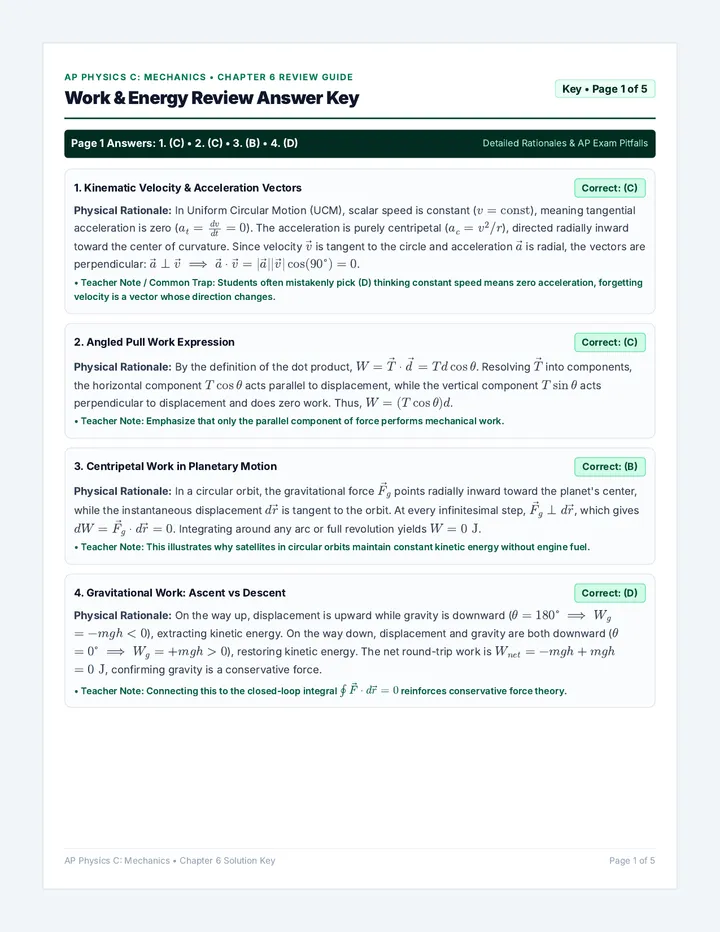
5. Sign of Kinetic Friction Work Correct: (C)
Physical Rationale: Kinetic friction \(\vec{f}_k\) by definition opposes relative interfacial motion. For a body sliding on a stationary surface, \(\vec{f}_k\) is directed opposite to displacement (\(\theta = 180.0^\circ\)). Since \(\cos(180^\circ) = -1\), the work is strictly negative: \(W_f = f_k s\cos(180^\circ) = -f_k s\). Negative work indicates mechanical energy is being removed from the object and transformed into internal thermal energy.
• Teacher Note: Clarify that static friction can do positive work (e.g., accelerating a box in the bed of a truck), but kinetic friction on a fixed surface is always negative.
6. Normal Force Modulation Under Upward Pull Correct: (B)
Physical Rationale: Vertical equilibrium requires \(\Sigma F_y = F_N + F\sin\theta - mg = 0 \implies F_N = mg - F\sin\theta\). The kinetic friction force is \(f_k = \mu_k F_N = \mu_k(mg - F\sin\theta)\). Because friction acts at \(180^\circ\) to displacement, the work is \(W_f = -f_k s = -\mu_k(mg - F\sin\theta)s\).
• Teacher Note: Students frequently forget that an angled pull reduces the normal force, erroneously using \(F_N = mg\).
7. Downward Pushing Force vs Upward Pull Correct: (C)
Physical Rationale: When pushing downward at angle \(\theta\), the vertical balance is \(F_N - F\sin\theta - mg = 0 \implies F_N = mg + F\sin\theta\). Because the normal force is increased, the friction force \(f_k = \mu_k(mg + F\sin\theta)\) is larger than in the pulling case (\(F_N = mg - F\sin\theta\)). Consequently, pushing dissipates significantly more mechanical energy over the same distance \(s\).
• Teacher Note: This is an everyday ergonomic principle: pulling a lawnmower or sled is physically easier than pushing it downward.
8. Thermal Dissipation Accounting Correct: (A)
Physical Rationale: By the extended work-energy relation, \(\Delta E_{mech} = W_{nc} = -f_k s = -\mu_k mg s\). The loss in mechanical energy equals the thermal energy generated: \(\Delta E_{thermal} = -\Delta E_{mech} = \mu_k mg s\).
• Teacher Note: Total energy is always conserved; mechanical energy alone decreases by \(\mu_k mgs\).
AP Physics C: Mechanics • Chapter 6 Solution Key Page 2 of 5
AP Physics C: Mechanics • Chapter 6 Review Guide Key • Page 3 of 5
Page 3 Answers: 9. (C) • 10. (C) • 11. (C) • 12. (D) Detailed Rationales & AP Exam Pitfalls
9. Definite Integral for 1D Variable Force Correct: (C)
Physical Rationale: Work is the spatial integral of force: \(W = \int_0^d F(x)\,dx = \int_0^d c\,x^3\,dx = c\left[\frac{x^4}{4}\right]_0^d = \frac{1}{4}c\,d^4\).
• Teacher Note: Emphasize that evaluating work by multiplying \(F(d)\cdot d\) yields \(c d^4\), which overestimates the work by a factor of 4! Integration is required.
10. Work Done on an Ideal Spring Correct: (C)
Physical Rationale: To stretch a spring, the external agent must apply \(F_{ext} = +kx\). The work done by this external agent is \(W_{ext} = \int_0^{x_1} kx\,dx = \frac{1}{2}k x_1^2\).
• Teacher Note: Be careful with signs: work done on the spring by the agent is \(+\frac{1}{2}kx_1^2\); work done by the spring on the agent is \(-\frac{1}{2}kx_1^2\).
11. Work-Energy Theorem Fundamental Relation Correct: (C)
Physical Rationale: Integrating Newton's second law along displacement yields \(W_{net} = \int F_{net} dx = \int m v dv = \frac{1}{2}mv_f^2 - \frac{1}{2}mv_i^2 = \Delta K\). The theorem applies universally to all forces, whether conservative or non-conservative.
• Teacher Note: Make sure students know \(W_{net}\) is the sum of ALL works: \(W_{net} = W_{cons} + W_{nc}\).
12. Quadratic Speed Stopping Distance Correct: (D)
Physical Rationale: By the Work-Energy Theorem, \(-f_k d = 0 - \frac{1}{2}mv^2 \implies d = \frac{v^2}{2\mu_k g}\). Since stopping distance is proportional to the square of initial speed (\(d \propto v^2\)), tripling speed (\(3v\)) produces a \(3^2 = \mathbf{9}\)-fold increase in distance: \(d' = 9d\).
• Teacher Note: This quadratic dependence is a standard AP C conceptual favorite.
AP Physics C: Mechanics • Chapter 6 Solution Key Page 3 of 5
AP Physics C: Mechanics • Chapter 6 Review Guide Key • Page 4 of 5
Page 4 Answers: 13. (B) • 14. (B) • 15. (D) • 16. (B) Detailed Rationales & AP Exam Pitfalls
13. Conservative Force Condition Correct: (B)
Physical Rationale: A force is conservative if and only if the work done along any closed path returning to the initial position is identically zero: \(\oint \vec{F}_{cons}\cdot d\vec{r} = 0\). Equivalently, the work between any two points is completely path-independent.
• Teacher Note: This condition is the prerequisite for defining a scalar potential energy function \(U(\vec{r})\).
14. Force from Potential Energy Derivative Correct: (B)
Physical Rationale: Since \(\Delta U = -W_{cons} = -\int F(x)dx\), applying the Fundamental Theorem of Calculus yields \(F(x) = -\frac{dU}{dx}\). Force is the negative spatial derivative (negative slope) of potential energy.
• Teacher Note: Be vigilant about the negative sign: a positive slope produces a force in the \(-x\) direction.
15. Simple Harmonic Motion Energy Partitioning Correct: (D)
Physical Rationale: Total energy is \(E = \frac{1}{2}kA^2\). At \(x = A/2\), the potential energy is \(U = \frac{1}{2}k(A/2)^2 = \frac{1}{4}\left(\frac{1}{2}kA^2\right) = \frac{1}{4}E = 25\%\). Therefore, kinetic energy is \(K = E - U = \frac{3}{4}E = \mathbf{75\%}\).
• Teacher Note: Many students guess \(50\%\) assuming energy divides linearly with displacement; emphasize \(U \propto x^2\).
16. Non-Conservative Energy Dissipation Correct: (B)
Physical Rationale: \(\Delta E_{mech} = \Delta K + \Delta U = W_{nc}\). Here \(\Delta U = -100\text{ J}\) and \(W_{nc} = -40\text{ J}\). Thus, \(\Delta K + (-100) = -40 \implies \Delta K = -40 + 100 = \mathbf{+60\text{ J}}\).
• Teacher Note: \(100\text{ J}\) of PE was converted: \(60\text{ J}\) into kinetic energy, and \(40\text{ J}\) into thermal heat.
AP Physics C: Mechanics • Chapter 6 Solution Key Page 4 of 5
AP Physics C: Mechanics • Chapter 6 Review Guide Key • Page 5 of 5
Page 5 Answers: 17. (B) • 18. (C) • 19. (B) • 20. (C) Detailed Rationales & AP Exam Pitfalls
17. Stability Classification Criteria Correct: (B)
Physical Rationale: At equilibrium, \(\frac{dU}{dx} = 0\). For stable equilibrium, the potential energy curve is concave up (\(\frac{d^2U}{dx^2} > 0\)), corresponding to a local minimum. If displaced to the right (\(+x\)), slope becomes positive \(\implies F = -dU/dx < 0\), creating a restoring force back toward the center.
• Teacher Note: \(\frac{d^2U}{dx^2} < 0\) is unstable (peak); \(\frac{d^2U}{dx^2} > 0\) is stable (bowl).
18. Potential Energy Curve Turning Points Correct: (C)
Physical Rationale: Since \(E = K + U(x)\), when \(U(x) = E\), kinetic energy drops to zero: \(K = E - U = 0\). Because \(K = \frac{1}{2}mv^2 = 0\), the particle's velocity is momentarily zero. The particle cannot penetrate into regions where \(U(x) > E\) because that would require \(K < 0\) (impossible in classical physics). The particle stops and reverses direction.
• Teacher Note: Turning points are the classical boundaries of motion for a given energy level \(E\).
19. Instantaneous Power Dot Product Correct: (B)
Physical Rationale: Differentiating work with respect to time: \(P = \frac{dW}{dt} = \frac{d}{dt}(\vec{F}\cdot\vec{r}) = \vec{F}\cdot\frac{d\vec{r}}{dt} = \vec{F}\cdot\vec{v} = F v\cos\theta\). Power is the scalar dot product of force and instantaneous velocity.
• Teacher Note: Remind students that power is a scalar (measured in Watts) and can be negative if force opposes velocity.
20. Incline Vehicle Power Requirement Correct: (C)
Physical Rationale: At constant speed along the incline (\(a = 0\)), the driving force must balance the downward component of gravity and total resistance: \(\Sigma F = F_{drive} - mg\sin\alpha - F_R = 0 \implies F_{drive} = mg\sin\alpha + F_R\). Power is \(P = F_{drive}\,v = (mg\sin\alpha + F_R)v\).
• Teacher Note: This directly matches Slide 32 of the curriculum slides.
AP Physics C: Mechanics • Chapter 6 Solution Key Page 5 of 5