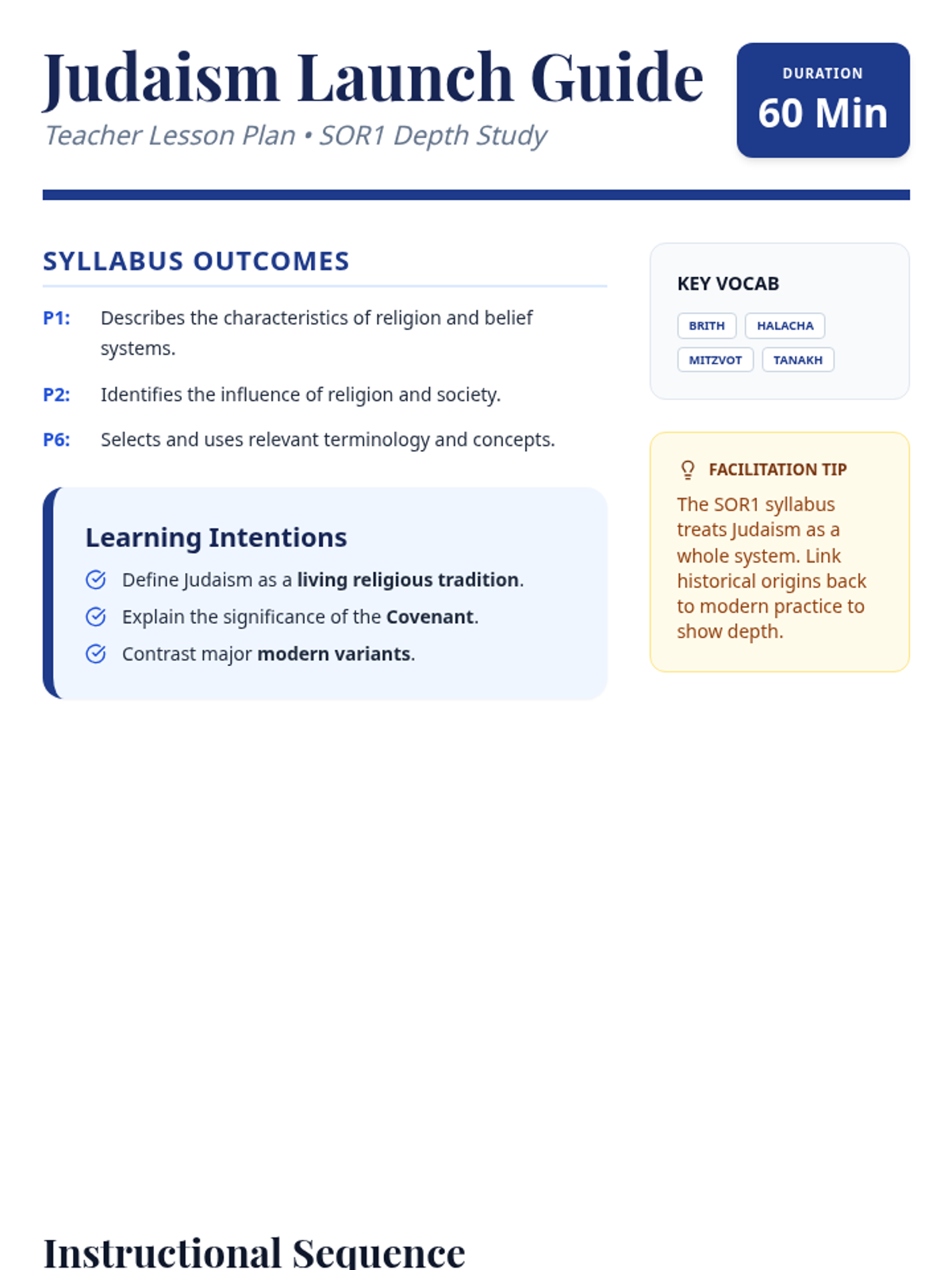
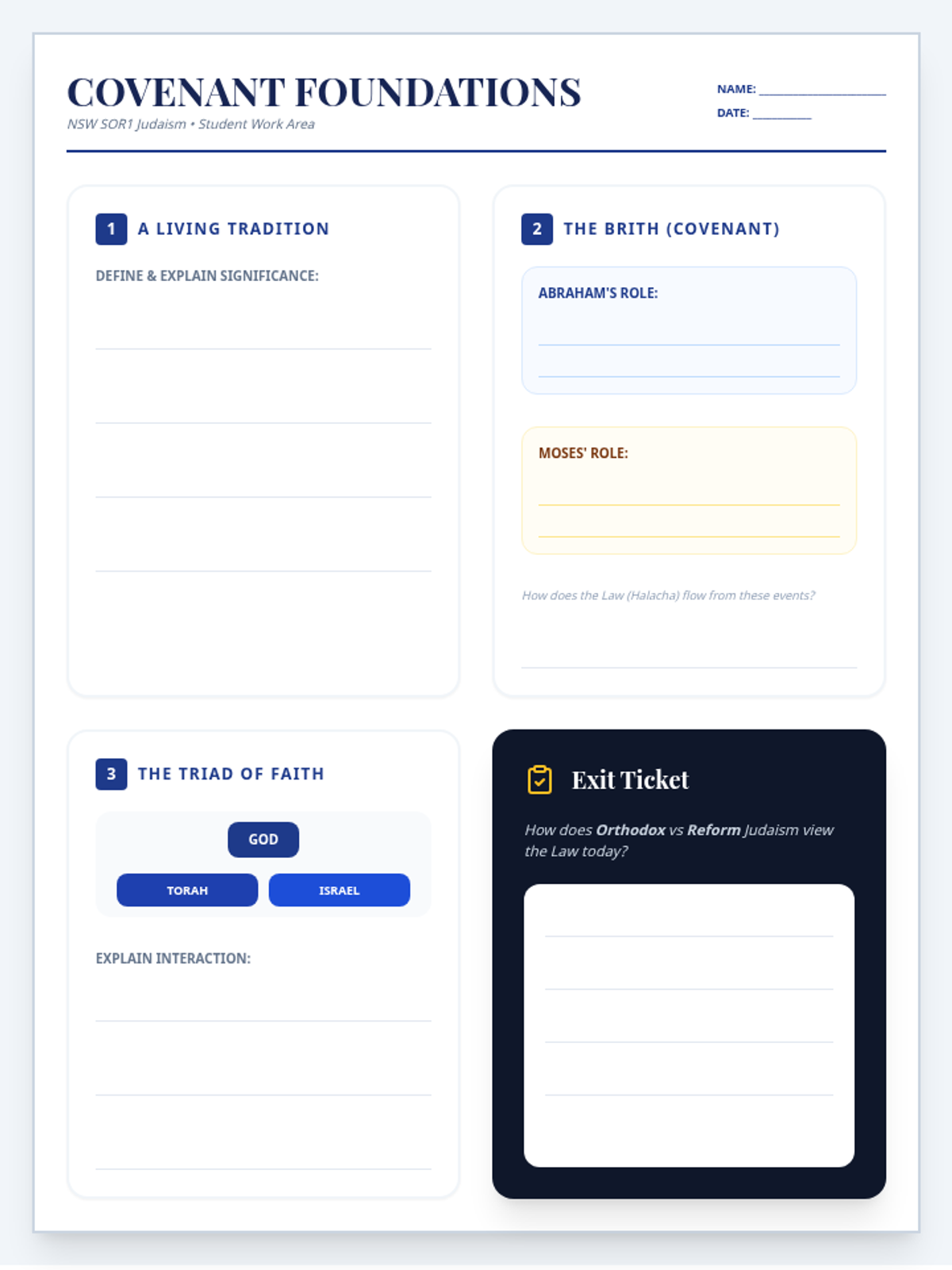
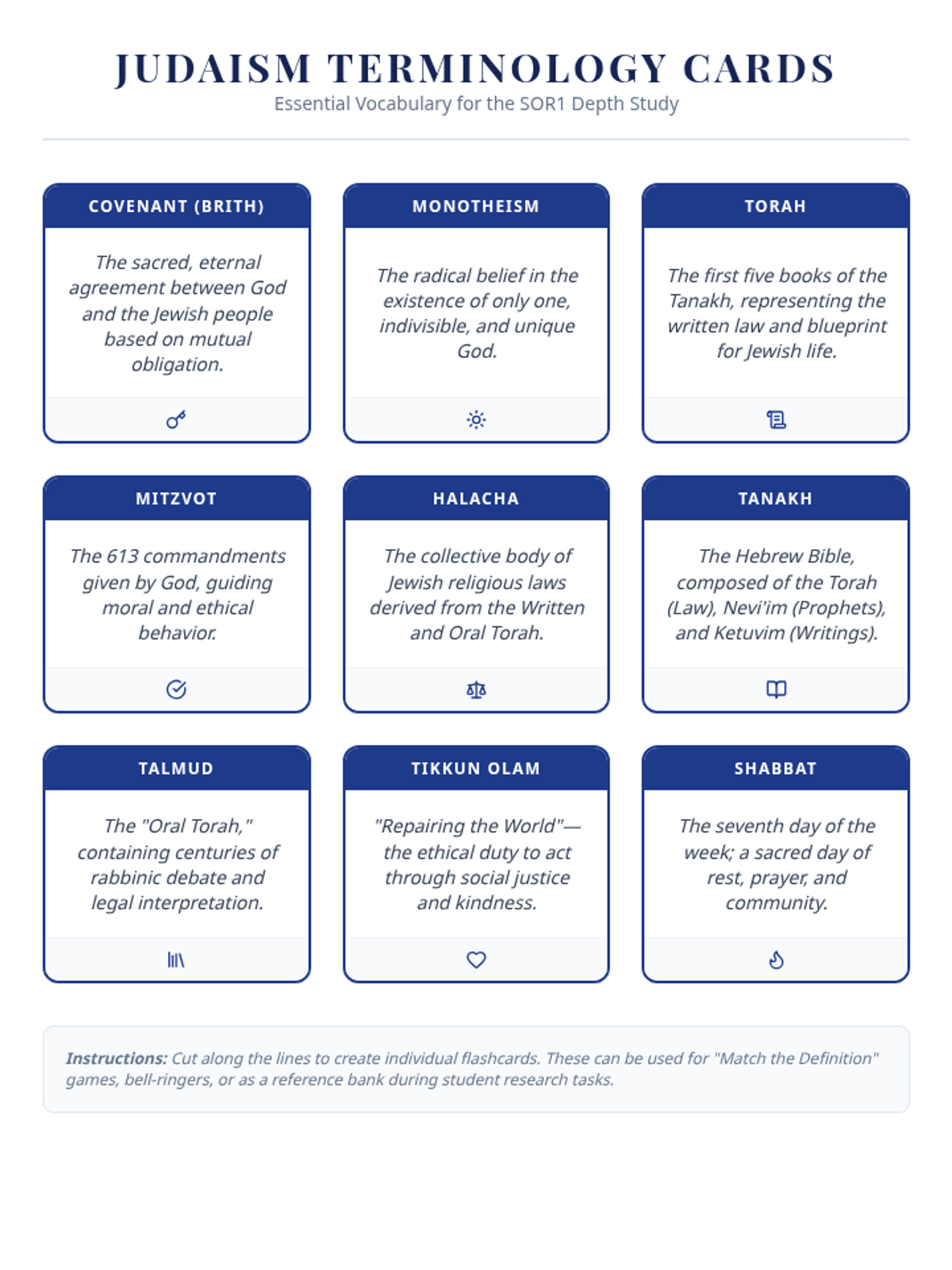
Covenant Origins Slides Covenant Origins
Tracing the Birth of Monotheism
The Abrahamic Family Tree
The history of three major world religions begins with a single family story.
Abraham is considered the "patriarch" or father of Judaism, Christianity, and Islam.
Through his son Isaac , the lineage leads to Judaism and Christianity.
Through his son Ishmael , the lineage leads to Islam.
Abraham
Isaac
Judaism &
Christianity
Ishmael
Islam
A Radical Shift
Polytheism
The standard in the Ancient Near East (Mesopotamia, Egypt).
Belief in many gods
Gods represented forces of nature (sun, rain, wind)
Gods often seen as unpredictable or moody
Monotheism
The revolutionary idea introduced through Abraham.
Belief in one single God
A moral, ethical relationship with the divine
God is separate from nature (the creator)
The Covenant
A Covenant is more than just a contract. It is a sacred, binding agreement or promise between two parties.
Abraham
The Agreement
God (Yahweh)
"I will make you into a great nation... and all peoples on earth will be blessed through you."
The Torah: Sacred Text
Definition
The first five books of the Hebrew Bible (Genesis, Exodus, Leviticus, Numbers, Deuteronomy).
Meaning
Often translated as "instruction" or "law." It contains 613 mitzvot (commandments).
Significance
The foundation for Jewish life, ethics, and history.
Central Theme: Ethical Monotheism
It's not just about believing in one God, but acting in a way that reflects God's justice and mercy in the world.
Turn and Talk
Why was the transition from many gods to one single God such a significant turning point in history?
Consider: Laws, community identity, and the relationship between humans and nature.
Covenant Connections Worksheet Covenant Connections
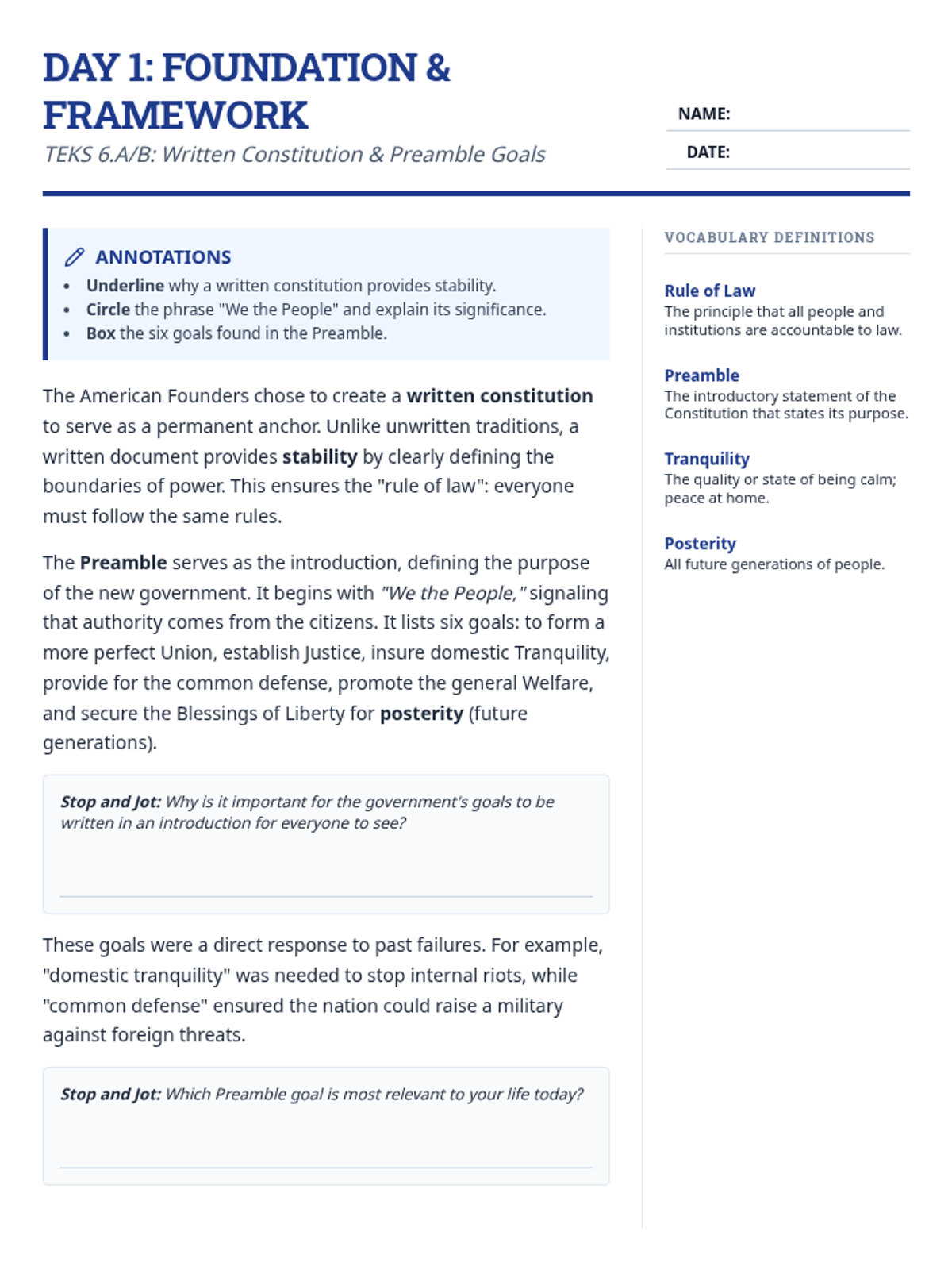
Lesson 1: Origins of Judaism & Monotheism
Name:
Date:
Part 1: The Patriarch's Legacy
Abraham is known as the "father" of three major religions. Based on the lesson, fill in the family tree below and identify which major religions trace their roots through each son.
Patriarch
Abraham
Son 1
Isaac
Son 2
Ishmael
Judaism
Christianity
Islam
Judaism
Christianity
Islam
Part 2: The Binding Promise
1. In your own words, define a "Covenant." How is it different from a simple business contract?
2. What were the TWO main "parts" of the promise God made to Abraham according to the Hebrew Bible?
A.
B.
Part 3: The Great Shift
Polytheism (The Old Way) Monotheism (The New Way) Describe the nature of the gods and human responsibility:
|
Describe the nature of God and human responsibility:
|
Part 4: Reflection
Why might a single set of laws (like those found in the Torah) help a nomadic group of people stay united across many generations?
Covenant Origins Teacher Guide Teacher Guide
Lesson 1: Establishing the Covenant
Time Estimate
50 Minutes
Lesson Purpose
This lesson introduces students to the foundational narrative of the Abrahamic faiths. By focusing on the "Covenant," students understand that Judaism wasn't just a change in the *number* of gods, but a change in the *nature* of the relationship between humans and the divine—one based on ethics and law rather than just power.
Key Vocabulary
Covenant: A sacred, binding agreement.
Patriarch: The male head of a family or tribe.
Monotheism: Belief in one God.
Torah: The first five books of the Hebrew Bible.
Standards & Skills
Skill: Chronological Reasoning
Skill: Text Analysis
Evaluate the shift from polytheism to monotheism.
Teaching Steps
1
The Family Hook (10 mins)
Display the family tree slide. Ask students if they know of any "famous" family trees (monarchs, superheroes, etc.). Explain that Abraham's family tree is the most significant in world history because it connects billions of people today. Have students complete Part 1 of the worksheet.
2
The Concept of Covenant (15 mins)
Use the slides to explain the shift to monotheism. Teacher Tip: Emphasize that in polytheism, gods were often capricious (unpredictable). The Covenant introduced a "contractual" relationship where humans knew exactly what was expected of them (The Law).
3
Comparative Analysis (15 mins)
Have students work in pairs to fill out the comparison table in Part 3. Facilitate a discussion on why "Ethical Monotheism" was a radical departure from the beliefs of surrounding empires like Egypt or Mesopotamia.
4
Closing Reflection (10 mins)
Complete the Part 4 reflection. Preview the next lesson: How this monotheistic tradition faced the power of the Roman Empire.
Watch Out For...
Misconception:
Judaism always looked exactly as it does today.
Reality:
Early Judaism was largely nomadic and centered on animal sacrifice before the building of the Temple in Jerusalem. It evolved significantly over centuries.
Misconception:
Abraham is only important to Jewish people.
Reality:
Abraham is a central figure in the Christian Bible and the Quran. Muslims refer to him as Ibrahim and consider him a prophet and the builder of the Kaaba.
Christianity and Rome Slides Christianity & Rome
From a Small Sect to an Imperial Faith
A Land Under Pressure
In the 1st Century CE, the Jewish homeland of Judea was a province of the massive Roman Empire .
Why was it tense?
Heavy Roman taxes
Religious friction (Monotheism vs Roman Polytheism)
Desires for independence
Imperial Power
Vs.
Religious Identity
This tension created a desire for a "Messiah" (Deliverer).
Jesus of Nazareth
Context
A Jewish teacher who began preaching in Galilee around 30 CE.
Message
Focused on the love of God, compassion for the poor, and the "Kingdom of Heaven."
Conflict
Seen by Roman authorities as a potential revolutionary and by some religious leaders as a challenger to tradition.
Execution
Jesus was crucified by the Romans (a standard Roman punishment for rebellion). His followers believed he rose from the dead, leading to the birth of Christianity.
The Great Spread
How did a small group of followers in Judea reach the entire Roman Empire?
The Catalyst: Paul of Tarsus
A Roman citizen who traveled over 10,000 miles to spread the message to "Gentiles" (non-Jews).
The Infrastructure: Roman Roads
Rome built over 50,000 miles of stone-paved roads for their armies. Missionaries used these same roads to travel safely and quickly.
"All Roads Lead to Rome"
The same network that held the empire together allowed the new faith to spread through it.
From Persecution to Power
Phase 1: Outlawed
Early Christians were often persecuted because they refused to worship Roman gods or the Emperor, which was seen as treason.
Phase 2: Constantine
In 313 CE, Emperor Constantine issued the Edict of Milan , making Christianity legal. By 380 CE, it became the official state religion of the Roman Empire.
The empire that once executed its founder became its greatest protector.
Imperial Pathways Map Activity Imperial Pathways
Lesson 2: Spread of Early Christianity
Name:
Date:
Part 1: All Roads Lead to Rome
The Roman Empire's greatest engineering feat was its road network. While intended for soldiers, these roads became the "Information Superhighway" of the 1st Century.
Mapping Prediction
Consider a missionary traveling from Antioch to Rome (approx. 2,000 miles).
By Sea: Faster, but dangerous/weather-dependent. (3-4 weeks)
By Road: Slower, but reliable and protected. (3-4 months)
1. Why did being a Roman Citizen give Paul of Tarsus a massive advantage in spreading Christianity?
2. How did the common language of the Empire (Greek/Latin) assist in the spread of ideas?
Part 2: Roman Reaction
Christianity's relationship with the Roman state changed over time. Fill in the flowchart below.
33 CE - 300 CE
Persecution
Why did Romans see Christians as a threat?
313 CE
Legalization
What was the Edict of Milan ?
Reflection: In your opinion, was the Roman Empire's adoption of Christianity a "religious" choice or a "political" one to keep the empire united? Explain.
Christianity and Rome Teacher Guide Teacher Guide
Lesson 2: Historical Context of Early Christianity
Time Estimate
50 Minutes
Lesson Purpose
This lesson shifts the focus from the internal development of monotheism to the external factors that allowed it to spread. By analyzing the Roman Empire's infrastructure (roads, language, laws), students see how a local movement became a global religion. This provides a bridge between the ancient origins and the medieval expansion of faiths.
Key Concepts
Roman Judea: The historical and political setting of Jesus' life.
Infrastructure: The physical and organizational structures (roads, language) that enabled spread.
Edict of Milan: The 313 CE decree that ended Christian persecution in Rome.
Skills Focus
Map Skills: Analyzing how geography affects movement.
Cause & Effect: Linking Roman policy to religious growth.
Teaching Steps
1
The "Internet" of Rome (10 mins)
Ask students: "How did people share ideas before the internet?" Introduce the concept of Roman roads. Use the slide on infrastructure to show that Rome essentially built the highway system that Christianity "drove" on.
2
The Judean Conflict (15 mins)
Explain the life of Jesus within the context of Roman occupation. Avoid getting bogged down in theology; focus on why a message about a "New King" would be threatening to Roman governors like Pontius Pilate.
3
Map & Flowchart Work (15 mins)
Have students complete the "Imperial Pathways" worksheet. Encourage them to think about how safety and common language are just as important as roads for spreading ideas.
4
The Turning Point (10 mins)
Discuss the Edict of Milan. Ask: "Would Christianity have spread so far if Constantine hadn't made it legal?" Use this to transition into the next lesson on the rise of the next great monotheistic faith: Islam.
Quick Timeline Reference
c. 4 BCE: Birth of Jesus in Bethlehem.
c. 30 CE: Ministry and Crucifixion of Jesus.
c. 45-65 CE: Journeys of Paul.
313 CE: Edict of Milan (Christianity becomes legal).
380 CE: Christianity becomes official religion of Rome.
Rise of Islam Slides The Rise of Islam
From the Arabian Desert to a Golden Age
The Final Prophet
The Revelation (610 CE): Muhammad, a merchant in Mecca, believed he received messages from God through the Angel Gabriel.
The Quran: These messages were later recorded as the holy book of Islam, believed to be the direct word of God.
The Hijra: In 622 CE, Muhammad and his followers moved to Medina to escape persecution—this marks Year 1 of the Islamic calendar.
Core Belief:
"There is no god but God, and Muhammad is His messenger."
The Five Pillars of Islam
The core practices that guide every Muslim's life.
Faith
Declaration of belief in one God.
Prayer
Five times daily toward Mecca.
Charity
Giving to the poor and needy.
Fasting
During the month of Ramadan.
Hajj
Pilgrimage to Mecca once in a lifetime.
The Caliphates
After Muhammad's death, leaders called Caliphs expanded the Islamic world.
By 750 CE, the Islamic Empire stretched from Spain to the borders of India .
Why so fast? Trade routes, shared language (Arabic), and a message of equality.
The Center: Baghdad
"The ink of the scholar is more holy than the blood of the martyr."
— Common saying during the Golden Age
A Legacy of Learning
Mathematics
Invention of Algebra and the use of Hindu-Arabic numerals (0-9).
Medicine
First hospitals and advanced surgical tools; discovered how germs spread.
Navigation
Perfected the Astrolabe to map stars and find direction.
While Europe was in the "Dark Ages," the Islamic world was preserving Greek and Roman knowledge.
Golden Age Discoveries Worksheet Golden Age Discoveries
Lesson 3: The Rise and Contribution of Islam
Name:
Date:
Foundations of Faith
1. Define the Quran. How do Muslims view this text differently than other books?
2. Why was the year 622 CE (The Hijra) so important for the survival of Islam?
The Five Pillars
Shahada
Salat
Zakat
Sawm
Hajj
Gallery Walk: The Golden Age
As you visit the stations, record one key fact and why it was important for the future of the world.
Mathematics
Medicine
Astronomy
Geography
Synthesis Question
How did the Islamic Golden Age help "save" Ancient Greek and Roman knowledge for modern people?
Rise of Islam Teacher Guide Teacher Guide
Lesson 3: The Rise of Islam & The Golden Age
Time Estimate
50-60 Minutes
Lesson Purpose
This lesson explores the final Abrahamic faith to emerge. It emphasizes the continuity between Islam and its predecessors (acknowledging previous prophets) while highlighting its unique contributions to science and math. Students will transition from the spiritual origins to the massive cultural impact of the Islamic Golden Age.
Activity Guide: Gallery Walk
Preparation: Print out the specific accomplishment slides or images for Algebra, Optics, Medicine, and Astrolabes to place around the room.
Students move in small groups (3-4) to each station.
They must identify one "problem" the invention solved (e.g., Algebra helped with inheritance and trade calculations).
Key Vocabulary
Quran: The holy book of Islam.
Caliph: A successor to Muhammad; political/religious leader.
Hijra: The migration from Mecca to Medina (622 CE).
Ramadan: The month of fasting.
House of Wisdom: A famous library and research center in Baghdad.
Teaching Steps
1
Inquiry Hook (10 mins)
Ask: "Who invented the number zero? Or the word 'Alcohol'? Or the first hospital?" Explain that many words and concepts we use today came from the Islamic world between 800-1200 CE.
2
Prophet & Pillars (15 mins)
Briefly go through the life of Muhammad and the 5 Pillars using the slides. Emphasize that Islam considers itself a continuation of the messages given to Abraham, Moses, and Jesus.
3
The Gallery Walk (20 mins)
Students use the "Golden Age Discoveries" worksheet. This is the main skill-building portion: analyzing cultural contributions.
4
Debrief & Synthesis (10 mins)
Return to the center of the room. Discuss: "If Baghdad was the center of world knowledge in 1000 CE, why don't we learn more about it in school?"
Differentiation Support
For EL Students
Use visual aids for the 5 Pillars (e.g., a clock for prayer, a piggy bank for charity). Provide a word bank for the Gallery Walk stations.
For Advanced Learners
Have them research The House of Wisdom and explain how the "Translation Movement" preserved Greek texts that had been lost in Europe.
Venn Diagram Narrative Challenge Venn Diagram Challenge
Lesson 4: Comparing Abrahamic Narratives
Name:
The Great Overlap
Where do these figures and concepts belong? Place the letter of each item into the correct section of the Venn Diagram.
A. One single God (Monotheism)
G. Moses (Great Prophet/Lawgiver)
B. Five Pillars of practice
H. Friday as the main congregational prayer day
C. The "Torah" is a sacred text
I. The "Bible" contains the Old & New Testaments
D. Belief in an afterlife
J. Sunday as the traditional day of rest
E. Jerusalem is a holy city
K. Jesus is a central figure/divine
F. Fasting as a spiritual discipline
L. Abraham is a patriarch/founding figure
Judaism
Christianity
Islam
ALL THREE
Part 2: Shared Stories, Different Lenses
The Story of Joseph (Yusuf)
In the Torah/Bible , Joseph is sold into slavery by his brothers and eventually becomes a powerful leader in Egypt. In the Quran , a similar story is told in the 12th Sura, but it focuses even more heavily on Joseph's personal trust in God (Allah) and his role as a prophet.
Reflect: Why do you think all three religions keep telling the same story of a brother who was betrayed and then rose to power?
The Prophet Moses (Musa)
Moses is a foundational figure in Judaism for leading the Exodus. In Christianity, he is seen as a precursor to Jesus. In Islam, Musa is one of the most mentioned prophets in the Quran and is highly revered as a messenger who spoke directly to God.
Reflect: How does having the same "heroes" (like Moses) make these religions more similar than they are different?
Venn Diagram Answer Key Teacher Answer Key
Lesson 4: Venn Diagram Narrative Challenge
Venn Diagram Placement
Central Overlap (A, D, E, F, L)
All three share: Monotheism (A), Afterlife (D), Jerusalem as Holy (E), Fasting (F), and Abraham as Patriarch (L).
Judaism Specific (C)
The Torah (C) is specific to Judaism (though also part of the Christian Bible as the Old Testament, its primary religious identity is Jewish law).
Christianity Specific (I, J, K)
The Bible containing the New Testament (I), Sunday Rest (J), and Jesus as Divine/Central (K).
Islam Specific (B, H)
Five Pillars (B) and Friday Prayer (H).
Judaism & Islam (G*)
Moses is shared by all three, but he and his Law are particularly central to the legal traditions of Judaism and Islam.
Note: Moses (G) is technically "All Three," but students may place him in the Judaism/Islam overlap if they focus on the "Law" aspect. Be flexible with student placement if they can justify it.
Facilitation Notes
Goal: Move students from "What are the differences?" to "Why are the similarities there?"
The Joseph Discussion: Highlight that in the ancient world, stories were like "moral maps." Joseph's story is about resilience, forgiveness, and the idea that God has a plan even in suffering. All three faiths find value in this message because it helped their followers survive difficult times (Exodus, Persecution, Hijra).
The Moses Discussion: Emphasize that Moses is the "blueprint" for a prophet in all three traditions. He is a person who talks to God and brings down a specific way for people to live. If you understand Moses, you understand the core mechanics of how these religions work.
The Holy City Slides Jerusalem: The Holy City
One City, Three Sacred Traditions, Thousands of Years
The Center of the World
Jerusalem is one of the oldest cities in the world. For the Abrahamic faiths, it is not just a place on a map—it is the location where the physical and spiritual worlds meet.
Sacred Geography
The city is divided into four quarters: Jewish, Christian, Muslim, and Armenian. This diversity exists within just 0.35 square miles of the Old City.
"Layers of History"
Ancient ruins, medieval walls, and modern buildings literally sit on top of each other.
Judaism: The Western Wall
The Western Wall (Kotel) is the holiest site where Jews can pray.
It is a remnant of the Second Temple, destroyed by the Romans in 70 CE.
For centuries, Jews have come here to mourn the loss of the Temple and pray for the future.
Tradition: Visitors often place handwritten prayers in the cracks of the wall.
Christianity: Church of the Holy Sepulchre
This church is built upon the site where Christians believe Jesus was crucified and buried.
It has been a major destination for Christian pilgrims since the 4th Century.
Ownership of the church is shared between several Christian denominations.
Central Theme: The Resurrection and the end of the earthly life of Jesus.
Islam: Dome of the Rock & Al-Aqsa
The Dome of the Rock sits on the "Noble Sanctuary" (Haram al-Sharif).
Muslims believe Muhammad ascended to heaven from this rock during his "Night Journey."
It is the third-holiest site in Islam after Mecca and Medina.
Note: This same plateau is where the Jewish Temples once stood, making it a site of shared history.
A Mirror of the Abrahamic Story
Jerusalem is a physical reminder that these three religions share the same ancestors and many of the same holy places. While this has caused conflict, it also provides a unique opportunity for understanding.
Conclusion of Roots of Faith Sequence
Mapping the Sacred Reflection Mapping the Sacred
Lesson 5: Jerusalem Site Analysis
Name:
Site Identification
1. The Western Wall
Why is this specific wall so important to the Jewish people today?
2. Church of the Holy Sepulchre
How does the shared ownership of this church reflect the diversity of Christianity?
3. Dome of the Rock / Al-Aqsa Mosque
Explain the "Night Journey" and why this plateau is significant to Muslims.
Unit Reflection: Roots of Faith
Final Synthesis Question
"How do shared historical roots influence the distinct identities of the three Abrahamic faiths?"
Consider: Shared prophets, the concept of monotheism, and the city of Jerusalem. Use at least two specific examples from the lessons.
What is one thing that surprised you about the connection between these three faiths?
Which of the three lessons did you find most interesting? Why? Holy City Teacher Guide Teacher Guide
Lesson 5: Jerusalem: A City of Three Faiths
Time Estimate
50 Minutes
Lesson Purpose
This final lesson serves as both a case study and a unit review. By looking at a single geographic point—Jerusalem—students see how all the threads of the previous four lessons (Abraham, Rome, Islam, and shared stories) weave together in a single physical location.
Virtual Field Trip Hook
Teacher Note: If technology allows, use Google Arts & Culture or YouTube 360 to show students the interior of these sites. If not, the slides provide descriptions.
Point out how close these sites are. The Western Wall and the Dome of the Rock are literally on the same hill.
Discuss the "Old City" vs. modern Jerusalem to show how history persists.
Skills Focus
Geographic Reasoning: Why this specific location?
Multiple Perspectives: Seeing the same city through three lenses.
Teaching Steps
1
The Visual Hook (10 mins)
Show images of the three holy sites without identifying them first. Ask students to guess which religion each belongs to based on architectural clues. This activates their prior knowledge from Lessons 1-4.
2
Site Deep Dive (20 mins)
Go through the slides for each site. Have students complete the first page of the "Mapping the Sacred" worksheet. Teacher Tip: Emphasize the concept of "Sacred Space"—why a place becomes holy because of what happened there.
3
Coexistence Discussion (10 mins)
Discuss the challenges and beauty of having three such different traditions living in such a small space. Avoid modern political debates; focus on the historical "status quo" that allows these sites to be shared.
4
Unit Reflection (10 mins)
Students complete the back of the worksheet. This serves as their summative assessment for the sequence. Collect these to gauge student understanding of the essential question.
Final Sequence Synthesis
By the end of this lesson, students should be able to articulate:
Judaism provided the covenant and legal foundation.
Christianity expanded the message through Roman infrastructure .
Islam preserved and expanded world knowledge while honoring the previous faiths.