Wild Homes Slides
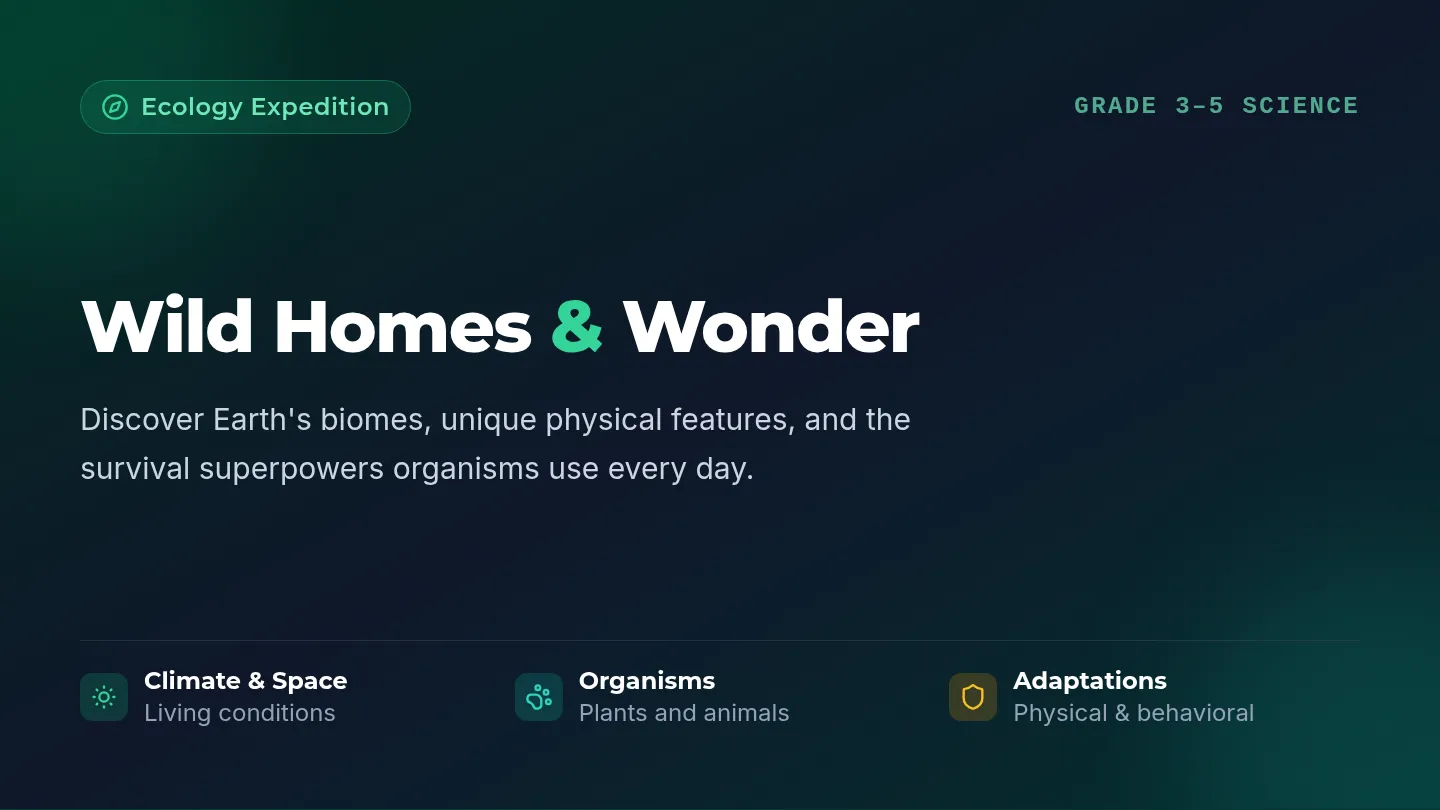
Life Science Expedition
Earth & Life Systems
Wild Homes
An Expedition Across Earth's Habitats and the Amazing Creatures Built to Survive in Them
🌲
Rainforest
🏜️
Desert
🌊
Ocean
🌾
Grassland
❄️
Tundra
Foundation
What Is a Habitat?
4 Key Needs
A habitat is a natural environment that supplies everything a living organism needs to survive and thrive.
Water
Essential moisture to hydrate, digest food, and keep cells working.
Food
Nutrients and energy for growth, movement, warmth, and repair.
Shelter
Safe protection from severe weather, storms, and hungry predators.
Space
Adequate territory to forage, establish nests, and raise young.
🌴
Habitat 1
Tropical Rainforest
Warm & Extremely Wet
Environment
Hot and humid year-round with over 80 inches of annual rain. Dense green canopies block most sunlight from reaching the floor.
Home to 50% of Earth's species!
Native Life
Jaguars, sloths, brightly colored toucans, spider monkeys, tree frogs, and climbing vines called lianas.
Multi-layer vertical ecosystem
Adaptations
Grasping claws and prehensile tails for high canopy travel; bright warning colors or vivid camouflage to avoid predators.
Built for tree canopy survival
Spotlight: Drip tips on rainforest leaves help heavy rainwater slide off quickly to prevent mold!
🏜️
Habitat 2
Arid Desert
Dry & Extreme Temperatures
Environment
Receives under 10 inches of rain per year. Scorching hot sun during daylight hours, but temperatures plummet rapidly at night.
Scarcity of surface water
Native Life
Camels, fennec foxes, sidewinder rattlesnakes, burrowing tortoises, scorpions, and giant saguaro cacti.
Masters of moisture conservation
Adaptations
Nocturnal sleeping by day to avoid heat, water-storing stems, oversized ears that radiate excess heat away from blood vessels.
Built to beat the heat
Spotlight: Saguaro cacti can expand like an accordion to hold up to 200 gallons of water after a storm!
🌊
Habitat 3
The Open Ocean
Vast & Deep Saltwater
Environment
Covers over 70% of planet Earth. From sun-drenched surface coral reefs down into freezing, pitch-black deep sea trenches.
Earth's largest living space
Native Life
Blue whales, sea turtles, sharks, clownfish, giant kelp forests, glowing anglerfish, and microscopic plankton.
Complex aquatic food webs
Adaptations
Gills to filter dissolved oxygen from water, streamlined torpedo-shaped bodies for gliding, and bioluminescent glow in deep dark zones.
Built for buoyancy & fluid speed
Spotlight: Marine phytoplankton produce more than 50% of all the breathable oxygen in Earth's atmosphere!
🌾
Habitat 4
Rolling Grassland
Open Horizons & Tough Grasses
Environment
Wide plains with warm summers and cold winters. Moderate rainfall supports tall hearty grasses, but cannot support large dense forests.
Prairies, savannas, and steppes
Native Life
Bison, zebras, giraffes, lions, prairie dogs, gazelles, and birds of prey hunting across vast open clearings.
Large roaming herds
Adaptations
Flat, tough teeth for grinding fibrous grass; herd behaviors for communal defense; high running speeds to escape open-ground predators.
Built for speed & grazing
Spotlight: Prairie grass roots reach up to 15 feet underground to survive wildfires, grazing, and droughts!
❄️
Habitat 5
Frozen Tundra
Treeless, Freezing & Windy
Environment
The coldest of all biomes. Long freezing dark winters with permanently frozen subsoil called permafrost that prevents trees from taking root.
Short, frantic summer bursts
Native Life
Polar bears, arctic foxes, musk oxen, caribou, snowy owls, and low-growing mosses, lichens, and dwarf shrubs.
Insulated survival specialists
Adaptations
Thick subcutaneous fat (blubber), dense double-layered fur, small ears to prevent heat escape, and white seasonal camouflage.
Built for extreme cold insulation
Spotlight: Arctic foxes change coat color from brown in summer to pure white in winter to match the snow!
🔍
Classroom Challenge
Habitat Detectives
Name That Wild Home!
Analyze the adaptation clue and identify which habitat the animal belongs to!
1
Dromedary Camel
Fat-filled humps for energy storage, wide padded feet for sand, and double-row eyelashes to block dust.
Habitat: Desert
2
Clownfish
Mucus coating immune to sea anemone stings, gills for breathing water, and fins for darting into coral.
Habitat: Ocean
3
Polar Bear
Black skin beneath hollow clear hair to absorb solar warmth, 4 inches of blubber, and wide snowshoe paws.
Habitat: Tundra
4
Toco Toucan
Large, lightweight serrated beak to pluck distant fruit from weak branches without falling from the canopy.
Habitat: Rainforest
Field Summary
Expedition Debrief
Key Takeaways
1
Habitats Meet All Basic Needs
Every animal and plant relies on its habitat to supply water, food, shelter, and living space in balance.
2
Adaptations Match the Environment
Physical traits and behaviors evolve specifically to solve the environmental challenges of each biome.
3
Protecting Habitats Preserves Life
When a habitat changes or is lost, the organisms specially adapted to it face danger of extinction.
🌍 What habitat would you explore first on your next field mission?