A visual presentation deck for the 'Minting Madness' lesson, featuring interactive auction tracking slides, embedded video cues, and simplified explanations of scarcity and fiat money.
The primary graphic organizer for the unit, allowing students to compare the physical and human characteristics of Mesopotamia, Egypt, the Indus Valley, and Ancient China side-by-side.
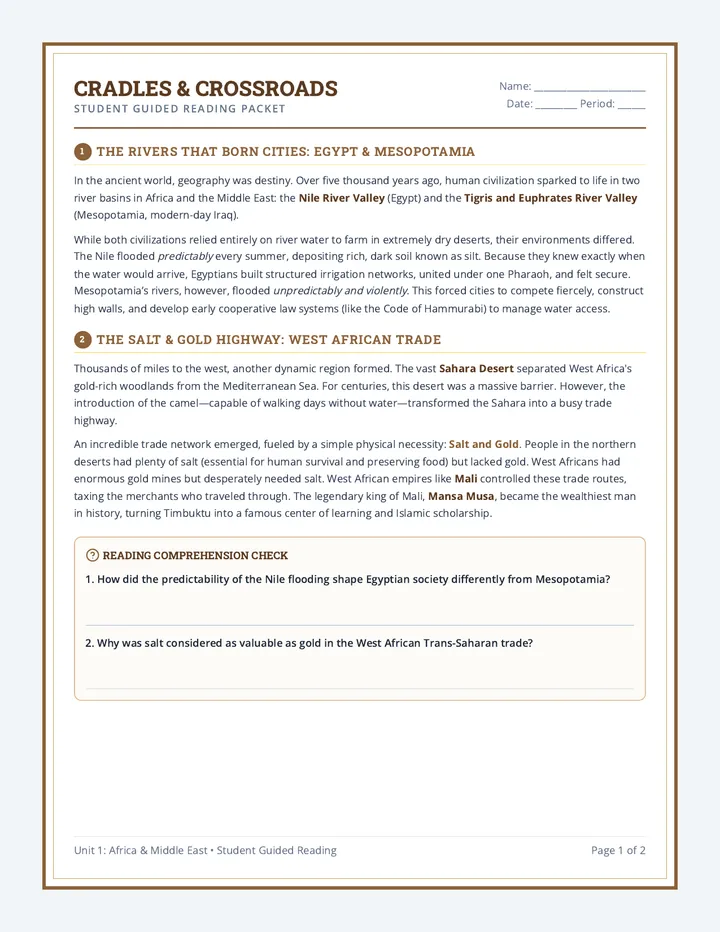
A comprehensive student reference sheet containing essential background knowledge on the rise of civilizations and a glossary of key vocabulary terms used throughout the unit.
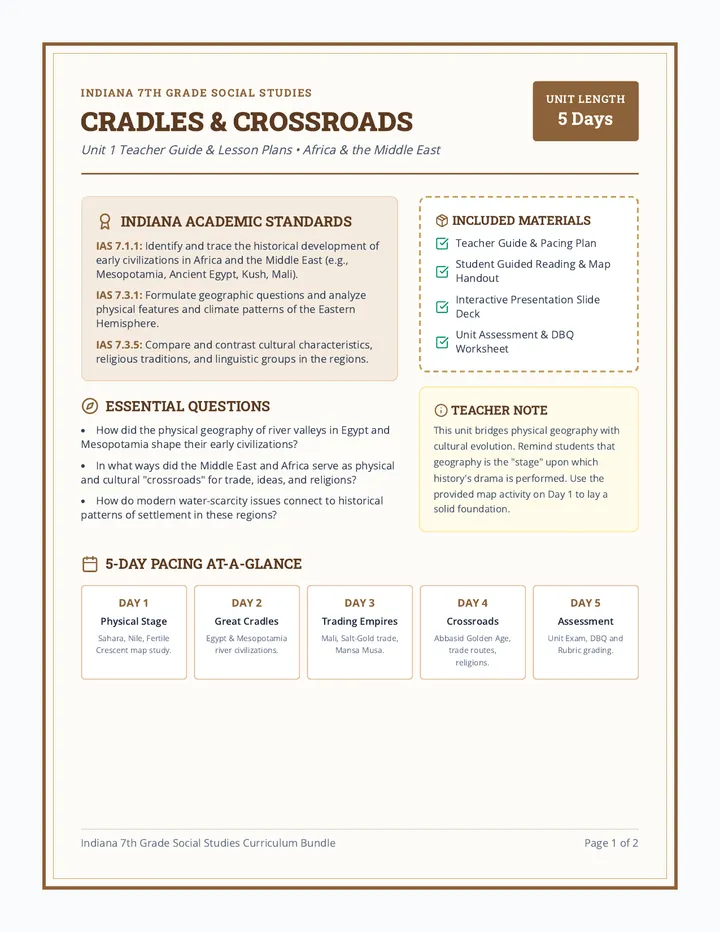
A comprehensive 10-day unit plan for teachers outlining the standards, daily pacing, and assessment strategies for the River Valley Chronicles unit.
A teacher's guide and answer key for the unit assessment, including exemplar responses for short-answer questions and instructional tips for grading and facilitating discussions.
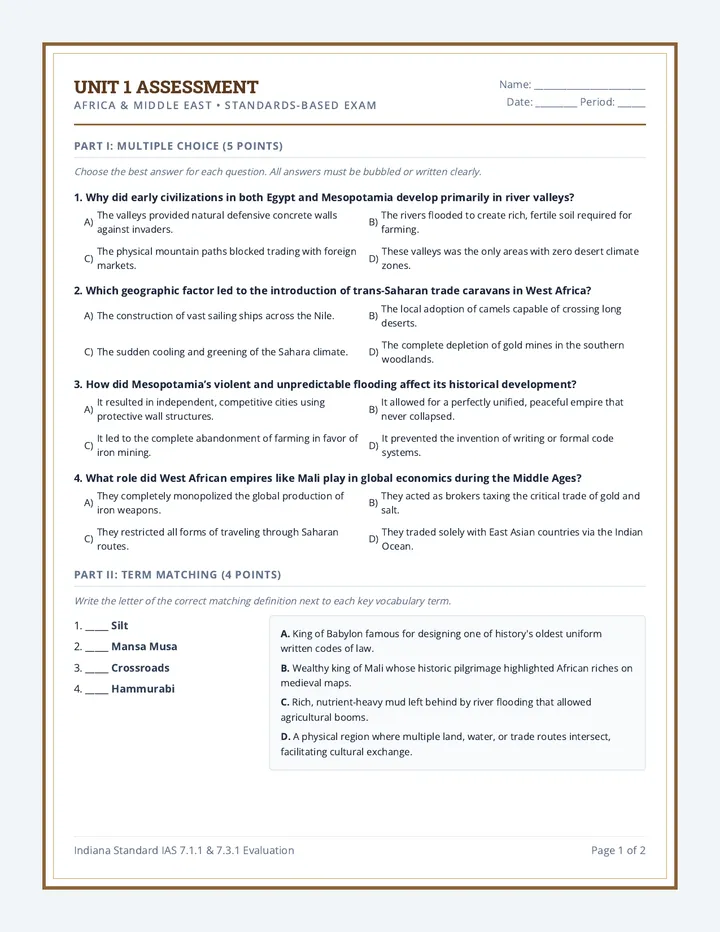
The final summative assessment for the unit, featuring multiple-choice questions, short-answer analysis, and a map skills section to evaluate student understanding of the four river valley civilizations.
Slides covering Ancient China's geography (the Yellow River), the concept of the Mandate of Heaven, the Dynastic Cycle, and the cultural importance of family and early writing.
Slides exploring the Indus Valley Civilization, focusing on monsoon geography, the world's first grid-planned cities, and the mystery of their undeciphered writing.
Slides detailing the geography of the Nile, the divine kingship of Pharaohs, the social pyramid, and Egyptian beliefs regarding the afterlife and writing.
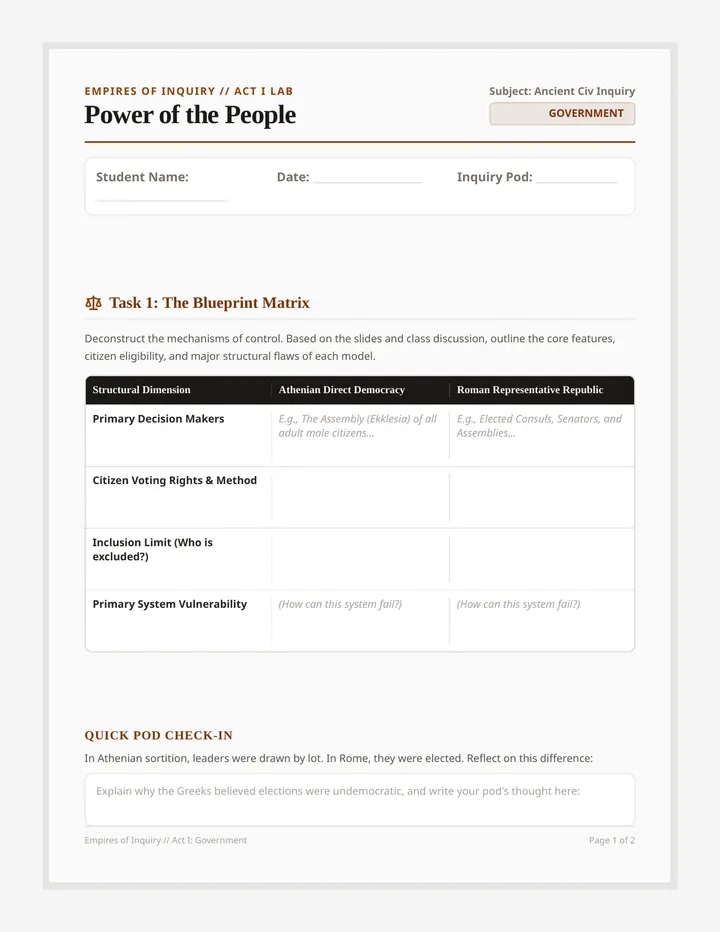
An engaging slide deck covering Mesopotamia's geography, the rise of city-states, the legal system of Hammurabi, and the cultural innovations of the Sumerians.
A comprehensive answer key for teachers comparing the book and movie versions of 'The Watsons Go to Birmingham', featuring character changes, plot adjustments, and ending variations.
A single-page student worksheet featuring a category-based comparison table to analyze differences between 'The Watsons Go to Birmingham' novel and its movie adaptation. This version uses fixed-height elements to ensure reliability when printing.
A teacher's answer key for the Voyager Navigation Chart, providing route data, motivation analysis, strategic explanations, and guidance for analyzing indigenous perspectives. Revised to fit on a single page with improved text contrast and a visual reference map.
An advanced mapping worksheet where students plot the routes of six global explorers on a schematic world map, color-code them by the 3 G's, and perform high-level geopolitical and indigenous perspective analysis.
A comprehensive student packet for a jigsaw activity, including role-specific investigation pages with questions from the source text, a collaborative summary table, and a final synthesis writing prompt.
A teacher's answer key for the Voyager Navigation Chart, providing route data, motivation analysis, and strategic explanations for advanced map inquiry.
An advanced mapping worksheet where students plot the routes of six global explorers, color-code them by motivation, and analyze strategic bottlenecks and geopolitical conflict zones.
A facilitation guide for teachers to implement a 3-part jigsaw activity on globalization, including pacing, grouping strategies, and differentiation tips.
A grading rubric and teacher guide for assessing the Legacy Capsule project, focusing on historical analysis, creative voice, and misinterpretation logic.
A comprehensive project guide for students to create a "Future Museum Exhibit," including selection categories, placard templates, and a legacy reflection task.
A student worksheet for analyzing modern objects from a future archaeological perspective, including descriptive observations and creative misinterpretations.
An engaging slide deck for students in grades 6-9, exploring archaeology concepts, future interpretations of modern objects, and the project brief.
A detailed teacher's guide for the Future Finders lesson, outlining objectives, timing, instructional steps, and differentiation strategies for grades 6-9.
Teacher's guide containing an answer key for the DBQ, a high-quality sample essay response, and a clear grading rubric for assessment. Fixed page breaks and updated rubric formatting.
A formal writing prompt and assessment for students to synthesize their learning about the religious transition of Ancient Rome, including an expanded pre-writing space and a student-facing rubric.
A document-based question (DBQ) activity for 6th-grade students, featuring four primary and secondary sources regarding Roman state religion, private worship, and the rise of Christianity. Optimized for handwriting with expanded answer areas.
A comprehensive slide deck covering Ancient Roman mythology, the concept of 'Pax Deorum', state vs. private worship, and the empire's eventual transition to Christianity. Includes clear transitions to the DBQ activity.
An advanced teacher's guide for the analytical voyager worksheet, featuring nuanced historical context, strategic motivations, and indigenous perspectives. Includes explicit definitions for the 3 G's and clarified analysis for indigenous reception and response.
A rigorous Claims, Evidence, and Reasoning (CER) worksheet where students evaluate the controversial legacy of an explorer through critical analysis and counter-argumentation. Expanded with significantly more space for students to write detailed reasoning and evidence. Now includes explicit definitions for the 3 G's and a focused prompt for indigenous stakeholder analysis. Final polish to ensure everything fits on two pages.
An advanced teacher's guide for the analytical voyager worksheet, featuring nuanced historical context, strategic motivations, and indigenous perspectives for six explorers. Revised to fit on a single page.
A teacher's answer key for the Voyager Log Worksheet, featuring detailed information on six explorers. Revised to fit onto a single page with improved readability and historical corrections.
An advanced three-page graphic organizer for older or higher-level students, requiring deep analysis of strategic motivations, indigenous perspectives, and long-term global consequences of famous voyages. Now includes significantly expanded writing space with two explorers per page and clear 3 G's definitions. Final polish to ensure all content fits across three pages.
Evaluación final en español que presenta dos propuestas de pensamiento crítico centradas en la necesidad militar y las consideraciones éticas del proyecto del Canal de Panamá.