Divided House Slides
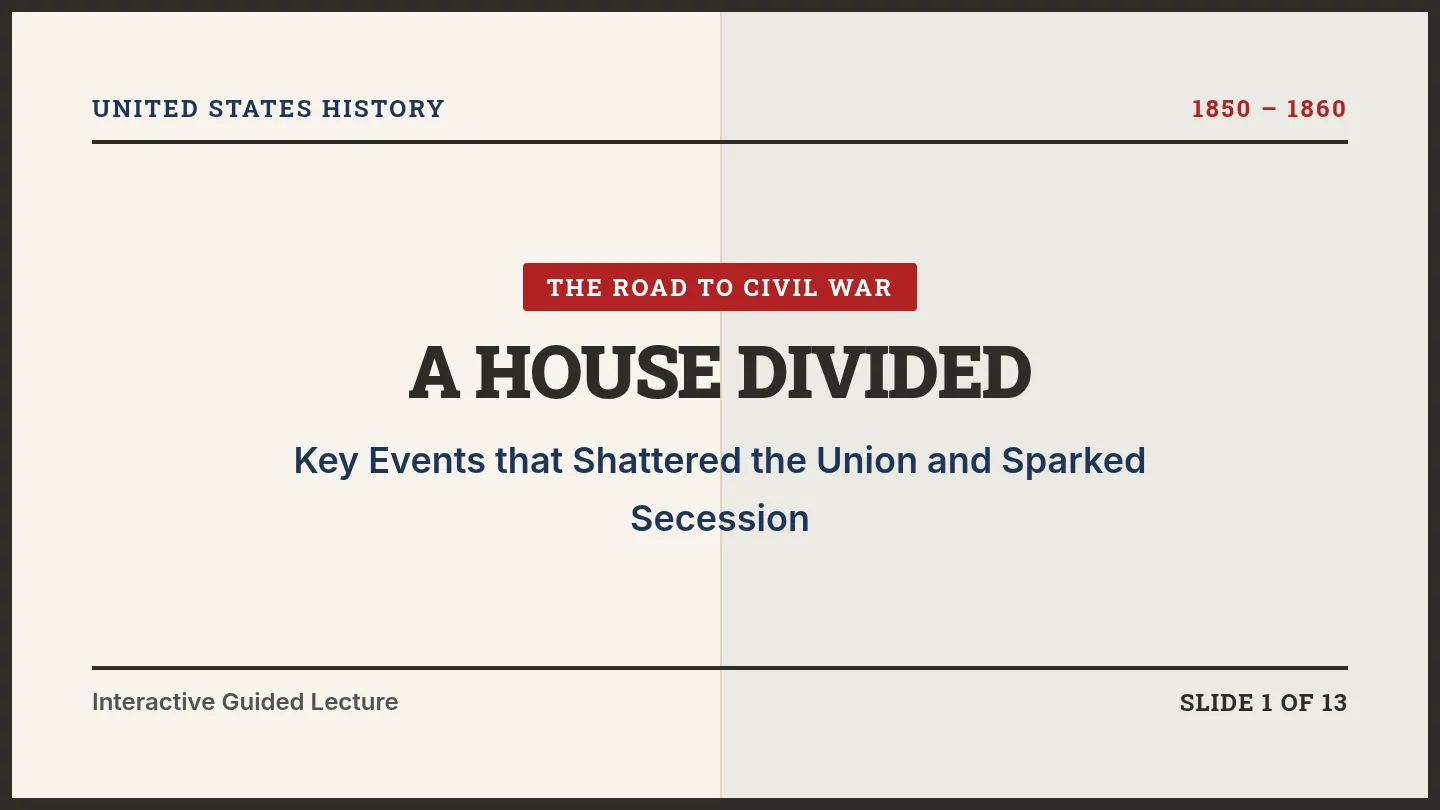
United States History 1850 – 1860
The Road to Civil War
A HOUSE DIVIDED
Key Events that Shattered the Union and Sparked Secession
Interactive Guided Lecture Slide 1 of 13
The Decade of Crisis Chronology
Timeline of Growing Tension
1850 – 1852
Law & Literature
The Compromise of 1850 sparks outrage with the Fugitive Slave Law, while Uncle Tom's Cabin (1852) converts millions to abolition.
1854 – 1857
Sovereignty & Court
The Kansas-Nebraska Act triggers bloody territorial warfare, and the Dred Scott Decision declares all compromises unconstitutional.
1859 – 1860
Raid & Rebellion
John Brown's Raid terrifies the South. Abraham Lincoln's election becomes the final straw, driving Southern states to secede.
Visual Timeline Overview Slide 2 of 13
The Catalyst 1848 – 1849
California Gold Rush & the Balance Crisis
In 1848, gold was discovered at Sutter's Mill. By 1849, over 80,000 seekers ("49ers") had rushed to California.
The Power Struggle: California had enough people to apply to become the 31st state. However, they wanted to enter as a Free State.
This threatened to permanently destroy the perfect balance of 15 free states and 15 slave states in the Senate.
Manifest Destiny vs. Slavery
While westward expansion was celebrated as progress, every newly acquired western territory forced a bitter national debate: Will it be free or slave?
Why did the Gold Rush create a massive political crisis? Slide 3 of 13
The Solution Compromise
The Compromise of 1850
Northern "Wins" (Anti-Slavery)
- California enters the Union as a completely free state.
- The Slave Trade is abolished in Washington D.C.
Southern "Wins" (Pro-Slavery)
- A strict, federal Fugitive Slave Law is passed.
- New territories decide slavery by Popular Sovereignty.
The Compromise only delayed the inevitable clash. Slide 4 of 13
The Flashpoint Fugitive Slave Act
CAUTION!
Colored People of Boston
Avoid conversing with Watchmen and Police Officers. They are empowered to act as KIDNAPPERS and Slave Catchers.
APRIL 24, 1851
A Harsher, More Brutal Fugitive Law
No Jury Trial: Accused runaways could not testify. A claimant’s sworn statement was enough to capture them.
Bribery of Officials: Commissioners received $10 if they ruled a black person was a runaway, but only $5 if set free.
Forced Help: Citizens aiding an escaped slave faced huge fines ($1,000) and six months in jail.
It brought the reality of southern slavery directly to the North. Slide 5 of 13
The Pen is Mightier 1852
Uncle Tom's Cabin
By Harriet Beecher Stowe
Stowe wrote this book to expose the cruelties of plantation slavery. It became a national phenomenon, selling 300,000 copies in year one.
The Reactions:
- North: Millions of citizens became passionate abolitionists.
- South: Furious; claimed it was false propaganda and banned it.
"So this is the little lady who made this big war."
— Abraham Lincoln to Stowe (1862)
How does media shape public opinion during a political crisis? Slide 6 of 13
Popular Sovereignty 1854
The Kansas-Nebraska Act
Senator Stephen Douglas wanted to organize the central plains to build a Transcontinental Railroad centered in Chicago.
To win Southern votes, Douglas proposed dividing the territory and allowing settlers to vote on slavery—called Popular Sovereignty.
This repealed the 1820 Missouri Compromise, which had kept slavery out of these northern lands for 34 years!
?
What is Popular Sovereignty?
The concept that the settlers of a territory should vote and decide for themselves whether to allow slavery, bypassing federal authority.
Result: A recipe for violent competition.
This act dismantled long-standing national compromises. Slide 7 of 13
Violence Erupts 1855 – 1856
"Bleeding Kansas"
The Rush to Vote
Armed pro-slavery settlers from Missouri ("Border Ruffians") and anti-slavery Northerners rushed into Kansas to establish competing governments.
Both sides claimed their elections were the only legitimate ones.
Civil War in Miniature
Violence exploded: the sacking of the town of Lawrence, and retributions by abolitionist John Brown. Over 200 people were killed.
Compromise was no longer functioning.
"Compromises tend to last only as long as they’re convenient." Slide 8 of 13
The Supreme Court 1857
The Dred Scott Decision
Dred Scott, an enslaved man, sued for his freedom after living in free territories with his owner.
The Ruling: Chief Justice Roger B. Taney delivered a sweeping pro-slavery bombshell.
It didn't just reject Scott's claim—it dismantled the entire legal framework of free territories.
Three Shocking Rules:
- No Citizenship: Blacks are not citizens and have no right to sue.
- Slaves are Property: Protected by the 5th Amendment.
- Compromise is Illegal: Congress cannot ban slavery anywhere in any territory.
This decision shocked the North and united the Republican Party. Slide 9 of 13
The Fallout A Nation Divided
Frederick Douglass
"My hopes were never brighter than now. The Supreme Court is not the only power in the world... This devilish decision will hasten the crash."
Fallout: Abolitionists mobilized with renewed fury.
Abraham Lincoln
"'A house divided against itself cannot stand.' I believe this government cannot endure, permanently half slave and half free."
Speech: Springfield, IL — June 16, 1858
The supreme court decision made a peaceful resolution impossible. Slide 10 of 13
The Spark 1859
John Brown's Raid
Abolitionist John Brown led 21 men in a sudden raid on a federal armory at Harpers Ferry, Virginia.
The Goal: Capture weapons, distribute them to enslaved people, and spark an armed slave rebellion across the South.
Outcome: Captured by Marines led by Col. Robert E. Lee. Brown was tried for treason, convicted, and hanged.
Shock and Outrage
Southern Reaction: Terror. They saw John Brown as a terrorist sponsored by the North and feared more raids.
Northern Reaction: Many moderate Northerners condemned the violence, but abolitionists hailed Brown as a hero and martyr.
The election year of 1860 opened in a climate of deep fear. Slide 11 of 13
The Final Straw 1860
The Election of 1860
The Democrats split their votes between a Northern candidate (Stephen Douglas) and a Southern candidate (John Breckinridge).
The Result: Abraham Lincoln won the presidency without carrying a single Southern state.
To the South, Lincoln's victory meant they had lost all power. Anti-slavery forces now controlled the nation.
Key Term: Secession
"To formally withdraw from an alliance, federation, or nation."
The Southern states decided to leave the Union.
In December 1860, South Carolina became the first to secede. Slide 12 of 13
Interactive Review Checking In
Connecting the Dots
1
The Power struggle
How did the California Gold Rush of 1849 directly lead to the controversial Fugitive Slave Act?
2
Sovereignty Fail
Why did the concept of "Popular Sovereignty" spark violence in Kansas instead of peacefully solving the debate?
3
Divided House
What did Lincoln mean by "a house divided against itself cannot stand"? How did the election of 1860 prove him right?
Be prepared to share your responses with the class. Slide 13 of 13
Divided House Matrix Answer Key
Teacher Reference:
ANSWER KEY
Unit: Road to Secession
Grade level: Middle/High School
DIVIDED HOUSE MATRIX — ANSWER KEY
Part 1
Teacher Guidance: Use this reference sheet to evaluate student mastery during or after the lecture. Student responses should capture the core historical reasoning shown in crimson text below.
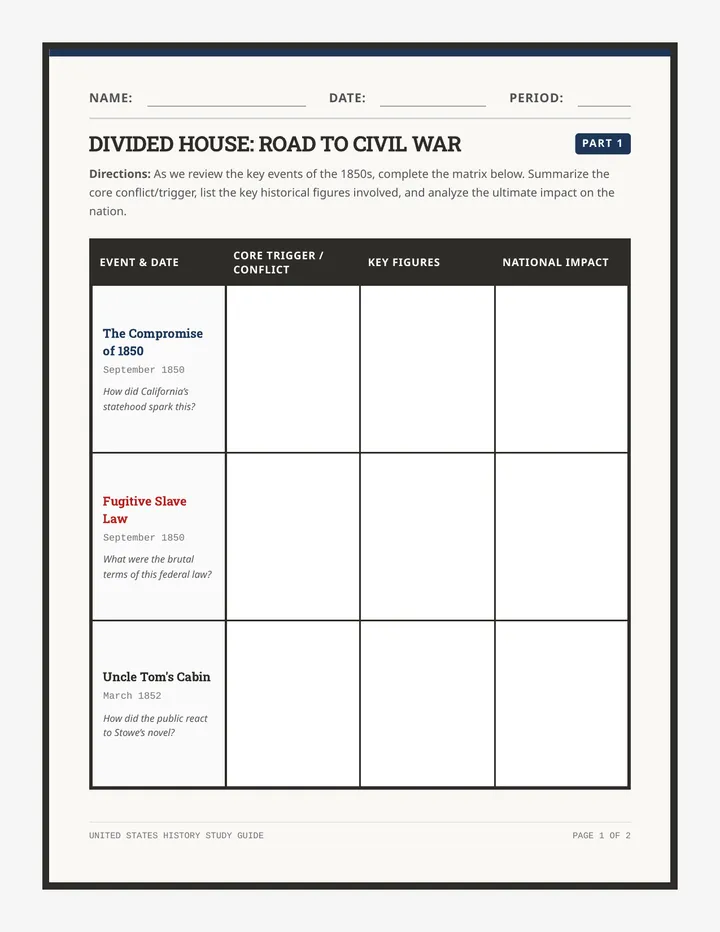
| Event & Date | Core Trigger / Conflict | Key Figures | National Impact |
|---|
| | | |
| The Compromise of 1850 | | | |
September 1850
How did California’s statehood spark this?
| The California Gold Rush led to a massive population boom. California applied to join as a free state, threatening to upset the equal balance of 15 free and 15 slave states in Congress. | • Henry Clay (author)
• Stephen Douglas (compromise broker)
• Daniel Webster | Temporarily settled the statehood crisis by admitting CA as free, but introduced a highly controversial federal Fugitive Slave Law, which deeply outraged Northern citizens. |
|
Fugitive Slave Law
September 1850
What were the brutal terms of this federal law?
| Made helping runaways a federal crime. Suspected escapees had no right to a jury trial or to testify in court. Commissioners received $10 if they ruled a person a slave, but only $5 if set free. | • Federal marshals
• Slave catchers
• Northern citizens (forced to assist) | Brought the cruel reality of southern slavery directly to the doorsteps of the North. Spurred intense Northern anger, growth of the Underground Railroad, and radical abolitionism. |
|
Uncle Tom's Cabin
March 1852
How did the public react to Stowe’s novel?
| A fictional but emotionally powerful novel written by Harriet Beecher Stowe to show the absolute cruelties and moral evils of southern plantation slavery, reacting against the 1850 Fugitive Law. | • Harriet Beecher Stowe (author)
• Abraham Lincoln (later recognized her impact) | Sold 300,000 copies in year one. Transformed anti-slavery stances in the North from a minor political issue into an urgent moral crusade. Angry Southerners banned the book. |
UNITED STATES HISTORY STUDY GUIDE — ANSWER KEY PAGE 1 OF 2
Teacher Reference:
ANSWER KEY
DIVIDED HOUSE MATRIX
Part 2
Teacher reference for Part 2 of the matrix. Ensure students understand how voting, court, and military actions led to secession.