Gravitational Force Answer Key
Teacher Resource
Gravitational Force — Answer Key
10 Questions
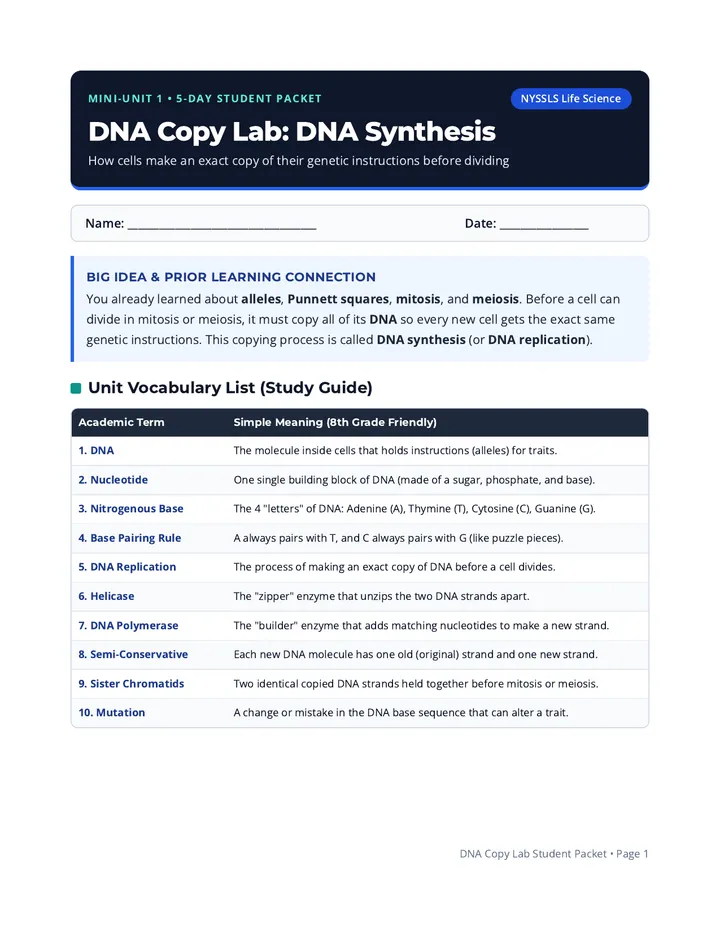
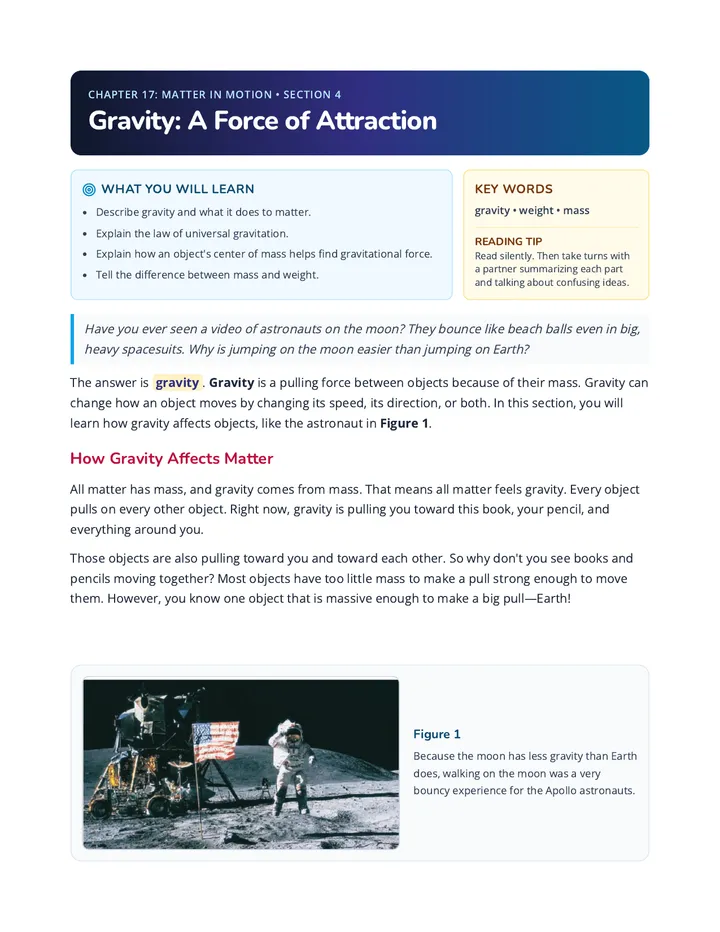
Gravity is a force (force of attraction) between objects and depends on an object's size and their distance apart.
Mass stays the same no matter what location you are in.
What causes the ocean tides to change from high tide to low tide?
Answer: The gravitational pull of the Moon (and the Sun) on Earth's oceans as Earth rotates.
The scientist who wrote the universal law of gravitation was Sir Isaac Newton.
Weight can change based on the force of gravity on an object.
Gravity pulls objects to the center of the Earth.
Astronomers are scientists who study space.
If a 2 pound ball and a 1 pound ball were dropped from the same height at the same time, which one would hit the ground first? Explain why.
Answer: They would hit the ground at the same time. Gravity pulls on all objects so they accelerate at the same rate regardless of their mass (ignoring air resistance).
Explain how the same object can weigh more by the ocean than it does at the top of a mountain.
Answer: At sea level (by the ocean), the object is closer to the center of the Earth. Because gravitational force is stronger when objects are closer together, the pull of gravity—and therefore the object's weight—is slightly greater than on a mountaintop.
Use a model (word, drawing, or both) to explain why the open umbrella hit the ground after the closed umbrella.
Answer: The open umbrella has a much larger surface area, which catches more air and creates greater air resistance pushing upward against gravity, slowing its fall compared to the closed umbrella.
Open Umbrella (Slower)
Large surface area = More air resistance
↑↑↑ Air ↓↓↓
Closed Umbrella (Faster)
Small surface area = Less air resistance
↑ Air ↓↓↓
Grading Note: Accept equivalent student wording for open-ended responses (Questions 3, 8, 9, and 10) that demonstrates understanding of gravity, distance, mass vs. weight, and air resistance.