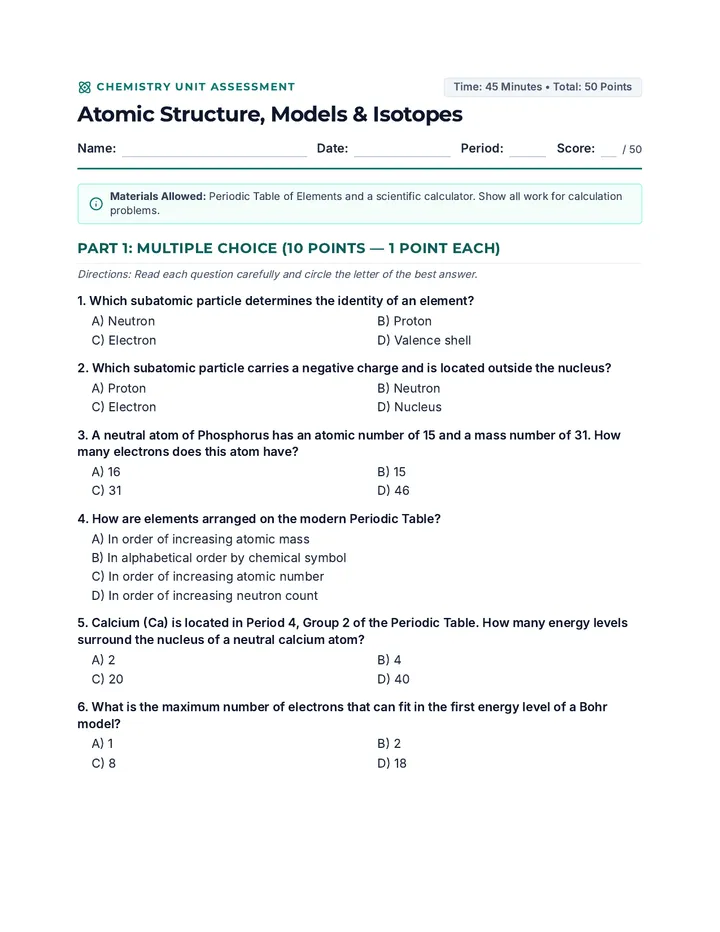
Atomic Structure Unit Test Chemistry Unit Assessment Time: 45 Minutes • Total: 50 Points
Atomic Structure, Models & Isotopes
Name:
Date:
Period:
Score: / 50
Materials Allowed: Periodic Table of Elements and a scientific calculator. Show all work for calculation problems.
Part 1: Multiple Choice (10 points — 1 point each)
Directions: Read each question carefully and circle the letter of the best answer.
1. Which subatomic particle determines the identity of an element?
A) Neutron
B) Proton
C) Electron
D) Valence shell
2. Which subatomic particle carries a negative charge and is located outside the nucleus?
A) Proton
B) Neutron
C) Electron
D) Nucleus
3. A neutral atom of Phosphorus has an atomic number of 15 and a mass number of 31. How many electrons does this atom have?
A) 16
B) 15
C) 31
D) 46
4. How are elements arranged on the modern Periodic Table?
A) In order of increasing atomic mass
B) In alphabetical order by chemical symbol
C) In order of increasing atomic number
D) In order of increasing neutron count
5. Calcium (Ca) is located in Period 4, Group 2 of the Periodic Table. How many energy levels surround the nucleus of a neutral calcium atom?
A) 2
B) 4
C) 20
D) 40
6. What is the maximum number of electrons that can fit in the first energy level of a Bohr model?
A) 1
B) 2
C) 8
D) 18
7. Why do elements in the same group (vertical column) on the Periodic Table share similar chemical properties?
A) They have the same atomic mass
B) They have the same number of energy levels
C) They have the same number of valence electrons
D) They have the same number of neutrons
8. How many neutrons are present in an atom of \(^{79}_{35}\text{Br}\)?
A) 35
B) 44
C) 79
D) 114
9. Isotopes of the same element always have the same number of:
A) Protons
B) Neutrons
C) Mass numbers
D) Energy levels
10. Gallium (Ga) has an average atomic mass of \(69.72\text{ amu}\) and two naturally occurring isotopes: Ga-69 and Ga-71. Which isotope is more abundant in nature?
A) Ga-69, because the average atomic mass is closer to 69 than to 71
B) Ga-71, because heavier isotopes always make up the majority of a sample
C) Both isotopes are equally abundant (50% each)
D) Neither isotope occurs naturally
Part 2: Subatomic Particles & Isotopic Notation (10 points — 0.5 point per blank)
Directions: Use your Periodic Table to complete the missing values for each neutral atom below.
Element Name
Atomic Number
Mass Number
Protons (\(p^+\))
Neutrons (\(n^0\))
Electrons (\(e^-\))
Isotopic Notation
Carbon
6
14
Chlorine
17
20
Iron
26
\(^{56}_{26}\text{Fe}\)
Sodium
23
11
10
12
10
Part 3: Bohr Models & Lewis Dot Diagrams (12 points)
A. Bohr Model Construction (4 points)
Draw a complete Bohr model for a neutral atom of Nitrogen (N) (Atomic Number: 7, Mass Number: 14). Label the number of protons (\(p^+\)) and neutrons (\(n^0\)) in the nucleus, draw the correct number of energy levels, and place each electron as a dot on the appropriate ring.
Protons (\(p^+\)):
Neutrons (\(n^0\)):
Energy Levels:
B. Lewis Dot Diagrams (8 points — 2 points each)
Draw the correct Lewis Dot Diagram for each neutral element below. Write the chemical symbol in the center and place one dot on each of the four sides before pairing any dots.
1. Lithium (Li) Group 1
2. Carbon (C) Group 14
3. Sulfur (S) Group 16
4. Argon (Ar) Group 18
Part 4: Periodic Trends & Isotope Reasoning (8 points — 4 points each)
Directions: Answer each question completely in the spaces provided using full sentences.
11. Sodium (Na, Atomic #11) and Potassium (K, Atomic #19) are both in Group 1 of the Periodic Table.
a) Explain why Sodium and Potassium have very similar chemical properties. (2 pts)
b) Explain how the Bohr model of Potassium differs from the Bohr model of Sodium in terms of energy levels. (2 pts)
12. Two atoms are analyzed in a lab: Atom X has 29 protons and 34 neutrons, while Atom Y has 29 protons and 36 neutrons.
a) Are Atom X and Atom Y the same element or different elements? Justify your answer. (2 pts)
b) Write the complete isotopic notation for both Atom X and Atom Y. (2 pts)
Atom X:
Atom Y:
Part 5: Average Atomic Mass Calculation (10 points)
13. Naturally occurring Boron (B) consists of two stable isotopes shown in the data table below.
Isotope
Isotopic Mass (amu)
Percent Abundance (%)
Boron-10
10.01 amu
19.90%
Boron-11
11.01 amu
80.10%
a) Show the step-by-step calculation to find the average atomic mass of Boron. Round your final answer to two decimal places and include units. (7 pts)
b) Explain why the average atomic mass of Boron is much closer to 11 amu than to 10 amu. (3 pts)
Atomic Structure Answer Key Teacher Answer Key & Scoring Guide
Atomic Structure, Models & Isotopes
50 Points Total • ~45 Min
Part 1: Multiple Choice (10 points — 1 point each)
1. B (Proton) — Atomic number (# of protons) defines the element.
2. C (Electron) — Negatively charged, orbits outside the nucleus.
3. B (15) — In a neutral atom, electrons equal protons (atomic #).
4. C (Increasing atomic number) — Modern periodic law.
5. B (4) — Period number equals the number of energy levels.
6. B (2) — First shell holds a maximum of 2 electrons.
7. C (Same valence electrons) — Determines reactivity/properties.
8. B (44) — Neutrons = Mass # (79) − Atomic # (35) = 44.
9. A (Protons) — Isotopes differ only in neutron count/mass.
10. A (Ga-69) — 69.72 amu is closer to 69 than to 71.
Part 2: Subatomic Particles & Isotopic Notation (10 points — 0.5 pt per blank)
Element Name
Atomic #
Mass #
Protons
Neutrons
Electrons
Isotopic Notation
Carbon
6
14
6
8
6
\(^{14}_{6}\text{C}\)
Chlorine
17
37
17
20
17
\(^{37}_{17}\text{Cl}\)
Iron
26
56
26
30
26
\(^{56}_{26}\text{Fe}\)
Sodium
11
23
11
12
11
\(^{23}_{11}\text{Na}\)
Neon
10
22
10
12
10
\(^{22}_{10}\text{Ne}\)
Part 3: Bohr Models & Lewis Dot Diagrams (12 points)
A. Nitrogen-14 Bohr Model (4 pts)
Protons (\(p^+\)): 7 (1 pt)Neutrons (\(n^0\)): 7 (1 pt)Energy Levels: 2 rings (Period 2) (1 pt)Electron Placement: 2 electrons on inner ring, 5 electrons on outer ring (1 pt)
B. Lewis Dot Diagrams (8 pts — 2 pts each)
1 pt for correct valence dot count; 1 pt for placing 1 dot per side before pairing.
1. Lithium (Li): 1 dot on any single side.2. Carbon (C): 4 dots total (1 dot on each of the 4 sides, none paired).3. Sulfur (S): 6 dots total (2 paired sides + 2 single-dot sides).4. Argon (Ar): 8 dots total (2 paired dots on all 4 sides).
Teacher Answer Key & Scoring Guide (Continued) Parts 4 & 5
Part 4: Periodic Trends & Isotope Reasoning (8 points)
11. Sodium (Na) and Potassium (K) Comparison (4 points)
a) Similar chemical properties (2 pts): Both Sodium and Potassium are in Group 1, so they each have 1 valence electron (1 pt). Elements with the same number of valence electrons react in very similar ways (1 pt).
b) Bohr model energy levels (2 pts): Sodium is in Period 3 and has 3 energy levels (1 pt), whereas Potassium is in Period 4 and has 4 energy levels (1 pt).
12. Atom X (29p, 34n) & Atom Y (29p, 36n) (4 points)
a) Same element justification (2 pts): They are the same element (Copper, Cu) (1 pt) because both atoms have the same atomic number / 29 protons ; they are isotopes with different numbers of neutrons (1 pt).
b) Isotopic notation (2 pts — 1 pt each): Atom X: \(^{63}_{29}\text{Cu}\) (Mass # = 29 + 34 = 63) • Atom Y: \(^{65}_{29}\text{Cu}\) (Mass # = 29 + 36 = 65)
Part 5: Average Atomic Mass Calculation (10 points)
13a) Step-by-Step Calculation for Boron (7 points)
Step 1 — Convert percentages to decimals (2 pts):
Boron-10: \(19.90\% = 0.1990\) | Boron-11: \(80.10\% = 0.8010\)
Step 2 — Multiply each mass by its decimal abundance (2 pts):
Boron-10 contribution: \(10.01\text{ amu} \times 0.1990 = 1.99199\text{ amu}\)
Boron-11 contribution: \(11.01\text{ amu} \times 0.8010 = 8.81901\text{ amu}\)
Step 3 — Add contributions and round to 2 decimal places (3 pts):
\(1.99199 + 8.81901 = 10.811\text{ amu} \approx \mathbf{10.81\text{ amu}}\)
Scoring note: 1 pt for correct rounding to two decimal places; 1 pt for including "amu" units.
13b) Conceptual Explanation (3 points)
The average atomic mass is a weighted average (1 pt). Because Boron-11 is much more abundant (80.10%) than Boron-10 (19.90%) (1 pt), Boron-11 has a much greater weight/pull on the final average, making it closer to 11 amu (1 pt).
Atomic Structure Unit Test B Chemistry Unit Assessment • Version B Time: 45 Minutes • Total: 50 Points
Atomic Structure, Models & Isotopes
Name:
Date:
Period:
Score: / 50
Materials Allowed: Periodic Table of Elements and a scientific calculator. Show all work for calculation problems.
Part 1: Subatomic Particles & Isotopic Notation (10 points — 0.5 point per blank)
Directions: Use your Periodic Table to complete the missing values for each neutral atom below.
Element Name
Atomic Number
Mass Number
Protons (\(p^+\))
Neutrons (\(n^0\))
Electrons (\(e^-\))
Isotopic Notation
Nickel
28
\(^{59}_{28}\text{Ni}\)
9
10
9
Silicon
14
28
Potassium
39
19
Phosphorus
15
16
Part 2: Multiple Choice (10 points — 1 point each)
Directions: Read each question carefully and circle the letter of the best answer.
1. How many neutrons are present in an atom of \(^{79}_{35}\text{Br}\)?
A) 114
B) 35
C) 44
D) 79
2. How are elements arranged on the modern Periodic Table?
A) In order of increasing neutron count
B) In order of increasing atomic number
C) In order of increasing atomic mass
D) In alphabetical order by chemical symbol
3. Gallium (Ga) has an average atomic mass of \(69.72\text{ amu}\) and two naturally occurring isotopes: Ga-69 and Ga-71. Which isotope is more abundant in nature?
A) Neither isotope occurs naturally
B) Both isotopes are equally abundant (50% each)
C) Ga-71, because heavier isotopes always make up the majority of a sample
D) Ga-69, because the average atomic mass is closer to 69 than to 71
4. Which subatomic particle determines the identity of an element?
A) Valence shell
B) Electron
C) Neutron
D) Proton
5. What is the maximum number of electrons that can fit in the first energy level of a Bohr model?
A) 8
B) 18
C) 2
D) 1
6. Isotopes of the same element always have the same number of:
A) Mass numbers
B) Protons
C) Energy levels
D) Neutrons
7. A neutral atom of Phosphorus has an atomic number of 15 and a mass number of 31. How many electrons does this atom have?
A) 31
B) 46
C) 15
D) 16
8. Why do elements in the same group (vertical column) on the Periodic Table share similar chemical properties?
A) They have the same number of valence electrons
B) They have the same number of energy levels
C) They have the same number of neutrons
D) They have the same atomic mass
9. Which subatomic particle carries a negative charge and is located outside the nucleus?
A) Nucleus
B) Proton
C) Electron
D) Neutron
10. Calcium (Ca) is located in Period 4, Group 2 of the Periodic Table. How many energy levels surround the nucleus of a neutral calcium atom?
A) 40
B) 20
C) 4
D) 2
Part 3: Lewis Dot Diagrams & Bohr Models (12 points)
A. Lewis Dot Diagrams (8 points — 2 points each)
Draw the correct Lewis Dot Diagram for each neutral element below. Write the chemical symbol in the center and place one dot on each of the four sides before pairing any dots.
1. Oxygen (O) Group 16
2. Beryllium (Be) Group 2
3. Chlorine (Cl) Group 17
4. Aluminum (Al) Group 13
B. Bohr Model Construction (4 points)
Draw a complete Bohr model for a neutral atom of Magnesium (Mg) (Atomic Number: 12, Mass Number: 24). Label the number of protons (\(p^+\)) and neutrons (\(n^0\)) in the nucleus, draw the correct number of energy levels, and place each electron as a dot on the appropriate ring.
Protons (\(p^+\)):
Neutrons (\(n^0\)):
Energy Levels:
Part 4: Average Atomic Mass Calculation (10 points)
11. Naturally occurring Chlorine (Cl) consists of two stable isotopes shown in the data table below.
Isotope
Isotopic Mass (amu)
Percent Abundance (%)
Chlorine-35
34.97 amu
75.78%
Chlorine-37
36.97 amu
24.22%
a) Show the step-by-step calculation to find the average atomic mass of Chlorine. Round your final answer to two decimal places and include units. (7 pts)
b) Explain why the average atomic mass of Chlorine is much closer to 35 amu than to 37 amu. (3 pts)
Part 5: Isotope Reasoning & Periodic Trends (8 points — 4 points each)
Directions: Answer each question completely in the spaces provided using full sentences.
12. Two atoms are analyzed in a lab: Atom X has 30 protons and 34 neutrons, while Atom Y has 30 protons and 36 neutrons.
a) Are Atom X and Atom Y the same element or different elements? Justify your answer. (2 pts)
b) Write the complete isotopic notation for both Atom X and Atom Y. (2 pts)
Atom X:
Atom Y:
13. Magnesium (Mg, Atomic #12) and Calcium (Ca, Atomic #20) are both in Group 2 of the Periodic Table.
a) Explain why Magnesium and Calcium have very similar chemical properties. (2 pts)
b) Explain how the Bohr model of Calcium differs from the Bohr model of Magnesium in terms of energy levels. (2 pts)
Atomic Structure Answer Key B Teacher Answer Key & Scoring Guide • Version B
Atomic Structure, Models & Isotopes
50 Points Total • ~45 Min
Part 1: Subatomic Particles & Isotopic Notation (10 points — 0.5 pt per blank)
Element Name
Atomic #
Mass #
Protons
Neutrons
Electrons
Isotopic Notation
Nickel
28
59
28
31
28
\(^{59}_{28}\text{Ni}\)
Fluorine
9
19
9
10
9
\(^{19}_{9}\text{F}\)
Silicon
14
28
14
14
14
\(^{28}_{14}\text{Si}\)
Potassium
19
39
19
20
19
\(^{39}_{19}\text{K}\)
Phosphorus
15
31
15
16
15
\(^{31}_{15}\text{P}\)
Part 2: Multiple Choice (10 points — 1 point each)
1. C (44) — Neutrons = Mass # (79) − Atomic # (35) = 44.
2. B (Increasing atomic number) — Modern periodic law.
3. D (Ga-69) — 69.72 amu is closer to 69 than to 71.
4. D (Proton) — Atomic number (# of protons) defines the element.
5. C (2) — First shell holds a maximum of 2 electrons.
6. B (Protons) — Isotopes differ only in neutron count/mass.
7. C (15) — In a neutral atom, electrons equal protons (atomic #).
8. A (Same valence electrons) — Determines reactivity/properties.
9. C (Electron) — Negatively charged, orbits outside the nucleus.
10. C (4) — Period number equals the number of energy levels.
Part 3: Lewis Dot Diagrams & Bohr Models (12 points)
A. Lewis Dot Diagrams (8 pts — 2 pts each)
1 pt for correct valence dot count; 1 pt for placing 1 dot per side before pairing.
1. Oxygen (O): 6 dots total (2 paired sides + 2 single-dot sides).2. Beryllium (Be): 2 dots total (1 dot each on 2 separate sides, none paired).3. Chlorine (Cl): 7 dots total (3 paired sides + 1 single-dot side).4. Aluminum (Al): 3 dots total (1 dot each on 3 separate sides, none paired).
B. Magnesium-24 Bohr Model (4 pts)
Protons (\(p^+\)): 12 (1 pt)Neutrons (\(n^0\)): 12 (1 pt)Energy Levels: 3 rings (Period 3) (1 pt)Electron Placement: 2 on 1st ring, 8 on 2nd ring, 2 on 3rd ring (1 pt)
Teacher Answer Key & Scoring Guide • Version B (Continued) Parts 4 & 5
Part 4: Average Atomic Mass Calculation (10 points)
11a) Step-by-Step Calculation for Chlorine (7 points)
Step 1 — Convert percentages to decimals (2 pts):
Chlorine-35: \(75.78\% = 0.7578\) | Chlorine-37: \(24.22\% = 0.2422\)
Step 2 — Multiply each mass by its decimal abundance (2 pts):
Chlorine-35 contribution: \(34.97\text{ amu} \times 0.7578 = 26.500266\text{ amu}\)
Chlorine-37 contribution: \(36.97\text{ amu} \times 0.2422 = 8.954134\text{ amu}\)
Step 3 — Add contributions and round to 2 decimal places (3 pts):
\(26.500266 + 8.954134 = 35.4544\text{ amu} \approx \mathbf{35.45\text{ amu}}\)
Scoring note: 1 pt for correct rounding to two decimal places; 1 pt for including "amu" units.
11b) Conceptual Explanation (3 points)
The average atomic mass is a weighted average (1 pt). Because Chlorine-35 is much more abundant (75.78%) than Chlorine-37 (24.22%) (1 pt), Chlorine-35 has a much greater weight/pull on the final average, making it closer to 35 amu (1 pt).
Part 5: Isotope Reasoning & Periodic Trends (8 points)
12. Atom X (30p, 34n) & Atom Y (30p, 36n) (4 points)
a) Same element justification (2 pts): They are the same element (Zinc, Zn) (1 pt) because both atoms have the same atomic number / 30 protons ; they are isotopes with different numbers of neutrons (1 pt).
b) Isotopic notation (2 pts — 1 pt each): Atom X: \(^{64}_{30}\text{Zn}\) (Mass # = 30 + 34 = 64) • Atom Y: \(^{66}_{30}\text{Zn}\) (Mass # = 30 + 36 = 66)
13. Magnesium (Mg) and Calcium (Ca) Comparison (4 points)
a) Similar chemical properties (2 pts): Both Magnesium and Calcium are in Group 2, so they each have 2 valence electrons (1 pt). Elements with the same number of valence electrons react in very similar ways (1 pt).
b) Bohr model energy levels (2 pts): Magnesium is in Period 3 and has 3 energy levels (1 pt), whereas Calcium is in Period 4 and has 4 energy levels (1 pt).
Atomic Structure Unit Test C Chemistry Unit Assessment • Version C Time: 45 Minutes • Total: 50 Points
Atomic Structure, Models & Isotopes
Name:
Date:
Period:
Score: / 50
Materials Allowed: Periodic Table of Elements and a scientific calculator. Show all work for calculation problems.
Part 1: Average Atomic Mass Calculation (10 points)
1. Naturally occurring Lithium (Li) consists of two stable isotopes shown in the data table below.
Isotope
Isotopic Mass (amu)
Percent Abundance (%)
Lithium-6
6.02 amu
7.59%
Lithium-7
7.02 amu
92.41%
a) Show the step-by-step calculation to find the average atomic mass of Lithium. Round your final answer to two decimal places and include units. (7 pts)
b) Explain why the average atomic mass of Lithium is much closer to 7 amu than to 6 amu. (3 pts)
Part 2: Multiple Choice (10 points — 1 point each)
Directions: Read each question carefully and circle the letter of the best answer.
2. Isotopes of the same element always have the same number of:
A) Neutrons
B) Energy levels
C) Mass numbers
D) Protons
3. Calcium (Ca) is located in Period 4, Group 2 of the Periodic Table. How many energy levels surround the nucleus of a neutral calcium atom?
A) 4
B) 2
C) 40
D) 20
4. Which subatomic particle carries a negative charge and is located outside the nucleus?
A) Electron
B) Neutron
C) Nucleus
D) Proton
5. Why do elements in the same group (vertical column) on the Periodic Table share similar chemical properties?
A) They have the same atomic mass
B) They have the same number of neutrons
C) They have the same number of valence electrons
D) They have the same number of energy levels
6. Which subatomic particle determines the identity of an element?
A) Proton
B) Electron
C) Valence shell
D) Neutron
7. Gallium (Ga) has an average atomic mass of \(69.72\text{ amu}\) and two naturally occurring isotopes: Ga-69 and Ga-71. Which isotope is more abundant in nature?
A) Both isotopes are equally abundant (50% each)
B) Ga-69, because the average atomic mass is closer to 69 than to 71
C) Neither isotope occurs naturally
D) Ga-71, because heavier isotopes always make up the majority of a sample
8. What is the maximum number of electrons that can fit in the first energy level of a Bohr model?
A) 18
B) 8
C) 1
D) 2
9. A neutral atom of Phosphorus has an atomic number of 15 and a mass number of 31. How many electrons does this atom have?
A) 15
B) 16
C) 46
D) 31
10. How many neutrons are present in an atom of \(^{79}_{35}\text{Br}\)?
A) 79
B) 114
C) 44
D) 35
11. How are elements arranged on the modern Periodic Table?
A) In alphabetical order by chemical symbol
B) In order of increasing neutron count
C) In order of increasing atomic mass
D) In order of increasing atomic number
Part 3: Periodic Trends & Isotope Reasoning (8 points — 4 points each)
Directions: Answer each question completely in the spaces provided using full sentences.
12. Fluorine (F, Atomic #9) and Chlorine (Cl, Atomic #17) are both in Group 17 of the Periodic Table.
a) Explain why Fluorine and Chlorine have very similar chemical properties. (2 pts)
b) Explain how the Bohr model of Chlorine differs from the Bohr model of Fluorine in terms of energy levels. (2 pts)
13. Two atoms are analyzed in a lab: Atom X has 26 protons and 28 neutrons, while Atom Y has 26 protons and 30 neutrons.
a) Are Atom X and Atom Y the same element or different elements? Justify your answer. (2 pts)
b) Write the complete isotopic notation for both Atom X and Atom Y. (2 pts)
Atom X:
Atom Y:
Part 4: Subatomic Particles & Isotopic Notation (10 points — 0.5 point per blank)
Directions: Use your Periodic Table to complete the missing values for each neutral atom below.
Element Name
Atomic Number
Mass Number
Protons (\(p^+\))
Neutrons (\(n^0\))
Electrons (\(e^-\))
Isotopic Notation
Calcium
40
20
Sulfur
16
16
5
6
5
Cobalt
27
\(^{59}_{27}\text{Co}\)
Nitrogen
7
15
Part 5: Bohr Models & Lewis Dot Diagrams (12 points)
A. Bohr Model Construction (4 points)
Draw a complete Bohr model for a neutral atom of Aluminum (Al) (Atomic Number: 13, Mass Number: 27). Label the number of protons (\(p^+\)) and neutrons (\(n^0\)) in the nucleus, draw the correct number of energy levels, and place each electron as a dot on the appropriate ring.
Protons (\(p^+\)):
Neutrons (\(n^0\)):
Energy Levels:
B. Lewis Dot Diagrams (8 points — 2 points each)
Draw the correct Lewis Dot Diagram for each neutral element below. Write the chemical symbol in the center and place one dot on each of the four sides before pairing any dots.
1. Neon (Ne) Group 18
2. Silicon (Si) Group 14
3. Phosphorus (P) Group 15
4. Sodium (Na) Group 1
Atomic Structure Answer Key C Teacher Answer Key & Scoring Guide • Version C
Atomic Structure, Models & Isotopes
50 Points Total • ~45 Min
Part 1: Average Atomic Mass Calculation (10 points)
1a) Step-by-Step Calculation for Lithium (7 points)
Step 1 (2 pts): Lithium-6: \(7.59\% = 0.0759\) | Lithium-7: \(92.41\% = 0.9241\)
Step 2 (2 pts): \(6.02 \times 0.0759 = 0.456918\text{ amu}\) | \(7.02 \times 0.9241 = 6.487182\text{ amu}\)
Step 3 (3 pts): \(0.456918 + 6.487182 = 6.9441\text{ amu} \approx \mathbf{6.94\text{ amu}}\) (1 pt rounding, 1 pt units)
1b) Conceptual Explanation (3 points)
The average atomic mass is a weighted average (1 pt). Because Lithium-7 is much more abundant (92.41%) than Lithium-6 (7.59%) (1 pt), Lithium-7 has a much greater weight/pull on the final average, making it closer to 7 amu (1 pt).
Part 2: Multiple Choice (10 points — 1 point each)
2. D (Protons) — Isotopes differ only in neutron count/mass.
3. A (4) — Period number equals the number of energy levels.
4. A (Electron) — Negatively charged, orbits outside the nucleus.
5. C (Same valence electrons) — Determines reactivity/properties.
6. A (Proton) — Atomic number (# of protons) defines the element.
7. B (Ga-69) — 69.72 amu is closer to 69 than to 71.
8. D (2) — First shell holds a maximum of 2 electrons.
9. A (15) — In a neutral atom, electrons equal protons (atomic #).
10. C (44) — Neutrons = Mass # (79) − Atomic # (35) = 44.
11. D (Increasing atomic number) — Modern periodic law.
Part 3: Periodic Trends & Isotope Reasoning (8 points)
12. Fluorine (F) & Chlorine (Cl) (4 pts)
a) Similar properties (2 pts): Both are in Group 17, so each has 7 valence electrons (1 pt); same valence electrons give similar reactivity (1 pt).
b) Energy levels (2 pts): F (Period 2) has 2 energy levels (1 pt); Cl (Period 3) has 3 energy levels (1 pt).
13. Atom X & Atom Y (4 pts)
a) Same element (2 pts): Same element (Iron, Fe) (1 pt) because both have 26 protons ; they are isotopes with different neutron counts (1 pt).
b) Isotopic notation (2 pts): X: \(^{54}_{26}\text{Fe}\) • Y: \(^{56}_{26}\text{Fe}\)
Teacher Answer Key & Scoring Guide • Version C (Continued) Parts 4 & 5
Part 4: Subatomic Particles & Isotopic Notation (10 points — 0.5 pt per blank)
Element Name
Atomic #
Mass #
Protons
Neutrons
Electrons
Isotopic Notation
Calcium
20
40
20
20
20
\(^{40}_{20}\text{Ca}\)
Sulfur
16
32
16
16
16
\(^{32}_{16}\text{S}\)
Boron
5
11
5
6
5
\(^{11}_{5}\text{B}\)
Cobalt
27
59
27
32
27
\(^{59}_{27}\text{Co}\)
Nitrogen
7
15
7
8
7
\(^{15}_{7}\text{N}\)
Part 5: Bohr Models & Lewis Dot Diagrams (12 points)
A. Aluminum-27 Bohr Model (4 pts)
Protons (\(p^+\)): 13 (1 pt)Neutrons (\(n^0\)): 14 (1 pt)Energy Levels: 3 rings (Period 3) (1 pt)Electron Placement: 2 on 1st ring, 8 on 2nd ring, 3 on 3rd ring (1 pt)
B. Lewis Dot Diagrams (8 pts — 2 pts each)
1 pt for correct valence dot count; 1 pt for placing 1 dot per side before pairing.
1. Neon (Ne): 8 dots total (2 paired dots on all 4 sides).2. Silicon (Si): 4 dots total (1 dot on each of the 4 sides, none paired).3. Phosphorus (P): 5 dots total (1 paired side + 3 single-dot sides).4. Sodium (Na): 1 dot on any single side.