DNA Blueprint Reading Molecular Biology • Reading Passage
DNA: The Blueprint of Life
Name: _________________________
Date: _______________
Key Terms to Watch For
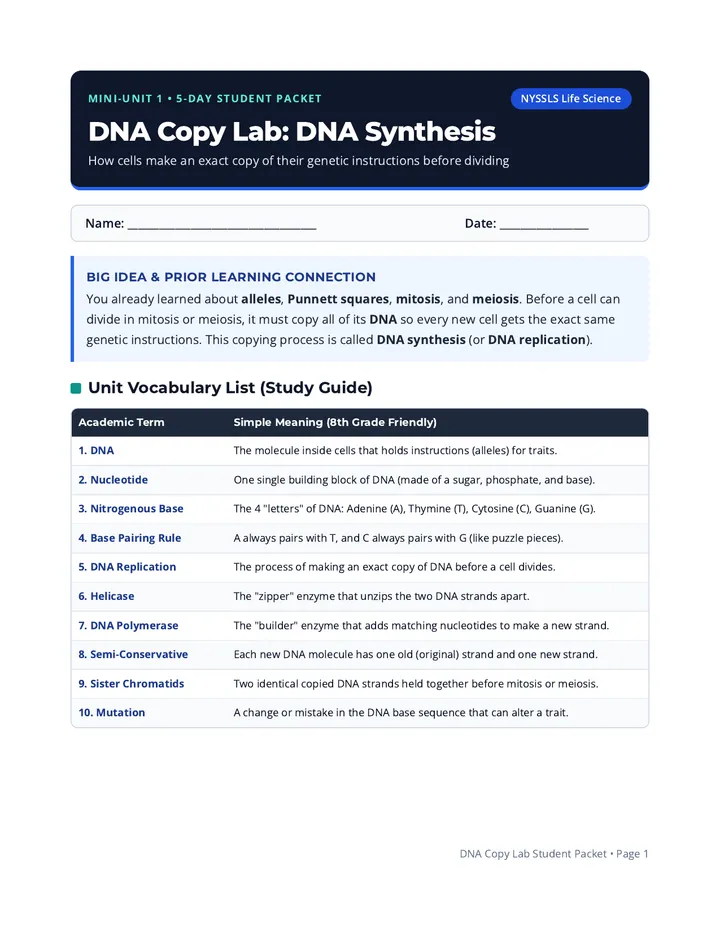
DNA (Deoxyribonucleic Acid) Nucleotide Double Helix Nitrogenous Base Hydrogen Bond
1. The Molecule of Heredity
Every living organism—from a microscopic bacterium to a giant redwood tree to you—carries a set of instructions inside its cells. This hereditary instruction manual is a molecule called deoxyribonucleic acid , or DNA . In eukaryotic cells (cells with a nucleus), DNA is stored safely inside the nucleus, coiled tightly into structures called chromosomes.
DNA is often called the "blueprint of life" because it contains the coded directions needed to build proteins, run cellular activities, and pass genetic traits from parents to offspring. Even though all living things use the exact same chemical building blocks to make DNA, the specific arrangement of those blocks makes every species—and every individual—unique.
2. Building Blocks: The Nucleotide
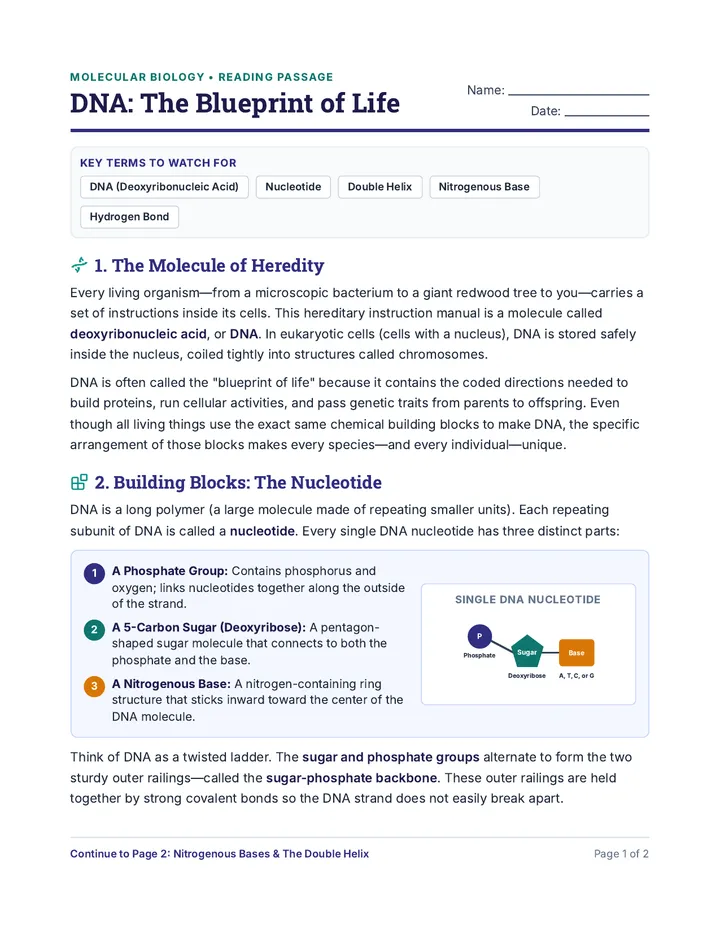
DNA is a long polymer (a large molecule made of repeating smaller units). Each repeating subunit of DNA is called a nucleotide . Every single DNA nucleotide has three distinct parts:
1
A Phosphate Group: Contains phosphorus and oxygen; links nucleotides together along the outside of the strand.
2
A 5-Carbon Sugar (Deoxyribose): A pentagon-shaped sugar molecule that connects to both the phosphate and the base.
3
A Nitrogenous Base: A nitrogen-containing ring structure that sticks inward toward the center of the DNA molecule.
Single DNA Nucleotide
P Phosphate Sugar Deoxyribose Base A, T, C, or G
Think of DNA as a twisted ladder. The sugar and phosphate groups alternate to form the two sturdy outer railings—called the sugar-phosphate backbone . These outer railings are held together by strong covalent bonds so the DNA strand does not easily break apart.
Continue to Page 2: Nitrogenous Bases & The Double Helix Page 1 of 2
DNA: The Blueprint of Life Page 2 • Bases & Structure
3. The Four Nitrogenous Bases & Complementary Pairing
While the sugar and phosphate are identical in every DNA nucleotide, the nitrogenous base varies. There are four nitrogenous bases in DNA: Adenine (A) , Thymine (T) , Cytosine (C) , and Guanine (G) .
These bases pair up across the center of the DNA molecule to form the "rungs" of the ladder. Because of their chemical shapes, the bases follow a strict rule called complementary base pairing :
Adenine (A) pairs with Thymine (T)
Joined by 2 weak hydrogen bonds
A — T
Cytosine (C) pairs with Guanine (G)
Joined by 3 weak hydrogen bonds
C — G
The two complementary bases are held together in the middle by weak hydrogen bonds . Why is it helpful that these middle bonds are weak? Before a cell divides, it must copy its DNA. Weak hydrogen bonds allow the two strands to easily "unzip" down the middle like a zipper without breaking the strong outer sugar-phosphate backbone!
4. Chargaff's Rule & The Double Helix
In the early 1950s, biochemist Erwin Chargaff analyzed DNA from many different species. He discovered a consistent mathematical pattern: in any sample of double-stranded DNA, the percentage of adenine always equals thymine (%A = %T) , and the percentage of cytosine always equals guanine (%C = %G) . For example, if a DNA molecule is 30% adenine, it must also be 30% thymine—leaving 40% to be split equally between cytosine (20%) and guanine (20%).
Shortly after, using X-ray diffraction images captured by Rosalind Franklin, scientists James Watson and Francis Crick determined the 3D shape of DNA: a double helix —two complementary strands wound around each other like a spiral staircase.
5. From Base Sequence to Traits
If every organism's DNA is made of the same four bases (A, T, C, and G), how can DNA create such incredible diversity of life? The secret is in the sequence (order) of the bases . Just as the 26 letters of the alphabet can be arranged into millions of different words, the sequence of A, T, C, and G along a DNA strand forms a genetic code. Sections of DNA called genes provide the exact sequence needed to assemble amino acids into specific proteins , and those proteins determine an organism's traits.
Big Picture Takeaways
Structure: DNA is a double helix made of repeating nucleotides (phosphate + deoxyribose sugar + nitrogenous base).Pairing Rule: Adenine pairs with Thymine (A–T); Cytosine pairs with Guanine (C–G) via weak hydrogen bonds.Function: The sequence of nitrogenous bases determines the sequence of amino acids, which builds specific proteins and traits. Helix Guided Notes Molecular Biology • Guided Notes
DNA Structure & Bases Notes
Name: _________________________
Date: _______________
Part 1: The Molecule of Heredity
1. DNA stands for __________________________________________. In eukaryotic cells, it is stored inside the _______________________.
2. DNA is called the "blueprint of life" because it carries coded instructions to build _______________________ and pass genetic _______________________ from parents to offspring.
Part 2: Building Blocks — The Nucleotide
3. DNA is a polymer made of repeating subunits called _______________________.
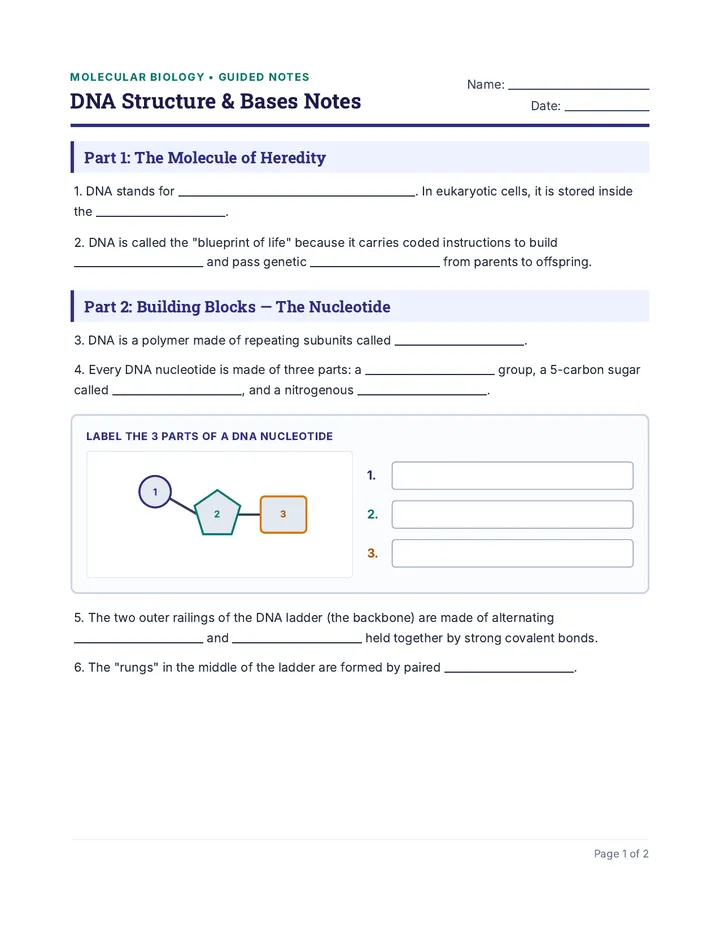
4. Every DNA nucleotide is made of three parts: a _______________________ group, a 5-carbon sugar called _______________________, and a nitrogenous _______________________.
Label the 3 Parts of a DNA Nucleotide
1 2 3
5. The two outer railings of the DNA ladder (the backbone) are made of alternating _______________________ and _______________________ held together by strong covalent bonds.
6. The "rungs" in the middle of the ladder are formed by paired _______________________.
Page 1 of 2
DNA Structure & Bases Notes Page 2 • Base Pairing & Function
Part 3: Nitrogenous Bases & Complementary Pairing
7. The four nitrogenous bases in DNA are ___________________ (A), ___________________ (T), ___________________ (C), and ___________________ (G).
8. Complementary base pairing rule: A always pairs with _____, and C always pairs with _____.
9. Complementary bases are joined in the center by weak _______________________ bonds. These bonds are weak so the DNA strands can easily _______________________ when the cell copies its DNA.
Practice: Write the Complementary DNA Strand
Original Strand
A
T
G
C
C
A
T
G
A
C
Complementary Strand
Part 4: Chargaff's Rule & The Double Helix
10. DNA's 3D shape is called a _______________________, which looks like a twisted ladder.
Problem A: A sample of DNA is 22% Adenine (A).
% Thymine (T) = ________%
% Cytosine (C) = ________%
% Guanine (G) = ________%
Problem B: A sample of DNA is 35% Guanine (G).
% Cytosine (C) = ________%
% Adenine (A) = ________%
% Thymine (T) = ________%
Part 5: Big Idea Check — From Sequence to Traits
11. All organisms use the same four DNA bases (A, T, C, and G). Explain how the same four bases can produce millions of different traits in living things.
Page 2 of 2
Regents DNA Worksheet Living Environment • Regents Practice
DNA Structure & Bases: Regents Review
Name: _________________________
Date: _______________
Part A: Multiple Choice — Circle the number of the word or expression that best completes each statement or answers each question.
1. Which three components make up a single DNA nucleotide?
(1) a fatty acid, a phosphate group, and a nitrogenous base
(2) a deoxyribose sugar, a phosphate group, and a nitrogenous base
(3) an amino acid, a ribose sugar, and a hydrogen bond
(4) a glucose molecule, a phosphate group, and an amino acid
2. If a single strand of DNA has the base sequence A-G-C-T-A-A, what is the sequence of the complementary DNA strand?
(1) A-G-C-T-A-A
(2) T-C-G-A-T-T
(3) C-T-A-G-C-C
(4) U-C-G-A-U-U
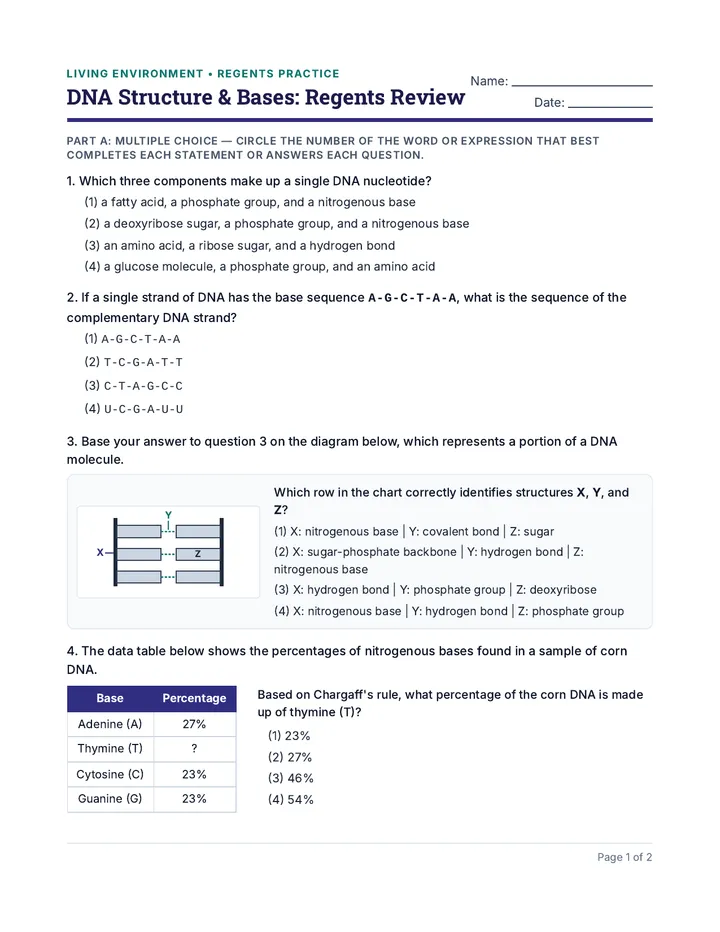
3. Base your answer to question 3 on the diagram below, which represents a portion of a DNA molecule.
X Y Z
Which row in the chart correctly identifies structures X , Y , and Z ?
(1) X: nitrogenous base | Y: covalent bond | Z: sugar
(2) X: sugar-phosphate backbone | Y: hydrogen bond | Z: nitrogenous base
(3) X: hydrogen bond | Y: phosphate group | Z: deoxyribose
(4) X: nitrogenous base | Y: hydrogen bond | Z: phosphate group
4. The data table below shows the percentages of nitrogenous bases found in a sample of corn DNA.
Base
Percentage
Adenine (A)
27%
Thymine (T)
?
Cytosine (C)
23%
Guanine (G)
23%
Based on Chargaff's rule, what percentage of the corn DNA is made up of thymine (T)?
(1) 23%
(2) 27%
(3) 46%
(4) 54%
Page 1 of 2
DNA Structure & Bases: Regents Review Page 2 • Analysis & Constructed Response
5. Although both an oak tree and a human have DNA composed of the exact same four nitrogenous bases (A, T, C, and G), they look and function very differently. Which statement best explains this difference?
(1) Humans have stronger covalent bonds between their nitrogenous bases than oak trees do.
(2) Oak trees have a different type of sugar in their DNA backbone than humans have.
(3) The specific sequence of nitrogenous bases differs between humans and oak trees.
(4) Oak tree DNA contains five different types of nucleotides, while human DNA has four.
6. The coded information in a segment of DNA (a gene) directly determines the
(1) rate at which water enters the cell by osmosis
(2) sequence of amino acids assembled to form a protein
(3) number of mitochondria located in the cytoplasm
(4) amount of sunlight absorbed by the cell membrane
Part B-2 / C: Constructed Response — Write your answers in the spaces provided.
7. A short segment of one DNA strand has the base sequence shown below:
C — G — T — A — A — C — G — A — T
a) In the box below, write the complementary DNA base sequence for this strand.
b) Explain why a change (mutation) in just one or two bases of this sequence could result in a different trait for the organism.
8. A marine biologist analyzes a sample of DNA from a newly discovered deep-sea worm and finds that 18% of its nitrogenous bases are cytosine (C) .
Determine the percentage of adenine (A) in this DNA sample, and explain the steps you used to find your answer.
Page 2 of 2
DNA Lesson Answer Key Teacher Resource • Answer Key
DNA Decoded: Complete Answer Key
TEACHER COPY
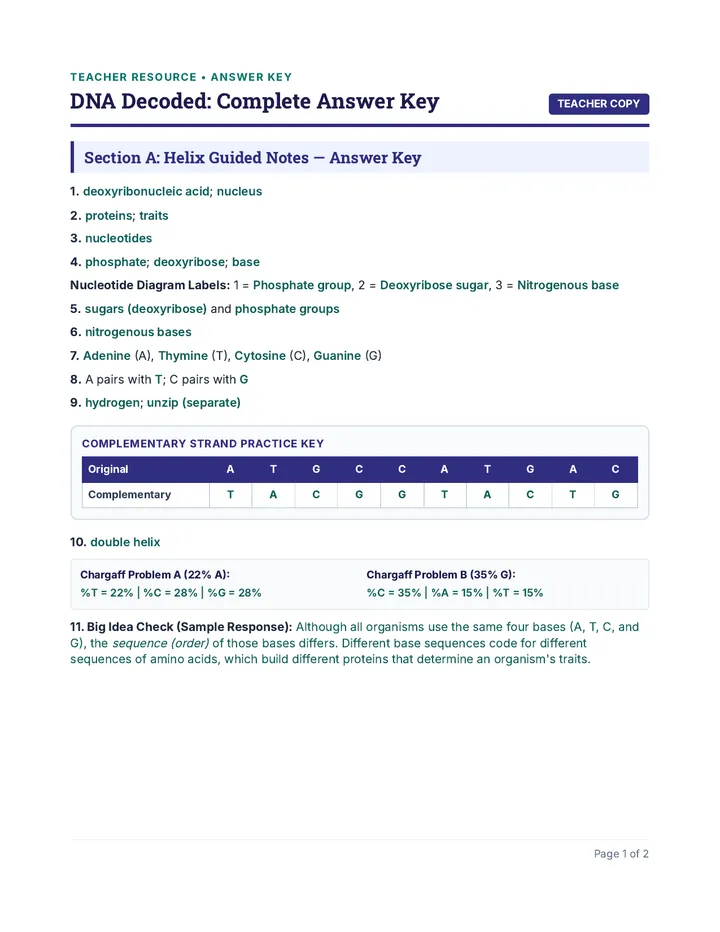
Section A: Helix Guided Notes — Answer Key
1. deoxyribonucleic acid; nucleus
2. proteins; traits
3. nucleotides
4. phosphate; deoxyribose; base
Nucleotide Diagram Labels: 1 = Phosphate group, 2 = Deoxyribose sugar, 3 = Nitrogenous base
5. sugars (deoxyribose) and phosphate groups
6. nitrogenous bases
7. Adenine (A), Thymine (T), Cytosine (C), Guanine (G)
8. A pairs with T; C pairs with G
9. hydrogen; unzip (separate)
Complementary Strand Practice Key
Original
A
T
G
C
C
A
T
G
A
C
Complementary
T
A
C
G
G
T
A
C
T
G
10. double helix
Chargaff Problem A (22% A):
%T = 22% | %C = 28% | %G = 28%
Chargaff Problem B (35% G):
%C = 35% | %A = 15% | %T = 15%
11. Big Idea Check (Sample Response): Although all organisms use the same four bases (A, T, C, and G), the sequence (order) of those bases differs. Different base sequences code for different sequences of amino acids, which build different proteins that determine an organism's traits.
Page 1 of 2
DNA Decoded: Complete Answer Key TEACHER COPY • PAGE 2
Section B: Regents DNA Worksheet — Part A (Multiple Choice)
1. Correct Answer: (2) — a deoxyribose sugar, a phosphate group, and a nitrogenous base.
Rationale: DNA nucleotides always contain deoxyribose (not ribose, which is in RNA) along with a phosphate and a nitrogenous base.
2. Correct Answer: (2) — T-C-G-A-T-T
Rationale: By complementary base pairing in DNA, A pairs with T and C pairs with G. (Choice 4 uses U, which is only in RNA).
3. Correct Answer: (2) — X: sugar-phosphate backbone | Y: hydrogen bond | Z: nitrogenous base.
Rationale: X points to the outer railing (alternating sugar and phosphate), Y points to the dashed weak bond in the center, and Z labels one of the inner base rungs.
4. Correct Answer: (2) — 27%
Rationale: According to Chargaff's rule, %A = %T. Since Adenine is 27%, Thymine must also be 27% (and 27 + 27 + 23 + 23 = 100%).
5. Correct Answer: (3) — The specific sequence of nitrogenous bases differs between humans and oak trees.
Rationale: All organisms share the same 4 DNA bases and sugar-phosphate backbone; genetic diversity comes from the order/sequence of bases.
6. Correct Answer: (2) — sequence of amino acids assembled to form a protein.
Rationale: Core Regents concept: DNA base sequence codes for amino acid sequence, which determines protein shape and function.
Section C: Regents DNA Worksheet — Part B-2 / C (Constructed Response)
7. Scoring Guide (2 credits total):
a) (1 credit): G — C — A — T — T — G — C — T — A
b) (1 credit): Acceptable responses include: Changing the DNA base sequence can change the sequence of amino acids assembled, producing a differently shaped protein (or enzyme) that alters the trait.
8. Scoring Guide (2 credits total):
Percentage of Adenine (1 credit): 32%
Explanation (1 credit): Because C pairs with G, %G is also 18% (18% + 18% = 36% C and G). The remaining 64% (100% − 36%) is split equally between A and T, so Adenine is 64% ÷ 2 = 32%.
Page 2 of 2