Genetics Cell Division Packet
8th Grade Intermediate Life Science
Unit 4: Genetics & Cell Division
Student Core Packet • Part 1
First:
Last:
Date:
Class: 8A 8B 8C 8D
Lesson Objective: I can explain how chromosomes duplicate to pass identical genes during cell division, define alleles as versions of a gene, and use a Punnett square to predict offspring traits.
1 Section 1: Do Now • Prior Knowledge Recall
⏱ Time: 4 Minutes
1. Where are chromosomes located inside an animal or plant cell? (Word Bank: cell wall, nucleus, cytoplasm)
Sentence Starter: Chromosomes are located inside the .
2. What do genes contain instructions for? (Word Bank: traits / physical features, water storage, digestion)
Sentence Starter: Genes give instructions that determine an organism's .
2 Section 2: Key Vocabulary • Plain-English Definitions
Core Science Terms
1. Chromosome Structure
A structure made of DNA inside the nucleus that holds many genes.
2. Gene DNA Segment
A short section on a chromosome that codes for one specific trait.
3. Allele Variation
Different versions of the same gene (example: brown eye vs. blue eye allele).
4. Dominant Allele Capital (B)
A stronger allele that hides the recessive version. Written as CAPITAL letter.
5. Recessive Allele Lowercase (bb)
A hidden allele that only shows if both alleles are lowercase (bb).
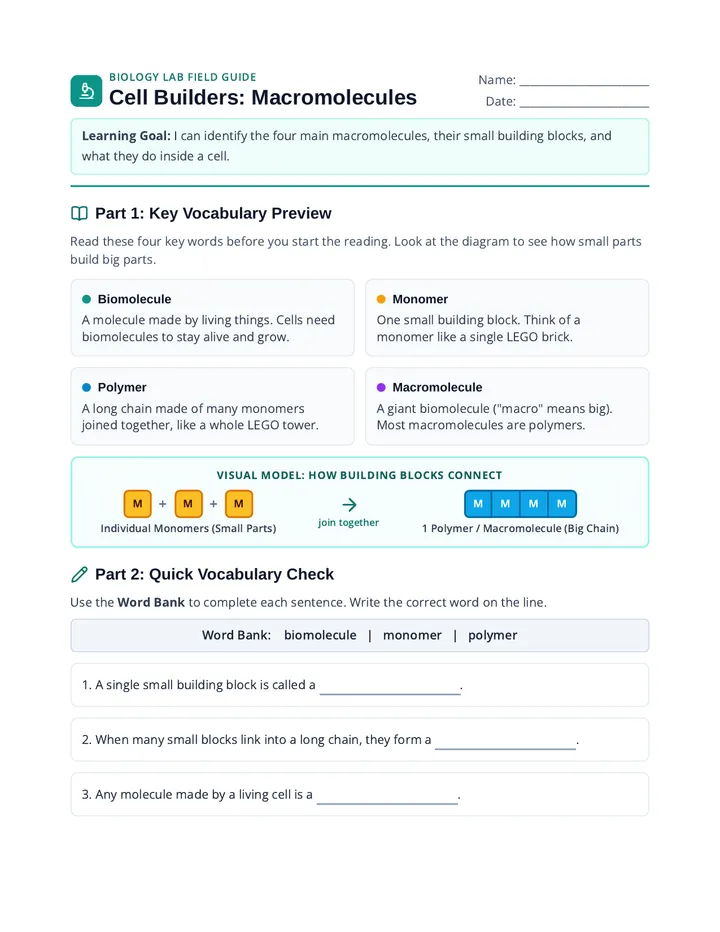
6. Mitosis Cell Division
When 1 body cell duplicates its chromosomes & splits into 2 identical cells.
3 Section 3: How Cells Pass Genes • Chromosome Duplication
Read & Analyze Model
Chunk A (Duplication):
Before any cell divides, each chromosome makes an exact copy of itself. This process is called chromosome duplication.
Chunk B (Division):
During cell division (mitosis), the copies separate into two new cells called daughter cells with identical chromosome counts.
Model: Tracing Chromosome Duplication & Cell Division (Mitosis)
Stage 1: Parent Cell Original Cell (2 Chromosomes)
2 Single Chromosomes
Stage 2: Duplication Chromosomes Make Exact Copies
Copied & Paired
Stage 3: 2 Daughter Cells Both Have Same Identical DNA
2 Identical Clones
8th Grade Intermediate Life Science • Student Core Packet Unit 4: Genetics & Mitosis
8.º Grado Ciencias de la Vida Intermedias • Versión en Español
Unidad 4: Genética y División Celular
Paquete del Estudiante • Parte 1
Nombre:
Apellido:
Fecha:
Clase: 8A 8B 8C 8D
Objetivo de la Lección: Puedo explicar cómo los cromosomas se duplican para transmitir genes idénticos durante la división celular, definir los alelos como versiones de un gen y usar un cuadro de Punnett para predecir los rasgos de la descendencia.
1 Sección 1: Hazlo Ahora • Activación de Conocimientos Previos
⏱ Tiempo: 4 Minutos
1. ¿Dónde se encuentran los cromosomas dentro de la célula? (Banco de palabras: pared celular, núcleo, citoplasma)
Inicio de oración: Los cromosomas se encuentran dentro del .
2. ¿Para qué contienen instrucciones los genes? (Banco de palabras: rasgos / características físicas, almacenar agua, digestión)
Inicio de oración: Los genes dan instrucciones que determinan los físicos.
2 Sección 2: Vocabulario Clave • Definiciones en Lenguaje Sencillo
Términos Clave
1. Cromosoma Estructura
Estructura formada por ADN en el núcleo que contiene muchos genes.
2. Gen Segmento ADN
Una sección corta en un cromosoma que contiene instrucciones para un rasgo.
3. Alelo Variación
Diferentes versiones de un mismo gen (ejemplo: alelo de ojos cafés vs. ojos azules).
4. Alelo Dominante Mayúscula (B)
Un alelo fuerte que oculta al recesivo. Se escribe con letra MAYÚSCULA.
5. Alelo Recesivo Minúscula (bb)
Un alelo oculto que solo se manifiesta si ambos alelos son minúsculas (bb).
6. Mitosis División
Cuando 1 célula duplica sus cromosomas y se divide en 2 células hijas idénticas.
3 Sección 3: Cómo las Células Pasan Genes • Duplicación de Cromosomas
Lectura y Modelo
Bloque A (Duplicación):
Antes de que una célula se divida, cada cromosoma hace una copia exacta de sí mismo. Este proceso se llama duplicación de cromosomas.
Bloque B (División):
Durante la división celular (mitosis), las copias se separan en dos nuevas células llamadas células hijas con cromosomas idénticos.
Modelo: Siguiendo la Duplicación de Cromosomas y la Mitosis
Etapa 1: Célula Madre Célula Original (2 Cromosomas)
2 Cromosomas Simples
Etapa 2: Duplicación Copias Exactas de Cromosomas
Copiados y Emparejados
Etapa 3: 2 Células Hijas Ambas Tienen el Mismo ADN
2 Clones Idénticos
8.º Grado Ciencias de la Vida Intermedias • Paquete del Estudiante Unidad 4: Genética y Mitosis
8th Grade Intermediate Life Science
Unit 4: Genetics & Cell Division
Student Core Packet • Part 2
Goal: Apply chromosome duplication facts and Punnett squares to predict genetic outcomes. Exam Application
4 Section 4: Authentic NYS 8th Grade Science Exam Practice
⏱ Time: 17–20 Minutes
Question 1 • NYS Statewide Intermediate-Level Science Exam Multiple Choice
A dog has 78 chromosomes in each of its body cells. When a body cell divides by mitosis to produce two new skin cells, how many chromosomes will each new daughter cell have?
(1) 39
(2) 78
(3) 156
(4) 0
Sentence Starter: Each new daughter cell will have chromosomes because before the cell divides, the chromosomes .
Question 2 • NYS Statewide Intermediate-Level Science Exam Model & Constructed Response
In pea plants, the allele for tall stems (T) is dominant over the allele for short stems (t). A tall plant with genotype Tt is crossed with a short plant with genotype tt.
Punnett Square Grid: Tt × tt
Combine 1 top allele + 1 side allele per box
a. What percentage of offspring are expected to have tall stems?
Answer: % tall
b. Why will an offspring with the letters Tt be tall instead of short?
Sentence Starter: An offspring with Tt is tall because the allele T is , which masks the recessive allele.
Question 3 • NYS Statewide Intermediate-Level Science Exam Short Explanation
Why do children produced through sexual reproduction look similar to both parents, but are not an identical copy of either parent?
Sentence Starter: Children inherit allele from the mother and allele from the father, creating a unique combination of traits.
5 Section 5: Exit Slip • Silent Check for Understanding
⏱ Time: 3 Minutes
If B is the dominant allele for brown eyes and b is the recessive allele for blue eyes, what eye color will a person with genotype Bb have?
Sentence Starter: A person with the genotype Bb will have eyes because .
Visual Allele Pair
B + b
Heterozygous (Bb)
8th Grade Intermediate Life Science • Student Core Packet Unit 4: Punnett Squares & Traits
8.º Grado Ciencias de la Vida Intermedias • Versión en Español
Unidad 4: Genética y División Celular
Paquete del Estudiante • Parte 2
Meta: Aplicar la duplicación cromosómica y cuadros de Punnett para predecir resultados genéticos. Práctica de Examen
4 Sección 4: Práctica Auténtica del Examen Estatal de Ciencias de 8.° Grado de NYS
⏱ Tiempo: 17–20 Minutos
Pregunta 1 • Examen Estatal de Ciencias de Nivel Intermedio de NYS Opción Múltiple
Un perro tiene 78 cromosomas en cada una de sus células corporales. Cuando una célula corporal se divide por mitosis para producir dos nuevas células de piel, ¿cuántos cromosomas tendrá cada nueva célula hija?
(1) 39
(2) 78
(3) 156
(4) 0
Inicio de oración: Cada nueva célula hija tendrá cromosomas porque antes de dividirse, los cromosomas .
Pregunta 2 • Examen Estatal de Ciencias de Nivel Intermedio de NYS Modelo y Respuesta Construida
En las plantas de guisantes, el alelo para tallos altos (T) es dominante sobre el alelo para tallos cortos (t). Se cruza una planta alta con genotipo Tt con una planta corta con genotipo tt.
Cuadro de Punnett: Tt × tt
Combina 1 alelo superior + 1 lateral por casilla
a. ¿Qué porcentaje de descendientes se espera que tengan tallos altos?
Respuesta: % altos
b. ¿Por qué un descendiente con las letras Tt será alto y no corto?
Inicio de oración: Un descendiente con Tt es alto porque el alelo T es , el cual oculta al alelo recesivo.
Pregunta 3 • Examen Estatal de Ciencias de Nivel Intermedio de NYS Explicación Breve
¿Por qué los hijos nacidos por reproducción sexual se parecen a ambos padres, pero no son una copia idéntica de ninguno de ellos?
Inicio de oración: Los hijos heredan alelo de la madre y alelo del padre, creando una combinación única de rasgos.
5 Sección 5: Boleta de Salida • Comprobación Silenciosa
⏱ Tiempo: 3 Minutos
Si B es el alelo dominante para ojos cafés y b es el alelo recesivo para ojos azules, ¿qué color de ojos tendrá una persona con el genotipo Bb?
Inicio de oración: Una persona con el genotipo Bb tendrá ojos porque .
Par de Alelos Visual
B + b
Heterocigoto (Bb)
8.º Grado Ciencias de la Vida Intermedias • Paquete del Estudiante Unidad 4: Cuadros de Punnett y Rasgos