Form Y Biology Answer Key
Teacher Scoring Key Living Environment / Regents Biology
FORM Y: Diagnostic Scoring Guide
Total: 8 Credits
Standards: HS-LS1-2, HS-LS1-3, HS-LS1-7
Form Y Quick Key:
Q1(1) Q2(3) Q3(3) Q4(3) Q5(2)
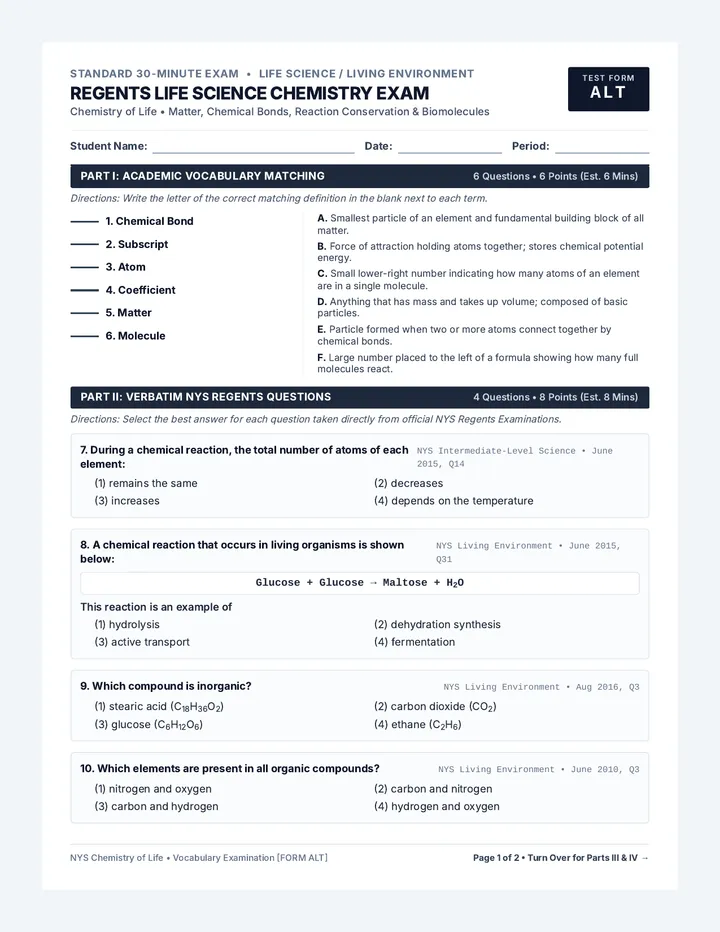
Part I: Multiple Choice Item Rationales (1 Credit Each)
Full Credit: single correct answer only
Q1: Cellular Process Producing Greatest ATP (June 2018 Regents, Q35)
Correct: (1)
Key: (1) aerobic cellular respiration. Complete catabolism of glucose through mitochondrial Krebs cycle and oxidative phosphorylation in the presence of \(O_2\) produces approximately 36–38 ATP per glucose molecule.
Distractor Alert: Fermentation pathways (2 & 3) produce only 2 net ATP per glucose; active transport (4) is a consumer of cellular ATP, not an ATP-producing process.
Q2: Insufficient Oxygen & Muscle ATP Production (Aug 2017 Regents, Q13)
Correct: (3)
Key: (3) fermentation, producing lactic acid. Under strenuous exertion with insufficient oxygen delivery, muscle cells resort to anaerobic lactic acid fermentation to regenerate \(NAD^+\) for continued glycolysis.
Distractor Alert: Photosynthesis (1) is autotroph-exclusive; aerobic respiration (2) requires adequate \(O_2\); circulation (4) transports substances but does not synthesize glycogen.
Q3: Levels of Structural Organization (June 2017 Regents, Q2)
Correct: (3)
Key: (3) organelles → cells → tissues → organs → organ systems. Biological hierarchy progresses from sub-cellular organelles to the functional cell, specialized tissue layers, coordinated organs, and comprehensive body systems.
Distractor Alert: Options (1), (2), and (4) incorrectly order the hierarchy by putting organelles after cells or placing organs before tissues.
Q4: Heart Rate & Breathing Rate Homeostasis (June 2022 Regents, Q17)
Correct: (3)
Key: (3) supplying muscle tissues with more oxygen while removing carbon dioxide. Increased ventilation and cardiac output accelerate blood transit, delivering vital oxygen to contracting muscles while expelling acidic \(CO_2\).
Distractor Alert: Exercise increases body temperature (1); homeostatic responses minimize waste accumulation (2); respiration increases rather than stopping (4).
Q5: Respiratory & Circulatory Systems Cooperation (Jan 2020 Regents, Q9)
Correct: (2)
Key: (2) deliver oxygen and nutrients to active muscles. Alveolar gas exchange loads oxygen onto hemoglobin in erythrocytes, which the circulatory system transports alongside blood glucose to exercising muscle beds.
Distractor Alert: Option (1) claims to eliminate "all" \(CO_2\) (untrue); (3) heart rate speeds up; (4) atmospheric nitrogen is not absorbed for human energy.
Form Y • Living Environment Diagnostic Assessment
Page 1 of 2 • Part I Complete
Scoring Rubric Part II: Constructed Response
Marathon Runner Scoring Criteria
Form Y: Q6–Q8
3 Credits Total (1 pt each)
Regents Stimulus Text: “A marathon runner completed a 26.2-mile race on a warm day. During the race, the runner's body temperature rose, breathing rate doubled, and muscle cramping occurred in the final two miles.”
Q6: Two Cooperating Organ Systems & Role Description 1 Credit • HS-LS1-2 / HS-LS1-3
Scoring Requirement: Student must correctly identify two organ systems AND accurately describe the role of at least one system in maintaining homeostasis during the race. (All or nothing: 1 credit).
Circulatory & Respiratory
Respiratory: delivers oxygen and expels \(CO_2\).
Circulatory: rapidly pumps oxygenated blood and nutrients to muscle cells.
Circulatory & Integumentary
Integumentary: produces sweat for evaporative cooling.
Circulatory: vasodilates skin capillaries to radiate excess thermal energy.
Nervous & Circulatory
Nervous: detects dropping blood pH / elevated \(CO_2\) and signals the heart to beat faster to restore equilibrium.
Q7: Biological Reason for Muscle Cramping 1 Credit • HS-LS1-7
Acceptable Responses (Award 1 Credit)
- Muscle cells lacked sufficient \(O_2\), switching to anaerobic respiration / lactic acid buildup.
- Lactic acid accumulation in muscle tissue caused fatigue and cramping.
- Dehydration / electrolyte imbalance caused by heavy sweating during the run.
- Depletion of glucose / glycogen supplies needed for muscle cell relaxation.
Unacceptable / Zero Credit
- “The runner was tired / overworked” (lacks biological mechanism).
- “The muscles stopped working” (vague/insufficient).
- Stating only that respiration stopped (respiration shifts, does not stop completely).
Q8: Immediate Source of Usable Chemical Energy (June 2016 Regents, Q58) 1 Credit • HS-LS1-7
Correct Response: ATP (or Adenosine Triphosphate) Full Credit: 1 Pt
ATP provides immediate phosphate-bond transfer energy required by actin and myosin motor proteins for muscular cross-bridge contraction.
Regents Scoring Pitfall — Do NOT Accept “Glucose”: While glucose is the precursor substrate broken down during cellular respiration, it is not the immediate usable energy molecule directly hydrolyzed by contractile proteins.
Regents Performance Band Conversion
Level 4 (Mastery)
8 / 8 Credits (100%)
Level 3 (Proficient)
6–7 / 8 Credits (75–88%)
Level 2 (Basic)
4–5 / 8 Credits (50–63%)
Level 1 (Remediation)
0–3 / 8 Credits (≤ 38%)
New York State Regents Examination in Living Environment Standards
Page 2 of 2 • Teacher Scoring Guide Complete