Forces Unit Test Answer Key
AP Physics 1 • Dynamics & Circular Motion
Forces Unit Test • Teacher Answer Key
2023–2024 MC Edition
26 Multiple Choice • Full Solutions
Master Answer Reference Matrix 1 point each • 26 Total Points
Q1B
Q2E
Q3A
Q4D
Q5A
Q6D
Q7E
Q8E
Q9A
Q10B
Q11C
Q12A
Q13C
Q14E
Q15A
Q16E
Q17C
Q18C
Q19A
Q20D
Q21D
Q22E
Q23B
Q24B
Q25D
Q26B
Step-by-Step Solutions • Questions 1 to 4
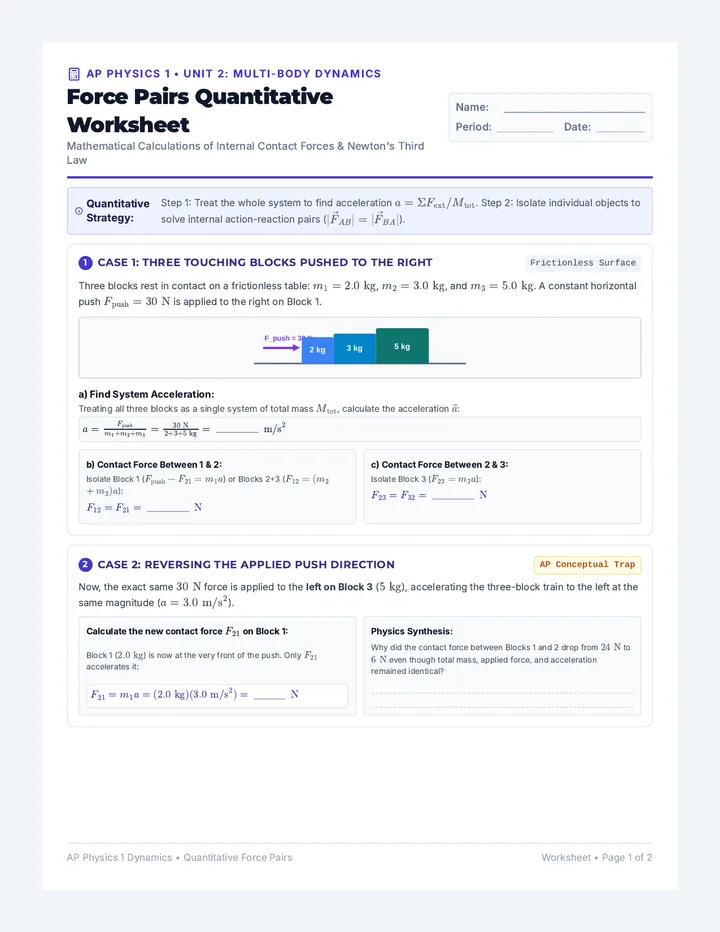
Question 1 • Contact Force & Acceleration of Pushed Blocks Answer: b (1.0 m/s²)
Isolate the \(2.0\text{ kg}\) block. The only horizontal force acting on it is the contact normal force from the \(1.0\text{ kg}\) block, given as \(F_{\text{push}} = 2.0\text{ N}\) to the right. Since the surface is frictionless:
\(\Sigma F_x = m_2 a \implies 2.0\text{ N} = (2.0\text{ kg}) a \implies a = 1.0\text{ m/s}^2\)
Conceptual Note: Because the blocks stay in contact, both accelerate at \(1.0\text{ m/s}^2\). The total applied force on the system is \(F = (m_1 + m_2)a = (3.0\text{ kg})(1.0\text{ m/s}^2) = 3.0\text{ N}\).
Question 2 • Vertical Rope Tension & Acceleration Answer: e (5 m/s² down)
The suspended block of mass \(m = 2\text{ kg}\) experiences upward rope tension \(T = 10\text{ N}\) and downward gravitational force \(F_g = mg \approx (2\text{ kg})(10\text{ m/s}^2) = 20\text{ N}\):
\(\Sigma F_y = T - mg = 10\text{ N} - 20\text{ N} = -10\text{ N} \implies a = \frac{\Sigma F_y}{m} = \frac{-10\text{ N}}{2\text{ kg}} = -5\text{ m/s}^2\text{ (down)}\)
Common Misconception: Students often overlook gravity and compute \(a = T/m = 10/2 = 5\text{ m/s}^2\) upward. Tension is less than weight, so acceleration is directed downward.
Question 3 • Magnitude of Net Force Ans: a (\(mv^2/r\))
The ball executes uniform circular motion in a horizontal circle of radius \(r\) at constant speed \(v\). By definition, the resultant net force acting on any mass in circular motion is purely centripetal:
\(F_{\text{net}} = F_c = \frac{mv^2}{r}\)
Horizontal forces \(T_2 + T_{1x}\) combine to equal \(mv^2/r\), while vertical forces cancel.
Question 4 • Tension in Upper String Ans: d (\(mg/\cos\theta\))
In the vertical direction, the ball does not accelerate (\(a_y = 0\)). The lower string is horizontal (\(T_{2y} = 0\)). The vertical component of \(T_1\) must balance gravity:
\(T_1 \cos\theta - mg = 0 \implies T_1 = \frac{mg}{\cos\theta}\)
Notice \(\theta\) is measured from the vertical rod, so the vertical component uses \(\cos\theta\).
Forces Unit Test (2023–24) • Answer Key & Solutions Guide Page 1 of 5
AP Physics 1 • Dynamics & Circular Motion
Solutions Guide • Questions 5 to 10
Loops • Equilibrium • Friction • Inclines
Question 5 • Roller Coaster Vertical Loop Apex Force Answer: a (200 N)
At the top of the vertical loop, both track normal force \(F_N\) and gravity \(mg\) point downward toward the center of the circular trajectory:
\(\Sigma F_c = F_N + mg = \frac{mv^2}{r} \implies F_N = \frac{mv^2}{r} - mg = \frac{(100)(6^2)}{3} - (100)(10) = 1200\text{ N} - 1000\text{ N} = 200\text{ N}\)
Question 6 • Stationary Object Static Equilibrium Condition Answer: d (The vector sum of the forces is zero)
For an object to remain stationary (static equilibrium), Newton’s first law requires the net vector force to vanish: \(\Sigma \vec{F} = \vec{F}_1 + \vec{F}_2 + \vec{F}_3 = 0\). Magnitudes are strictly non-negative, so the sum of magnitudes cannot be zero unless each force is individually zero.
Question 7 • Centripetal Friction Quadratic Scaling with Speed Answer: e (¼ F)
On an unbanked circular path of radius \(r\), static friction provides the necessary centripetal force: \(f = \frac{mv^2}{r}\). For the faster car at speed \(2v\), the force is \(F = \frac{m(2v)^2}{r} = 4\left(\frac{mv^2}{r}\right)\). Thus, the slower car traveling at speed \(v\) requires \(f_{\text{slow}} = \frac{mv^2}{r} = \frac{1}{4}F\).
Question 8 • Normal Force and Kinetic Friction Independence Answer: e (Remains constant • Remains constant)
The block is already moving on a horizontal table, so it experiences kinetic friction: \(f_k = \mu_k F_N\). Because the pulling force is directed purely horizontally, vertical equilibrium remains \(\Sigma F_y = F_N - mg = 0 \implies F_N = mg\) (constant). With constant \(F_N\) and constant \(\mu_k\), kinetic friction remains completely constant.
Question 9 • Components of Tension in String 2 Answer: a (\(T_1 \cos\theta_1 \;\vert\; mg - T_1 \sin\theta_1\))
At the knot, the three forces (tension 1, tension 2, and weight \(mg\)) must balance in both dimensions:
Horizontal Equilibrium \(T_{2x} = T_{1x} = T_1 \cos\theta_1\)
Vertical Equilibrium \(T_{2y} = mg - T_{1y} = mg - T_1 \sin\theta_1\)
Question 10 • Acceleration at Incline Turnaround Point Answer: b (5 m/s² down the incline)
On a frictionless \(30^\circ\) incline, the only force along the ramp is the component of gravity parallel to the incline: \(\Sigma F_{\parallel} = mg \sin 30^\circ\). By Newton’s second law, \(a = g \sin 30^\circ = (10\text{ m/s}^2)(0.5) = 5\text{ m/s}^2\) directed down the incline. At the highest point, velocity is momentarily zero, but net force and acceleration remain non-zero!
Forces Unit Test (2023–24) • Answer Key & Solutions Guide Page 2 of 5
AP Physics 1 • Dynamics & Circular Motion
Solutions Guide • Questions 11 to 15
Pendulum Dynamics • Braking • Inertia
Context for Questions 11 & 12: Pendulum Swing (Points X → Y → Z)
A sphere on a string swings through lowest point Y between turnaround points X and Z. Air resistance is negligible. Total acceleration is the vector sum of centripetal acceleration \(a_c = v^2/L\) (radial, toward pivot) and tangential acceleration \(a_t = g \sin\theta\) (tangent to arc).
Question 11 • Acceleration Direction at Peak Point Z Answer: c (Arrow III)
At point Z, the swinging sphere reaches its maximum height and is momentarily at rest (\(v = 0\)). Consequently, centripetal acceleration is strictly zero: \(a_c = \frac{v^2}{L} = 0\). The only acceleration is tangential acceleration, created by the component of gravity tangent to the circular path. This vector points along the tangent back down toward point Y, which matches Arrow III.
Question 12 • Acceleration Direction at Lowest Point Y Answer: a (Arrow I)
At point Y (the bottom of the swing), gravity is purely vertical and collinear with the string, so the tangential component of gravity is zero (\(a_t = 0\)). However, the sphere has maximum speed and moves along a curved arc. Therefore, it experiences centripetal acceleration directed radially inward toward the pivot (vertically upward, along the string), which matches Arrow I.
Question 13 • Centripetal Acceleration & Maximum Safe Cornering Speed Answer: c (14 m/s)
Centripetal acceleration is \(a_c = \frac{v^2}{r}\), which gives \(v = \sqrt{a_c r}\). Because both cars travel the same curved track of radius \(r\), maximum speed is directly proportional to \(\sqrt{a_c}\):
\(v_B = \sqrt{\frac{a_{c, B}}{a_{c, A}}} \cdot v_A = \sqrt{2} \cdot (10\text{ m/s}) \approx 1.414 \times 10\text{ m/s} \approx 14\text{ m/s}\)
Question 14 • Skidding Distance Dependence on Velocity Answer: e (4d)
By the work-energy theorem, the work done by friction equals the change in kinetic energy: \(-f_k \cdot d = 0 - \frac{1}{2}mv^2 \implies d = \frac{mv^2}{2f_k}\). With the same frictional force and car mass, stopping distance scales with the square of initial speed:
\(d \propto v^2 \implies d_{2v} = (2)^2 \cdot d = 4d\)
Question 15 • Friction on Box Moving with Cart at Constant Velocity Answer: a (Zero)
The cart travels at a constant velocity of \(20\text{ m/s}\), so its acceleration is zero (\(a = 0\)). Since the box moves without slipping, its acceleration is also zero. By Newton's second law, the net horizontal force on the box is \(\Sigma F_x = ma = 0\). Friction only acts to prevent slipping when there is a tendency to accelerate; with \(a=0\), the frictional force is strictly zero.
Forces Unit Test (2023–24) • Answer Key & Solutions Guide Page 3 of 5
AP Physics 1 • Dynamics & Circular Motion
Solutions Guide • Questions 16 to 21
FBDs • Connected Systems • 2D Circular Motion
Question 16 • Free-Body Diagram with Time-Varying Force Answer: e (Normal Up, Gravity Down, Force F Right)
The surface has negligible friction. The only interactions acting on the block are: gravity downward (\(mg\)), normal force upward (\(F_N\)), and the applied force \(F = \alpha t\) directed to the right. Even though the block was initially moving to the left, velocity is not a force and must never be drawn on a free-body diagram. Diagram (e) correctly displays exactly these three forces.
Question 17 • Tension in String Connecting Two Blocks Answer: c (4.5 N)
First determine the acceleration of the combined two-block system (\(m_X = 3.0\text{ kg}\), \(m_Y = 5.0\text{ kg}\)) under applied force \(F = 12\text{ N}\):
\(a = \frac{F}{m_X + m_Y} = \frac{12\text{ N}}{3.0\text{ kg} + 5.0\text{ kg}} = \frac{12}{8.0} = 1.5\text{ m/s}^2\)
Now isolate block X. The only horizontal force accelerating block X is the tension \(T\):
\(T = m_X a = (3.0\text{ kg})(1.5\text{ m/s}^2) = 4.5\text{ N}\)
Question 18 • Acceleration Function from Velocity Polynomial Answer: c (\(2\alpha t + \beta\))
Acceleration is the time rate of change of velocity: \(a(t) = \frac{dv}{dt}\). Differentiating \(v(t) = \alpha t^2 + \beta t + \gamma\) with respect to time using the power rule yields:
\(a(t) = \frac{d}{dt}\left(\alpha t^2 + \beta t + \gamma\right) = 2\alpha t + \beta\)
Context for Questions 19–21: Clockwise Circular Racetrack (\(R = 1440\text{ m}\))
The car is at the northernmost point of the track, moving clockwise at \(v = 36.0\text{ m/s}\), and slowing down tangentially at \(a_t = 1.20\text{ m/s}^2\).
Q19 • Velocity Dir. Ans: a (due east)
At the top (12 o'clock), moving clockwise corresponds to moving horizontally to the right: due east.
Q20 • Accel. Dir. Ans: d (south of west)
Centripetal acceleration points toward the center (south). Tangential acceleration opposes velocity (west). Resultant vector points south of west.
Q21 • Accel. Mag. Ans: d (1.5 m/s²)
\(a_c = \frac{v^2}{R} = \frac{36^2}{1440} = 0.90\text{ m/s}^2\).
\(a_t = 1.20\text{ m/s}^2\).
\(a = \sqrt{0.90^2 + 1.20^2} = 1.50\text{ m/s}^2\).
Forces Unit Test (2023–24) • Answer Key & Solutions Guide Page 4 of 5
AP Physics 1 • Dynamics & Circular Motion
Solutions Guide • Questions 22 to 26
Terminal Drag • Atwood Machine
Question 22 • Stacked Blocks Slipping & Kinetic Friction Answer: e (Right of starting position • kinetic friction)
The bottom block accelerates rapidly to the right. Since the blocks slip relative to each other, the bottom block exerts a kinetic friction force directed to the right on the top block. This friction accelerates the top block to the right while it remains in contact. By the time it clears the bottom block, it has gained rightward velocity and displacement, landing to the right of its original position.
Question 23 • Velocity, Acceleration, and Distance Trends Under Drag Answer: b (Increases • Decreases • Increases)
Net downward force is \(F_{\text{net}} = mg - kv\), so downward acceleration is \(a = g - \frac{k}{m}v\). As the sphere falls, speed \(v\) increases, increasing air resistance \(kv\) and causing acceleration to decrease toward zero. Because acceleration remains positive throughout, speed continually increases, so the distance fallen during each successive second increases.
Question 24 • Net Force Expression for Exponential Velocity Decay Answer: b (\(-3e^{-3t}\text{ N}\))
Given \(v(t) = \alpha e^{-\beta t} = 2e^{-3t}\) and mass \(m = 0.5\text{ kg}\). Differentiating velocity yields acceleration:
\(a(t) = \frac{dv}{dt} = 2(-3)e^{-3t} = -6e^{-3t}\text{ m/s}^2 \implies F_{\text{net}} = m \cdot a(t) = (0.5\text{ kg})(-6e^{-3t}) = -3e^{-3t}\text{ N}\)
Question 25 • Cord Tension Ans: d (\(9Mg/5\))
With system acceleration \(a = \frac{2}{5}g\) (from Q26), write Newton’s second law for hanging mass \(3M\):
\(3Mg - T = (3M)a \implies T = 3Mg - 3M\left(\frac{2}{5}g\right) = \frac{9}{5}Mg\)
Question 26 • System Acceleration Ans: b (\(2g/5\))
Frictional force on block \(2M\) is \(f_k = \mu_K(2Mg) = 0.5(2Mg) = Mg\). Total system mass is \(5M\):
\(a = \frac{3Mg - f_k}{2M + 3M} = \frac{3Mg - Mg}{5M} = \frac{2Mg}{5M} = \frac{2}{5}g\)
Key Standards & Misconception Targets
Equilibrium & Inertia
Q6, Q8, Q15, Q16: Constant velocity implies zero net force. Velocity is never drawn on FBDs.
Circular Motion
Q3, Q5, Q7, Q11–13, Q19–21: Differentiate centripetal (\(v^2/r\)) from tangential acceleration.
Coupled Systems
Q1, Q17, Q25, Q26: Solve external forces on whole system for \(a\), then isolate for internal tension.
Forces Unit Test (2023–24) • Answer Key & Solutions Guide Page 5 of 5