Faith Clash Reading Packet
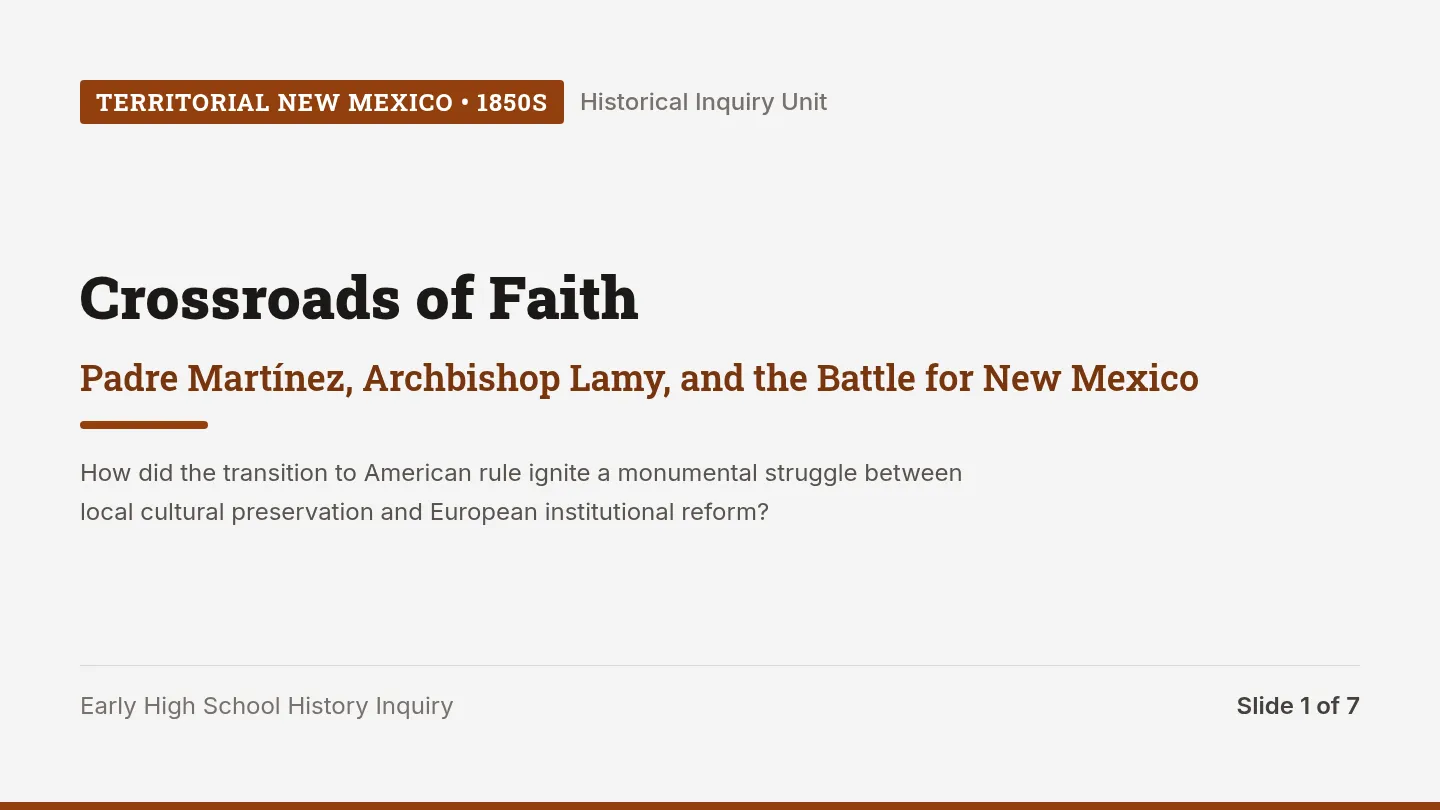
New Mexico Territorial History • 1850–1865
Faith Clash: Two Leaders, One Territory
Name:
Date: Period:
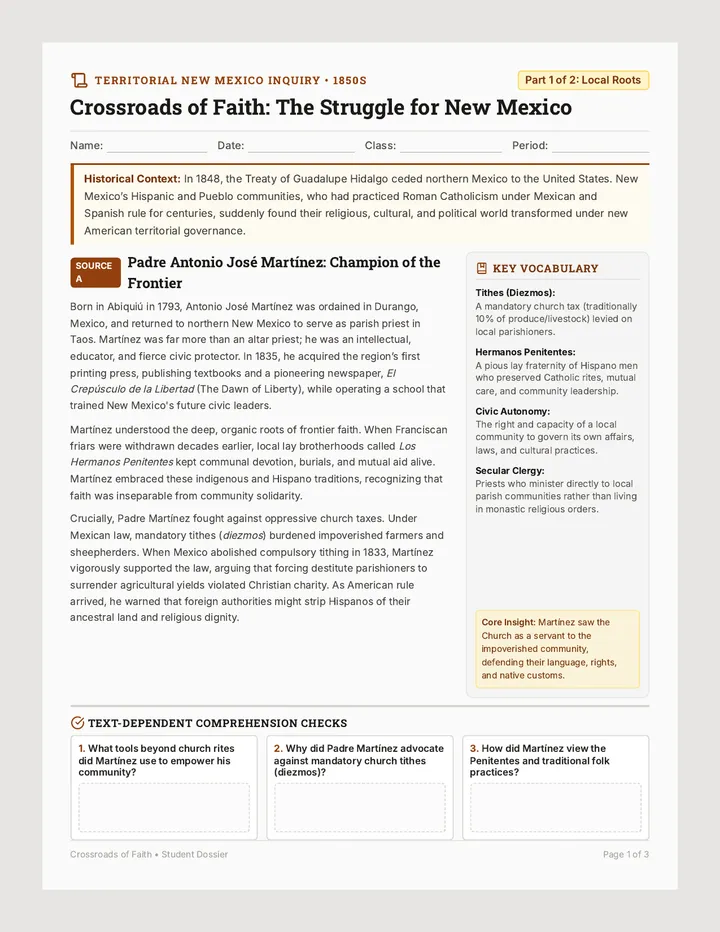
Historical Context: Following the U.S.–Mexican War (1846–1848), New Mexico became a United States territory. The Roman Catholic Church established a new administration, sparking a profound debate over culture, language, regional autonomy, and religious leadership between native Nuevomexicanos and arriving American-backed officials.
Essential Territory Glossary
Territorial Period: The era (1850–1912) when New Mexico was governed as a U.S. territory prior to full statehood.
Cofradía (Penitentes): A lay religious brotherhood in northern New Mexico preserving Spanish folk Catholic rituals and mutual aid.
Tithes (Diezmos): Mandatory church taxes paid in crops or livestock, traditionally levied on parishioners.
Excommunication: An official ecclesiastical decree removing an individual from communion and rights within the Church.
Article 1: Padre Antonio José Martínez of Taos
Voice of the Nuevomexicanos
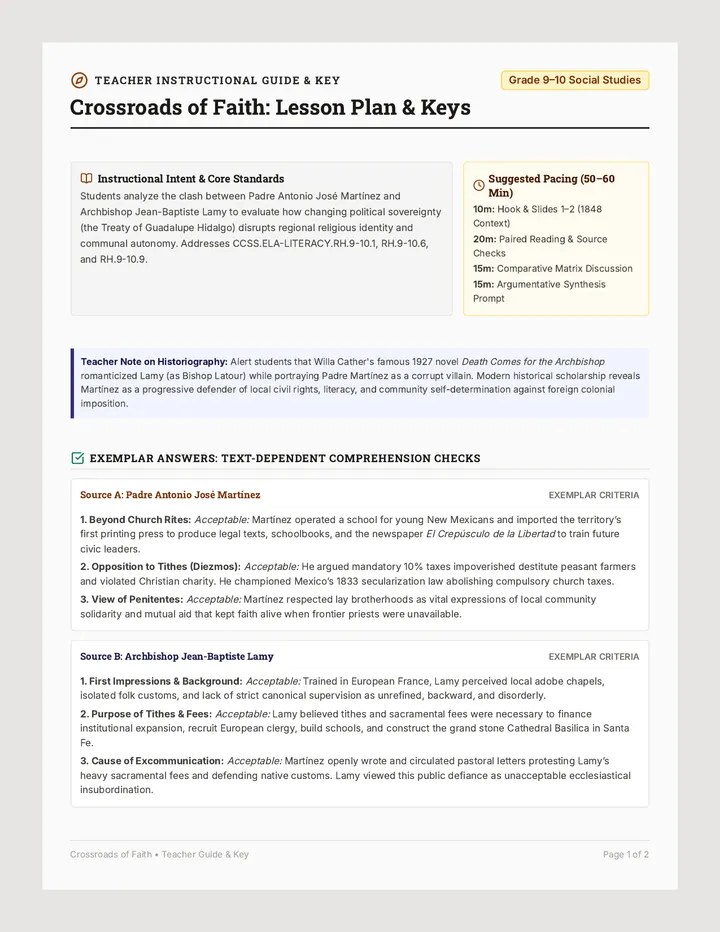
Born in Abiquiú in 1793, Antonio José Martínez was ordained in Durango, Mexico, and served as the parish priest of Taos from 1826 until his death in 1867. A lawyer, educator, and civic organizer, Padre Martínez brought the first printing press to New Mexico in 1834. Through pamphlets, schoolbooks, and the territory's first newspaper, El Crepúsculo de la Libertad, he championed literacy, civil rights, and constitutional law among his parishioners.
Martínez passionately defended Hispanic and Pueblo land tenure and customs. During the Mexican period, he fought vigorously to abolish mandatory ecclesiastical tithes, arguing that forced taxation impoverished struggling rural families while enriching distant hierarchies. When the United States annexed New Mexico, Martínez urged his people to master American legal and political systems to defend their property and culture against Anglo-American encroachment.
Deeply respected by the local fraternity known as the Penitentes, Martínez viewed local customs—including vernacular hymns, handmade bultos, and community solidarity—as the spiritual lifeblood of Northern New Mexico, rejecting the idea that indigenous expressions of faith were backward.
Comprehension Check: Article 1
1. Why did Padre Martínez oppose mandatory church tithes?
He wanted all churches closed permanently in Taos.
He believed forced taxes impoverished poor rural families.
He wished to divert the funds to the U.S. Army in Santa Fe.
2. Identify two ways Padre Martínez prepared his community for American governance:
Territorial Catholic Leadership • Comparative Reader Page 2 of 3
Article 2: Bishop Jean-Baptiste Lamy of Santa Fe
The French Prelate & Builder
Born in Lempdes, France, in 1814, Jean-Baptiste Lamy was serving as a missionary priest in Ohio when Pope Pius IX appointed him in 1850 to lead the newly formed Vicariate Apostolic of New Mexico. Arriving in Santa Fe after a grueling journey across the Santa Fe Trail, Lamy found an ancient Catholic society that had operated for centuries with minimal oversight from Mexico City or Rome. To European eyes, local traditions appeared disorganized, lax, and unorthodox.
Lamy embarked on an ambitious program of institutional centralization and Europeanization. Believing that education was vital to assimilating Hispanic youth into the broader American republic, he recruited Christian Brothers and Sisters of Loretto from Europe to build schools and academies. He also initiated the construction of the Saint Francis Cathedral in Santa Fe, commissioning French architects to build a Romanesque stone cathedral to replace the historic adobe parroquia.
To fund his diocese and discipline the clergy, Lamy reinstated strict tithing guidelines and suspended priests who failed to remit dues or conformed to local lay leadership. He specifically targeted the Penitente brotherhood, ordering priests to withhold sacraments from members who refused to cease their traditional practices.
The Breaking Point: The 1857 Excommunication
Padre Martínez and Bishop Lamy soon clashed over pastoral philosophy and power. Martínez publicly criticized Lamy’s revived tithing policies in local newspapers, arguing that excommunicating parishioners unable to pay dues violated Christian charity. Lamy viewed Martínez's public dissent as open rebellion against legitimate episcopal authority. In 1857, Lamy officially pronounced excommunication against Martínez. Undeterred, Martínez continued holding mass in an independent chapel in Taos with the overwhelming support of his community until his death.
Martínez's Position: Faith belongs to the people; the Church must defend indigenous language, local customs, and the economic survival of Nuevomexicanos.
Lamy's Position: Faith requires universal orthodoxy and strict hierarchical obedience; the Church must modernize and integrate with Western standards.
Comprehension Check: Article 2
1. What architectural change symbolized Lamy's vision for New Mexico?
Expanding traditional adobe mission compounds.
Building a French Romanesque stone cathedral in Santa Fe.
Replacing all churches with secular government halls.
2. Why did Bishop Lamy attempt to suppress the Penitente brotherhood?
Student Analysis & Synthesis Task
Comparing Visions: Martínez vs. Lamy
Page 3 of 3
Directions: Complete the comparative matrix below using evidence from both articles. Then, use your findings to answer the synthesis writing prompt at the bottom of the page.
| Category | Padre Antonio José Martínez | Bishop Jean-Baptiste Lamy |
|---|
| 1. Origin & Cultural Identity | | |
| | |
|
| 2. View on Church Tithes & Taxation |
|
|
| 3. Stance on Local Traditions & Penitentes |
|
|
| 4. Primary Educational or Institutional Legacy |
|
|
Synthesis Essay Prompt
How did the conflict between Padre Martínez and Bishop Lamy represent a larger struggle over identity, culture, and power in Territorial New Mexico? Provide at least two specific pieces of evidence from the texts.
Evaluation Criteria:
Identifies both viewpoints Cites 2+ text details Connects to Territorial period