Whats Development Lesson Plan What's Development?
The Life Map Series: Part 1
Lesson Plan
9th Grade • 15 Minutes
Why This Matters
Understanding human development helps students make sense of their own growth, the changes they observe in others, and the diverse experiences that shape individuals throughout life.
Learning Objective
Students will be able to define human development and identify key stages of human development across the lifespan.
Preparation
Review the What's Development? Slide Deck to familiarize yourself with the content and flow.
Ensure projector and computer are set up and working.
Consider any real-world examples of development to share if discussion is particularly lively.
Prep Time: 10 mins
Instructional Journey
3m
1. Introduction: What Is Development?
Begin by posing the question: "What comes to mind when you hear the word 'development'?" Allow students to share initial thoughts.
Use Slides 1-2
7m
2. Stages of Development Overview
Guide students through the main stages of human development. Briefly discuss characteristics of each stage (infancy through late adulthood). Encourage students to think about societal impact.
Use Slides 3-4
5m
3. Quick Reflection & Discussion
Facilitate a short discussion. Ask: "Which stage of development do you find most interesting?" and "How does this help us relate to others?" Emphasize that development is continuous.
Use Slide 5
Approach: Interactive Presentation
Audience: 9th Grade
Whats Development Slide Deck Introduction to Psychology
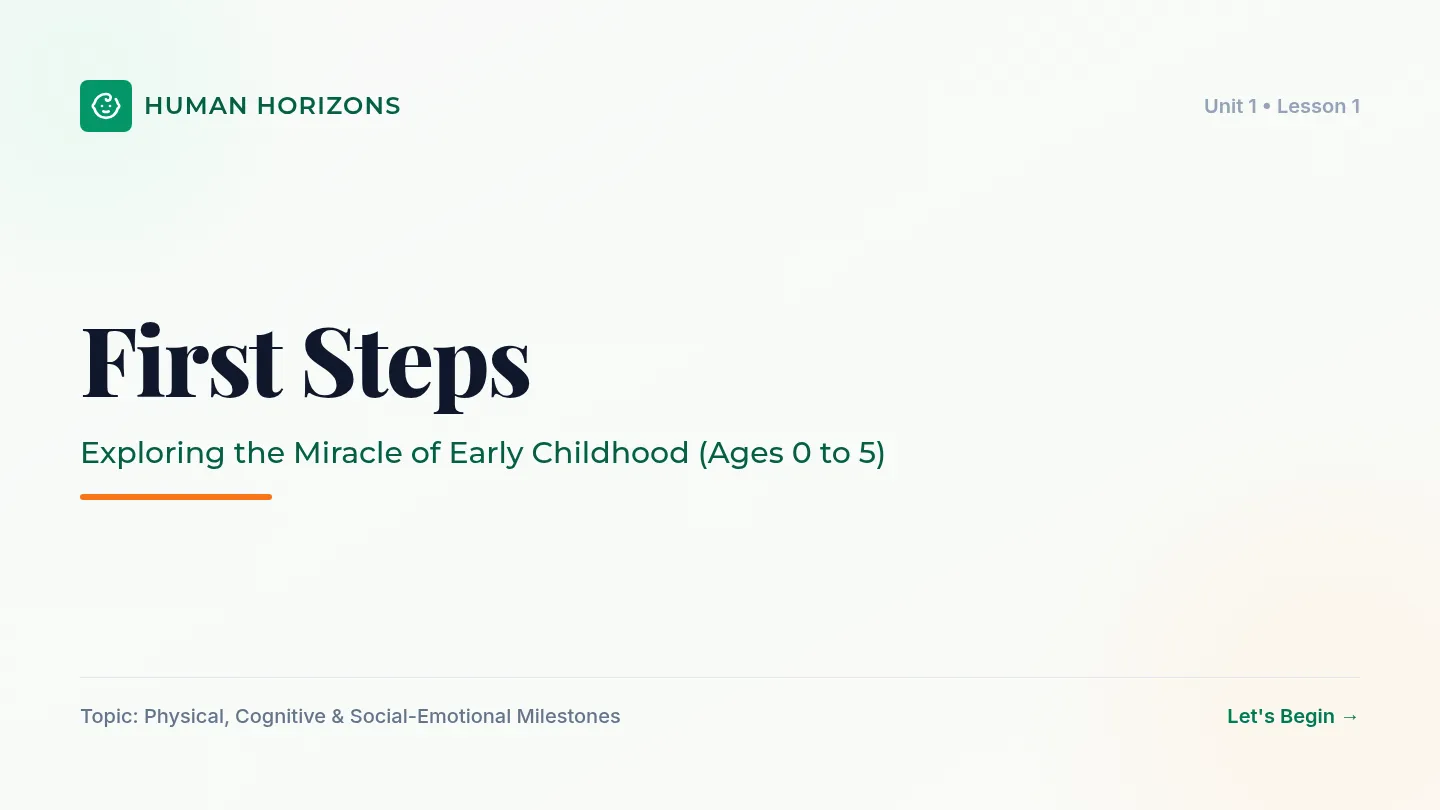
What's Development?
Understanding how we grow and change throughout life!
LIFE MAP SERIES
What is Human Development?
"The scientific study of how people change and grow across the entire lifespan."
Physical
Growing taller, health, strength, and motor skills.
Cognitive
Learning, memory, logic, and problem-solving.
Social
Emotions, identity, and complex relationships.
Why Study Development?
1
Understand Yourself
Why you feel and act the way you do right now.
2
Understand Others
Empathize with people of all ages and experiences.
3
Understand Society
How culture and laws impact how we grow.
Journey Through Life: The Stages
0–2 Years
Infancy
Rapid growth, motor skills, and building basic trust.
2–11 Years
Childhood
Learning, exploring, and building social skills.
12–18 Years
Adolescence
Identity, independence, and abstract thought. (You are here!)
19–40 Years
Early Adulthood
Careers, relationships, and starting families.
40–65 Years
Middle Adulthood
Mentoring, reflecting, and contributing to society.
65+ Years
Late Adulthood
Wisdom, legacy, and reflecting on the journey.
Let's Reflect!
Which stage of development do you find most interesting?
How does this help us relate to people of different ages?
What's one new thing you learned today?
Class Discussion
Whats Development Script Instructional Script
Lesson: What's Development?
Duration: 15 Minutes
Part 1
Introduction (3 mins)
Display Slide 1: "What's Development?"
Teacher
"Good morning, everyone! Today we're going to explore a really interesting topic: development. When you hear the word 'development,' what immediately comes to mind? Don't overthink it, just share your first thoughts. Maybe a new building? A skill you're learning?"
Action
Allow 1-2 students to share their initial ideas. Acknowledge their responses with positive reinforcement.
Teacher
"Those are all great ideas! Today, we're going to focus on human development. It's the scientific study of how people change and grow across their entire lifespan. It's not just about getting taller or older; it's about all the amazing ways we transform from birth until late adulthood."
Display Slide 2: "What is Human Development?"
Teacher
"As you can see, human development covers a lot! It includes physical changes, like growing taller or your hair changing. It also involves cognitive changes – how we learn, think, and solve problems. And, very importantly, socioemotional changes, which are about our emotions, our relationships with others, and our personality. It's truly a holistic journey."
Part 2
Stages Overview (7 mins)
Display Slide 3: "Why Study Development?"
Teacher
"So, why bother studying this? Why is it important for you? Well, understanding human development can help you in a few key ways. First, it helps you understand yourself – why you feel certain ways, or act in particular situations. Second, it helps you understand others, allowing for more empathy with people of different ages and experiences. And finally, it helps us understand society – how different cultures and policies can impact how people grow and develop."
Display Slide 4: "Journey Through Life"
Teacher
"Now, let's take a quick journey through the different stages of human development. Think of this as a roadmap of life."
Infancy: Birth to 2 years. Incredibly rapid growth and learning to trust caregivers.
Childhood: 2 to 11 years. Learning, exploring, and developing crucial social skills.
Adolescence: 12 to 18 years. Where many of you are right now! Focus on identity, independence, and abstract thinking.
Early Adulthood: 19 to 40 years. Focus on careers, relationships, and starting families.
Middle Adulthood: 40 to 65 years. Mentoring, reflecting, and contributing to communities.
Late Adulthood: 65+ years. Reflecting on legacy and wisdom.
Lifespan Roadmap Note Taker The Human Journey
Guided Notes: What's Development?
Name: ____________________________________
Date: __________________
1
Defining Development
Human Development is the scientific study of how people
_____________________ and _____________________ across the entire lifespan.
Physical
Examples: Growth, strength...
Cognitive
Examples: Thinking, memory...
Socioemotional
Examples: Relationships, feelings...
2
The Lifespan Roadmap
0–2 Years
Infancy: ________________________________________________
2–11 Years
Childhood: ______________________________________________
12–18 Years
Adolescence: ____________________________________________
19–40 Years
Early Adulthood: _________________________________________
40–65 Years
Middle Adulthood: ________________________________________
65+ Years
Late Adulthood: __________________________________________
One Big Idea
Why is it important for you personally to understand these stages?
Lifespan Roadmap Note Taker Answer Key Answer Key
Reference: Lifespan Roadmap Note Taker
Teacher Resource
1
Defining Development
Human Development is the scientific study of how people
CHANGE and GROW across the entire lifespan.
Physical
Changes in body size, health, strength, and motor skills (e.g., getting taller, hair turning gray).
Cognitive
Changes in learning, memory, logic, language, and problem-solving abilities.
Socioemotional
Changes in emotions, personality, and relationships with other people.
2
The Lifespan Roadmap
0–2 Years
Infancy: Rapid growth and development of basic trust in caregivers.
2–11 Years
Childhood: Learning about the world, exploring, and building social skills.
12–18 Years
Adolescence: Finding identity, independence, and abstract thinking. (Current stage)
19–40 Years
Early Adulthood: Focusing on careers, serious relationships, and family-building.
40–65 Years
Middle Adulthood: Mentoring others, reflecting on life, and societal contribution.
65+ Years
Late Adulthood: Reflecting on legacy, retirement, and life-review.
Note: Students' descriptions of the stages may vary. As long as they capture the core developmental focus of each stage mentioned in the script, they should be considered correct.