Water Engine Slides
Science 6 | Topic 1 Weather Guided Workbook Notes
The Water Cycle
Guided notes lesson: watch for the yellow highlighted text to complete your workbook lines!
Energy from the Sun
•
Force of Gravity
•
Continuous Process
Workbook Note Line Slide 2 / 10
Fill in the blank in your workbook:
The water cycle is...
The water cycle is the continuous process by which water moves from Earth’s surface to the atmosphere and back again.
3 States of Matter
Solid (ice), liquid (water), and gas (water vapor). State depends on temperature.
A Continuous Process
A process is a series of changes happening over time that leads to an expected result.
Write the yellow highlighted sentence on your workbook line!
Key Idea 1 Slide 3 / 10
Workbook Question
What are the factors that drive the water cycle?
Factor 1
Energy from the sun moves water up into the atmosphere
Factor 2
Gravity returns water down to Earth’s surface and pulls it underground
Fill in the 2 factors: Energy from the sun and Gravity.
Workbook Note Line Slide 4 / 10
Fill in the blank in your workbook:
Energy from the sun...
Energy from the sun moves water from Earth’s surface to the atmosphere.
• Heats water: Sun heats bodies of water and causes molecules to move faster.
• Drives state change: Water absorbs energy and changes to a gas (water vapor).
Write the yellow highlighted sentence on your workbook line!
Workbook Note Line Slide 5 / 10
Fill in the blank in your workbook:
Gravity...
Gravity returns water to Earth’s surface through precipitation and pulls water downhill and underground.
1. Precipitation
Pulls falling rain, snow, hail, or sleet to the surface.
2. Surface Runoff
Pulls water downhill into streams, rivers, and oceans.
3. Aquifers
Pulls water below ground to collect in aquifers.
Write the highlighted sentence and three gravity actions: Precipitation, Surface Runoff, Aquifers.
Key Idea 2 Slide 6 / 10
Workbook Question
How is water cycled on Earth?
Water moves continuously through the geosphere, biosphere, hydrosphere, and atmosphere.
Hydrosphere
Surface waters & ice
Atmosphere
Air & clouds
Geosphere
Soil & aquifers
Biosphere
Plants & animals
Record the 4 highlighted spheres: Hydrosphere, Atmosphere, Geosphere, Biosphere.
Cycle Processes (Liquid to Gas) Slide 7 / 10
Evaporation & Transpiration
Evaporation
Liquid water molecules absorb energy to change into a gas (water vapor).
• Constantly evaporates from surfaces of bodies of water and soil.
Transpiration
Plants release water vapor through leaf openings called stomata (or guard cells).
• Roots draw water from soil; leaves give off vapor into the air.
Highlight both processes: Evaporation and Transpiration.
Cycle Processes (Gas to Liquid) Slide 8 / 10
Condensation
Condensation is the process by which water vapor becomes liquid water.
How Clouds Form:
-
Warm air carries water vapor upward where temperatures are cooler.
-
Droplets cool and collect around solid particles like dust in the air, forming visible clouds.
Highlight: Condensation = water vapor cools and turns back into liquid water.
Cycle Processes (Falling & Flowing) Slide 9 / 10
Precipitation & Movement
Precipitation
Any form of water that falls from clouds back to Earth.
4 Types: Rain, snow, hail, or sleet
Surface Runoff & Aquifers
• Runoff: Gravity moves water downhill into streams, rivers, and lakes.
• Aquifers: Gravity pulls water underground to collect in aquifers.
Record highlighted terms: Precipitation, Runoff, and Aquifers.
Review Check Slide 10 / 10
Workbook Fill-In Summary
The water cycle is...
...the continuous process by which water moves from Earth’s surface to the atmosphere and back again.
Energy from the sun...
...moves water from Earth’s surface to the atmosphere.
Gravity...
...returns water to Earth’s surface through precipitation and pulls water downhill and underground.
How is water cycled on Earth?
...water moves continuously through the geosphere, biosphere, hydrosphere, and atmosphere.
All workbook note lines checked and fully highlighted!
Water Cycle Notes Reference
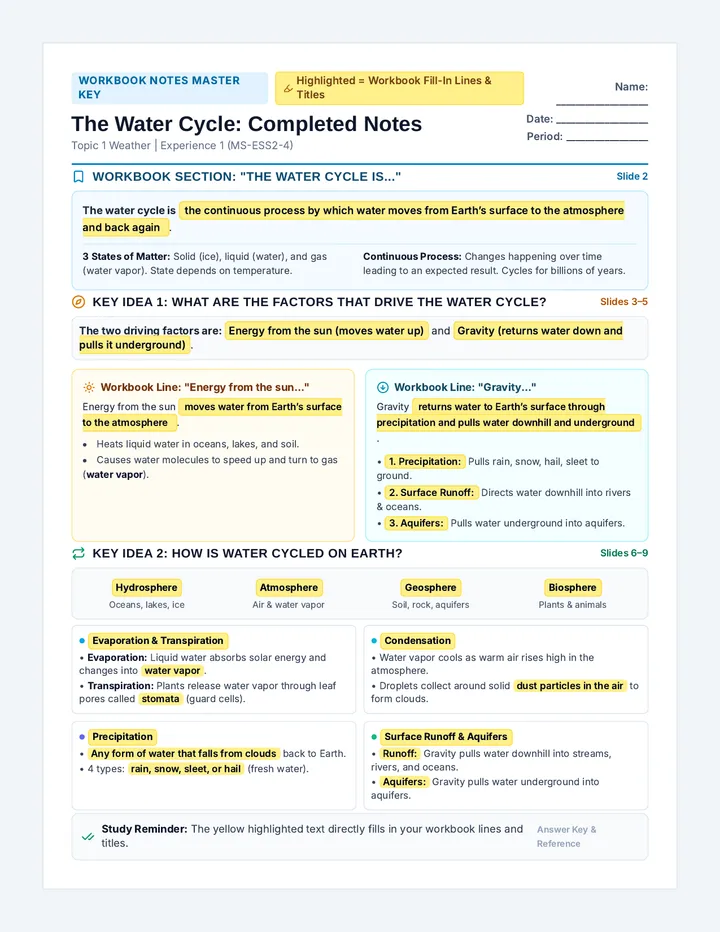
Workbook Notes Master Key Highlighted = Workbook Fill-In Lines & Titles
The Water Cycle: Completed Notes
Topic 1 Weather | Experience 1 (MS-ESS2-4)
Name: ___________________
Date: ___________________
Period: _________________
Workbook Section: "The water cycle is..."
Slide 2
The water cycle is the continuous process by which water moves from Earth’s surface to the atmosphere and back again .
3 States of Matter: Solid (ice), liquid (water), and gas (water vapor). State depends on temperature.
Continuous Process: Changes happening over time leading to an expected result. Cycles for billions of years.
Key Idea 1: What are the factors that drive the water cycle?
Slides 3–5
The two driving factors are: Energy from the sun (moves water up) and Gravity (returns water down and pulls it underground).
Workbook Line: "Energy from the sun..."
Energy from the sun moves water from Earth’s surface to the atmosphere .
- Heats liquid water in oceans, lakes, and soil.
- Causes water molecules to speed up and turn to gas (water vapor).
Workbook Line: "Gravity..."
Gravity returns water to Earth’s surface through precipitation and pulls water downhill and underground .
- • 1. Precipitation: Pulls rain, snow, hail, sleet to ground.
- • 2. Surface Runoff: Directs water downhill into rivers & oceans.
- • 3. Aquifers: Pulls water underground into aquifers.
Key Idea 2: How is water cycled on Earth?
Slides 6–9
Hydrosphere
Oceans, lakes, ice
Atmosphere
Air & water vapor
Geosphere
Soil, rock, aquifers
Biosphere
Plants & animals
Evaporation & Transpiration
• Evaporation: Liquid water absorbs solar energy and changes into water vapor.
• Transpiration: Plants release water vapor through leaf pores called stomata (guard cells).
Condensation
• Water vapor cools as warm air rises high in the atmosphere.
• Droplets collect around solid dust particles in the air to form clouds.
Precipitation
• Any form of water that falls from clouds back to Earth.
• 4 types: rain, snow, sleet, or hail (fresh water).