Volcano Viscosity Reading Worksheet
Unit 1: Magma, Viscosity & States of Matter Digital Kami Activity
Volcano Viscosity & Eruption Styles
Independent Science Reading
Interactive Annotation & CER
Kami Reading Tip: Use the Highlighter Tool to mark key definitions and evidence as you read through Parts 1–3.
The Guiding Phenomenon
Why do Hawaiian shield volcanoes gently pour runny red lava into the ocean, while stratovolcanoes like Mount St. Helens explode violently into ash and dust?
1 Part 1: The Two Types of Eruptions
Volcanoes around the world erupt in remarkably different ways. In Hawaii, shield volcanoes erupt basalt lava that is red-hot and runny. This lava bubbles gently out of ground vents or flows as glowing liquid rivers that move slowly down hillsides. Tourists and volcanologists can often stand safely a short distance away to observe.
In contrast, stratovolcanoes like Mount St. Helens in Washington State erupt with sudden, catastrophic violence. Instead of smooth lava streams, stratovolcanoes blast giant columns of gray ash miles into the atmosphere, pulverize solid rock into dust, and unleash superheated avalanches down their slopes.
2 Part 2: What is Viscosity?
The primary scientific property controlling these eruptions is viscosity. Viscosity is a liquid's resistance to flow—essentially how thick or sticky a liquid behaves.
Think of water versus cold honey. Water has low viscosity: it is thin and runny, so it pours immediately. Cold honey has high viscosity: it is thick and sticky, so it flows very slowly. Hawaiian basalt magma has low viscosity, letting it flow smoothly like warm syrup. Stratovolcano magma has high viscosity, making it thick and pasty like cold peanut butter or wet cement.
3 Part 3: Particles & Trapped Gas Pressure
Deep underground, all magma contains dissolved gases (such as water vapor and carbon dioxide). As thermal energy (heat) increases, gas particles absorb kinetic energy and bounce around much faster.
In runny, low-viscosity magma, expanding gas bubbles can rise rapidly and escape harmlessly into the air. But in thick, high-viscosity magma, the sticky molten rock traps the gas bubbles. As the trapped gas particles heat up and expand, they hammer against the sticky magma, building immense pressure until the rock blows apart in an explosive eruption.
Hawaiian Shield Volcanoes
Low Viscosity (Runny) → Gas escapes easily → Gentle, oozing lava
Stratovolcanoes (Mt. St. Helens)
High Viscosity (Thick) → Gas trapped inside → Violent explosion
Page 1 of 2 Proceed to Page 2 for Questions 1–5
Student Assessment Page Digital Response
Check for Understanding
Score: _____ / 15 pts
Kami Tools Guide: Use the Highlight or Drawing tool for Parts A & B. Use the Text Box Tool to type your responses inside the boxes in Part C.
Part A: Multiple Choice (Highlight or circle the letter of the best answer)
1. According to Part 2, what does the scientific property viscosity describe?
A How hot rock gets before melting
B A liquid's resistance to flow (thickness)
C The height of a volcano's ash cloud
D The color of cooled volcanic rock
2. Why do Hawaiian shield volcanoes erupt gently with runny lava instead of exploding?
A Low-viscosity magma lets gas bubbles escape easily
B Their magma contains zero gas particles
C Ocean water cools the volcano until it freezes
D Their magma is thick like cold peanut butter
3. According to Part 3, what causes violent pressure to build inside stratovolcanoes like Mt. St. Helens?
A Rainwater fills the crater from above
B Gas particles slow down and stop moving
C Fast-moving gas particles are trapped in thick magma
D Wind pushes the mountaintop downward
Part B: Compare & Contrast (Highlight or circle your choice in each pair)
4. Highlight the correct word choice inside each pair of brackets to contrast the two magma types:
• Hawaiian Magma: Has [ LOW / HIGH ] viscosity, which means it flows [ EASILY / SLOWLY ] and erupts [ GENTLY / VIOLENTLY ].
• Mt. St. Helens: Has [ LOW / HIGH ] viscosity, which means it flows [ EASILY / SLOWLY ] and erupts [ GENTLY / VIOLENTLY ].
Part C: Scientific Explanation CER (Question 5)
5. Use Kami's Text Box Tool to type your responses inside each digital response box below:
Prompt A • Claim & Viscosity Cause: Click inside the box with Kami Text Tool
Sentence Starter: "I claim that stratovolcanoes explode violently because their magma has [ HIGH / LOW ] viscosity, which causes trapped gas to..."
Prompt B • Particle Motion & Pressure Reasoning: Click inside the box with Kami Text Tool
Sentence Starter: "When thermal energy increases, gas particles move [ FASTER / SLOWER ]. Because thick magma traps the gas, pressure builds until..."
Kami Checklist: Read Page 1 Q1–3 Marked Q4 Highlighted Q5 Typed
Ready to turn in via Kami
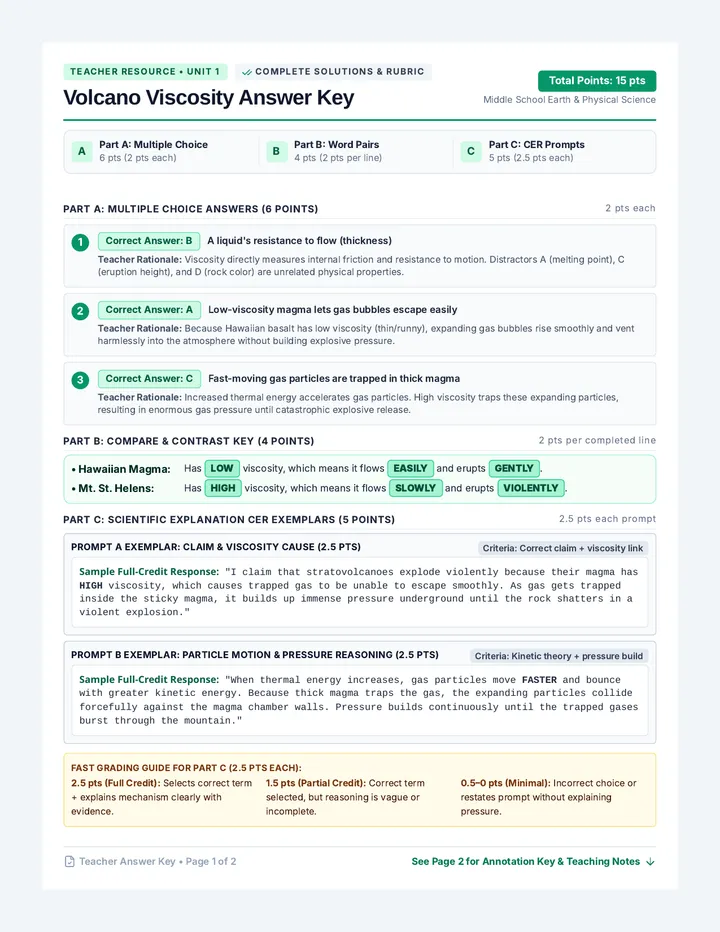
Volcano Viscosity Answer Key
Teacher Resource • Unit 1 Complete Solutions & Rubric
Volcano Viscosity Answer Key
Total Points: 15 pts
Middle School Earth & Physical Science
A
Part A: Multiple Choice
6 pts (2 pts each)
B
Part B: Word Pairs
4 pts (2 pts per line)
C
Part C: CER Prompts
5 pts (2.5 pts each)
Part A: Multiple Choice Answers (6 Points) 2 pts each
1
Correct Answer: B A liquid's resistance to flow (thickness)
Teacher Rationale: Viscosity directly measures internal friction and resistance to motion. Distractors A (melting point), C (eruption height), and D (rock color) are unrelated physical properties.
2
Correct Answer: A Low-viscosity magma lets gas bubbles escape easily
Teacher Rationale: Because Hawaiian basalt has low viscosity (thin/runny), expanding gas bubbles rise smoothly and vent harmlessly into the atmosphere without building explosive pressure.
3
Correct Answer: C Fast-moving gas particles are trapped in thick magma
Teacher Rationale: Increased thermal energy accelerates gas particles. High viscosity traps these expanding particles, resulting in enormous gas pressure until catastrophic explosive release.
Part B: Compare & Contrast Key (4 Points) 2 pts per completed line
• Hawaiian Magma: Has LOW viscosity, which means it flows EASILY and erupts GENTLY.
• Mt. St. Helens: Has HIGH viscosity, which means it flows SLOWLY and erupts VIOLENTLY.
Part C: Scientific Explanation CER Exemplars (5 Points) 2.5 pts each prompt
Prompt A Exemplar: Claim & Viscosity Cause (2.5 pts) Criteria: Correct claim + viscosity link
Sample Full-Credit Response: "I claim that stratovolcanoes explode violently because their magma has HIGH viscosity, which causes trapped gas to be unable to escape smoothly. As gas gets trapped inside the sticky magma, it builds up immense pressure underground until the rock shatters in a violent explosion."
Prompt B Exemplar: Particle Motion & Pressure Reasoning (2.5 pts) Criteria: Kinetic theory + pressure build
Sample Full-Credit Response: "When thermal energy increases, gas particles move FASTER and bounce with greater kinetic energy. Because thick magma traps the gas, the expanding particles collide forcefully against the magma chamber walls. Pressure builds continuously until the trapped gases burst through the mountain."