Code Breakers Slides
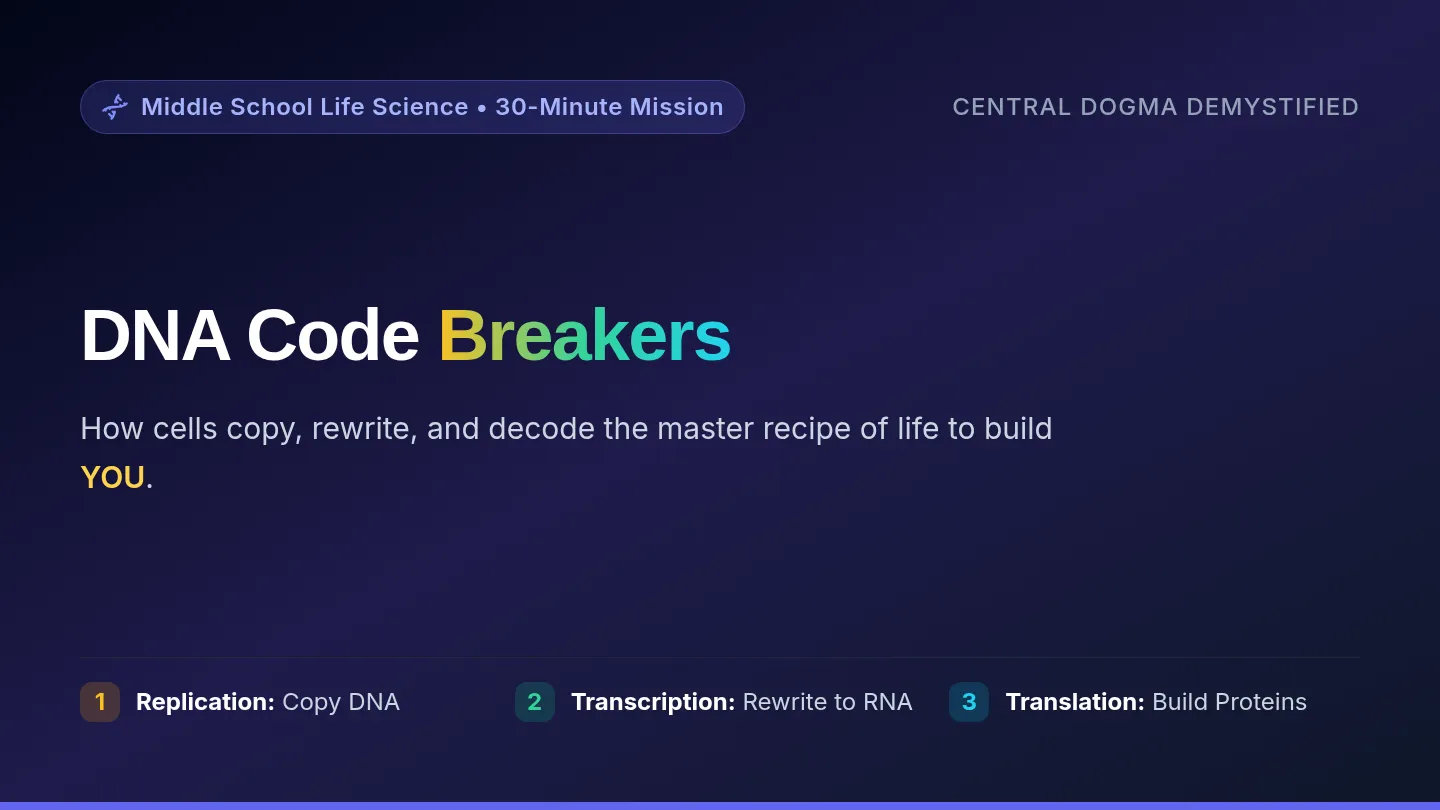
Middle School Life Science • 30-Minute Mission
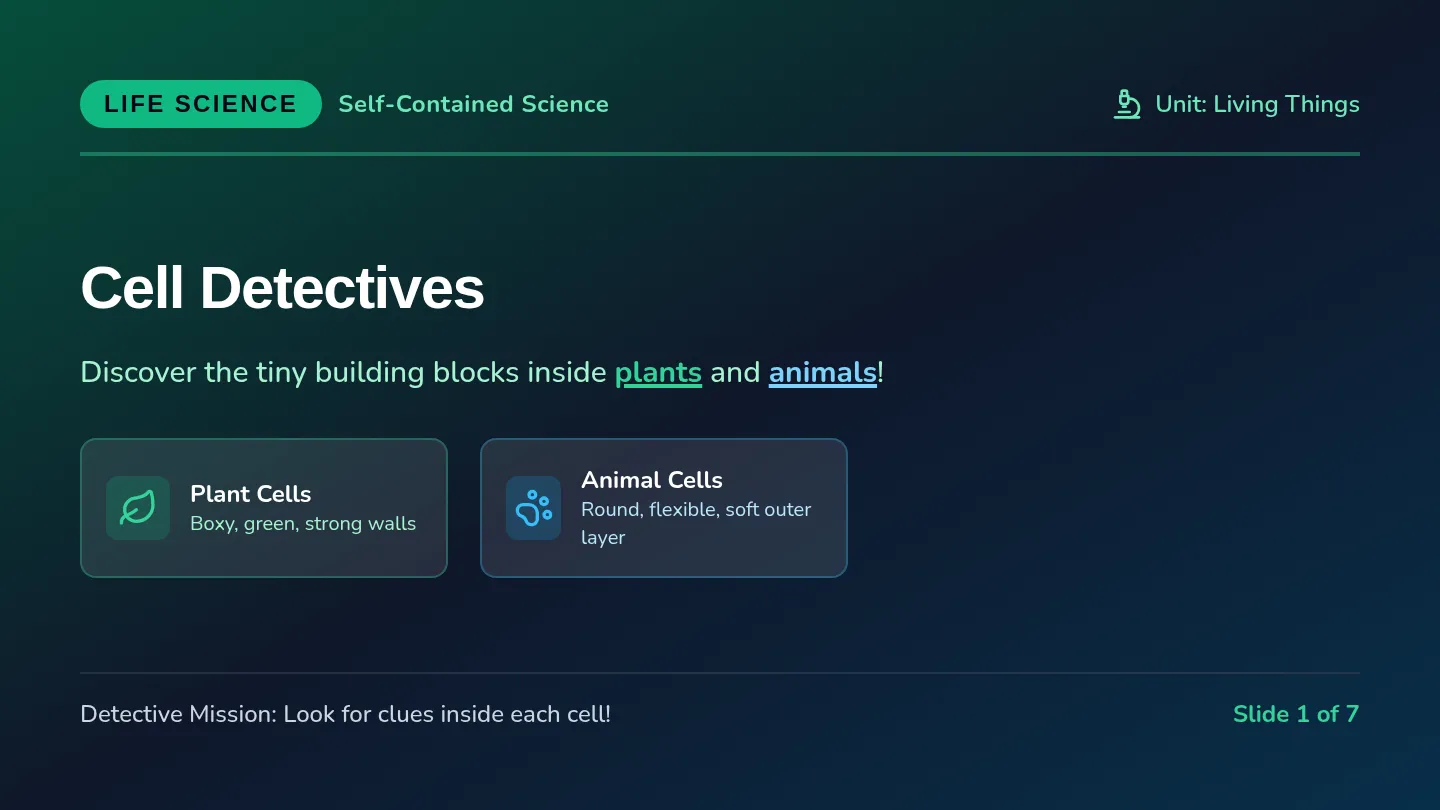
Central Dogma Demystified
DNA Code Breakers
How cells copy, rewrite, and decode the master recipe of life to build YOU.
1 Replication: Copy DNA
2 Transcription: Rewrite to RNA
3 Translation: Build Proteins
The Big Picture The Cellular Kitchen Analogy
How Does a Cell Read a Recipe?
DNA stays protected in the nucleus like a rare cookbook in a museum vault.
The Master Book
DNA: The giant original recipe book. It is too precious to ever leave the nucleus vault.
Locked in Nucleus
The Recipe Card
mRNA: A short scratch-paper copy of just ONE recipe that is allowed to travel out to the kitchen.
Messenger to Cell
The Chef & Dish
Ribosome & Protein: The ribosome reads the card and snaps amino acids together to cook the protein!
Kitchen Workbench
DNA mRNA Protein (Traits!)
STEP 1
Location: Cell Nucleus
Replication: Copying the DNA
Before one cell splits into two, it must photocopy its entire manual so each new cell gets an exact set.
Base Pairing Rule
DNA bases always pair up in exact pairs like lock and key:
A • T
Adenine ↔ Thymine
"Apples in Trees"
C • G
Cytosine ↔ Guanine
"Cars in Garages"
Quick Replication Check:
If the original strand reads:
A - T - C - G - G - A
The replicated complementary strand is:
T - A - G - C - C - T
Result: Two identical double-stranded DNA molecules!
Memory Hack: Replication sounds like replica—an exact duplicate!
STEP 2
Location: Cell Nucleus
Transcription: Writing the Message
Rewriting DNA into a single-stranded messenger: mRNA.
THE BIG RNA RULE CHANGE!
RNA does NOT have Thymine (T). Instead, RNA uses Uracil (U)!
DNA A pairs with RNA: U (Uracil)
DNA T pairs with RNA: A (Adenine)
DNA C pairs with RNA: G (Guanine)
DNA G pairs with RNA: C (Cytosine)
Why Rewrite to RNA?
- Single-stranded: Thin enough to slip out nuclear pores into cytoplasm.
- Disposable: Can be broken down after use without harming the master DNA.
- Only 1 gene: Just the specific instructions needed right now.
"Script" means to write — Transcription is rewriting the code!
Next, mRNA travels out of the nucleus to find a ribosome in the cytoplasm!
STEP 3
Location: Ribosome (Cytoplasm)
Translation: Building the Protein
Translating genetic language (nucleic acids) into protein language (amino acids).
1
Codons (3 Letters)
The ribosome reads mRNA in words of exactly 3 letters called codons.
A - U - G • G - C - U
2
Amino Acids
Each 3-letter codon matches one specific amino acid (molecular building block).
AUG = Met (Start)
3
Folding into Traits
Amino acids link into a long chain, which folds into a 3D protein (pigment, muscle, enzyme!).
Chain → Trait!
Why is it called Translation? It translates from RNA letters into Amino Acid blocks!
The Secret Decoder Middle School Friendly Codon Key
How to Read the Codon Table
Scientists and cells use this chart to translate 3-letter mRNA into amino acids.
AUG
Methionine
"START" Signal
GGU
Glycine
Flexible link
AAG
Lysine
Charged chain
UAA
Stop Codon
"FINISH" Signal
UUU
Phenylalanine
Structural block
CCU
Proline
Rigid angle
GAA
Glutamic Acid
Acidic block
UGA
Stop Codon
"FINISH" Signal
Rule: Always look for AUG (Start) first, and end at a Stop codon! Every living thing on Earth uses this same code!
Team Challenge Crack the Mystery Gene
Can You Decode the Trait?
Follow the 2 steps: Transcribe the DNA, then Translate the mRNA!
1. Master DNA Gene (in nucleus): Original Template
T A C • C C A • T T C • A T T
2. Transcribed mRNA (Messenger): Remember: A pairs with U!
A U G • G G U • A A G • U A A
3. Translated Protein Chain (Ribosome): Check codon key!
START (Met) Glycine Lysine STOP
🎉 Decoded Creature Trait: Bioluminescent Glow in the Dark!
Mission Summary 30-Minute Life Science Takeaway
The Central Dogma at a Glance
Keep these three processes straight on your worksheet:
Step 1
Replication
- Input: DNA
- Output: Exact DNA copy
- Where: Nucleus
- Why: Cell division
DNA → DNA
Step 2
Transcription
- Input: DNA gene
- Output: mRNA strand
- Where: Nucleus
- Key Rule: A pairs with U
DNA → mRNA
Step 3
Translation
- Input: mRNA codons
- Output: Protein chain
- Where: Ribosome
- Why: Creates physical traits
mRNA → Protein
Ready to crack codes on your own? Grab your worksheet and codon decoder!
Code Breakers Worksheet
DNA CODE BREAKERS | Student Mission
Life Science: Replication, Transcription & Translation
Name:
Date: Period:
1
DNA (The Vault): Master recipe book. Never leaves the nucleus!
→
2
mRNA (Recipe Card): Portable copy sent into the cell.
→
3
Ribosome (The Chef): Reads codons and cooks the protein!
Part 1
The Cellular Trio: Compare the Processes
Fill in the missing details for each biological process using your notes or word bank.
| Process | Where in Cell? | What is Produced? | Main Purpose |
|---|
| 1. Replication | | | |
| | | |
|
|
| 2. Transcription |
|
|
|
| 3. Translation |
|
|
|
Word Bank: Nucleus (x2), Ribosome (Cytoplasm), Exact DNA Copy, mRNA Molecule, Protein Chain, Cell Division, Safe Recipe Copy, Building Traits
Part 2
Base-Pairing Training Ground
DNA Replication Rule: A pairs with T • C pairs with G
Mnemonic: Apples in Trees, Cars in Garages
RNA Transcription Rule: DNA A → RNA U • DNA T → RNA A • C ↔ G
Important: RNA has NO Thymine (T), only Uracil (U)!
Challenge A: Replicate this DNA strand (DNA → DNA) Step 1: Cell Division
Original DNA: T - A - G - C - C - A - T - G - A
Replicated DNA:
Challenge B: Transcribe this DNA strand into mRNA (DNA → mRNA) Watch for URACIL (U)!
Template DNA: T - A - C - G - G - T - A - C - T
mRNA Strand:
DNA Code Breakers • Page 1 of 2 Turn over to crack the Alien Pet Gene →
Mission Operations: Crack the Alien Pet Trait
Page 2
Official Codon Key (mRNA → Amino Acid) Codons are read in groups of 3
AUG
Methionine
(START)
UUU
Phenylalanine
Phe
GGU
Glycine
Code Breakers Teacher Guide
TEACHER FACILITATION GUIDE | 30-Min Lesson
DNA Code Breakers: Replication, Transcription & Translation
Middle School Life Science
Target Pacing: 30 Minutes
Essential Question: How do cells read secret genetic instructions to build physical traits?
Key Vocabulary: DNA, mRNA, Replication, Transcription, Translation, Codon, Ribosome, Amino Acid.
Core Analogy: Vault Cookbook (DNA) → Recipe Note (mRNA) → Kitchen Chef (Ribosome).
Timeline
30-Minute Minute-by-Minute Lesson Pacing
00-05 min
Hook & The Vault Mystery (Slides 1–2)
Ask: "If you owned a priceless 1,000-year-old family cookbook, would you take it into a messy kitchen?" Connect to DNA trapped safely in the nucleus vault, needing a messenger card (mRNA).
05-17 min
Direct Instruction & Guided Decode (Slides 3–7)
Cover Step 1 Replication (A-T, C-G for cell division), Step 2 Transcription (highlight Uracil rule change: A pairs with U), and Step 3 Translation (ribosome reads 3-letter codons). Walk students through Slide 7 team challenge.
17-27 min
Independent / Partner Practice (Worksheet)
Students complete Part 1 (comparison table) and Part 2 (base pairing). Then they flip to Page 2 to crack the Alien Pet Trait gene. Circulate to check Uracil base pairing in Challenge B.
27-30 min
Debrief & Self-Check Exit (Slide 8 & Exit Box)
Quick cold-call recap: "Where does translation happen?" "What letter never appears in RNA?" Collect worksheets or have students self-assess using the 3-point confidence meter.
Alert
Top 3 Middle School Misconceptions & Fixes
1. "T pairs with U"
Students often pair Thymine with Uracil. Remind them: DNA T still pairs with A! Uracil ONLY replaces T when pairing with DNA's A.
2. "DNA goes to the Ribosome"
Emphasize that DNA NEVER exits the nucleus in eukaryotes. If DNA left, enzymes in cytoplasm could damage the only master copy.
3. Confusing Script vs Late
Use alphabetical order: TransCription (C) happens before TransLation (L). Or "scribble a note" first, then "translate the language."
Quick Differentiation: Support: Have students highlight all 'A's in yellow to immediately write 'U'. Extend: Ask students to create a silent mutation that still encodes the same amino acid!