Tsunami Surge Quiz
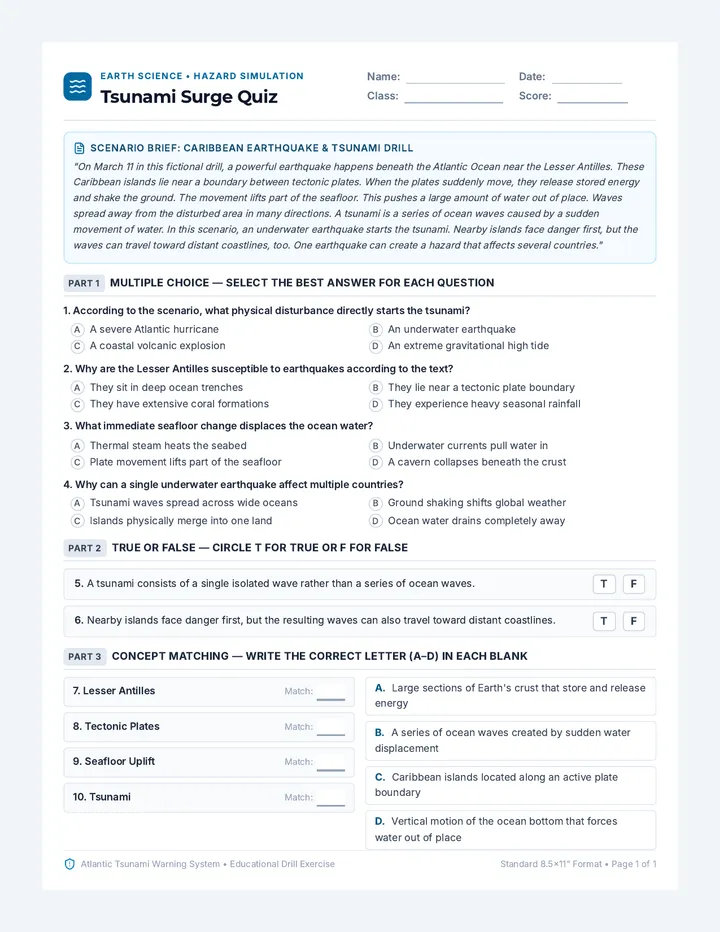
Earth Science • Hazard Simulation
Tsunami Surge Quiz
Name:
Date:
Class:
Score:
Scenario Brief: Caribbean Earthquake & Tsunami Drill
"On March 11 in this fictional drill, a powerful earthquake happens beneath the Atlantic Ocean near the Lesser Antilles. These Caribbean islands lie near a boundary between tectonic plates. When the plates suddenly move, they release stored energy and shake the ground. The movement lifts part of the seafloor. This pushes a large amount of water out of place. Waves spread away from the disturbed area in many directions. A tsunami is a series of ocean waves caused by a sudden movement of water. In this scenario, an underwater earthquake starts the tsunami. Nearby islands face danger first, but the waves can travel toward distant coastlines, too. One earthquake can create a hazard that affects several countries."
Part 1 Multiple Choice — Select the best answer for each question
1. According to the scenario, what physical disturbance directly starts the tsunami?
A A severe Atlantic hurricane
B An underwater earthquake
C A coastal volcanic explosion
D An extreme gravitational high tide
2. Why are the Lesser Antilles susceptible to earthquakes according to the text?
A They sit in deep ocean trenches
B They lie near a tectonic plate boundary
C They have extensive coral formations
D They experience heavy seasonal rainfall
3. What immediate seafloor change displaces the ocean water?
A Thermal steam heats the seabed
B Underwater currents pull water in
C Plate movement lifts part of the seafloor
D A cavern collapses beneath the crust
4. Why can a single underwater earthquake affect multiple countries?
A Tsunami waves spread across wide oceans
B Ground shaking shifts global weather
C Islands physically merge into one land
D Ocean water drains completely away
Part 2 True or False — Circle T for True or F for False
- A tsunami consists of a single isolated wave rather than a series of ocean waves.
T F
- Nearby islands face danger first, but the resulting waves can also travel toward distant coastlines.
T F
Part 3 Concept Matching — Write the correct letter (A–D) in each blank
7. Lesser Antilles
Match:
8. Tectonic Plates
Match:
9. Seafloor Uplift
Match:
10. Tsunami
Match:
A. Large sections of Earth's crust that store and release energy
B. A series of ocean waves created by sudden water displacement
C. Caribbean islands located along an active plate boundary
D. Vertical motion of the ocean bottom that forces water out of place
Atlantic Tsunami Warning System • Educational Drill Exercise
Standard 8.5×11" Format • Page 1 of 1
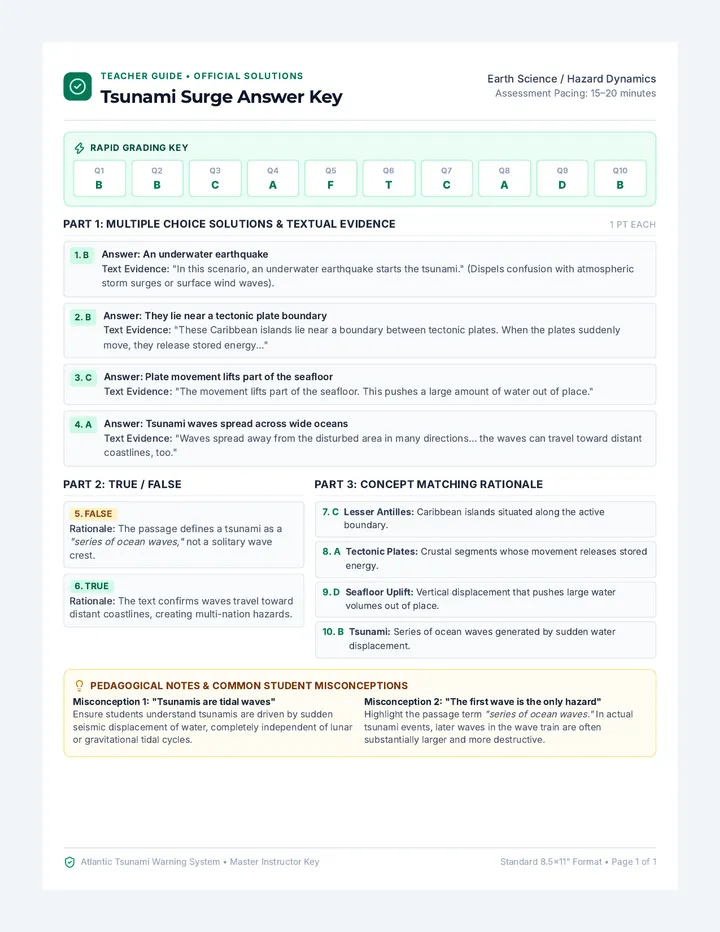
Tsunami Surge Answer Key
Teacher Guide • Official Solutions
Tsunami Surge Answer Key
Earth Science / Hazard Dynamics
Assessment Pacing: 15–20 minutes
Rapid Grading Key
Q1
B
Q2
B
Q3
C
Q4
A
Q5
F
Q6
T
Q7
C
Q8
A
Q9
D
Q10
B
Part 1: Multiple Choice Solutions & Textual Evidence 1 pt each
1. B
Answer: An underwater earthquake
Text Evidence: "In this scenario, an underwater earthquake starts the tsunami." (Dispels confusion with atmospheric storm surges or surface wind waves).
2. B
Answer: They lie near a tectonic plate boundary
Text Evidence: "These Caribbean islands lie near a boundary between tectonic plates. When the plates suddenly move, they release stored energy..."
3. C
Answer: Plate movement lifts part of the seafloor
Text Evidence: "The movement lifts part of the seafloor. This pushes a large amount of water out of place."
4. A
Answer: Tsunami waves spread across wide oceans
Text Evidence: "Waves spread away from the disturbed area in many directions... the waves can travel toward distant coastlines, too."
Part 2: True / False
5. FALSE
Rationale: The passage defines a tsunami as a "series of ocean waves," not a solitary wave crest.
6. TRUE
Rationale: The text confirms waves travel toward distant coastlines, creating multi-nation hazards.
Part 3: Concept Matching Rationale
7. C Lesser Antilles: Caribbean islands situated along the active boundary.
8. A Tectonic Plates: Crustal segments whose movement releases stored energy.
9. D Seafloor Uplift: Vertical displacement that pushes large water volumes out of place.
10. B Tsunami: Series of ocean waves generated by sudden water displacement.
Pedagogical Notes & Common Student Misconceptions
Misconception 1: "Tsunamis are tidal waves"
Ensure students understand tsunamis are driven by sudden seismic displacement of water, completely independent of lunar or gravitational tidal cycles.
Misconception 2: "The first wave is the only hazard"