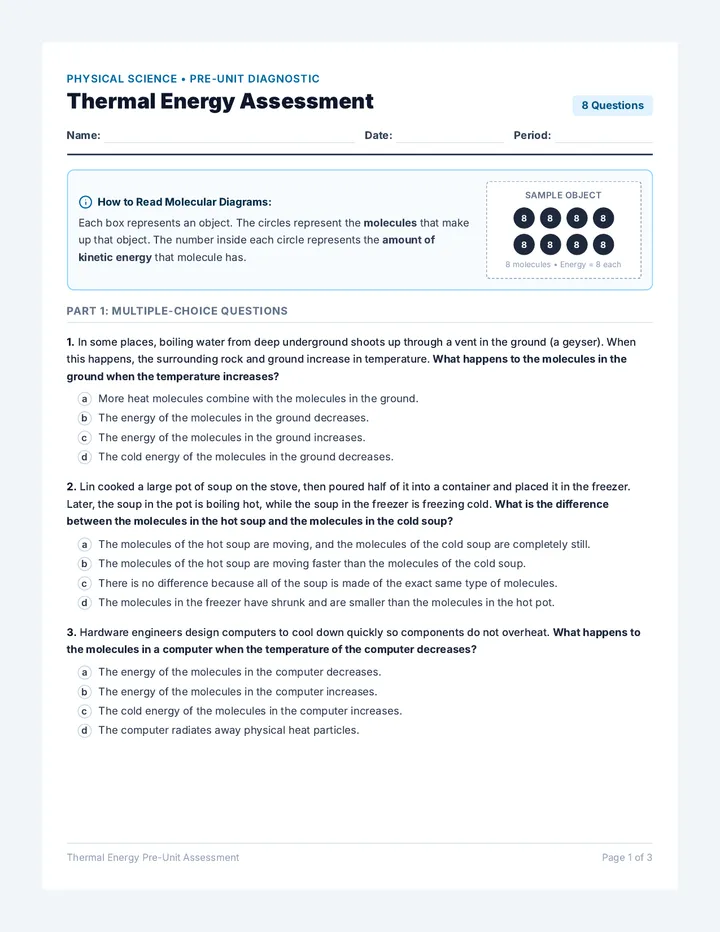
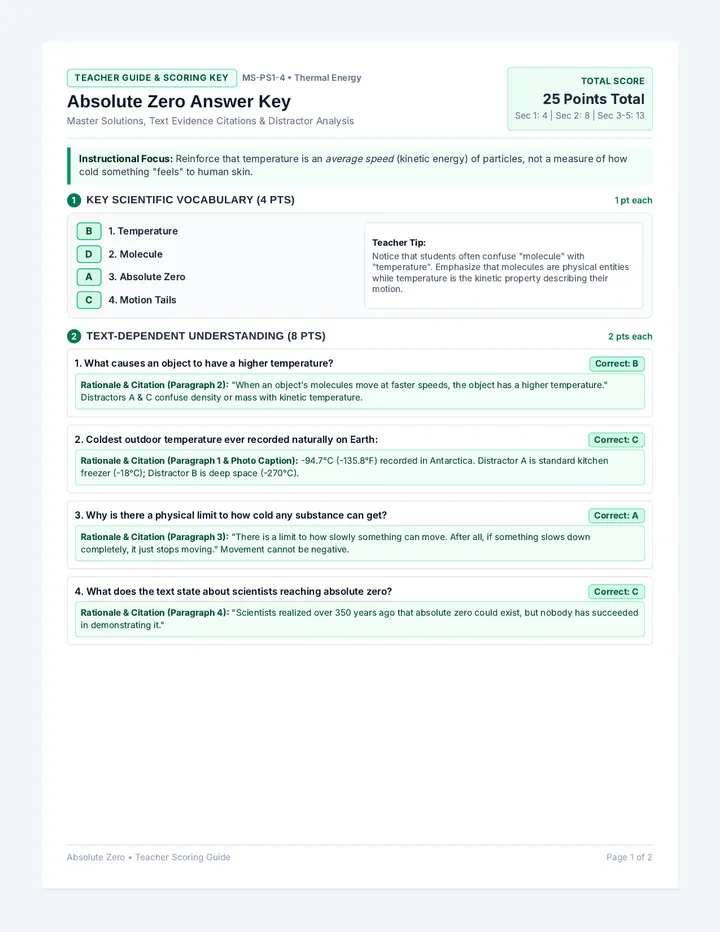
Absolute Zero Comprehension Worksheet
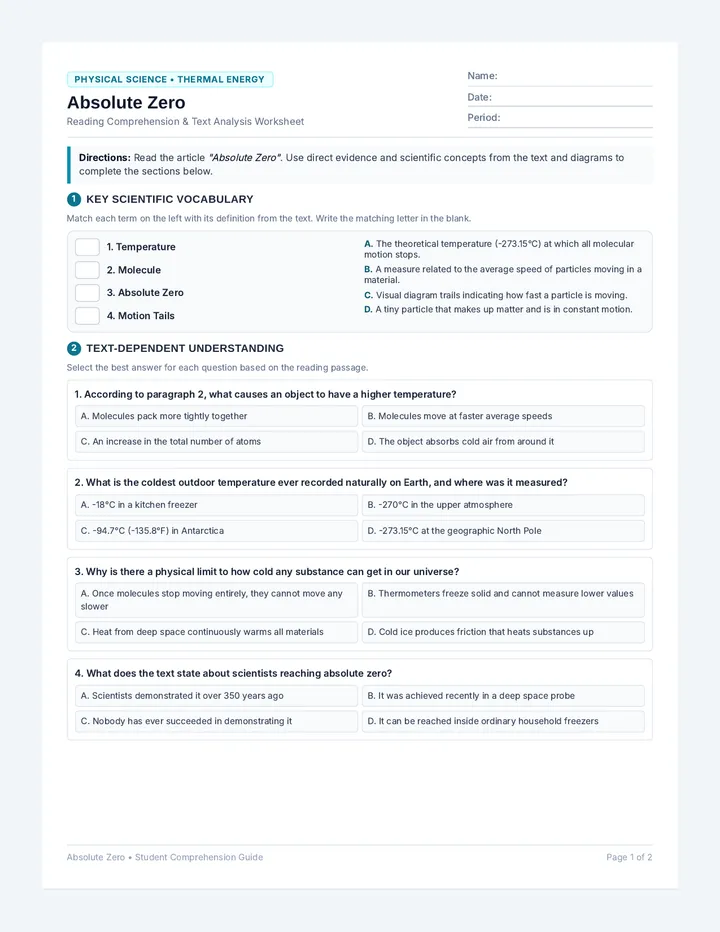
Physical Science • Thermal Energy
Absolute Zero
Reading Comprehension & Text Analysis Worksheet
Name:
Date:
Period:
Directions: Read the article "Absolute Zero". Use direct evidence and scientific concepts from the text and diagrams to complete the sections below.
1
Key Scientific Vocabulary
Match each term on the left with its definition from the text. Write the matching letter in the blank.
1. Temperature
2. Molecule
3. Absolute Zero
4. Motion Tails
A. The theoretical temperature (-273.15°C) at which all molecular motion stops.
B. A measure related to the average speed of particles moving in a material.
C. Visual diagram trails indicating how fast a particle is moving.
D. A tiny particle that makes up matter and is in constant motion.
2
Text-Dependent Understanding
Select the best answer for each question based on the reading passage.
1. According to paragraph 2, what causes an object to have a higher temperature?
A. Molecules pack more tightly together
B. Molecules move at faster average speeds
C. An increase in the total number of atoms
D. The object absorbs cold air from around it
2. What is the coldest outdoor temperature ever recorded naturally on Earth, and where was it measured?
A. -18°C in a kitchen freezer
B. -270°C in the upper atmosphere
C. -94.7°C (-135.8°F) in Antarctica
D. -273.15°C at the geographic North Pole
3. Why is there a physical limit to how cold any substance can get in our universe?
A. Once molecules stop moving entirely, they cannot move any slower
B. Thermometers freeze solid and cannot measure lower values
C. Heat from deep space continuously warms all materials
D. Cold ice produces friction that heats substances up
4. What does the text state about scientists reaching absolute zero?
A. Scientists demonstrated it over 350 years ago
B. It was achieved recently in a deep space probe
C. Nobody has ever succeeded in demonstrating it
D. It can be reached inside ordinary household freezers
Absolute Zero • Student Comprehension Guide Page 1 of 2
Student Name: ___________________________________ Absolute Zero • Part II
3
Diagram & Scientific Model Analysis
Review the diagram in the article comparing molecules in cold water (left) versus hot water (right).
Cold Water Model
Short motion tails
Hot Water Model
Long motion tails
5. Interpreting Molecular Models: How do the "motion tails" represent the temperature difference between the two glasses of water? What would molecules look like if brought to absolute zero?
6. Evidence-Based Deduction: If a cup of hot water is placed in a kitchen freezer (-18°C), describe what happens to the molecular speed and motion tails over time.
4
Critical Thinking & Reasoning
7. Evaluating Claims: A classmate claims: "An ice cube at 0°C has no thermal energy and its molecules have stopped moving." Is your classmate correct? Support your answer using text evidence.
8. Explaining Limits: In your own words, explain why scientists consider absolute zero (-273.15°C) to be a "one-way limit"—why can temperatures go higher, but never lower than absolute zero?
5
Thermal Scale Challenge
Number the environments below from 1 (Warmest) to 4 (Coldest) based on the temperatures reported in the text.
| Rank (1-4) | Location / Condition | Recorded Temperature | Molecular Movement Status |
|---|
| Deep Space | -270°C (-454°F) | Molecules move extremely slowly |
| Antarctica (Record on Earth) | -94.7°C (-135.8°F) | Molecules move slower than normal |
| Absolute Zero (Coldest Limit) | -273.15°C (-459.67°F) | Zero molecular movement (all motion stops) |
| Kitchen Freezer | -18°C (0°F) | Molecules move moderately slow |
Absolute Zero • Student Comprehension Guide Page 2 of 2
Absolute Zero Answer Key
Teacher Guide & Scoring Key MS-PS1-4 • Thermal Energy
Absolute Zero Answer Key
Master Solutions, Text Evidence Citations & Distractor Analysis
Total Score
25 Points Total
Sec 1: 4 | Sec 2: 8 | Sec 3-5: 13
Instructional Focus: Reinforce that temperature is an average speed (kinetic energy) of particles, not a measure of how cold something "feels" to human skin.
1
Key Scientific Vocabulary (4 Pts)
1 pt each
B 1. Temperature
D 2. Molecule
A 3. Absolute Zero
C 4. Motion Tails
Teacher Tip: Notice that students often confuse "molecule" with "temperature". Emphasize that molecules are physical entities while temperature is the kinetic property describing their motion.
2
Text-Dependent Understanding (8 Pts)
2 pts each
1. What causes an object to have a higher temperature?
Correct: B
Rationale & Citation (Paragraph 2): "When an object's molecules move at faster speeds, the object has a higher temperature." Distractors A & C confuse density or mass with kinetic temperature.
2. Coldest outdoor temperature ever recorded naturally on Earth:
Correct: C
Rationale & Citation (Paragraph 1 & Photo Caption): -94.7°C (-135.8°F) recorded in Antarctica. Distractor A is standard kitchen freezer (-18°C); Distractor B is deep space (-270°C).
3. Why is there a physical limit to how cold any substance can get?
Correct: A
Rationale & Citation (Paragraph 3): "There is a limit to how slowly something can move. After all, if something slows down completely, it just stops moving." Movement cannot be negative.
4. What does the text state about scientists reaching absolute zero?
Correct: C
Rationale & Citation (Paragraph 4): "Scientists realized over 350 years ago that absolute zero could exist, but nobody has succeeded in demonstrating it."
Absolute Zero • Teacher Scoring Guide Page 1 of 2
Teacher Scoring Guide • Part II Free-Response Rubrics & Scale Key
3
Diagram & Scientific Model Analysis (5 Pts)
Q5: 3 pts | Q6: 2 pts
5. Interpreting Molecular Models Criteria:
Exemplar Response: The length of the motion tails indicates how quickly the molecules are moving. Longer tails in hot water indicate higher kinetic speed/higher temperature; short tails indicate slower speed. At absolute zero, the molecules would have because all molecular movement stops completely (speed = 0).