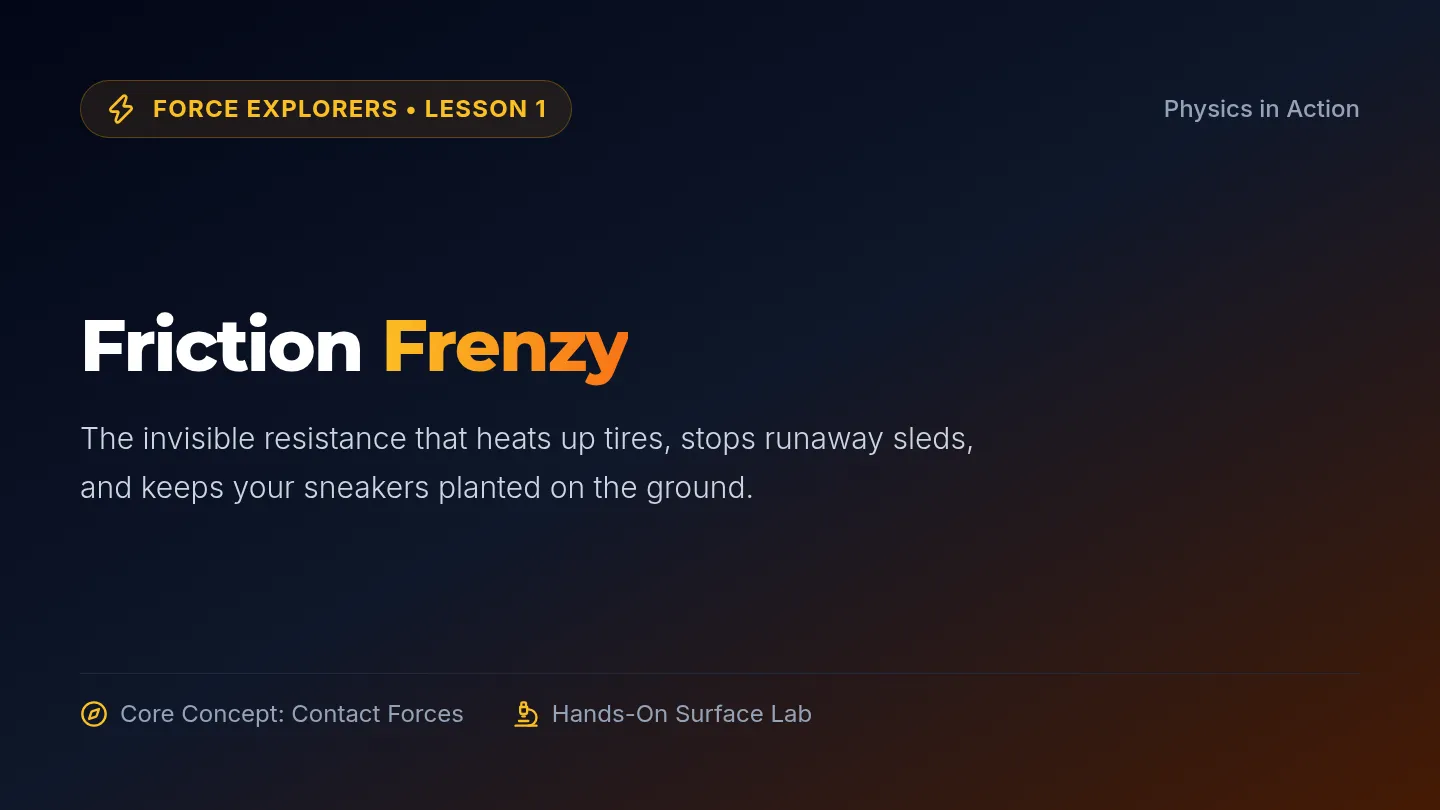
Landscape Forensics Activity
Earth Science Lab Post-Note Application Activity
LANDSCAPE FORENSICS ACTIVITY
Investigating Earth's Breakdown, Transport, and Reshaping Systems
NAME:
DATE:
PERIOD:
SCORE:
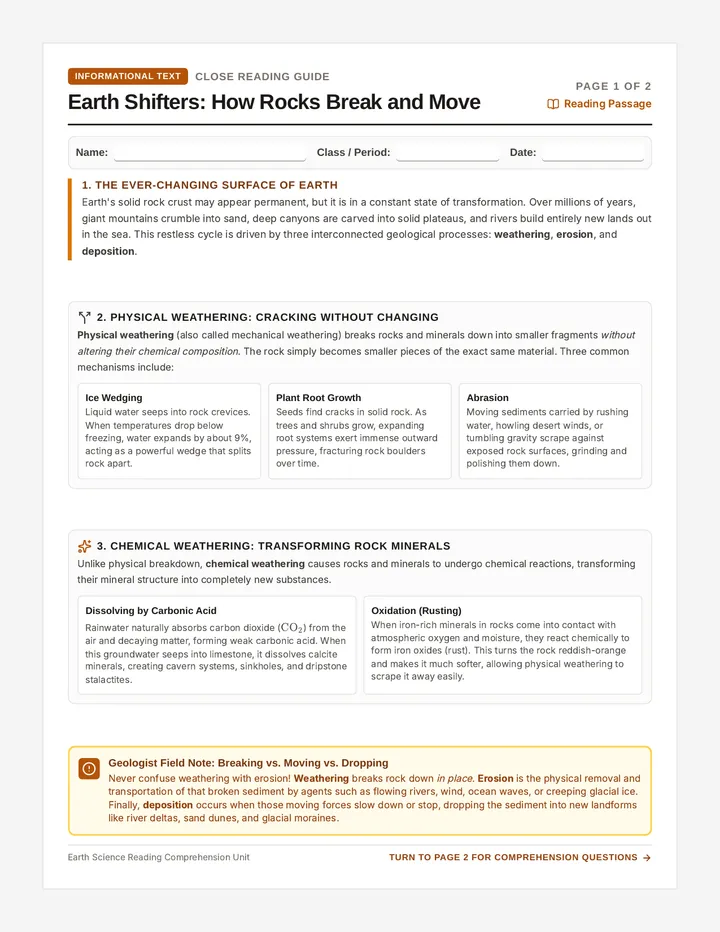
Weathering
Breaks it! Physical or chemical rock breakdown.
Erosion
Moves it! Transport by water, wind, ice, or gravity.
Deposition
Drops it! Sediments settle in a new location.
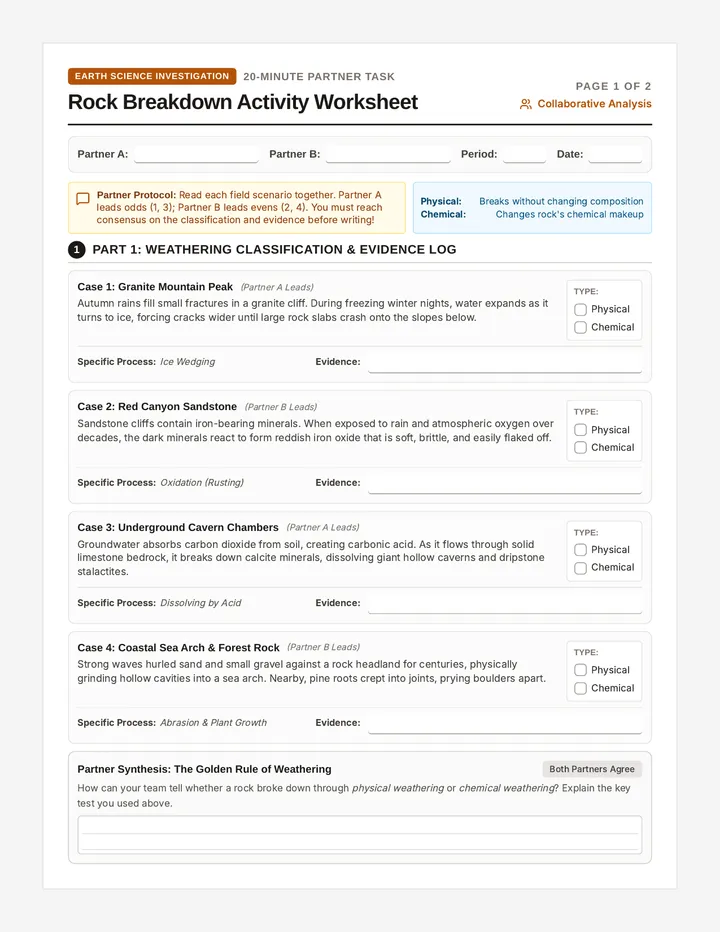
1 The Breakdown Bureau: Mechanical vs. Chemical Weathering
Classify the process & state the specific mechanism
Case #101: Mountain Rock Fractures Alpine Zone
Liquid water fills cracks in granite cliffs. Freezing overnight expands the volume by 9%, wedging rocks apart.
Type: Mechanical Chemical
Specific Mechanism:
Case #102: Rusty Desert Sandstone Arid Basin
Iron minerals in sandstone react with air and periodic moisture, turning outer rock into soft, reddish-brown iron oxide.
Type: Mechanical Chemical
Specific Mechanism:
Case #103: Cliff Tree Root Expansion Forest Ridge
A pine seed sprouts in a narrow joint. As roots thicken over 20 years, they pry giant boulders away from the cliff face.
Type: Mechanical Chemical
Specific Mechanism:
Case #104: Cavern Limestone Dissolution Subsurface
Groundwater mixes with carbon dioxide to form weak carbonic acid, slowly dissolving solid calcite rock to form caves.
Type: Mechanical Chemical
Specific Mechanism:
2 Erosion Agents in Action: Landform Matching & Transport Analysis
Agents: Running Water • Wind • Glacial Ice • Gravity
| Landform Observation | Primary Agent | How Sediment Moves | Deposition Feature Formed |
|---|
| | | |
| U-Shaped Alpine Valley | | | |
Steep vertical walls & polished striations
|
|
|
|
|
Deep V-Shaped Canyon
Fast torrential flow carving layered rock
|
|
|
|
|
Mushroom Rock (Ventifact)
Narrow rock pedestal blasted by quartz sand
|
|
|
|
|
Talus Scree Slope
Angular rocks fallen at foot of sheer cliff
|
|
|
|
Field Station Alpha • Earth Science Surface Dynamics Turn over for Case Study & Landform Evolution Model →
FORENSIC CASE STUDY: THE COLLAPSING ARCH
Field Site: Arches National Park • Entrada Sandstone Formation
INVESTIGATION DOSSIER • CASE #409
GEOLOGIC EVIDENCE LOG:
Over millions of years, subsurface salt movement lifted and cracked thick sandstone into narrow vertical slabs called fins. Repeated winter freeze-thaw cycles pry stone chips loose. Windstorms blast sand particles through fractured zones, while occasional rainfall slightly dissolves mineral cements. As an opening widens, gravity ultimately collapses the fragile span into a pile of rubble.
3 Visual Evidence Station: Diagram Landform Evolution
Sketch the 3 evolutionary stages
Stage 1: Solid Fin & Cracks PAST
Active Weathering Agent:
Stage 2: Mature Arch PRESENT
Active Erosion Agent:
Stage 3: Remnant Pillars / Talus FUTURE
Deposition Location:
4 Scientific Explanation (Claim • Evidence • Reasoning)
Construct an evidence-based argument
INVESTIGATION QUESTION: How do weathering and erosion work together to transform a solid sandstone fin into an arch and eventually a pile of sediment?
CLAIM (Direct 1-sentence answer to the investigation question):
EVIDENCE (Cite at least two specific physical observations from the case dossier):
REASONING (Scientific principles explaining HOW and WHY these processes drove the changes):
INVESTIGATOR CHECKLIST: Classified mechanical vs chemical Identified all 4 erosion agents Completed CER argument
MS-ESS2-1 • MS-ESS2-2