Weathering and Erosion
Earth Science Investigation 20-Minute Partner Task
Rock Breakdown Activity Worksheet
Page 1 of 2
Collaborative Analysis
Partner A:
Partner B:
Period:
Date:
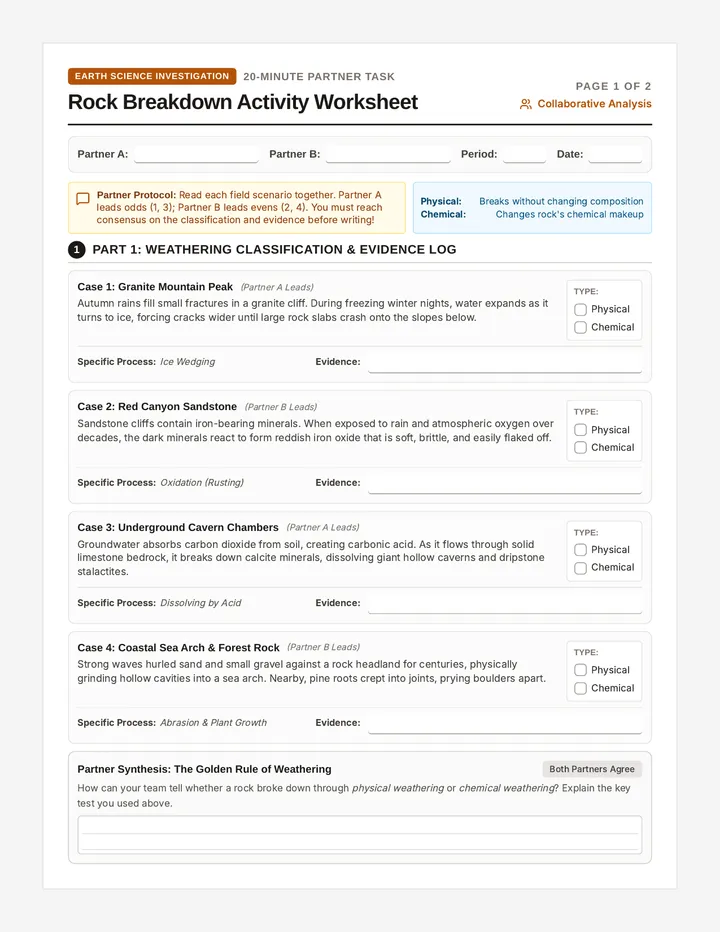
Partner Protocol: Read each field scenario together. Partner A leads odds (1, 3); Partner B leads evens (2, 4). You must reach consensus on the classification and evidence before writing!
Physical: Breaks without changing composition
Chemical: Changes rock's chemical makeup
1
Part 1: Weathering Classification & Evidence Log
Case 1: Granite Mountain Peak (Partner A Leads)
Autumn rains fill small fractures in a granite cliff. During freezing winter nights, water expands as it turns to ice, forcing cracks wider until large rock slabs crash onto the slopes below.
Type: Physical Chemical
Specific Process: Ice Wedging
Evidence:
Case 2: Red Canyon Sandstone (Partner B Leads)
Sandstone cliffs contain iron-bearing minerals. When exposed to rain and atmospheric oxygen over decades, the dark minerals react to form reddish iron oxide that is soft, brittle, and easily flaked off.
Type: Physical Chemical
Specific Process: Oxidation (Rusting)
Evidence:
Case 3: Underground Cavern Chambers (Partner A Leads)
Groundwater absorbs carbon dioxide from soil, creating carbonic acid. As it flows through solid limestone bedrock, it breaks down calcite minerals, dissolving giant hollow caverns and dripstone stalactites.
Type: Physical Chemical
Specific Process: Dissolving by Acid
Evidence:
Case 4: Coastal Sea Arch & Forest Rock (Partner B Leads)
Strong waves hurled sand and small gravel against a rock headland for centuries, physically grinding hollow cavities into a sea arch. Nearby, pine roots crept into joints, prying boulders apart.
Type: Physical Chemical
Specific Process: Abrasion & Plant Growth
Evidence:
Partner Synthesis: The Golden Rule of Weathering Both Partners Agree
How can your team tell whether a rock broke down through physical weathering or chemical weathering? Explain the key test you used above.
Landform Dynamics Scenario Challenge
Tracing the Dynamic Earth Trio
Page 2 of 2
3 Landform Scenarios
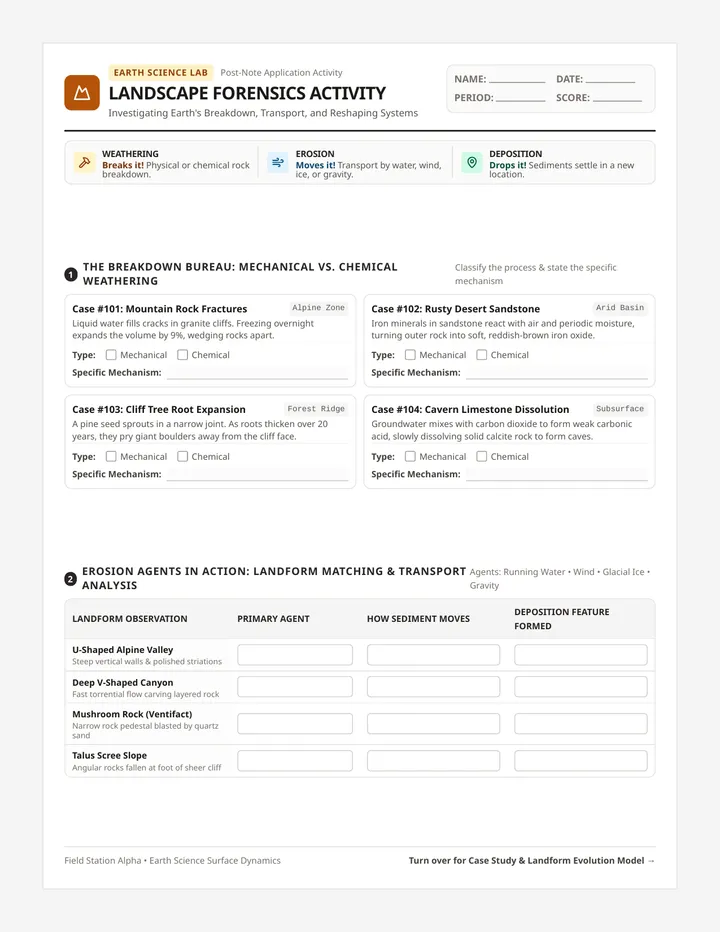
1. Weathering "Breaks It"
Processes that break rocks into sediments
2. Erosion "Takes It"
Moving and transporting sediments
3. Deposition "Drops It"
Laying down sediment in a new resting place
Scenario A
High Mountain River to Ocean Delta
Partner A leads discussion
High in the Rockies, repeated freeze-thaw cycles shatter granite into sharp fragments. A raging springtime river rolls and scrapes these rocks downstream, grinding them into smooth pebbles and sand. Fifty miles away, the river reaches a calm ocean bay, slows down, and drops its sediment to build a fan-shaped delta.
1. Weathering (Breaks It) What broke down & how?
2. Erosion (Takes It) What moved the sediment?
3. Deposition (Drops It) Where did it settle & build?
Scenario B
Desert Windstorm & Rolling Dunes
Partner B leads discussion
In a windswept desert, howling gale-force winds whip grit against a towering sandstone pedestal, sandblasting the rock base into a top-heavy mushroom rock. The airborne sand grains are blown over thirty miles across the basin until the wind dies down, gently settling the sand into towering rolling dunes.
1. Weathering (Breaks It) What broke down & how?
2. Erosion (Takes It) What moved the sediment?
3. Deposition (Drops It) Where did it settle & build?
Scenario C
Alpine Glacier & Valley Moraine Ridges
Both Partners Collaborate
A massive alpine glacier slowly creeps down a mountain valley. Boulders frozen in the glacial ice grind against the bedrock floor, pulverizing rock into gravel and silt. The creeping ice river carries these mixed sediments fifteen miles down the valley. As the glacier melts at lower elevations, it dumps the rock debris to form giant ridges called moraines.
1. Weathering (Breaks It) What broke down & how?
2. Erosion (Takes It) What moved the sediment?
3. Deposition (Drops It) Where did it settle & build?
Partner Consensus Check: We reviewed all three landform pathways and agree on each stage.
Initials A:
Initials B:
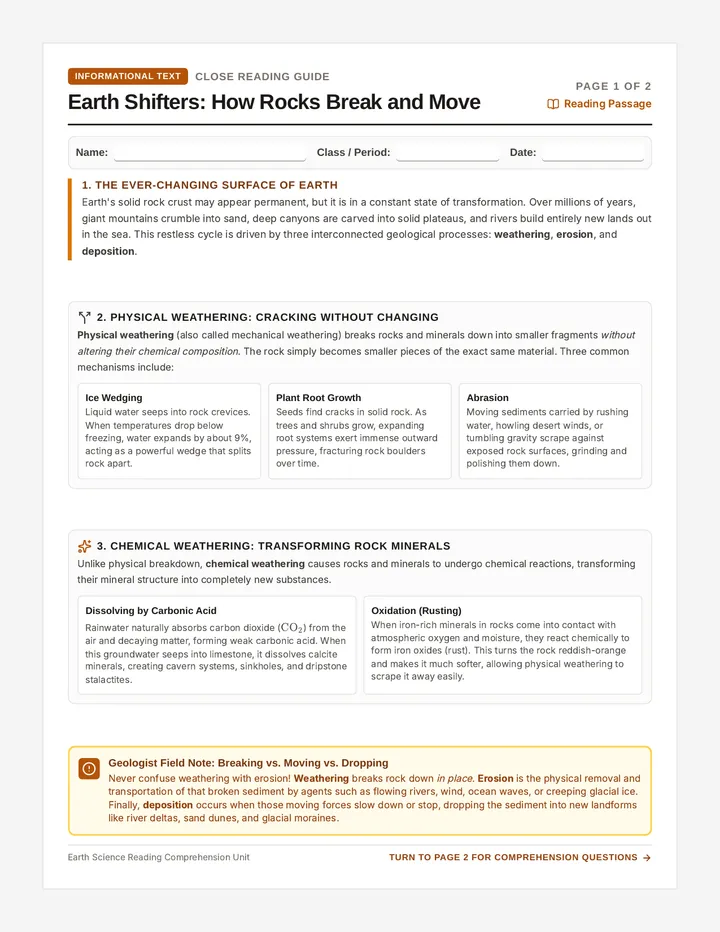
Weathering and Erosion Earth Shifters Reading Assignment
Informational Text Close Reading Guide
Earth Shifters: How Rocks Break and Move
Page 1 of 2
Reading Passage
Name:
Class / Period:
Date:
1. The Ever-Changing Surface of Earth
Earth's solid rock crust may appear permanent, but it is in a constant state of transformation. Over millions of years, giant mountains crumble into sand, deep canyons are carved into solid plateaus, and rivers build entirely new lands out in the sea. This restless cycle is driven by three interconnected geological processes: weathering, erosion, and deposition.
2. Physical Weathering: Cracking Without Changing
Physical weathering (also called mechanical weathering) breaks rocks and minerals down into smaller fragments without altering their chemical composition. The rock simply becomes smaller pieces of the exact same material. Three common mechanisms include:
Ice Wedging
Liquid water seeps into rock crevices. When temperatures drop below freezing, water expands by about 9%, acting as a powerful wedge that splits rock apart.
Plant Root Growth
Seeds find cracks in solid rock. As trees and shrubs grow, expanding root systems exert immense outward pressure, fracturing rock boulders over time.
Abrasion
Moving sediments carried by rushing water, howling desert winds, or tumbling gravity scrape against exposed rock surfaces, grinding and polishing them down.
3. Chemical Weathering: Transforming Rock Minerals
Unlike physical breakdown, chemical weathering causes rocks and minerals to undergo chemical reactions, transforming their mineral structure into completely new substances.
Dissolving by Carbonic Acid
Rainwater naturally absorbs carbon dioxide (\(\text{CO}_2\)) from the air and decaying matter, forming weak carbonic acid. When this groundwater seeps into limestone, it dissolves calcite minerals, creating cavern systems, sinkholes, and dripstone stalactites.
Oxidation (Rusting)
When iron-rich minerals in rocks come into contact with atmospheric oxygen and moisture, they react chemically to form iron oxides (rust). This turns the rock reddish-orange and makes it much softer, allowing physical weathering to scrape it away easily.
Geologist Field Note: Breaking vs. Moving vs. Dropping
Never confuse weathering with erosion! Weathering breaks rock down . is the physical removal and transportation of that broken sediment by agents such as flowing rivers, wind, ocean waves, or creeping glacial ice. Finally, occurs when those moving forces slow down or stop, dropping the sediment into new landforms like river deltas, sand dunes, and glacial moraines.