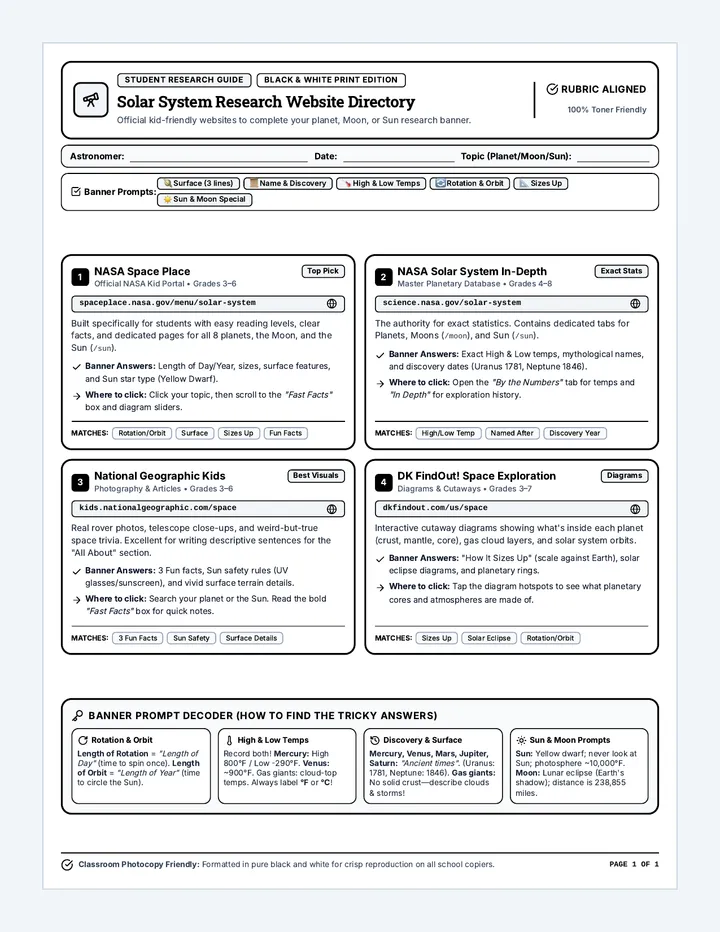
Lightning Charge Article
Physical Science Grade 6 • Static Electricity
Reading Article
Anatomy of a Lightning Strike
How static electrical charges build up, separate, and discharge during severe thunderstorms
Name:
Date:
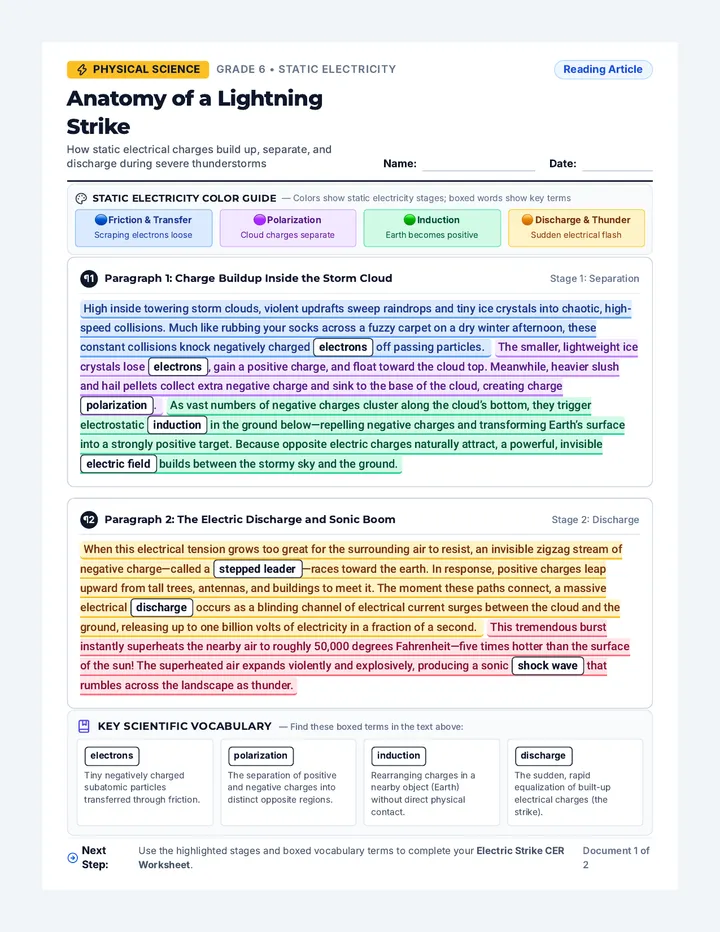
Static Electricity Color Guide — Colors show static electricity stages; boxed words show key terms
🔵 Friction & Transfer Scraping electrons loose
🟣 Polarization Cloud charges separate
🟢 Induction Earth becomes positive
🟠 Discharge & Thunder Sudden electrical flash
¶1
Paragraph 1: Charge Buildup Inside the Storm Cloud
Stage 1: Separation
High inside towering storm clouds, violent updrafts sweep raindrops and tiny ice crystals into chaotic, high-speed collisions. Much like rubbing your socks across a fuzzy carpet on a dry winter afternoon, these constant collisions knock negatively charged electrons off passing particles. The smaller, lightweight ice crystals lose electrons, gain a positive charge, and float toward the cloud top. Meanwhile, heavier slush and hail pellets collect extra negative charge and sink to the base of the cloud, creating charge polarization. As vast numbers of negative charges cluster along the cloud’s bottom, they trigger electrostatic induction in the ground below—repelling negative charges and transforming Earth’s surface into a strongly positive target. Because opposite electric charges naturally attract, a powerful, invisible electric field builds between the stormy sky and the ground.
¶2
Paragraph 2: The Electric Discharge and Sonic Boom
Stage 2: Discharge
When this electrical tension grows too great for the surrounding air to resist, an invisible zigzag stream of negative charge—called a stepped leader—races toward the earth. In response, positive charges leap upward from tall trees, antennas, and buildings to meet it. The moment these paths connect, a massive electrical discharge occurs as a blinding channel of electrical current surges between the cloud and the ground, releasing up to one billion volts of electricity in a fraction of a second. This tremendous burst instantly superheats the nearby air to roughly 50,000 degrees Fahrenheit—five times hotter than the surface of the sun! The superheated air expands violently and explosively, producing a sonic shock wave that rumbles across the landscape as thunder.
Key Scientific Vocabulary
— Find these boxed terms in the text above:
electrons
Tiny negatively charged subatomic particles transferred through friction.
polarization
The separation of positive and negative charges into distinct opposite regions.
induction
Rearranging charges in a nearby object (Earth) without direct physical contact.
discharge
The sudden, rapid equalization of built-up electrical charges (the strike).
Next Step: Use the highlighted stages and boxed vocabulary terms to complete your Electric Strike CER Worksheet.
Document 1 of 2
Electric Strike CER Worksheet
Student Investigation Grade 6 • Scientific Argumentation
Document 2 of 2
Electric Strike CER Investigation
Construct a formal scientific explanation using evidence from your color-coded article.
Name:
Date:
Period:
Prompt
How do the movements and buildup of electric charges inside a storm cloud cause a lightning bolt to strike the ground?
Directions: Re-read the color-coded sections in your article. Write a complete scientific explanation consisting of a claim, supporting textual evidence, and scientific reasoning.
Evidence Organizer (Reference Your Article Colors) Select at least 2 color-coded components to cite
🔵 Blue Section Friction & Transfer
🟣 Purple Section Polarization in Cloud
🟢 Green Section Induction on Ground
🟠 Amber Section Discharge / Leader
C
1. Claim
— A clear, direct one-sentence answer to the prompt question.
Score: /2
E
2. Evidence
— Provide specific facts, observations, and details from the color-coded text.
Score: /4
R
3. Reasoning
— Explain the science principle (e.g., attraction of opposites) that links evidence to claim.
Score: /4
Student Rubric Checklist: Claim directly answers question 2+ facts cited from text Explains why using science laws
Total Score: ___ / 10