Innovation Loop Lesson Plan Teacher Guide
The Innovation Loop
Grade 10 Integrated Science • Symbiotic Relationship of Science & Tech
Duration
80 Minutes
Learning Objectives
Distinguish clearly between scientific discovery (acquiring knowledge) and technological innovation (applying knowledge).Analyze how scientific concepts serve as direct tools to develop new technologies.Evaluate how technology drives scientific exploration through tools and instruments.
Standards Alignment
NGSS HS-ETS1-1: Analyze a major global challenge to specify qualitative/quantitative criteria for technological solutions.
NGSS HS-PS4-5: Communicate scientific and technical info about how devices use waves to transmit energy.
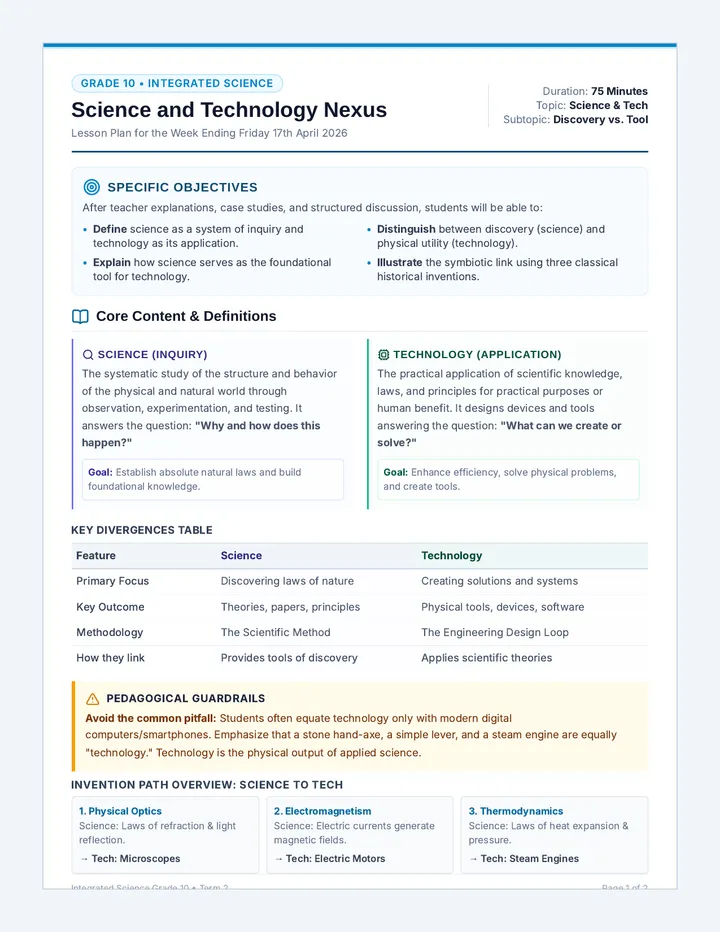
The Core Conceptual Distinction
Science ("The Spark")
The systematic inquiry to understand natural laws, answer questions, and build explanations about the universe. Focuses on discovery and empirical truth.
Technology ("The Tool")
The application of scientific knowledge to solve human problems, build systems, or design devices. Focuses on practical utility, design, and performance.
Critical Misconception: Students often equate technology with electronics or think technology is "just applied science." Emphasize that a simple wood hammer is technology, and that technology also drives science forward (e.g., telescopes allowing cosmological discoveries).
Instructional Sequence: Part 1
PHASE 01
Inquiry Sorting Challenge & Hook
15 Mins
Action: Project Slide 2. Group students into pairs and distribute the Discovery to Device Worksheet. Have them list their definitions of science vs. technology, then challenge them to categorize 8 cards (e.g., Optics, Lens, Electromagnetism, Electric Motor) without teacher assistance.
Debrief: Guide students to notice that the scientific concepts are natural phenomena discovered, whereas the technologies are tools created by humans.
PHASE 02
Direct Instruction: Defining the Symbiosis
15 Mins
Action: Present Slides 3-5. Introduce "The Innovation Loop": Science provides the theory and constraints (the Spark), while Technology provides the physical instruments and data gathering (the Tool) that enables more science. Highlight that scientific breakthroughs like thermodynamics led directly to the steam engine, which then allowed scientists to build better thermodynamics models.
Unit: Foundations of Modern Science Page 1 of 2
The Innovation Loop
Instructional Sequence: Part 2 & Answer Keys
Teacher Guide
PHASE 03
Case Studies & Debate Cards
25 Mins
Action: Distribute the Spark and Tool Discussion Cards to small groups. Each card details an invention pathway (e.g., Hertz & Maxwell’s EM Waves leading to Marconi's Radio). Students trace the transitions between scientific discoveries and technological breakthroughs. Groups present their analysis of the "Loop" in their assigned case study.
PHASE 04
Invention Lab Design Prompt
20 Mins
Action: Students complete Part 3 of the worksheet. They are provided a scientific principle (e.g., Thermal expansion of metals or Total internal reflection of light ) and must design a simple technology solving a practical human problem (e.g., a high-temperature alarm or a non-electrical signal messenger). Encourage sketch-focused engineering blueprints.
PHASE 05
Exit Ticket Assessment
5 Mins
Action: Distribute the The Innovation Loop Exit Ticket. Collect to gauge student conceptual understanding of how science and tech feed back into each other.
Reference Answer Guide
Part 1: Sorting Classification
Science: Electromagnetism (phenomenon), Optics (wave behavior), Photoelectric Effect (matter excitation), Gravity (spacetime curvature).Technology: Generator (mechanical to electric), Camera Lens (manipulates light), Solar Panel (harvests photons), Pendulum Clock (uses gravity).
Part 2: Case Study Framework
For any selected card, check that students clearly trace:
Teacher Tip for Design Challenge Grading: Focus on whether students show the mechanism . They should label how the physical scientific fact (e.g., "bimetallic strip bends when hot") physically triggers the technological outcome (e.g., "closes the electric alarm circuit"). Avoid grading on drawing skill.
Unit: Foundations of Modern Science Page 2 of 2
Innovation Loop Slides Grade 10 Integrated Science
The Innovation Loop
Tracing the symbiotic relationship: How science sparks technology, and how technology accelerates scientific discovery.
Lesson 1: Foundations Use Arrow Keys to Navigate →
The Sorting Challenge
Inquiry Activity
Look at your worksheet. In pairs, categorize the following terms into Science (Discovered) or Technology (Designed):
💡 Electromagnetism
⚡ Electric Generator
🔎 Light Refraction
👓 Camera Lens
Key Question: What is the core rule or difference you used to decide if an item is science or technology?
The Innovation Loop Slide 2 of 6
Defining the Boundaries
Core Concepts
Science
The pursuit of knowledge.
The study of the natural world through observation, questioning, and experimentation. Science explains how the universe behaves naturally.
Goal: Discovery & Explanation
Technology
The application of knowledge.
The tools, systems, and devices built by humans to solve specific physical challenges. Technology acts as a practical solution to human needs.
Goal: Utility, Problem Solving & Action
The Innovation Loop Slide 3 of 6
Science is the Spark
Pathway A
01. Scientific Discovery
Electromagnetic Induction
Michael Faraday discovered that moving a magnet near a wire loop generates an electric current. (Raw Science).
Application
02. Technological Device
The Dynamo Generator
Engineers applied Faraday's formula to build mechanical turbines, powering entire cities with electricity. (Technology).
"Without the pure scientific discovery of induction, the modern electrical grid could not be engineered."
The Innovation Loop Slide 4 of 6
Technology is the Tool
Pathway B
01. Technological Tool
Optical Lenses & Telescopes
Glassmakers crafted pure lenses to correct vision. Craftsmen then assembled these lenses into telescopes.
Enables
02. Scientific Discovery
Astrophysical Mechanics
Galileo used this tool to discover Jupiter's moons, directly proving the heliocentric theory of the solar system.
"Advanced scientific theories are locked away until engineers build the keys to observe them."
Discovery to Device Worksheet DISCOVERY TO DEVICE
Inquiry Worksheet • The Innovation Loop
Name:
Date:
Class Period:
Are science and technology the same thing? Although we often group them together, they are distinct partners. Science is the pursuit of understanding the natural universe (how things work), while Technology is the creation of tools and systems that solve human problems using that understanding.
PART 1: The Sorting Challenge Classify each concept into its proper column
Electromagnetism Electric Generator Optics & Wave Refraction Camera Lens Photoelectric Effect Solar Cell Panel Spacetime Curvature Pendulum Clock
SCIENCE (Discovered natural laws)
TECHNOLOGY (Designed physical tools)
PART 2: The Continuous Loop
Science and technology form an ongoing feedback loop. Write down how they support and amplify each other below.
SCIENCE (The Spark) Provides fundamental theories and laws of nature
TECHNOLOGY (The Tool) Builds functional tools based on physical theories
SCIENCE ACCELERATOR Tools allow deeper scientific observations
1. Explain how science acts as a tool for the development of technology. (Provide an example):
2. Explain how technology acts as the practical application of science. (Provide an example):
The Innovation Loop • Student Investigation Pack Page 1 of 2
PART 3: Case Study Loop Analysis Use your assigned Innovation Card to complete this section
Select one of the case studies from the discussion cards (e.g., Optics to Telescope, Electromagnetism to Radio). Map its cycle:
Case Study Selected:
A. What is the Scientific Spark? Describe the underlying natural laws or scientific principles that had to be discovered first.
B. What is the Technological Tool? Explain the physical tool built from this science, and the human problem it was designed to solve.
C. What is the Loop Return? How did that exact technology eventually help scientists observe, study, or discover even more scientific facts?
PART 4: The Loop Design Lab Design Challenge
Choose One Scientific Concept:
• Option A: Thermal expansion of metals (metals expand predictably when heated).
• Option B: Total internal reflection of light inside glass fibers (light trapped inside reflective strands).
Concept Selected: (Option A or B)
Innovation Loop Debate Cards Discussion Cards
The Spark & The Tool Cards
Cut along the dotted lines. In groups, use these real-world case studies to trace the Loop.
Cut Grid Guide
Case 01
Optics & The Stars
The Spark (Science): In the 13th century, scholars studied the laws of refraction —the physics of how light waves bend when passing through different media like glass.
The Tool (Technology): Spectacle makers applied this physics to grind precision lenses, which Hans Lippershey combined into the first patent for a spyglass/telescope in 1608.
The Return Loop: Galileo pointed this telescope skyward, discovering Jupiter's moons and launching astrophysics and modern orbital mathematics.
Debate Topic: Where does the scientific exploration of optics end and the technological engineering of the telescope begin?
Case 02
Current & Power Grid
The Spark (Science): Luigi Galvani discovered animal electricity, which led Alessandro Volta to discover that chemical reactions between copper and zinc plates create a steady electric current.
The Tool (Technology): Engineers packaged Volta's pile into industrial chemical batteries, dynamos, and eventually massive electrical grids to power factories.
The Return Loop: Reliable electrical current let scientists isolate new elements via electrolysis and discover the subatomic particle: the electron.
Debate Topic: Would we have discovered subatomic particles without the engineering of electrical currents? Which drove which?
Case 03
Microbes & Penicillin
The Spark (Science): Biologists discovered that microorganisms make food rot and spread diseases (the Germ Theory of Disease).
The Tool (Technology): Louis Pasteur developed the heating tool/process of "pasteurization" to sterilize milk. Later, Alexander Fleming engineered penicillin mass-production.
The Return Loop: Industrial fermenters and microscopes let geneticists isolate DNA sequences and discover the mechanics of bacterial cell replication.
Debate Topic: Pasteur's scientific discovery of germs saved lives, but did pasteurization save lives before we understood the genetics of bacteria?
Case 04
Waves & Wireless Tech
The Spark (Science): James Clerk Maxwell wrote mathematical equations predicting electromagnetic waves. Heinrich Hertz proved their existence in 1887.
Innovation Loop Exit Ticket COPY A
The Innovation Loop Exit Ticket
Grade 10 Integrated Science • Lesson Assessment
Name: Date:
1. In your own words, what is the core difference between science and technology?
2. Complete the Loop Diagram: Describe the missing step.
A. Science Discovering Scientists discover the properties of electromagnetic waves.
B. Tech Applying Engineers build wireless antennas and digital transmitters.
C. Loop Return? (Write how this technology drives more science below)
How confident are you distinguishing science from technology?
CUT HERE TO SAVE PAPER • TWO COPIES PER PAGE
COPY B
The Innovation Loop Exit Ticket
Grade 10 Integrated Science • Lesson Assessment
Name: Date:
1. In your own words, what is the core difference between science and technology?
2. Complete the Loop Diagram: Describe the missing step.
A. Science Discovering Scientists discover the properties of electromagnetic waves.
B. Tech Applying Engineers build wireless antennas and digital transmitters.
C. Loop Return? (Write how this technology drives more science below)
How confident are you distinguishing science from technology?