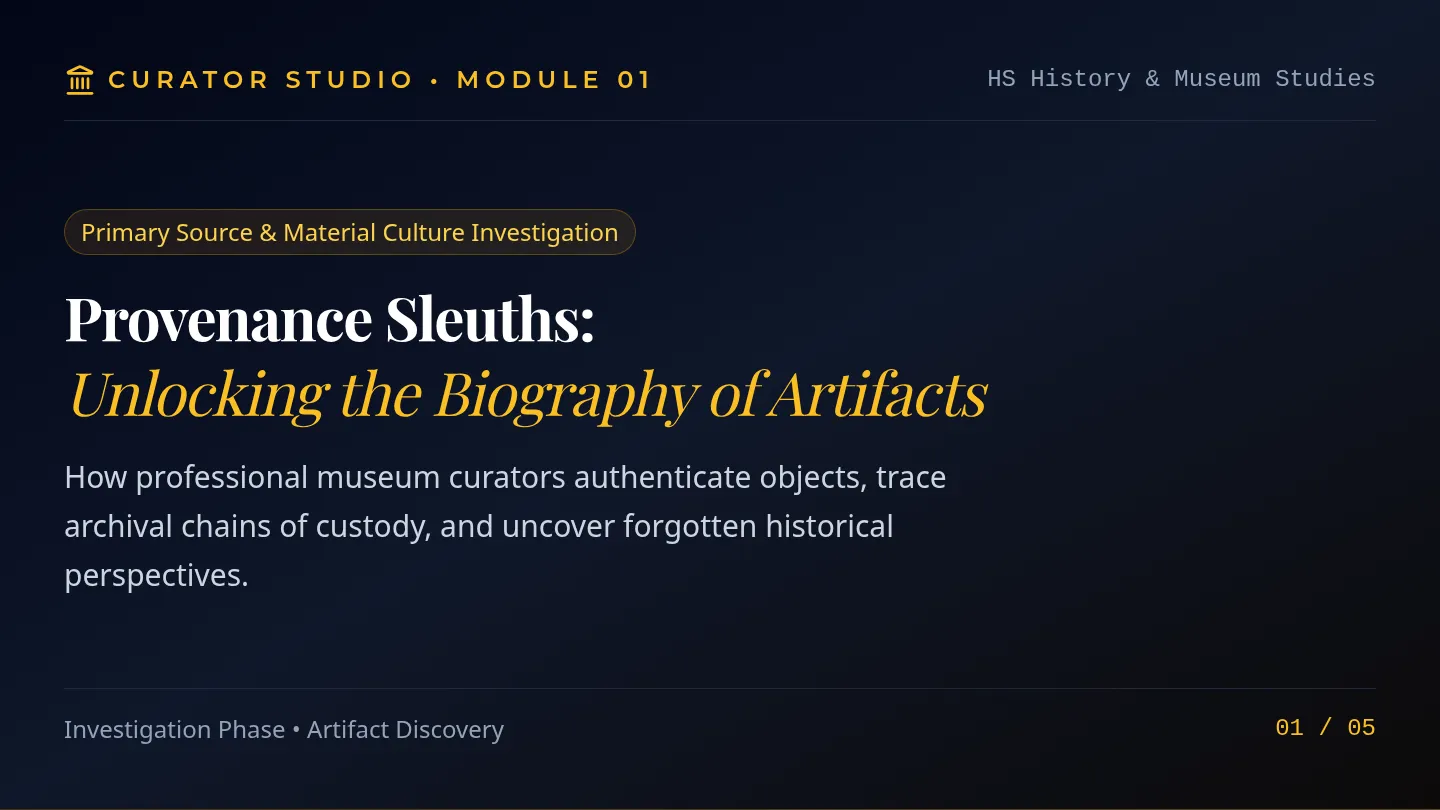
Spark to Venture Slides High School Entrepreneurship Masterclass
Module 1 • Ideation, Filtering & 6-Step Problem Solving
Spark to Venture
Great businesses don't start with random guesses—they start when you identify a real, painful problem, verify that people will pay for a fix, and systematically build a solution.
The Big Picture: Today you will align personal goals, brainstorm 3 ideas, filter them against 4 reality checks, and build a 6-step prototype launch plan.
Part 1 & 2: Sourcing
Personal Goals & 5 Idea Catalysts
Part 3: Opportunity Filter
Demand, Feasibility, Margin, Moat
Part 4 & 5: Execution
6-Step Model & 14-Day MVP Launch
Worksheet Part 1 In-Depth
Your Personal Compass: 4 Founder Goals
Why Personal Fit Matters
1. Money & Financial Targets
The Detail: Define your benchmark: side cash ($200/mo), college savings ($3,000/yr), or funding future tools.
Key: Earn enough profit per hour to justify your study time.
2. Lifestyle & Time Freedom
The Detail: Set realistic hours. Do you want remote flexibility (online) or set local hours (weekends)?
Key: Don't build a business that traps you in 40 hrs during finals.
3. Helping Others & Impact
The Detail: Mission-driven startups thrive: reducing campus waste, tutoring peers, or supporting community causes.
Key: Purpose keeps you motivated through early setbacks.
4. Leveraging Talents & Hobbies
The Detail: Use your unfair advantage: coding, art, gaming, cooking, video editing, or sports skills.
Key: Starting with existing talents cuts your learning curve to zero.
Worksheet Action: Complete the 4 Goal boxes in Part 1 on Page 1 before moving to brainstorming. Self-Alignment
Worksheet Part 2 In-Depth
5 Sources for Great Business Ideas
How Founders Mine Opportunities
01
Daily Friction
Things that waste time, cause stress, or require too many manual steps.
Explain: If 10 people complain about it weekly, there's a paying market.
02
Personal Skills
Tasks you find easy that others find frustrating or difficult.
Explain: Turn what friends ask you to help with into a structured service.
03
Market Gaps
Customer segments completely ignored by national chains.
Explain: Big brands ignore teens, neighborhood niches, and local clubs.
04
Tech & Trends
Riding new consumer habits like thrifting, AI tools, or healthy energy.
Explain: Don't invent the trend—build a service that helps people adopt it.
05
The Remix
Borrowing a business model from one industry and applying it to another.
Explain: "Subscription boxes for study snacks" or "Uber for lawn care".
Worksheet Action: In Part 2 , write 3 distinct concepts: Idea A (Friction), Idea B (Skill), and Idea C (Gap/Trend).
Worksheet Part 3 In-Depth
Opportunity Filter: 4 Reality Checks
The Scoring Formula
1. Real Demand (Urgency)
Score 1–5
The Detail: Are people actively searching for a fix, or is it a "nice to have"? If people don't lose sleep or money over the problem, demand is low.
Benchmark: 1 = Cool idea, zero buyers • 5 = Customers asking to prepay today!
2. Feasibility (Can You Build It?)
Score 1–5
The Detail: Can you launch this in 14 days with zero coding and under $50? If it requires $20,000 factory molds or legal permits, feasibility is low.
Benchmark: 1 = Needs huge venture capital • 5 = Can launch this Friday afternoon!
3. Profit Potential (Unit Margins)
Score 1–5
The Detail: Unit economics matter. If it costs you $18 to make and you sell it for $20, you make only $2 for an hour of work. Seek 60%+ margins.
Benchmark: 1 = Razor-thin profit • 5 = High margin service or digital product!
4. Your Edge (Defensibility)
Score 1–5
The Detail: What stops a bigger company from copying you? Your personal reputation, direct school connections, speed, or superior curation.
Benchmark: 1 = Easily duplicated by anyone • 5 = Unmatched local relationship edge!
Worksheet Action: Score all 3 ideas in Part 3 . The highest total score out of 20 becomes your project for Page 2! Total / 20
Worksheet Part 4 Framework
The 6-Step Problem-Solving Model
The Engineering of Startups
Step 1
Define the problem
State the exact friction without assuming any product features.
Focus on who hurts & when
Step 2
Gather Information
Collect real data: survey users, observe habits, probe root causes.
Facts replace founder guesses
Step 3
Identify various solutions
Brainstorm 3 diverse formats (digital, physical, or service).
Quantity leads to innovation
Step 4
Evaluate alternatives
Weigh options by cost, launch speed, and customer value.
Select the highest ROI path
Step 5
Take action
Build a fast Minimum Viable Product (MVP) to test live with users.
Test within 14 days
Step 6
Evaluate the action
Measure real metrics, gather user friction feedback, and iterate.
Close the feedback loop
Core Rule: Problem solving is a feedback loop! Step 6 data tells you whether to scale or adjust Steps 3 & 4.
Steps 1 & 2 In Action
4 Real Problem Ideas for High School Founders
Worksheet Page 2 • Top Row
Idea 1: The Dead Phone Crisis
Step 1 (Problem): Phones die by 6th period; zero accessible charging stations near lockers, gym, or bus stops.
Step 2 Data: 84% of 60 students surveyed missed rides, bus updates, or work schedules due to dead batteries.
Idea 2: The 20-Min Lunch Crunch
Step 1 (Problem): 1,100 students have 30-min lunch; standing in line takes 22 minutes, leaving only 8 minutes to eat.
Step 2 Data: 35% of students give up on hot cafeteria meals and buy vending machine chips just to avoid lines.
Idea 3: Overpriced Athletic Gear
Step 1 (Problem): Varsity cleats cost $150+, while seniors toss barely-used equipment in garbage bins every June.
Step 2 Data: 40 athlete families spend an average of $380/year on single-season sports equipment.
Idea 4: The 9 PM Homework Wall
Step 1 (Problem): Students get stuck on Chem & Math at night with nobody to ask and private tutors costing $35+/hr.
Step 2 Data: 78% study after 8 PM; 88% say commercial tutoring apps are unaffordable for high schoolers.
Worksheet Action: Choose one of these 4 scenarios, or write your own problem and evidence in Boxes 1 & 2 ! Select & Define
Steps 3 & 4 In Action
Brainstorm Solutions & Pick the Winner
Worksheet Page 2 • Middle Row
Step 3: Identify Various Solutions Box 3 on Page 2
The Detail: Never settle for your first idea. Force yourself to brainstorm 3 distinctly different formats for your chosen problem:
Format A (App): Custom mobile reservation app ($5,000+ to build).
Format B (Physical): Permanent hall kiosk (needs admin permits & rent).
Format C (Service): Direct peer-to-peer exchange or Discord ($0 cost).
Step 4: Evaluate Alternatives & Select Box 4 on Page 2
The Detail: Use a simple filter to choose the smartest option. Ask: "Which delivers maximum value with the lowest upfront build friction?"
Winning Rule of Thumb:
Choose the format you can build and test in under 7 days without asking for loan money or administrative red tape!
Worksheet Action: In Box 3 write your 3 formats; in Box 4 justify why your winning pick is fastest and cheapest.
Steps 5 & 6 In Action
Take Action (MVP) & Evaluate the Action
Worksheet Page 2 • Bottom Row
Step 5: Take Action (Build Your MVP) Box 5 on Page 2
The Detail: A Minimum Viable Product (MVP) is the simplest test version built to prove demand. Do not spend months building—launch a pilot in 14 days!
Concrete 3-Step Milestone Plan:
Create flyer or free Google Form; 2) Enlist 10 test users; 3) Run a 1-week pilot manually before automating.
Step 6: Evaluate the Action (Iterate) Box 6 on Page 2
The Detail: You need hard numbers, not compliments. "My friends said it's cool" is not validation. Track real usage, retention, and friction points.
Set a Concrete Metric & Pivot Trigger:
Target: 80% repeat weekly usage. Pivot Trigger: If users drop off after day 3, interview them to find where friction occurred!
Worksheet Action: In Box 5 write your 3 MVP milestones; in Box 6 write your validation metric and pivot trigger.
Worksheet Part 5 In-Depth
4 Ways to Sharpen Your Problem-Solving
Founder Mindset Habits
1. The "5 Whys" Root Cause Analysis
When an issue happens, ask "Why?" five consecutive times. Peels away surface excuses to reveal the real systemic flaw.
2. Reverse Brainstorming (Sabotage)
Ask: "How could we make this problem 100x worse?" Listing deliberate ways to fail reveals hidden vulnerabilities to prevent.
3. Customer Empathy Fieldwork
Leave your room. Shadow users in the lunch line or library. Listening to 5 real customers beats 50 hours of guessing.
4. Rapid Smoke-Test Prototyping
Create a one-page signup sheet or cardboard model in 24 hours. If nobody signs up for a free prototype, don't build the app!
Pick either The 5 Whys or Reverse Brainstorming to write your tool reflection in Part 5 !
Class Warm-Up Sprint
Sprint: The Campus Parking & Commute Jam
8-Minute Team Challenge
1. The Real Problem
By 7:45 AM, the student lot is totally jammed. Bike locks keep getting cut, and morning tardies jumped 30%, landing students in Friday detention.
The Pain: Stressed teens & detention slips!
2. The Hidden Cause
8 out of 10 student drivers drive alone with 3 empty seats! Students want to carpool, but there is no safe, easy way to find rides.
The Goldmine: Hundreds of empty car seats!
3. Your Team Mission
With your partner, brainstorm 3 different fixes. Pick the fastest, cheapest one and write a quick 60-second pitch to share with class!
Goal: 60-Second Venture Pitch
8-Min Sprint Timer: 6 Min to brainstorm 3 ideas • 2 Min to pick winner & prep pitch
Work in Pairs
Execution Phase
Venture Blueprint Complete Roadmap
Classroom Lab Mission
P1
Page 1: Ideation
• Part 1: Set your 4 founder targetsPart 2: Brainstorm 3 distinct ideasPart 3: Reality Check score /20
Select Your #1 Winning Venture
P2
Page 2: 6 Steps
• Steps 1–2: Problem & Data evidenceSteps 3–4: 3 Formats & winning pickSteps 5–6: 14-day MVP plan & metric
Build Your Concrete Test Plan
P3
Page 2: Reflection
• Part 5: 5 Whys or Reverse tool reviewGoal Check: Align with Part 1 goalsChecklist: Complete all 4 boxes
Teacher Sign-Off & Launch!
Work through each section on your Venture Blueprint Worksheet
Let's Build It!
Venture Blueprint Worksheet High School Entrepreneurship
Venture Blueprint Worksheet
Page 1 of 2
Ideation & Filter
Name:
Date:
Period:
1
Your Personal Goals (Slide 2)
Money Goal:
What is your financial target (savings, extra cash, college fund)?
Lifestyle Goal:
What work schedule or freedom do you want (e.g. 5 hrs/week)?
Helping Others:
What positive impact do you want to have on school or community?
Talents & Hobbies:
What skills (coding, art, gaming, cooking, sports) will you use?
2
Idea Radar: Brainstorm 3 Business Ideas (Slide 3)
Idea A (Daily Annoyance) Slow, broken, or annoying in daily life
Venture Name / Concept:
Who Needs It & Problem Solved:
Idea B (Personal Talent or Hobby) Something you're already good at or love
Venture Name / Concept:
Who Needs It & Problem Solved:
Idea C (Trend, Gap, or Remix) New trend, missing teen need, or remixed idea
Venture Name / Concept:
Who Needs It & Problem Solved:
3
Opportunity Filter: Score Your Ideas (Slide 4)
Rate 1 (Low) to 5 (High)
The 4 Reality Checks Idea A Idea B Idea C 1. Real Demand: Do people really want this and will they pay?
|
|
| 2. Doable: Can you realistically build this with your tools? |
|
|
|
| 3. Profit Potential: Can you charge more than it costs to make? |
|
|
|
| 4. Your Edge: What makes it special so copycats can't steal it? |
|
|
|
| Total Score (out of 20): |
|
|
|
My Winning Idea (Highest Score):
Action Plan
The 6-Step Problem-Solving Model
Page 2 of 2
Action Plan
Winning Business Idea:
Apply Steps 1–6 below
1 Define the problem (Slide 6)
Who has this problem, when does it happen, and why is it frustrating?
Venture Blueprint Teacher Guide Educator Toolkit Lesson Facilitation & Pedagogical Blueprint
VENTURE BLUEPRINT TEACHER GUIDE
Page 1 of 2
Instructional Roadmap
Target Level: High School / Intro College
Duration: 55–65 Minutes
Subject: Entrepreneurship / CTE
Modality: Direct Instruction + Workshop
Core Learning Objectives & Takeaways
1. Sourcing & Ideation
Students identify 5 distinct sources for business ideas (friction, skills, gaps, megatrends, remixing) and map them against personal ambitions.
2. Opportunity Filtering
Students differentiate between raw ideas and validated opportunities using market demand, feasibility, profitability, and competitive moat.
3. 6-Step Problem Solving
Students apply all 6 steps: Define problem, Gather Information, Identify solutions, Evaluate alternatives, Take action, and Evaluate the action.
Suggested Instructional Pacing Guide (60 Min)
Phase & Time Slide Alignment Teacher Actions & Student Experience Hook (7 min) Slides 1–2 (Personal Goals) Explore founder motivation. Have students record financial, lifestyle, social impact, and skill targets in Part 1 of the worksheet. Ideate (10 min) Slides 3–4 (5 Sources & Filter) Unpack the 5 idea catalysts and the Reality Check Filter. Students brainstorm 3 ideas (Friction, Skills, Trends) and complete Part 3 scoring. Model (15 min) Slides 5–8 (6-Step Venture Cases) Walk through the 6-step model using the QuickTutor case study: demonstrate defining the problem, customer interviews, solution variations, MVP action plan, and metrics. Sprint (10 min) Slides 9–10 (Toolkit & Challenge) Introduce 5 Whys and Reverse Brainstorming. Run the 8-minute pair sprint on "The Commute Crunch" with 60-second venture pitches. Lab & Wrap (18 min) Slide 11 (Venture Blueprint Lab) Students apply all 6 steps to their winning concept on Worksheet Page 2, complete the reflection, and conduct peer sign-offs.
Facilitation Prompts & Misconception Busting
Common Pitfall: Jumping to Step 3 (Solutions First)
Students fall in love with an app idea before gathering evidence on whether anyone suffers from the issue.
Teacher Probe: "What data or interview proof did you gather in Step 2 to prove this problem is urgent?"
Venture Spark Bell Ringer Daily Class Warm-Up 5–7 Minutes • Individual Starter
VENTURE SPARK BELL RINGER
Module 1 Warm-Up
Entrepreneurial Mindset
Name:
Date:
Period:
1
The 24-Hour Friction Hunt
Every complaint is a business opportunity
Think about the last 24 hours (getting ready, commuting, cafeteria, sports, or homework). Describe one thing that was slow, broken, or frustrating:
The Specific Headache / Problem:
What went wrong? When did it happen?
Who Else Struggles With This?
Who would gladly pay or use a better solution?
2
Match the Founder's Personal Goal
Draw a line or match the letters (A–D)
1. "I want to save $2,500 for a car this summer."
2. "I only want to work 6 hours a week from home."
3. "I want to eliminate single-use cafeteria trays."
4. "I love editing videos and want to get better at it."
A. Lifestyle & Schedule Autonomy
B. Financial Ambition & Earnings
C. Personal Talent & Passion Mastery
D. Helping Others & Social Impact
3
Reality Check: Idea vs. Opportunity
Critical Thinking
Mini-Case: Jordan wants to manufacture glow-in-the-dark mechanical pencils that sell for $22 each . Jordan loves how they look and thinks it's an amazing invention.
Is this just an "Idea" or a real "Opportunity"? Why?
What Reality Check (Demand, Price, Margin) fails most?
4
The 6-Step Problem-Solving Sequence
Write numbers 1 through 6 in logical order
Gather Info Collect facts
Take Action Launch MVP
Define Problem State pain point
Evaluate Action Review & iterate
Identify Solutions Brainstorm 3+
Evaluate & Select Pick best option
Why must you Gather Information (Step 2) before jumping to Solutions (Step 3)?
Warm-Up Complete: Ready for the Venture Blueprint Worksheet!
Teacher Check / Stamp:
Venture Spark Bell Ringer Key Teacher Resource • Master Key Classroom Warm-Up Evaluation Guide
VENTURE SPARK BELL RINGER • KEY
Scoring Guide
Answer Key & Exemplars
Estimated Time: 5–7 Minutes
Total Points: 10 Points (or Completion)
Core Focus: Mindset & 6-Step Order
1
Part 1: The 24-Hour Friction Hunt (Exemplar Answers)
2 Pts (Open-Ended)
Scoring Standard: Accept any authentic everyday annoyance that clearly identifies an actual friction point and a specific affected audience.
Exemplar Problem Statement:
"My phone battery dropped to 4% by 5th period. All hallway outlets are locked or occupied, so I couldn't text my mom for a ride after practice."
Exemplar Target Customer Group:
"All 450+ student athletes, club members, and bus riders who stay on campus until 6:00 PM without access to reliable power."
2
Part 2: Founder Goal Match (Exact Key)
4 Pts (1 Pt Each)
1. "Save $2,500 for a car this summer" B
2. "Only work 6 hours/week from home" A
3. "Eliminate single-use cafeteria trays" D
4. "Love video editing & want to master it" C
B = Financial Ambition: Clear monetary benchmark for personal savings.
A = Lifestyle Autonomy: Control over hours, location, and weekly schedule.
D = Helping Others: Mission-driven focus on school environmental health.
C = Talent & Passion: Turning personal creative hobby into domain craft.
3
Part 3: Reality Check: Jordan's $22 Glow Pencil Key
2 Pts
Idea vs. Opportunity Verdict:
It is just an "Idea", NOT a viable opportunity. Jordan is excited by the gimmick, but students already have adequate $1 pencils and light isn't a burning customer pain.
Failed Reality Checks (Demand & Price):
Fails Real Demand & Profit Potential: Teen customers will not spend $22 on a disposable school tool; the willingness to pay does not justify manufacturing costs.
4
Part 4: 6-Step Sequence & Reflection Key
2 Pts
2 Gather Info
5 Take Action
1 Define Problem
6 Evaluate Action
3 Identify Solutions
4 Evaluate & Select
Commute Crunch Sprint Activity Slide 10 Companion • Pair Workshop 8-Minute Timed Innovation Sprint
THE COMMUTE CRUNCH SPRINT
Pair Sprint Sheet
60-Second Venture Pitch
Partner 1:
Partner 2:
Period:
Sprint Role:
Case Briefing: The High School Commute Jam (Slide 10) The Real Problem
By 7:45 AM, the student lot is totally jammed. Bike locks keep getting cut, and morning tardies jumped 30%, landing students in Friday detention.
The Hidden Cause: 8 out of 10 student drivers drive alone with 3 empty seats.
The Opportunity: Students want to carpool, but lack a safe, easy way to coordinate.
1 Phase 1: Brainstorm 3 Different Fixes (5 Min) Aim for 3 completely different formats!
Option A (Mobile / Tech Hub):
Option B (Physical / School Space):
Option C (Service / Student Club):
2 Phase 2: Pick Your Winning Fix (2 Min) Fastest & Cheapest
Winning Chosen Concept:
Why this option wins (Cost, Speed, Safety):
3 Phase 3: The 60-Second Venture Pitch Script (1 Min) Ready to Pitch
1. The Hook (Pain): "Did you know that every morning on our campus..."
2. Our Fix: "That's why we created..."
3. How It Works: "Instead of driving solo, students simply..."
4. Call to Action: "Join our 14-day free pilot by..."
Peer Pitch Scorecard: Clear Problem (1–5) [___] Creative Fix (1–5) [___] Doable (1–5) [___] Total: ___ / 15
Teacher Stamp:
Venture Hackathon Group Activity Collaborative Lab • Teams of 3–4 Startup Studio Simulation
VENTURE HACKATHON GROUP CHALLENGE
Page 1 of 2
Team Strategy Deck
Startup Venture Team Name:
Period / Room:
1
Founder Team Roles (Assign 1 to Each Member)
Every founder has a core responsibility
CEO / Pitch Lead
Manages time & delivers final pitch:
Customer Insights Lead
Steps 1 & 2: Problem & user facts:
Product & MVP Lead
Steps 3 & 4: 3 Solution formats:
Finance & Metric Lead
Steps 5 & 6: Pricing & validation:
2
The Arena: Select 1 Campus Friction Challenge
Check 1 Box
Track A: The Dead Phone Crisis
84% of students lose phone battery by 6th period; zero safe charging outlets near lockers or athletic fields.
Track B: The 20-Min Lunch Crunch
1,100 students have 30 minutes for lunch; waiting in cafeteria lines takes 22 minutes, leaving 8 minutes to eat.
Track C: Overpriced Athletic Gear
Varsity cleats cost $150+, while graduating seniors throw away barely-used seasonal sports gear every June.
Track D: The 9 PM Homework Wall
Students get stuck on Chem & Math late at night with nobody to ask and private tutors charging $35+/hour.
3
Steps 1 & 2: Define Problem & Gather Information
Root-Cause Deep Dive
Step 1: The Team Problem Statement
Who specifically deals with this headache, when does it strike, and why does it hurt?
Step 2: Customer Evidence & 5 Whys
What real numbers, poll results, or root causes explain why this problem hasn't been fixed?
Team Goal Alignment: Does this venture target Financial earnings, Lifestyle freedom, or Social Impact most?
Execution & Shark Pitch Steps 3–6 & Live Investor Showcase
VENTURE BUILD & PITCH SHOWDOWN
Page 2 of 2
6-Step Execution
Chosen Challenge:
Apply Steps 3–6 below
4
Steps 3 & 4: 3 Solution Formats & Selected Winner
Divergent Brainstorming
Format A (Tech / App):
Format B (Physical Item / Space):
Format C (Hands-on Service / Club):
Step 4 Winner: Which format did your team select?
Why it wins (Cost, Speed, and Feasibility):
5
Steps 5 & 6: 14-Day MVP Action Plan & Metrics