Method Mastery Slides
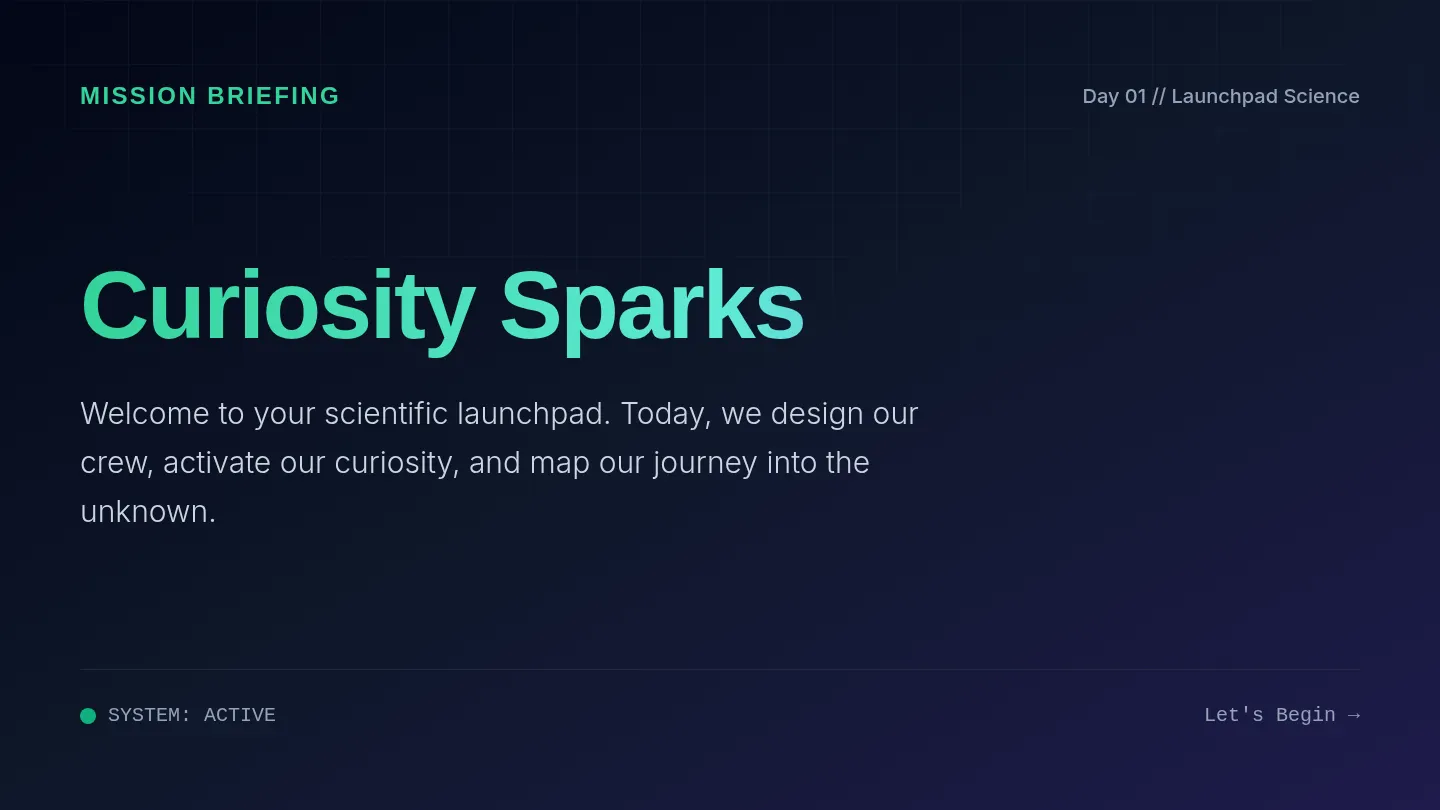
Inquiry Investigators
7th Grade Science
The Scientific Method
Mastering the six essential phases of scientific inquiry to unlock the mysteries of the natural world.
Ready to Explore
Slide 1 of 7
The Road Map
6 Steps of Inquiry
1
Question
Identify a specific problem or query to investigate.
2
Research
Gather background info on the topic.
3
Hypothesis
Form an educated testable prediction.
4
Plan & Conduct
Design experiment with procedures & materials.
5
Data
Observe, measure, and record results.
6
Conclusion
Analyze findings and accept/reject theory.
The standard framework for real-world scientific inquiry.
Slide 2 of 7
Phases 1 - 3
Initiating Investigation
1. Question
What do we want to solve?
Must be defined, open-ended but narrow, and highly measurable. Science starts with observation, leading to curiosity.
Example: "Does salt water affect how quickly seeds sprout?"
2. Research
What is already known?
Investigate past experiments, read reliable scientific studies, and consult experts. Don't waste time repeating known errors!
Example: Looking up plant cell salt tolerance in a biology database.
3. Hypothesis
The Educated Prediction
An "If..., then..." statement that directly predicts the outcome. It MUST be something you can physically test.
Example: "If seeds get saltwater, then they will take longer to sprout."
Tip: A hypothesis is not just a guess—it is based on your research!
Slide 3 of 7
Phases 4 - 6
Executing Investigation
4. Plan & Conduct
Procedures & Materials
Write down specific materials needed. List clear, step-by-step instructions so that anyone can repeat your test identically and safely.
Detailed list of supplies, constants, and clear controls.
5. Data/Results
Tracking Observations
Record facts, numbers, and physical measurements. Use organized tables, charts, or graphs to map raw details and detect patterns.
Qualitative vs Quantitative data collection.
6. Conclusion
The Final Judgment
Look back at the hypothesis. Do the data trends agree with or prove it wrong? Summarize errors and suggest next steps.
Science is circular; every conclusion spawns new questions!
Remember: A disproven hypothesis is still a highly successful experiment!
Slide 4 of 7
Visual Discovery
Video Case Study
Embedded media
The Method in Action
Watch carefully to see how real investigators progress through these exact six phases. Pay special attention to:
-
A
The Problem: How does the question prompt research?
-
B
Variables & Materials: How is the test planned and conducted?
-
C
Synthesis: What does the data tell the researcher?
Get ready for your Exit Ticket assignment based on this video.
Slide 5 of 7
Interactive Check
Concept Connection
Class Challenge: Match the Scenario to the Step!
Scenario A
"We gathered 10 organic bean seeds, 2 bags of loam soil, and wrote down 5 sequential steps to water them 50mL daily in direct sunlight."
Identify step: Plan & Conduct
Scenario B
"Because the plant heights were nearly identical in both soils, we rejected our initial guess that sandy loam would speed growth."
Identify step: Conclusion
Scenario C
"If bean plants are grown in sandier soils, then they will grow slower than plants grown in standard organic potting soil."
Identify step: Hypothesis
Review these carefully—similar questions appear on your worksheet!
Slide 6 of 7
Mission Briefing
Your Objective
Become an Inquiry Investigator!
You are now equipped with the ultimate template of human discovery. Pick up your student worksheet and let's prove your mastery of these 6 critical phases.
Step 1: Guided Worksheet
Vocabulary and step-ordering exercises.
Step 2: Video Exit Ticket
Post-video check & concept confirmation.
Let the investigation begin!
Slide 7 of 7
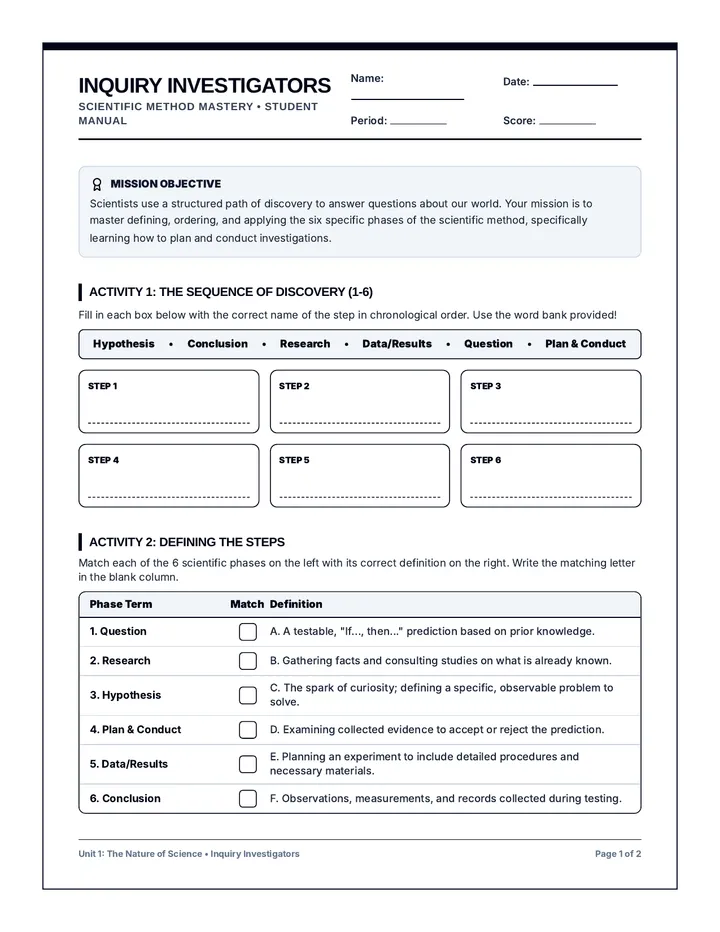
Method Mastery Worksheet
Inquiry Investigators
Scientific Method Mastery • Student Manual
Name:
Date:
Period:
Score:
MISSION OBJECTIVE
Scientists use a structured path of discovery to answer questions about our world. Your mission is to master defining, ordering, and applying the six specific phases of the scientific method, specifically learning how to plan and conduct investigations.
Activity 1: The Sequence of Discovery (1-6)
Fill in each box below with the correct name of the step in chronological order. Use the word bank provided!
Hypothesis • Conclusion • Research • Data/Results • Question • Plan & Conduct
Step 1
Step 2
Step 3
Step 4
Step 5
Step 6
Activity 2: Defining the Steps
Match each of the 6 scientific phases on the left with its correct definition on the right. Write the matching letter in the blank column.
Phase Term
Match
Definition
1. Question
A. A testable, "If..., then..." prediction based on prior knowledge.
2. Research
B. Gathering facts and consulting studies on what is already known.
3. Hypothesis
C. The spark of curiosity; defining a specific, observable problem to solve.
4. Plan & Conduct
D. Examining collected evidence to accept or reject the prediction.
5. Data/Results
E. Planning an experiment to include detailed procedures and necessary materials.
6. Conclusion
F. Observations, measurements, and records collected during testing.
Unit 1: The Nature of Science • Inquiry Investigators
Page 1 of 2
Applied Investigations
Method Mastery Workbook • Page 2
Activity 3: Real-World Scenario Analysis
Read each classroom experiment story below. Identify which of the 6 Scientific Method steps is described and write it in the blank column.
Word Bank: Question, Research, Hypothesis, Plan & Conduct, Data/Results, Conclusion
Scenario A
Elena notices that her locker door squeaks loudly, leading her to wonder: "Will spraying cooking oil on the hinges silence the noise?"
Scientific Step
Scenario B
Maya reads two scientific journal articles about soil chemistry to understand how nitrates boost seed germination rates before starting her own tests.
Scientific Step
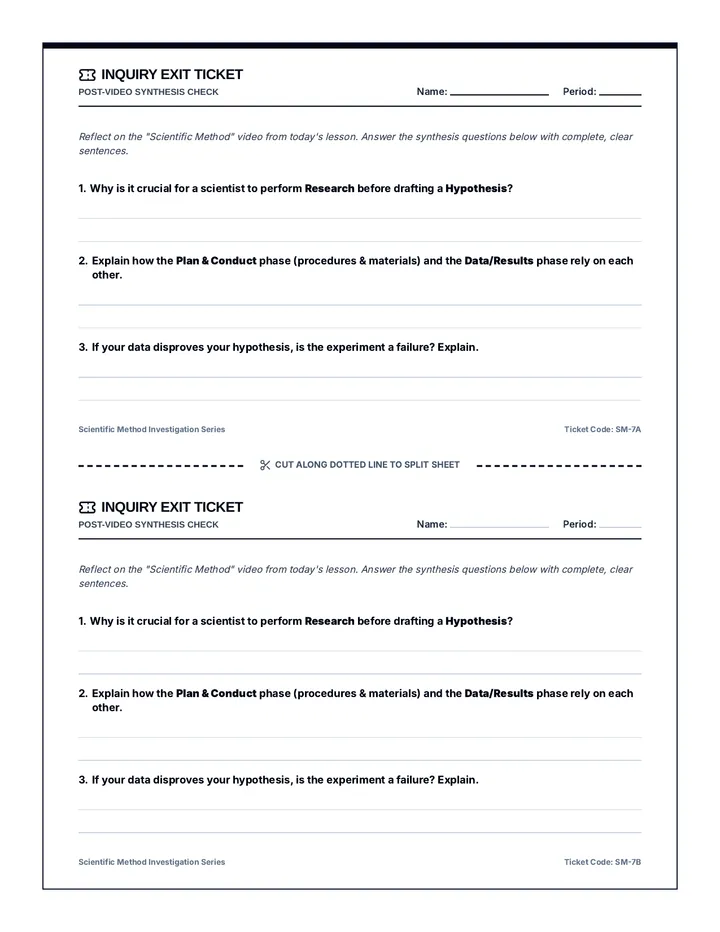
Method Mastery Exit Ticket
Inquiry Exit Ticket
Post-Video Synthesis Check
Name:
Period:
Reflect on the "Scientific Method" video from today's lesson. Answer the synthesis questions below with complete, clear sentences.
-
Why is it crucial for a scientist to perform Research before drafting a Hypothesis?
-
Explain how the Plan & Conduct phase (procedures & materials) and the Data/Results phase rely on each other.
-
If your data disproves your hypothesis, is the experiment a failure? Explain.
Scientific Method Investigation Series Ticket Code: SM-7A
CUT ALONG DOTTED LINE TO SPLIT SHEET
Inquiry Exit Ticket
Post-Video Synthesis Check
Name:
Period:
Reflect on the "Scientific Method" video from today's lesson. Answer the synthesis questions below with complete, clear sentences.
-
Why is it crucial for a scientist to perform Research before drafting a Hypothesis?
-
Explain how the Plan & Conduct phase (procedures & materials) and the Data/Results phase rely on each other.
-
If your data disproves your hypothesis, is the experiment a failure? Explain.
Scientific Method Investigation Series Ticket Code: SM-7B