Plasma Paradox CER Worksheet
Level A • Scaffolded Support
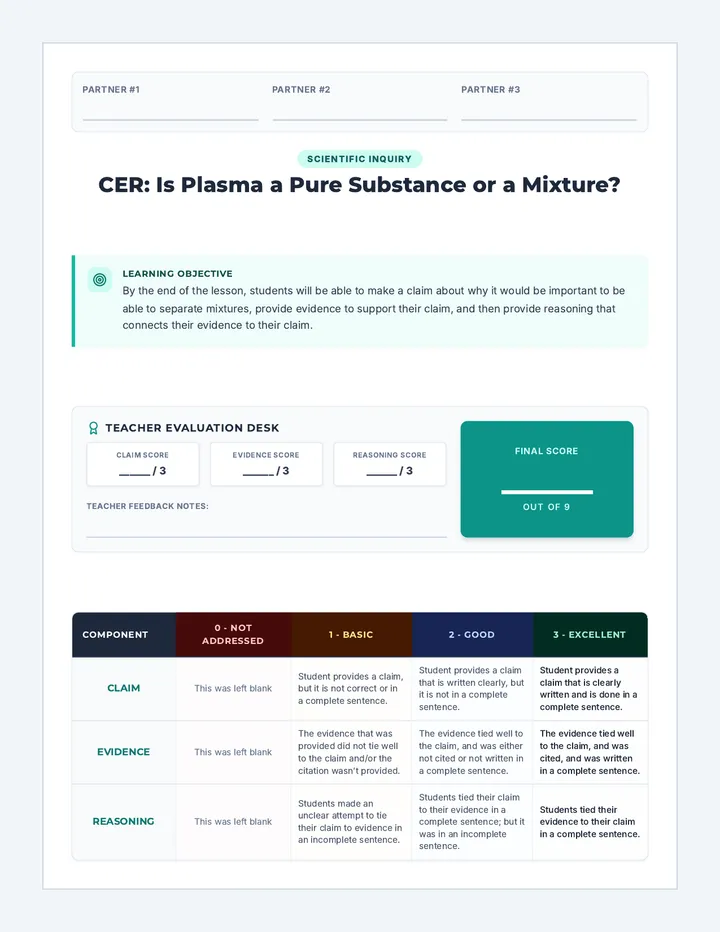
The Plasma Paradox CER
Name: Date: Period:
Guiding Question
Is blood plasma classified as a pure substance or a mixture?
Clinical Lab Report: Physical Properties Data (NGSS PS1.A) ID: PS1.A-HEMA
| Tested Material | Composition Details | Boiling Point Property | Density Property |
|---|
| Pure Water | 100% H₂O molecules. | | |
| Cannot be separated physically. | Exactly 100°C | | |
| (Constant/Unchanging) | 1.00 g/mL | | |
| (Constant/Unchanging) | | | |
| Blood Plasma | 90% water, 10% dissolved parts (salts, glucose, proteins). | | |
| Can be physically separated. | 101°C to 102°C | | |
| (Varies with donor hydration) | 1.025 to 1.029 g/mL | | |
| (Varies with protein levels) | | | |
Step 1: Write Your Claim
Circle or highlight the correct choice to complete the scientific claim.
Based on physical properties data, blood plasma is classified as a [ pure substance / mixture ] .
Step 2: Provide Your Evidence Word Bank Included
Complete the sentences using data from the lab table above.
• separated • dissolved • boiling point • density
Evidence A: Unlike pure water, blood plasma can be physically ________________ by evaporation to leave behind yellow ________________ solute particles.
Evidence B: While water's boiling point is constant, plasma's ________________ (101°C-102°C) and ________________ (1.025-1.029 g/mL) are not constant.
Step 3: State Your Reasoning
Explain the scientific science rules connecting your evidence to standard PS1.A.
According to standard PS1.A, a pure substance has characteristic physical properties that never change, while a mixture has properties that can change and can be physically separated.
Therefore, because blood plasma's physical properties can [ change / stay constant ] and it can be physically separated, plasma must be a [ pure substance / mixture ].
HEMATOLOGY LAB SCIENCE • UNIT 3: MIXTURES & SOLUTIONS Page 1 • Level A
Level B • Guided Support
The Plasma Paradox CER
Name: Date: Period:
Guiding Question
Is blood plasma classified as a pure substance or a mixture?
Clinical Lab Report: Physical Properties Data (NGSS PS1.A) ID: PS1.A-HEMA
| Tested Material | Composition Details | Boiling Point Property | Density Property |
|---|
| Pure Water | 100% H₂O molecules. | | |
| Cannot be separated physically. | Exactly 100°C | | |
| (Constant/Unchanging) | 1.00 g/mL | | |
| (Constant/Unchanging) | | | |
| Blood Plasma | 90% water, 10% dissolved parts (salts, glucose, proteins). | | |
| Can be physically separated. | 101°C to 102°C | | |
| (Varies with donor hydration) | 1.025 to 1.029 g/mL | | |
| (Varies with protein levels) | | | |
Step 1: Write Your Claim
State your claim clearly in one complete sentence answering the guiding question.
Step 2: Provide Your Evidence
Cite specific data values from the clinical properties table above.
A. Describe the separation properties of blood plasma vs. pure water:
B. Cite the boiling point and density values of both materials to show differences:
Step 3: State Your Reasoning
Explain the science rule (standard PS1.A) connecting your evidence to your claim.
Focus: Why do changing physical properties mean a substance is a mixture and not a pure substance?
HEMATOLOGY LAB SCIENCE • UNIT 3: MIXTURES & SOLUTIONS Page 2 • Level B
Level C • Independent & Extension
The Plasma Paradox CER
Name: Date: Period:
Guiding Question
Is blood plasma classified as a pure substance or a mixture?
Clinical Lab Report: Physical Properties Data (NGSS PS1.A) ID: PS1.A-HEMA
| Tested Material | Composition Details | Boiling Point Property | Density Property |
|---|
| Pure Water | 100% H₂O molecules. | | |
| Cannot be separated physically. | Exactly 100°C | | |
| (Constant) | 1.00 g/mL | | |
| (Constant) | | | |
| Blood Plasma | 90% water, 10% dissolved parts (salts, glucose, proteins). | | |
| Can be physically separated. | 101°C to 102°C | | |
| (Varies with donor hydration) | 1.025 to 1.029 g/mL | | |
| (Varies with protein levels) | | | |
Step 1: Write Your Claim
Steps 2 & 3: Evidence & Reasoning Argument
Composition BP/Density PS1.A Rule
Write a scientific argument paragraph. State clear evidence from the data, then explain the science rules of standard PS1.A that support your claim.
Clinical Practice Dilemma (Dehydration Assessment)
A dehydrated patient's plasma contains less water relative to solutes. How will this affect its physical properties (density and boiling point)? Explain how this property change supports your mixture classification.
HEMATOLOGY LAB SCIENCE • UNIT 3: MIXTURES & SOLUTIONS Page 3 • Level C
Plasma Paradox Slides
HEMATOLOGY LAB • INVESTIGATION 03 NGSS PS1.A
Lab Inquiry Challenge
The Plasma Paradox
Is the liquid carrier of life a pure chemical substance or a complex mixture? Let's use physical properties to crack the code.
Clinical Laboratory & Biochemistry Unit
Slide 1 of 5
Scientific Principle NGSS PS1.A
Characteristic Properties
According to standard PS1.A, every pure substance has a unique signature of physical and chemical properties that remains exactly the same under any condition.
These properties—like density, boiling point, and composition—can be used to identify substances and distinguish them from mixtures.
Pure Substances
Made of only one type of particle (atoms or molecules). Properties like boiling point and density are **always constant**. Cannot be physically separated.
Mixtures (Solutions)
Physical combinations of different substances. Properties can **vary** based on concentration and hydration. Can be physically separated.
Class Discussion: Can physical properties reveal a substance's identity? Slide 2 of 5
Lab Experiment Property 1: Separability
The Physical Separation Test
Can Plasma Be Separated?
If you heat pure water, it boils, evaporates completely, and leaves **nothing** behind in the beaker.
If you heat blood plasma, the water solvent boils away, but leaves behind a **crust of yellow powder** containing salts, glucose, and proteins.
Results of Thermal Evaporation
Pure Water Test
Evaporates completely
0% Residue Left
Blood Plasma Test
Water boils off, yellow crust remains
10% Solute Residue
Class Question: Does physical separation point to a pure substance or a mixture? Slide 3 of 5
Scientific Evidence Physical Properties Lab Table
Analyzing Lab Constants
| Tested Substance | Composition Details | Boiling Point | Density Property |
|---|
| Pure Water | 100% Water molecules | | |
| No physical separation possible | Exactly 100°C | | |
| Characteristic constant | 1.00 g/mL | | |
| Characteristic constant | | | |
| Blood Plasma |
Plasma Paradox Teacher Key
Teacher Reference Resource
Plasma Paradox Teacher Key & Rubric
DOC ID: PS1.A-KEY-2026
NGSS Alignment (PS1.A): Bulk quantities of a pure substance exhibit constant physical and chemical properties that identify them. Homogeneous mixtures (solutions) exhibit physical properties that change with solute levels and can be separated through physical means (evaporation, density settling).
Exemplar Answers & Key
Level A (Scaffolded) Answers
- Claim: mixture
- Evidence: (1) separated, (2) dissolved, (3) boiling point, (4) density
- Reasoning: Choice 1: change | Choice 2: mixture
Level B (Guided) Expectations
Claim: Blood plasma is a mixture because it contains multiple components that can be physically separated.
Evidence: Cite data: pure water has no residue and constant boiling point (100°C) / density (1.00 g/mL), while plasma leaves a yellow crust, boils in a range (101°C-102°C), and has variable density (1.025-1.029 g/mL).
Reasoning: Pure substances are locked and have unchanging properties. Since plasma's properties vary based on hydration and can be physically separated, it must be a mixture.
Level C (Independent) & Extension Key
Dehydration Dilemma Answer: A dehydrated patient's plasma contains less water relative to solutes, which increases solute concentration. This will increase density (towards/beyond 1.029 g/mL) and elevate the boiling point range. Since these characteristic physical properties alter depending on hydration state, it proves plasma is a mixture under PS1.A, as a pure substance has static properties that never vary with health states.
3-Point CER Diagnostic Rubric
| Element | 3 - Advanced | 2 - Proficient | 1 - Developing |
|---|
| Claim | Accurately identifies mixture with precise, complete chemical terminology. | Identifies mixture clearly. | Claim is vague or partially incorrect. |
| Evidence | Cites all relevant properties (bp, density, separability) with exact values. | Cites most properties and includes specific numeric values. | Mentions properties generally without numeric data. |
| Reasoning | Articulately links variable properties and separation to PS1.A standard. |