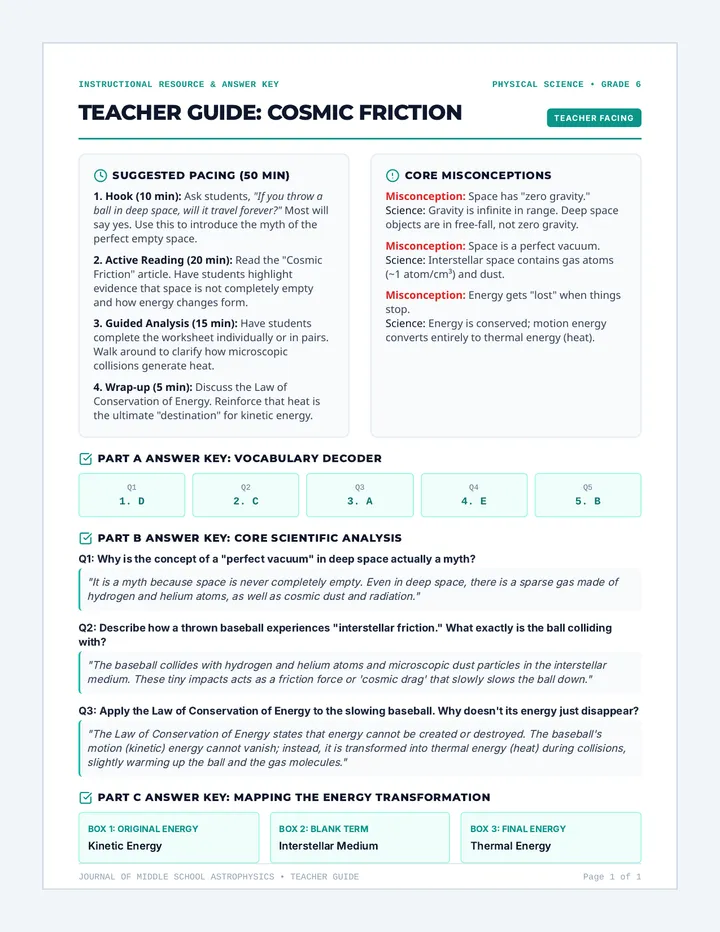
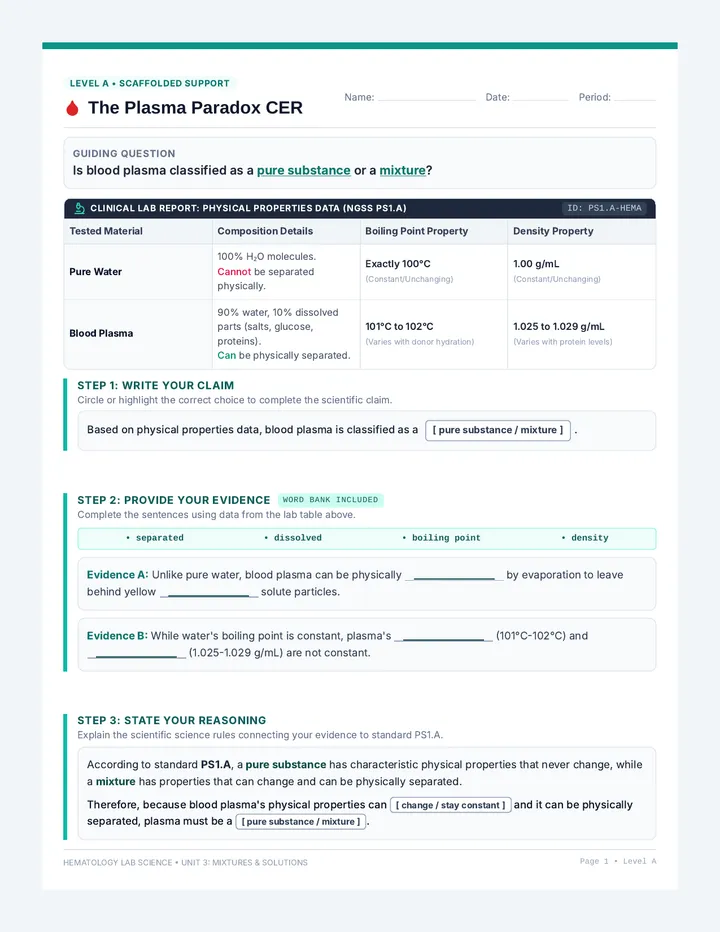
Substance Observation Table (Accept ranges within +/- 3 degrees)
| Substance | Solid Temp Range (ºC) | Liquid Temp Range (ºC) | Gas Temp Range (ºC) |
|---|---|---|---|
| Neon | Below -249 ºC | -248 ºC to -246 ºC | Above -245 ºC |
| Argon | Below -189 ºC | -189 ºC to -186 ºC | Above -185 ºC |
| Oxygen (O₂) | Below -218 ºC | -218 ºC to -183 ºC | Above -183 ºC |
| Water (H₂O) | Below 0 ºC | 0 ºC to 100 ºC | Above 100 ºC |
Analysis Questions
1. Describe what happens to the spacing and speed of particles when you heat a substance. What role does kinetic energy play?
Heating adds thermal energy, which increases the average kinetic energy of the molecules. This causes the speed of the particles to increase, making them collide more forcefully and separate further, increasing their overall spacing.
2. Notice the molecular structure of water solid (ice) compared to neon or argon solid. What makes ice's shape and spacing unique?
Water molecules form a hexagonal crystalline structure with large open spaces in between them when frozen. This is due to intermolecular hydrogen bonding. In contrast, neon and argon solids form tightly packed atomic structures with minimal spacing.
3. During heating, did the temperature stay perfectly flat at any point while a state changed? Explain what you observed.
Yes. During phase transitions (e.g., water melting at exactly 0 ºC or boiling at 100 ºC), the temperature pause/remains flat on the scale because thermal energy is used to break intermolecular hydrogen bonds, rather than increasing molecular kinetic energy.
Unit: States & Matter Interactions Page 2 of 4
Chemistry & Physics Laboratory Part 3 Answer Key
Part 3: Phase Change Vocabulary Diagram
State transitions involve the addition or removal of thermal energy. Label the following diagram by writing the correct phase change terms (Melting, Freezing, Vaporization, Condensation) next to the corresponding letters.
SOLID
A. Melting
B. Freezing
LIQUID
C. Vaporization
D. Condensation
GAS
Thermodynamics of Transitions
For each phase change below, identify the direction of the change (e.g., solid to liquid) and state whether thermal energy is Added to the substance or Removed from it.
| Phase Change Term | Direction of Change | Thermal Energy (Added / Removed) |
|---|---|---|
| Melting | Solid → Liquid | Added (Endothermic) |
| Freezing | Liquid → Solid | Removed (Exothermic) |
| Vaporization | Liquid → Gas | Added (Endothermic) |
| Condensation | Gas → Liquid | Removed (Exothermic) |
Unit: States & Matter Interactions Page 3 of 4
Chemistry & Physics Laboratory Part 4 Answer Key
Scientific Question: How does the addition of thermal energy affect the velocity, arrangement, and attractive forces of water molecules?
Claim
Write a clear, direct, one-sentence answer. Avoid using personal pronouns (e.g. "I think").
Evidence
State specific data from PhET (approximate Celsius temperatures, spacing, and speed).
Reasoning
Apply the Kinetic Theory of Matter to explain why your evidence logically supports your claim.
1. Scientific Claim
Adding thermal energy directly increases the kinetic energy and velocity of water molecules, which causes them to slide randomly as a liquid, separate widely as a gas, and break the rigid intermolecular attractions of their solid crystal lattice.
2. Scientific Evidence
In the PhET simulator: Solid ice at -127 ºC has particles trapped in a widely spaced hexagonal structure vibrating slowly. When heated past 0 ºC, the rigid shape collapses, molecules move closer together and tumble over one another. At temperatures above 100 ºC, the molecules break free completely, speeding rapidly and randomly to fill the container.
3. Scientific Reasoning
Under Kinetic Molecular Theory, thermal energy represents the microscopic kinetic motion of matter. Adding heat directly increases average particle speed. Once molecular velocity is high enough, the particles gain sufficient energy to overcome the intermolecular hydrogen bonds holding them together. This transitions water from solid vibration, to liquid translation, and finally to rapid free gaseous motion.
Unit: States & Matter Interactions Page 4 of 4