Cosmic Friction Article and Questions
The Astrophysical Frontier for Young Minds Volume 14, Issue 3 • August 2026
Cosmic Friction
Peer-Reviewed Article
Exploring the Reality of Motion, Energy, and Vacuums in Deep Space
Lead Scientist: Dr. Evelyn Vance, Department of Astrophysics, Deep Space Research Institute
Abstract
It is a common misconception that outer space is a completely empty void with absolute zero gravity and zero matter. In this paper, we explore the physical reality of deep space by tracing the theoretical journey of a baseball thrown in interstellar space. Our scientific models prove that because space contains a sparse population of gas atoms and dust particles, a moving object experiences continuous microscopic collisions. In accordance with the Law of Conservation of Energy, the baseball’s kinetic energy gradually transforms into thermal energy, eventually bringing the object to a complete halt relative to the surrounding medium. This demonstrates that energy in our universe is never lost, only changed.
1. The Myth of Empty Space
When we think of outer space, we picture a silent, dark vacuum—a place where nothing exists. Many believe that if you throw a ball in space, it will fly forever in a straight line at the same speed. However, astrophysics reveals that a perfect vacuum does not exist anywhere in the universe.
Even in the deepest space between galaxies, there is a sparse gas known as the interstellar medium. This medium is a thin "soup" made mostly of hydrogen and helium atoms, cosmic dust, and electromagnetic radiation. On average, there is about one atom of gas in every cubic centimeter of deep space. While this is incredibly thin compared to Earth’s atmosphere, it is far from empty.
2. Gravity is Everywhere
Furthermore, there is no such thing as a "zero-gravity zone." Gravity is an attractive force that has an infinite range. Every star, planet, black hole, and atom in the universe pulls on every other object. While gravity becomes extremely weak over massive distances, it never truly drops to zero. A ball floating in space is always being gently pulled by billions of cosmic bodies.
3. Microscopic Collisions
Let us trace a baseball moving at 100 miles per hour through deep space. As the baseball travels, it does not move through nothingness. Instead, it collides with those tiny hydrogen atoms and microscopic dust particles.
Each individual collision is unimaginably small, but they add up. These tiny impacts act as a microscopic form of air resistance, which scientists call cosmic drag or interstellar friction. Every time the ball hits a gas atom, the atom bounces off, gaining a tiny bit of speed, while the baseball loses a microscopic fraction of its speed.
4. The Great Energy Swap
What happens to the baseball's motion? Here, we must look to the Law of Conservation of Energy, which states that energy cannot be created or destroyed, only changed from one form to another.
The baseball's motion energy (known as kinetic energy) cannot simply vanish. Instead, the friction from these atomic collisions converts the kinetic energy into thermal energy (heat). The microscopic collisions slightly warm up the baseball and the surrounding gas particles. Over immense spans of time and distance, this "cosmic friction" will transfer all the baseball's kinetic energy into heat, bringing the baseball to a complete stop relative to the gas around it.
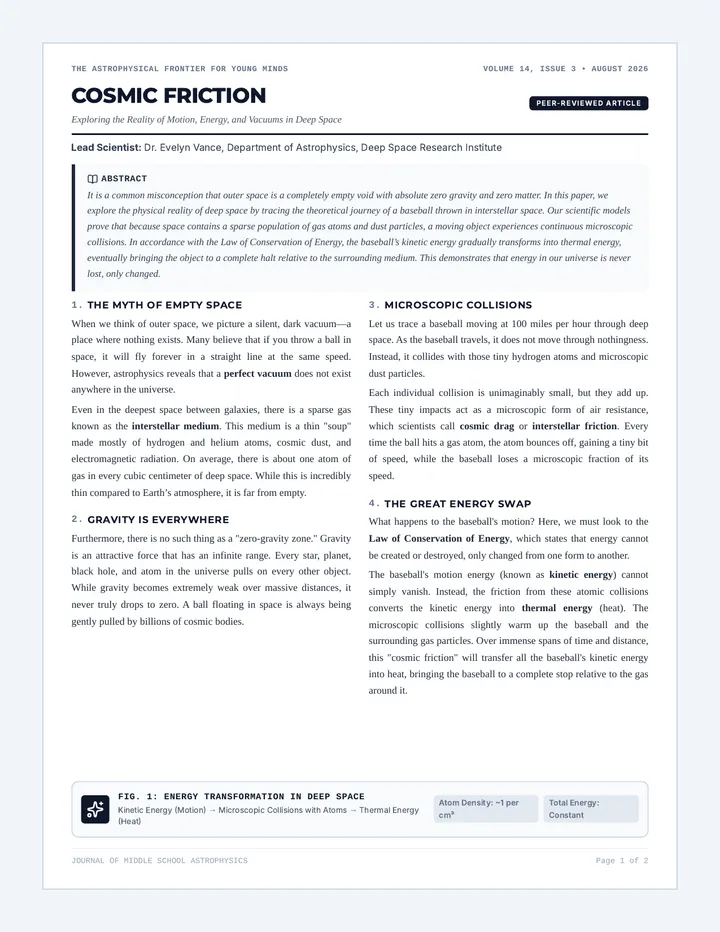
Fig. 1: Energy Transformation in Deep Space
Kinetic Energy (Motion) → Microscopic Collisions with Atoms → Thermal Energy (Heat)
Atom Density: ~1 per cm³ Total Energy: Constant
JOURNAL OF MIDDLE SCHOOL ASTROPHYSICS Page 1 of 2
Cosmic Friction Worksheet
Reading Comprehension & Scientific Analysis
Astro-Physics Lab
Student Name:
Date:
Class Period:
Part A: Vocabulary Decoder
Write the letter of the correct definition next to each term.
1. Interstellar Medium
A. The energy an object has due to its motion.
2. Perfect Vacuum
B. The scientific rule that energy cannot be created or destroyed.
3. Kinetic Energy
C. A theoretical space that contains absolutely zero matter or particles.
4. Thermal Energy
E. Internal energy created by atomic motion, commonly felt as heat.
5. Conservation of Energy
D. The thin soup of gas atoms and dust particles scattered in deep space.
Part B: Core Scientific Analysis
Answer the following questions in complete sentences based on the journal article.
1. Why is the concept of a "perfect vacuum" in deep space actually a myth? Name two things found in interstellar space.
2. Describe how a thrown baseball experiences "interstellar friction." What exactly is the ball colliding with?
3. Apply the Law of Conservation of Energy to the slowing baseball. Why doesn't its energy just disappear?
Part C: Mapping the Energy Transformation
Fill in the boxes below to map how a baseball's energy changes as it travels through outer space.
1. Original State Baseball in Motion
Energy: ________________
2. Collision Event Colliding with atoms of the ___________
Causes cosmic friction
3. Final State Baseball Comes to Stop
Energy: ________________
JOURNAL OF MIDDLE SCHOOL ASTROPHYSICS Page 2 of 2
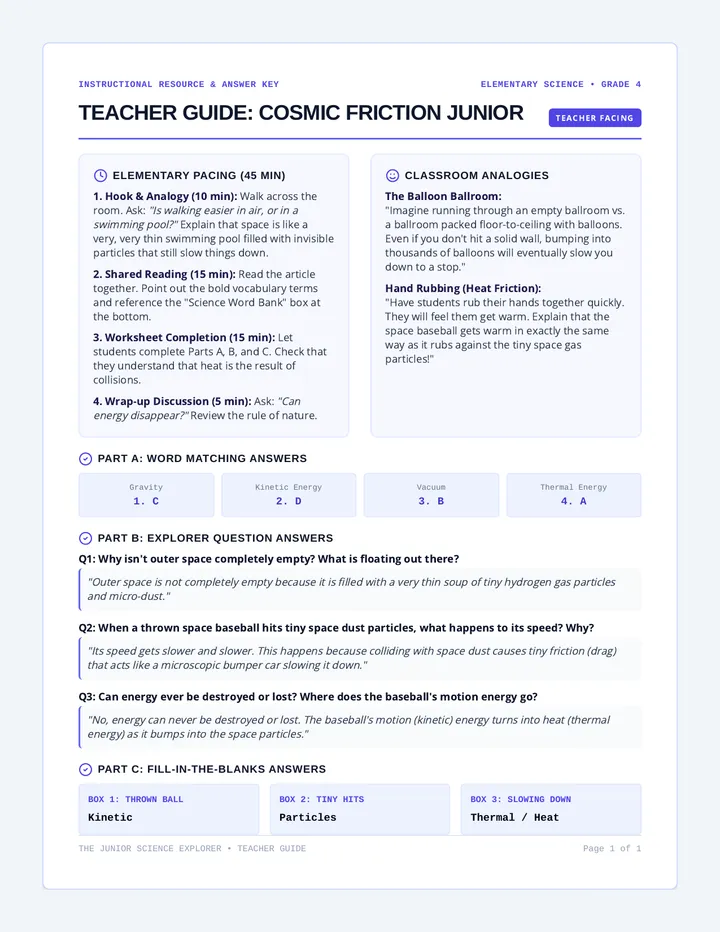
Cosmic Friction Teacher Guide
Instructional Resource & Answer Key Physical Science • Grade 6
Teacher Guide: Cosmic Friction
Teacher Facing
Suggested Pacing (50 Min)
- 1. Hook (10 min): Ask students, "If you throw a ball in deep space, will it travel forever?" Most will say yes. Use this to introduce the myth of the perfect empty space.
- 2. Active Reading (20 min): Read the "Cosmic Friction" article. Have students highlight evidence that space is not completely empty and how energy changes form.
- 3. Guided Analysis (15 min): Have students complete the worksheet individually or in pairs. Walk around to clarify how microscopic collisions generate heat.
- 4. Wrap-up (5 min): Discuss the Law of Conservation of Energy. Reinforce that heat is the ultimate "destination" for kinetic energy.
Core Misconceptions
- Misconception: Space has "zero gravity."
Science: Gravity is infinite in range. Deep space objects are in free-fall, not zero gravity.
- Misconception: Space is a perfect vacuum.
Science: Interstellar space contains gas atoms (~1 atom/cm³) and dust.
- Misconception: Energy gets "lost" when things stop.
Science: Energy is conserved; motion energy converts entirely to thermal energy (heat).
Part A Answer Key: Vocabulary Decoder
Q1 1. D
Q2 2. C
Q3 3. A
Q4 4. E
Q5 5. B
Part B Answer Key: Core Scientific Analysis
Q1: Why is the concept of a "perfect vacuum" in deep space actually a myth?
"It is a myth because space is never completely empty. Even in deep space, there is a sparse gas made of hydrogen and helium atoms, as well as cosmic dust and radiation."
Q2: Describe how a thrown baseball experiences "interstellar friction." What exactly is the ball colliding with?
"The baseball collides with hydrogen and helium atoms and microscopic dust particles in the interstellar medium. These tiny impacts acts as a friction force or 'cosmic drag' that slowly slows the ball down."
Q3: Apply the Law of Conservation of Energy to the slowing baseball. Why doesn't its energy just disappear?
"The Law of Conservation of Energy states that energy cannot be created or destroyed. The baseball's motion (kinetic) energy cannot vanish; instead, it is transformed into thermal energy (heat) during collisions, slightly warming up the ball and the gas molecules."
Part C Answer Key: Mapping the Energy Transformation
Box 1: Original Energy
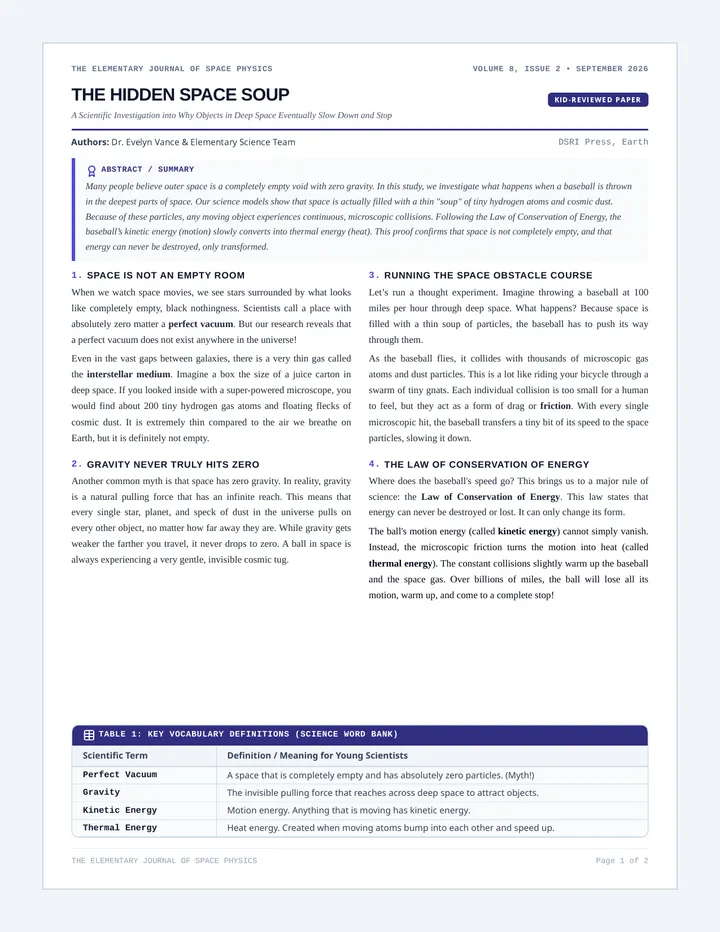
Cosmic Friction Junior Article and Questions
The Elementary Journal of Space Physics Volume 8, Issue 2 • September 2026
The Hidden Space Soup
Kid-Reviewed Paper
A Scientific Investigation into Why Objects in Deep Space Eventually Slow Down and Stop
Authors: Dr. Evelyn Vance & Elementary Science Team DSRI Press, Earth
Abstract / Summary
Many people believe outer space is a completely empty void with zero gravity. In this study, we investigate what happens when a baseball is thrown in the deepest parts of space. Our science models show that space is actually filled with a thin "soup" of tiny hydrogen atoms and cosmic dust. Because of these particles, any moving object experiences continuous, microscopic collisions. Following the Law of Conservation of Energy, the baseball’s kinetic energy (motion) slowly converts into thermal energy (heat). This proof confirms that space is not completely empty, and that energy can never be destroyed, only transformed.
1. Space is Not an Empty Room
When we watch space movies, we see stars surrounded by what looks like completely empty, black nothingness. Scientists call a place with absolutely zero matter a perfect vacuum. But our research reveals that a perfect vacuum does not exist anywhere in the universe!
Even in the vast gaps between galaxies, there is a very thin gas called the interstellar medium. Imagine a box the size of a juice carton in deep space. If you looked inside with a super-powered microscope, you would find about 200 tiny hydrogen gas atoms and floating flecks of cosmic dust. It is extremely thin compared to the air we breathe on Earth, but it is definitely not empty.
2. Gravity Never Truly Hits Zero
Another common myth is that space has zero gravity. In reality, gravity is a natural pulling force that has an infinite reach. This means that every single star, planet, and speck of dust in the universe pulls on every other object, no matter how far away they are. While gravity gets weaker the farther you travel, it never drops to zero. A ball in space is always experiencing a very gentle, invisible cosmic tug.
3. Running the Space Obstacle Course
Let’s run a thought experiment. Imagine throwing a baseball at 100 miles per hour through deep space. What happens? Because space is filled with a thin soup of particles, the baseball has to push its way through them.
As the baseball flies, it collides with thousands of microscopic gas atoms and dust particles. This is a lot like riding your bicycle through a swarm of tiny gnats. Each individual collision is too small for a human to feel, but they act as a form of drag or friction. With every single microscopic hit, the baseball transfers a tiny bit of its speed to the space particles, slowing it down.