Particle Playgrounds Teacher Guide Instructional Blueprint
Particle Playgrounds Teacher Guide
Hands-On States of Matter for Special Education (Grade 10)
SpEd Chemistry
Lesson Pacing
50-60 Minutes Total
Self-paced modeling segment
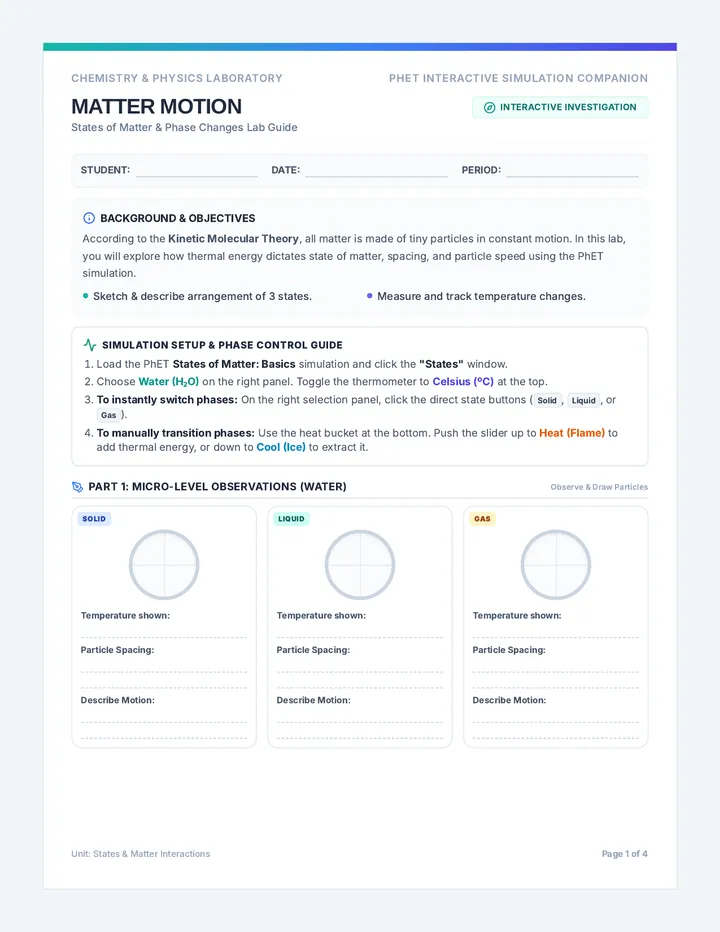
Core Concept
Kinetic Molecular Theory
Macro-to-micro connections
Materials Needed
Fruit Loops or Pom-Poms
Glue, markers, activity sheets
Lesson Flow & Steps
1
Warm-Up: Zoom in on Water (8 min)
Project the slide showing liquid water, ice, and steam. Ask students to describe how water changes without changing its identity. Guide them to focus on movement.
2
Visual Anchor Chart Setup (12 min)
Complete the Graphic Organizer. Color-code each state: Teal for Solid , Emerald for Liquid , and Violet for Gas . Act out particle movements using hands.
3
Tactile Model Creation (15 min)
Students use physical circular items (fruit loops, buttons, or pom-poms) to glue down representations of particles on the Model Board inside defined beaker shapes.
4
Scaffolded 10-Question Review (10 min)
Distribute the structured worksheet. Encourage students to refer back to their physical models and color-coded anchor chart to answer the visual and matching questions.
5
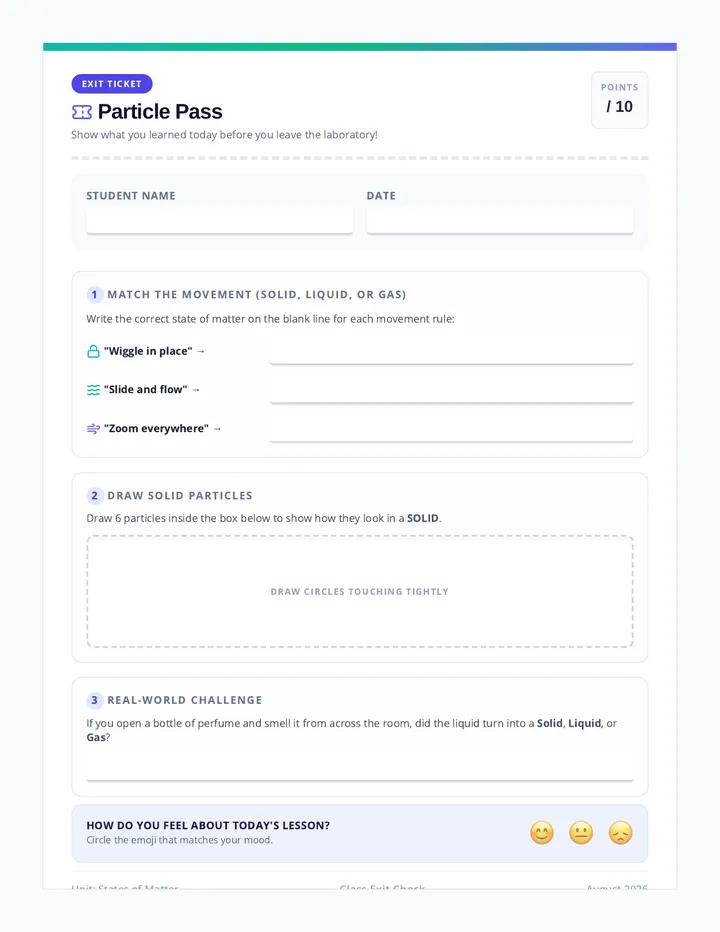
Exit Ticket Formative Check (5 min)
Use the simplified 3-question slip to quickly assess individual understanding of particle organization and movement.
Key Misconceptions to Address
"Sinking particles" : Students may place liquid particles only at the bottom, or gas particles grouped on one side. Emphasize that gas expands to fill the entire space randomly.Particle shrinkage : Remind students that the individual particles themselves do not shrink or grow when freezing or melting; only the space between them changes.
Accommodations
Fine Motor Support
If gluing objects is difficult, use large stickers (such as round dot labels) or high-contrast markers to draw circles instead of using small manipulatives.
Sensory Considerations
Provide low-odor glue sticks rather than liquid glue to reduce sensory distress. Use soft foam pom-poms for students sensitive to textures.
Visual Task Cards
Display the physical color-code visual continuously on the slide deck. Maintain high contrast on all worksheets.
Verbal Facilitation Cues
🗣️ For Solids: "Look how shoulder-to-shoulder they are. Can they move? Only a tiny wiggle! Say wiggle, wiggle!"
🗣️ For Liquids: "They can slide! They are flowing past each other. Say flow, flow!"
🗣️ For Gases: "So much space! Zoom! They bounce off the walls! Say zoom, zoom!"
Quick Check Criteria
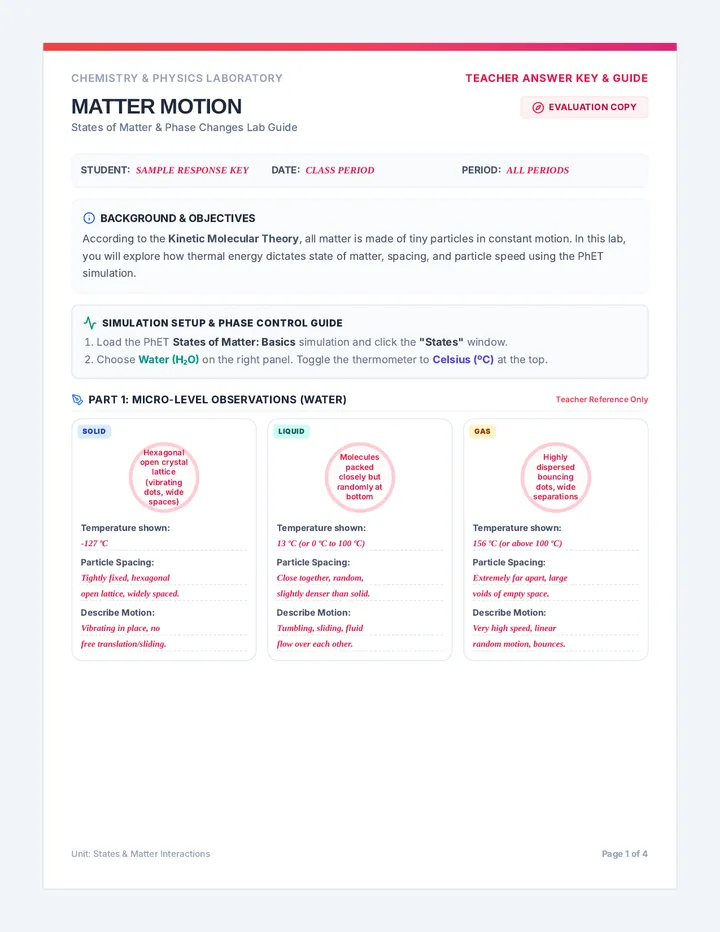
Solid is packed & tight
Liquid sits on bottom
Gas fills whole frame
Color associations met
Unit: States of Matter GRADE 10 CHEMISTRY SUPPORT NGSS HS-PS1-3 Scaffolded
Particle Playgrounds Slides Chemistry Session
Grade 10
Particle Playgrounds
Exploring and building the structures of Solids, Liquids, and Gases!
Hands-On Science Review Let's Zoom In on Matter! →
Class Warm-Up Activity 1 of 4
Brain Activator
What is Water?
Water can be solid ice, a liquid drink, or invisible steam gas.
💡 Do the tiny particles change shape, or is it just how they move?
🧊
Solid Ice
💧
Liquid
💨
Gas Steam
Talk with a partner! Next Rule →
Core Rules Activity 2 of 4
How Do Particles Move?
🔴🔴 Solid
Super Packed
Particles only wiggle in place .
Locked and rigid!
🔴 🔴 Liquid
Close & Flowing
Particles slide and flow .
Smoothly sliding!
🔴 🔴 Gas
Far Apart
Particles zoom and fly .
Zooming around!
Notice spacing and speeds! Next: Let's Build →
Hands-On! Activity 3 of 4
Let's Build It!
Grab your Model Board Handout and items!
1
SOLID: Pack items tightly. No gaps!
2
LIQUID: Pool at bottom. Small gaps!
3
GAS: Place items far apart!
Model Placement Guide
SOLID
LIQUID
GAS
Raise hand for glue help! Next: Let's Practice →
Challenge Activity 4 of 4
Show What You Know!
Let's Work Together!
Now we will complete our 10-Question Particle Practice Worksheet!
Look at the Pictures
Look closely at the spaces.
Think of Movement
Wiggle, slide, or zoom?
Good luck! Particle Playgrounds Project © 2026
Particle Playgrounds Model Board Student Name
Date
Class Period
Particle Modeling Board
Directions: Glue your physical pieces (pom-poms, cereal, or stickers) inside each beaker outline to show how particles look in each state of matter. Then, use the word bank to fill in the sentences below!
Movement Word Bank
wiggle in place slide and flow zoom everywhere
STATE 1: SOLID
Super Packed
Fill container completely
The particles in a solid are packed very tightly .
Movement Rule
These particles only:
STATE 2: LIQUID
Close & Flowing
Settle at the bottom
The particles in a liquid are close but can move .
Movement Rule
These particles can:
STATE 3: GAS
Super Spread Out
Spread out everywhere
The particles in a gas are very far apart .
Movement Rule
These particles will:
Reflective Synthesis Question
If you add high heat to a liquid, what will the particles do? Write down your thought below using one of your vocabulary words.
Grade 10 Chemistry • Tactile Activities Interactive Model Board Unit 2 Review
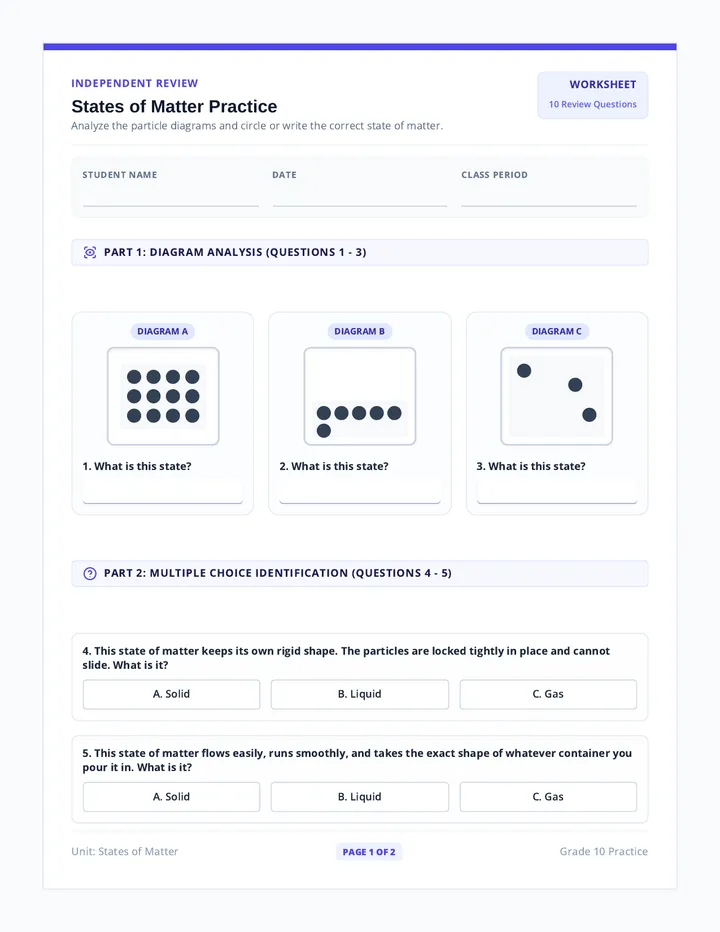
Particle Playgrounds Practice Worksheet Independent Review
States of Matter Practice
Analyze the particle diagrams and circle or write the correct state of matter.
Worksheet 10 Review Questions
Student Name
Date
Class Period
Part 1: Diagram Analysis (Questions 1 - 3)
DIAGRAM A
1. What is this state?
DIAGRAM B
2. What is this state?
DIAGRAM C
3. What is this state?
Part 2: Multiple Choice Identification (Questions 4 - 5)
4. This state of matter keeps its own rigid shape. The particles are locked tightly in place and cannot slide. What is it?
A. Solid
B. Liquid
C. Gas
5. This state of matter flows easily, runs smoothly, and takes the exact shape of whatever container you pour it in. What is it?
A. Solid
B. Liquid
C. Gas
Unit: States of Matter PAGE 1 OF 2 Grade 10 Practice
Practice Problems (Continued)
Apply knowledge to scenarios and physical examples.
Activity Part 3
Part 3: Word-Matching Scenarios (Questions 6 - 8)
6. This state of matter expands and spreads out to fill the entire container. Its particles fly at very high speeds. What is it?
A. Solid
B. Liquid
C. Gas
7. Fill in the blank: Particles inside a hard ice cube are packed so close that they can only:
A. wiggle in place
B. zoom around freely
8. Fill in the blank: Particles inside flowing water have slightly more space, allowing them to:
A. remain completely frozen
B. slide and flow past each other
Part 4: Real-World Identification (Questions 9 - 10)
SCENARIO 9
Glass of Orange Juice
Juice takes the shape of the cup and pours smoothly.
🍹
Juice is a: (write answer below)
SCENARIO 10
Helium in a Balloon
Helium floats up and expands to fill the rubber balloon.
🎈
Helium is a: (write answer below)
Unit: States of Matter PAGE 2 OF 2 Grade 10 Practice
Particle Playgrounds Exit Ticket Exit Ticket
Particle Pass
Show what you learned today before you leave the laboratory!
Points / 10
Student Name
Date
1 Match the Movement (Solid, Liquid, or Gas)
Write the correct state of matter on the blank line for each movement rule:
"Wiggle in place" →
"Slide and flow" →
"Zoom everywhere" →
2 Draw solid particles
Draw 6 particles inside the box below to show how they look in a SOLID .
Draw circles touching tightly
3 Real-World Challenge
If you open a bottle of perfume and smell it from across the room, did the liquid turn into a Solid , Liquid , or Gas ?
How do you feel about today's lesson?
Circle the emoji that matches your mood.
😊 😐 😞
Unit: States of Matter Class Exit Check August 2026