Liquid Life Worksheet
Hematology Lab
Liquid Life: Blood as a Mixture
Name: ______________________
Date: _________ Period: _____
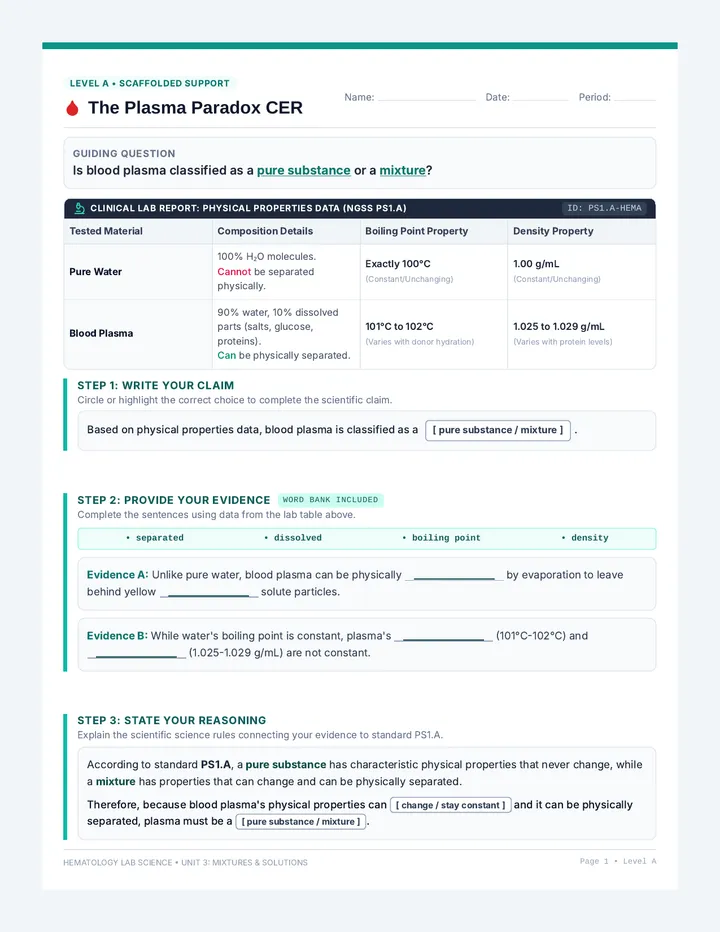
Mixtures: Physical combinations of substances that are not chemically bonded and can be separated.
Homogeneous: Uniformly mixed. Individual parts are spread evenly and cannot be seen. (Example: Blood in motion).
Separation: Mixtures can be separated back into their original parts using physical properties like density.
Is Blood Pure or a Mixture?
If you get a paper cut, you see a uniform red liquid. It looks perfectly even throughout. Inside your body, whole blood acts as a homogeneous mixture. Because your heart is constantly beating, it pumps and mixes the blood so rapidly that the solid components are spread completely evenly throughout the liquid. This makes the mixture uniform from top to bottom. However, because its parts are not chemically bonded, they can still be separated if the blood stops moving.
The Solvent Carrier: Plasma
More than half of your blood (about 55%) is a yellowish, watery fluid called plasma. Plasma itself is a clear homogeneous mixture (or solution). It is made of about 90% water, which acts as the solvent. Dissolved uniformly inside are essential solutes: proteins, glucose, hormones, and salts. Because these solutes are completely dissolved, plasma looks consistent and transparent.
The Suspended Particles: Blood Cells
Pumping through the plasma are three main types of solid particles. Active mixing keeps them evenly distributed:
- Red Blood Cells (RBCs): Tiny disks containing a protein called hemoglobin, which binds to and carries oxygen to the body's tissues.
- White Blood Cells (WBCs): Larger, defensive cells that are part of the immune system to fight off germs like bacteria and viruses.
- Platelets: Tiny cell fragments that cluster at cuts to form clots, stopping bleeding.
Separating the Mixture
Although blood is uniform while flowing, its parts can be separated using a machine called a centrifuge. When blood is placed in a test tube and spun at high speeds, the mixing stops. The rapid spinning separates components by density: the heaviest, densest parts (RBCs) sink to the bottom, while the lightest (plasma) floats to the top, leaving WBCs and platelets in the middle.
Stop & Think #1
What body organ acts as the "mixer" to keep blood homogeneous inside us?
Pronunciation Guide
• Plasma: PLAZ-muh
• Hemoglobin: HEE-muh-glow-bin
• Platelets: PLAYT-lets
• Centrifuge: SEN-trih-fyooj
Stop & Think #2
What machine do scientists use to separate the blood mixture into layers?
Unit 3: Mixtures & Solutions Page 1 of 2
Concept Review
Comprehension & Vocabulary Lab
Name: _________________
1 Vocabulary Lab
Match each term on the left with its definition on the right by writing the correct letter in the blank.
____ 1. Mixture
____ 2. Plasma
____ 3. Centrifuge
____ 4. Hemoglobin
____ 5. Homogeneous
A. The yellow, liquid portion of blood that contains dissolved nutrients and proteins.
B. A spinning machine used to separate mixture components based on their different densities.
C. A physical combination of substances that are not chemically bonded.
D. A mixture that is uniform throughout because its components are completely evenly distributed.
E. The oxygen-binding protein inside red blood cells that colors blood red.
2 Comprehension & Analysis
Q1. Explain step-by-step why whole blood is classified as a mixture rather than a pure substance. Reference at least two specific components.
Q2. How does the heart's active pumping action keep blood acting as a homogeneous mixture inside our blood vessels?
Q3. Describe the layered result of spinning blood in a centrifuge. Which layer lies at the bottom, which is at the top, and why?
💡 Hematology Lab Challenge: If a vial of whole blood sits perfectly still on a lab table for hours without moving, what will eventually happen to its uniform appearance? Why?
Unit 3: Mixtures & Solutions Page 2 of 2
Liquid Life Organizers
Hematology Lab
Blood Components Organizer
Name: ______________________
Date: _________ Period: _____
Part A Directions: Complete the centrifuge tube diagram below. Label each separated layer of the blood mixture using the word bank. Then, describe whether that component is a liquid or a solid when separated.
[ Red Blood Cells ] [ Plasma ] [ White Blood Cells & Platelets ]
Spun Blood Sample
Layer 1
Layer 2
Layer 3
Spins inside centrifuge
Layer 1 (Top, 55%) Least Dense
Name of Component:
State of Matter:
Layer 2 (Middle, ~1%) Middle Density
Name of Component:
State of Matter:
Layer 3 (Bottom, 44%) Most Dense
Name of Component:
State of Matter:
Part B Directions: Fill in the classification grid to analyze whether blood mixtures appear homogeneous (uniform throughout) or heterogeneous (separated) under different physical conditions.
| Component & Condition | Homogeneous or Heterogeneous? | Evidence (Why is it classified this way?) |
|---|
| 1. Liquid Plasma alone | ________________________ | _____________________________________________ |
| 2. Blood flowing in the body | ________________________ | _____________________________________________ |
| 3. Blood sample from a centrifuge | ________________________ | _____________________________________________ |
🔍 Scientific Analysis: Summarize why blood acts as a homogeneous mixture while circulating inside your body, but separates into layers when left undisturbed.
Unit 3: Mixtures & Solutions Page 1 of 2
Hematology Lab
Circulatory Flow & Transport
Name: _________________
Part C Directions: The circulatory system keeps blood components mixed together so they don't settle, while distributing dissolved solutes. Analyze the transport loops of this biological mixture below. Label each numbered stage using the options provided.
[ Lungs (Add O₂ / Release CO₂) ] [ Arteries (Pumps Mixture Away) ] [ Veins (Returns Mixture) ] [ Body Cells (Delivers Solutes) ]
The Circulation Mix Highway
Stage 1
Oxygen enters hemoglobin, CO₂ leaves the mixture.
The Heart (Pump)
Acts as a mechanical agitator, forcing the suspension to flow rapidly and prevent components from separating by density.