Beam Blockers Teacher Guide
Instructional Guide
Beam Blockers
Physical Science: Light & Matter Interactions
Pacing 60 Minutes
Lesson Overview
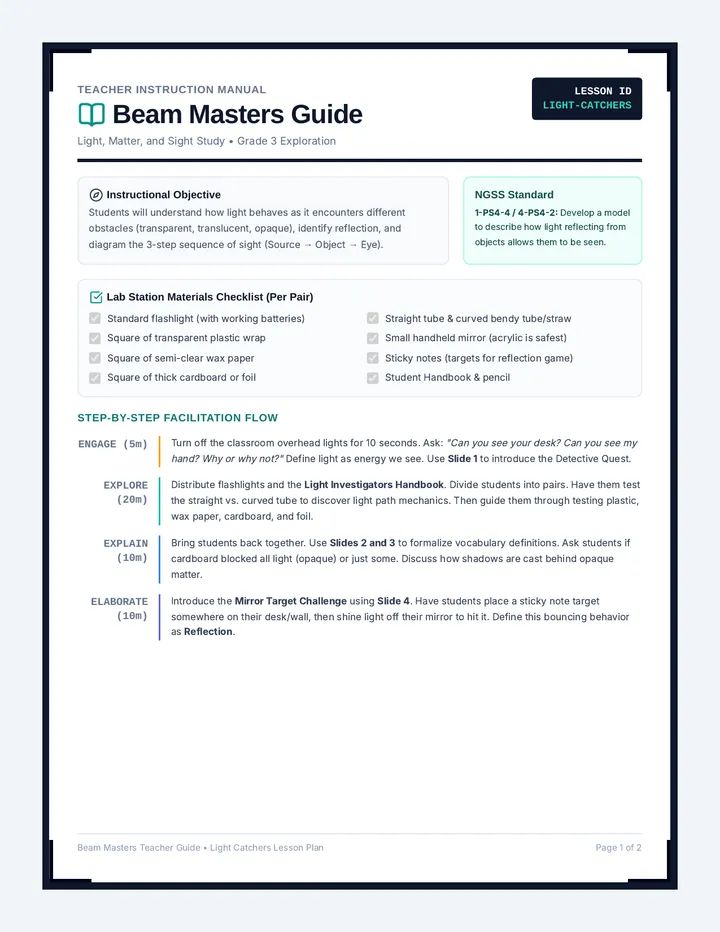
Students explore how light interacts with matter by classifying classroom objects as transparent, translucent, or opaque. They will transition from observation to physical modeling by using lasers and mirrors to map and predict the angle of light reflection.
Materials Needed
- • Construction paper (cut to recognizable shapes)
- • Clear plastic (cellophane or laminating sheet)
- • Light-colored printer paper
- • Flat handheld mirrors & painter's tape
- • Low-power keychain laser pointers (Class 2)
- • Tape, textbooks, and various classroom objects
Laser Safety Protocol
CRITICAL: Instruct students never to shine a laser pointer at anyone's eyes, faces, or reflective surfaces above eye-level. Class 2 lasers can cause temporary flash blindness. Establish a strict "keep lasers flat on desks" rule.
1 Phase 1: Engage & Explore (25 Mins)
Step 1: The Window Shape Demo (10 Mins)
Tape a construction paper triangle directly onto a bright classroom window. Run the three trials below, prompting students to notice what changes (shape, color, outline) to build operational definitions:
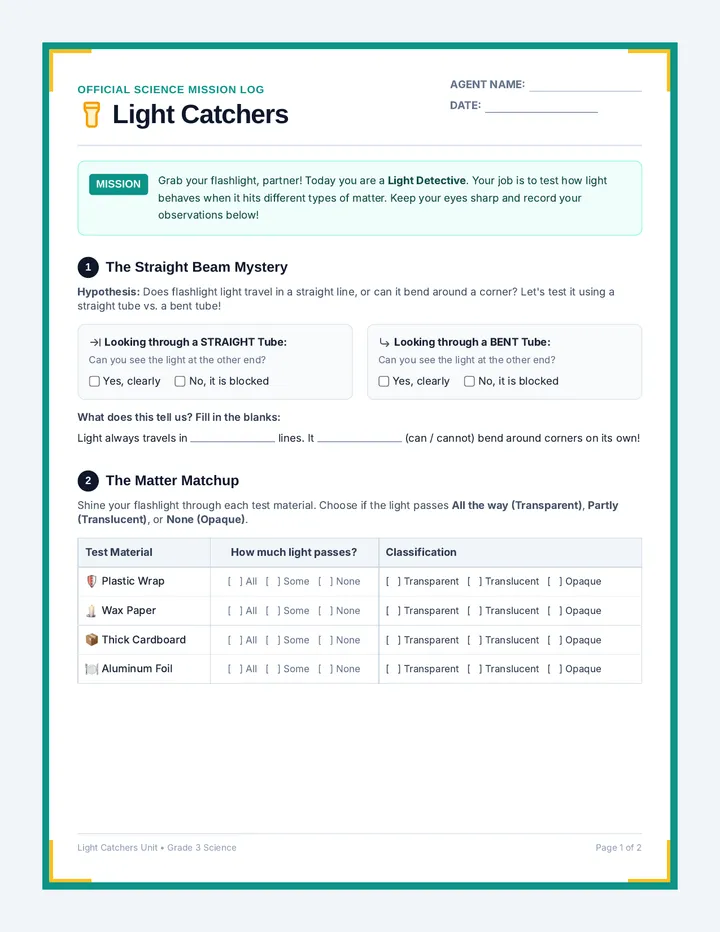
Trial 1: Clear Plastic
Transparent: Clear view of color & shape. Almost all light passes through.
Trial 2: Light Paper
Translucent: Only dark outline is visible. Color lost. Some light passes.
Trial 3: Solid Book
Opaque: Completely blocks visibility. No light passes through.
Step 2: Classroom Light Hunt (15 Mins)
Send students in pairs around the room with their lab sheets. They should choose 5 unique items, make a hypothesis, test them against a light source (windows, light fixtures, or flashlights), and record observations.
Tip: Encourage testing of tricky objects (e.g., colored folders, tissues, plastic water bottles) to challenge their definitions of translucent vs. transparent.
Bending and Blocking Beams • Teacher Resource Page 1 of 2
Instructional Guide
Reflection & Explanation
Physical Science: Light & Matter Interactions
Pacing Remaining: 35 Mins
2 Phase 2: Explain & Discuss (15 Mins)
Gather the class together to screen the Generation Genius Light Reflection Video. Use the following structured prompts to anchor key theoretical concepts during and after the video:
Discussion Prompt 1: The Core Mechanism
"How do we see objects in our everyday lives if they do not produce their own light?"
Expected Response: Light from a source (like the sun or a lamp) strikes an object and bounces (reflects) off it, eventually entering our eyes where our brain decodes it as an image.
Discussion Prompt 2: Opaque vs. Reflective
"If both a textbook and a mirror block all light (making them opaque), why do we see ourselves in a mirror but not in a book?"
Expected Response: Mirrors have an extremely flat, smooth surface that reflects light at matching angles (specular reflection). Book surfaces are microscopically rough, scattering light in all directions (diffuse reflection).
3 Phase 3: Elaborate - Laser & Mirror Reflection (20 Mins)
This hands-on demo models specular light path mechanics. Use tape on a table or wall to mark ray angles.
Practical Execution Steps
- Mount Mirror: Tape a flat mirror perpendicular to a flat tabletop (against the wall).
- Mark Alignment: Draw a straight "normal line" perpendicular (90 degrees) to the mirror face using painter's tape on the table.
- Angle Trials: Shine the laser at 30° relative to the normal line. Have a student mark the outgoing beam's dot location. Repeat at 45° and 60°.
- Verify Reflection Rule: Note how incoming angle (\(\theta_i\)) always matches the reflected angle (\(\theta_r\)).
- Surface Testing: Place cardboard, paper, or plastic in front of the mirror. Observe that the coherent laser dot disperses, explaining why matte surfaces don't project clear reflections.
Scaffolding Student Scientific Explanations
The student lab sheet contains a structured CER (Claim-Evidence-Reasoning) block. Guide students through these requirements:
- Claim: Direct answer to how light behaves differently when hitting a clear window vs. a dark wall.
- Evidence: Specific data recorded in their table (e.g., "The clear folder let me read text, but the black foam blocked it").
- Reasoning: Connecting evidence to scientific concepts ("Because the plastic is transparent, it lets photons pass through undisturbed").
Bending and Blocking Beams • Teacher Resource Page 2 of 2
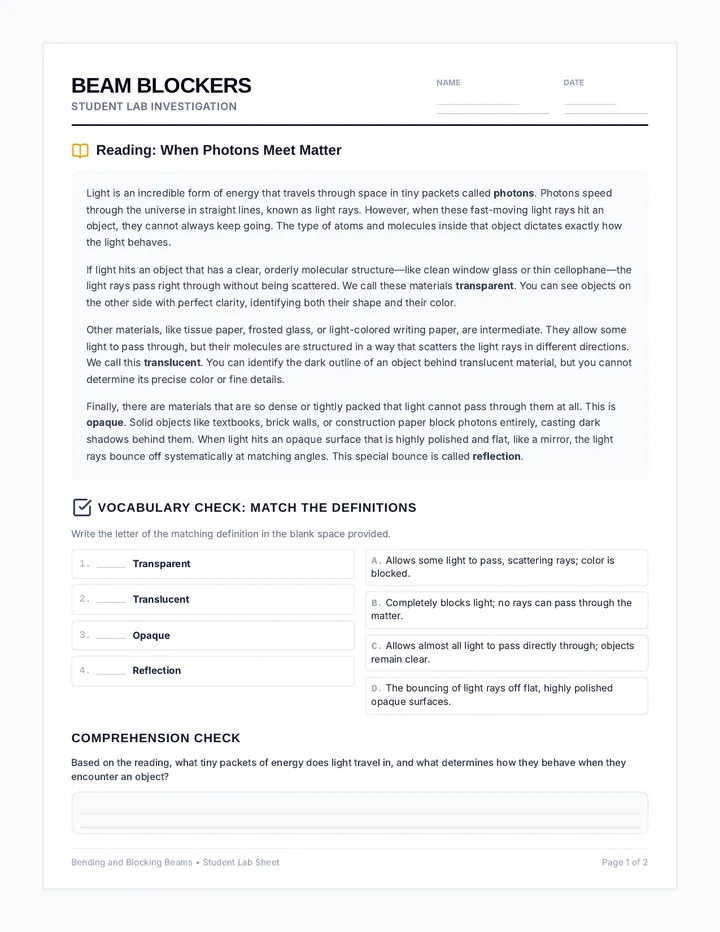
Beam Blockers Student Lab Sheets
Beam Blockers
STUDENT LAB INVESTIGATION
Name _________________
Date ___________
Reading: When Photons Meet Matter
Light is an incredible form of energy that travels through space in tiny packets called photons. Photons speed through the universe in straight lines, known as light rays. However, when these fast-moving light rays hit an object, they cannot always keep going. The type of atoms and molecules inside that object dictates exactly how the light behaves.
If light hits an object that has a clear, orderly molecular structure—like clean window glass or thin cellophane—the light rays pass right through without being scattered. We call these materials transparent. You can see objects on the other side with perfect clarity, identifying both their shape and their color.
Other materials, like tissue paper, frosted glass, or light-colored writing paper, are intermediate. They allow some light to pass through, but their molecules are structured in a way that scatters the light rays in different directions. We call this translucent. You can identify the dark outline of an object behind translucent material, but you cannot determine its precise color or fine details.
Finally, there are materials that are so dense or tightly packed that light cannot pass through them at all. This is opaque. Solid objects like textbooks, brick walls, or construction paper block photons entirely, casting dark shadows behind them. When light hits an opaque surface that is highly polished and flat, like a mirror, the light rays bounce off systematically at matching angles. This special bounce is called reflection.
Vocabulary Check: Match the Definitions
Write the letter of the matching definition in the blank space provided.
1. _____ Transparent
2. _____ Translucent
3. _____ Opaque
4. _____ Reflection
A. Allows some light to pass, scattering rays; color is blocked.
B. Completely blocks light; no rays can pass through the matter.
C. Allows almost all light to pass directly through; objects remain clear.
D. The bouncing of light rays off flat, highly polished opaque surfaces.
Comprehension Check
Based on the reading, what tiny packets of energy does light travel in, and what determines how they behave when they encounter an object?
Bending and Blocking Beams • Student Lab Sheet Page 1 of 2