Constitutional Classroom Narrative
EDC 5101: Graduate School Law
Constitutional Classroom Master Brief
ALP Keystone Legal Portfolio • Administrative & Faculty Guide
Dossier I
Ref: ALP-KEY-01
Executive Briefing & Context
This master brief and accompanying speaker narrative serves as a legal anchor for educational leaders and faculty members. By reconciling constitutional mandates, administrative codes, and board policies, this text equips educators to act as systemic student advocates while insulating school districts from substantial liability.
Source Hierarchy of School Law
1. U.S. Constitution (1st, 4th, 14th Am.)
2. Fed. Statutes & Code (IDEA, Title IX, ADA)
3. State Ed. Statutes & Administrative Code
4. District Board Policy & Collective Bargaining
Issue 1: Teacher Contracts, Due Process & Property Interests
Employment Law
Legal Analysis: Under the 14th Amendment, public employees may possess a constitutionally protected "property interest" in continued employment if they have achieved tenure. Non-tenured teachers generally do not have this interest beyond their contract term unless state code creates an expectation of renewal.
Citations: Board of Regents of State Colleges v. Roth, 408 U.S. 564 (1972); Perry v. Sindermann, 408 U.S. 593 (1972).
Speaker Narrative Transcript
"When we discuss contracts, remember: tenure is not a job-for-life guarantee. It is a procedural shield. If you have tenure, you have a property right. The district cannot terminate you without formal notice and a fair hearing."
Issue 2: Academic Freedom vs. Curricular Authority
First Amendment
Legal Analysis: Public school teachers have a right to speak as private citizens on matters of public concern. However, when speaking as employees pursuant to official duties, their speech is not insulated from employer discipline. The board of education retains absolute legal authority over curricula.
Citations: Pickering v. Board of Education, 391 U.S. 563 (1968); Garcetti v. Ceballos, 547 U.S. 410 (2006); Mayer v. Monroe County, 474 F.3d 477 (7th Cir. 2007).
Speaker Narrative Transcript
"Your classroom is a public space, but not your personal megaphone. You must teach the approved curriculum. While you have freedom to design lessons, you cannot introduce personal political viewpoints outside of standards."
Issue 3: Collective Bargaining & Negotiated Agreements
Labor Relations
Legal Analysis: Public employee unions navigate statutory framework at the state level. Collective bargaining agreements (CBAs) govern mandatory terms of employment (hours, pay, grievance procedures). In 2018, the Supreme Court ruled that public sector agency fees are unconstitutional, reshaping labor economics.
Citations: Janus v. AFSCME, 138 S. Ct. 2448 (2018); State Labor Relations Acts.
Speaker Narrative Transcript
"The CBA is legally binding on school boards and individual staff members. It determines workload, planning periods, and steps for grievances. Never settle a dispute on your own terms outside of the bargaining language."
DISTRICT POLICY ALIGNMENT: SERIES 100 CONFIDENTIAL - FOR FACULTY USE ONLY PAGE 1 OF 4
EDC 5101: Graduate School Law
Constitutional Classroom Master Brief
ALP Keystone Legal Portfolio • Liability & Classroom Discipline
Dossier II
Ref: ALP-KEY-02
Issue 4: Educator Negligence, Liability & Sovereign Immunity
Tort Law
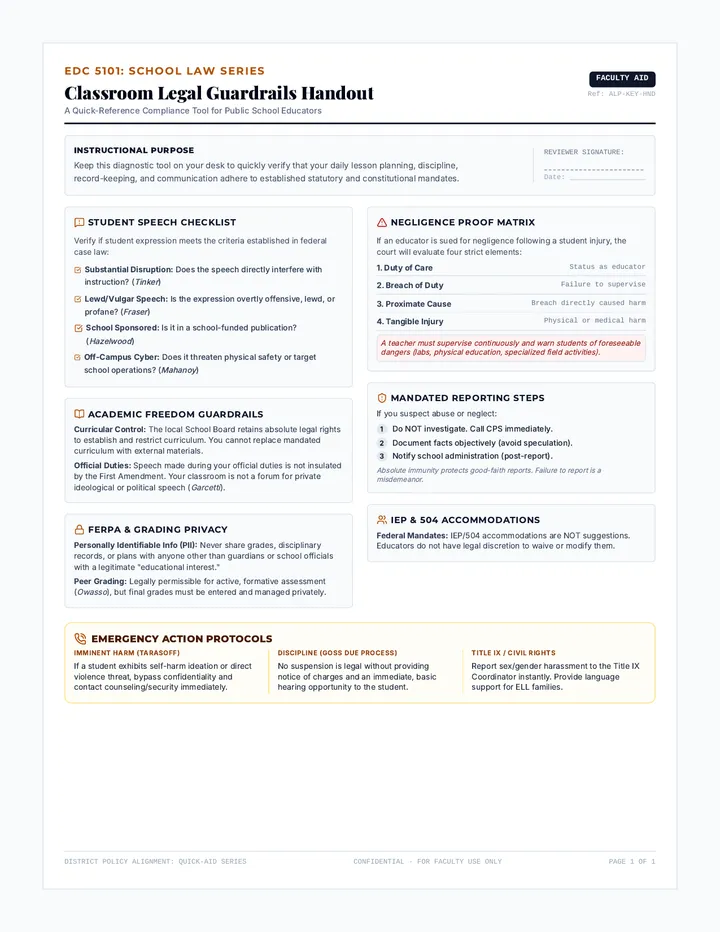
Legal Analysis: School personnel face personal liability if their conduct constitutes negligence. Negligence is established by four elements: (1) a duty of care, (2) a breach of that duty, (3) proximate causation, and (4) actual damage. While sovereign/governmental immunity provides broad protections for districts, individual educators are vulnerable to claims of active negligence or willful misconduct if they fail to maintain a safe physical environment.
Citations: Restatement (Second) of Torts; State Tort Claims Acts; Wood v. Strickland, 420 U.S. 308 (1975).
Speaker Narrative Transcript
"Do not leave students unattended—ever. If a student is injured in your room while you stepped down the hall to grab coffee, a court will measure your duty against that of a reasonably prudent educator. That absent coffee break could be ruled a breach of duty."
Issue 5: Student Discipline & Procedural Due Process
14th Amendment
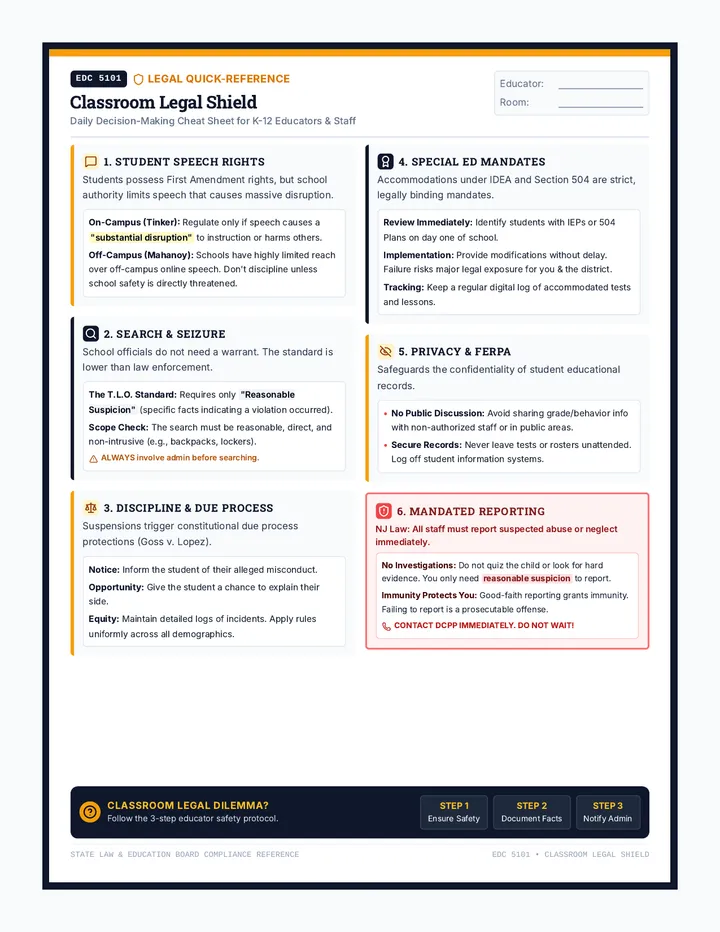
Legal Analysis: Students possess property and liberty interests in receiving a public education. Therefore, suspensions or expulsions require adherence to procedural due process. For suspensions of ten days or less, the school must provide oral or written notice of the charges, an explanation of the evidence, and an opportunity for the student to present their version of events. Long-term suspensions demand formal hearings.
Citations: Goss v. Lopez, 419 U.S. 565 (1975); District Student Codes of Conduct.
Speaker Narrative Transcript
"No principal or teacher can suspend a student on a whim. The landmark Goss v. Lopez ruling establishes that even a one-day suspension requires notice and a basic hearing. This standard protects students from arbitrary exclusion and protects their right to learn."
Issue 6: Student Free Speech & Substantial Disruption
First Amendment
Legal Analysis: Students do not "shed their constitutional rights to freedom of speech or expression at the schoolhouse gate." However, schools can restrict speech that causes or reasonably threatens "substantial disruption" or material interference with school operations, or is lewd, vulgar, or school-sponsored. Off-campus digital speech can only be disciplined if it has a direct nexus to substantial disruption on-campus.
Citations: Tinker v. Des Moines (1969); Bethel v. Fraser (1986); Hazelwood v. Kuhlmeier (1988); Mahanoy Area S.D. v. B.L., 141 S. Ct. 2038 (2021).
Speaker Narrative Transcript
"Students can express controversial opinions, but they cannot disrupt instruction. If a student wears a political shirt, it is protected speech unless it causes a substantial classroom disruption. Be cautious of censoring student voice."
DISTRICT POLICY ALIGNMENT: SERIES 200 CONFIDENTIAL - FOR FACULTY USE ONLY PAGE 2 OF 4
EDC 5101: Graduate School Law
Constitutional Classroom Master Brief
ALP Keystone Legal Portfolio • Grading, Supervision & Privacy
Dossier III
Ref: ALP-KEY-03
Issue 7: Grading Equity & Privacy of Records
FERPA Compliance
Legal Analysis: The Family Educational Rights and Privacy Act (FERPA) protects the privacy of student education records. Personally identifiable information (PII) cannot be disclosed without parental consent. However, peer-grading in classrooms does not violate FERPA, as grades written on papers are not "maintained" by the educational agency until collected and entered by the teacher.
Citations: Family Educational Rights and Privacy Act, 20 U.S.C. § 1232g; Owasso Independent School District v. Falvo, 534 U.S. 426 (2002).
Speaker Narrative Transcript
"Posting student test grades publicly by name or student ID is a clear FERPA violation. Peer-grading is legally safe for active learning, but keep private records securely locked and digital portals highly secure."
Issue 8: Educator's Duty of Care & Active Supervision
Standard of Care
Legal Analysis: Public school teachers have a duty of care to protect students from foreseeable risks of harm. The standard of care is that of an ordinary, prudent, and professional educator under similar circumstances. School activities with high inherent risk (science labs, athletics, field trips) demand specific safety briefings and active, non-distracted monitoring.
Citations: Restatement (Third) of Torts; State Tort Liability Precedents.
Speaker Narrative Transcript
"If a student is injured during a science lab because you failed to distribute safety goggles or went to your desk to grade papers, that is active negligence. Document your safety instructions before every single lab."
Issue 9: Counselor Ethics & Boundaries of Confidentiality
Ethics & Duty to Warn
Legal Analysis: While school counselors maintain high professional standards of confidentiality, this right is legally limited. Counselors and clinical staff have an absolute duty to disclose confidential information to prevent clear and imminent danger to the student or others (e.g., suicide risk, threats of violence).
Citations: Tarasoff v. Regents of Univ. of California, 17 Cal. 3d 425 (1976); ASCA Ethical Standards; State Education Codes.
Speaker Narrative Transcript
"Confidentiality is a critical tool for student trust, but it stops immediately at the threshold of harm. If a student reveals self-harm intent or details threats of violence, the law requires us to contact guardians and administration immediately."
DISTRICT POLICY ALIGNMENT: SERIES 300 CONFIDENTIAL - FOR FACULTY USE ONLY PAGE 3 OF 4
EDC 5101: Graduate School Law
Constitutional Classroom Master Brief
ALP Keystone Legal Portfolio • Equal Access & Mandated Protections
Dossier IV
Ref: ALP-KEY-04
Issue 10: Mandated Reporting of Abuse and Neglect
Child Protection
Legal Analysis: Under federal and state laws, school staff are mandated reporters. Any reasonable suspicion of child abuse, physical or emotional neglect, or sexual exploitation must be reported immediately to Child Protective Services (CPS). Mandatory reporters possess absolute civil immunity for good-faith reports.
Citations: Child Abuse Prevention and Treatment Act (CAPTA); State Penal Codes.
Speaker Narrative Transcript
"You do not investigate. You report. If you suspect abuse, contact CPS immediately. Postponing a report to 'wait for more evidence' can lead to personal criminal prosecution."
Issue 11: Special Education Rights, FAPE & LRE
IDEA / Section 504
Legal Analysis: The Individuals with Disabilities Education Act (IDEA) guarantees a Free Appropriate Public Education (FAPE) in the Least Restrictive Environment (LRE). Under Endrew F., schools must offer an IEP reasonably calculated to enable a child to make progress appropriate in light of their circumstances. IEP accommodations are legally binding.
Citations: 20 U.S.C. § 1400; Endrew F. v. Douglas County, 137 S. Ct. 988 (2017).
Speaker Narrative Transcript
"IEP modifications are not recommendations—they are federal mandates. Failing to provide a student their designated oral reading support is a violation of federal civil rights."
Issue 12: Equal Access, Title IX & Non-Discrimination
Federal Civil Rights
Legal Analysis: Title IX prohibits sex discrimination in federally funded programs, covering sexual harassment and gender-identity protection. Public schools must accommodate English Language Learners (ELL) through language access and provide religious accommodations under the Free Exercise Clause.
Citations: Title IX of 1972; Bostock v. Clayton County (2020); Lau v. Nichols (1974); Kennedy v. Bremerton S.D. (2022).
Speaker Narrative Transcript
"Equal access is systemic advocacy in action. Under Title IX and Bostock, we protect LGBTQ+ students, provide language support for ELL families, and respect religious expressions, building a legally resilient community."
DISTRICT POLICY ALIGNMENT: SERIES 400 CONFIDENTIAL - FOR FACULTY USE ONLY PAGE 4 OF 4
Constitutional Classroom Slides
EDC 5101: School Law
ALP Keystone Series
Constitutional Classroom Mastery
A Faculty Guide to Navigating Complex School Law, Teacher Rights, and Student Advocacy Standards.
Prepared For New Faculty & Leadership
Instructional Leader Graduate Seminar Presenter
Slide 1 of 9
The School Law Hierarchy
Framework
School operations are governed by overlapping, tiered regulatory bodies. Local board policy is legally binding, but is completely subordinate to federal and state law.
Golden Rule of School Law:
A district policy, teacher contract, or student handbook cannot waive or diminish rights guaranteed by the U.S. Constitution or federal statutes.
01. US CONSTITUTION 1st, 14th Amendments
02. FEDERAL STATUTES IDEA, Title IX, ADA, FERPA
03. STATE EDUCATION CODE Licensure, Pension, CPS
04. LOCAL BOARD POLICY CBA, Handbooks
EDC 5101 | School Law Masterclass Slide 2 of 9
Contracts & Academic Freedom
Module 1
Teacher Contracts & Tenure
Constitutional Property Interest
Tenure establishes a protected property interest under the 14th Amendment. Tenured teachers cannot be fired without procedural due process.
Key Precedents: Board of Regents v. Roth (1972); Perry v. Sindermann (1972)
Academic Freedom Limits
Employee Speech Standard
When you speak as an employee, you do not speak as a private citizen. The Board of Education holds legal custody over curriculum standards.
Key Precedents: Pickering v. Board of Ed (1968); Garcetti v. Ceballos (2006)
EDC 5101 | School Law Masterclass Slide 3 of 9
Bargaining & Liability
Module 2
Negotiated Agreements & Union Rights
Negotiated collective bargaining agreements govern classroom sizes, working conditions, and disciplinary procedures. Under the landmark Janus decision, public sector unions cannot mandate non-member "fair share" representation fees.
Citation: Janus v. AFSCME, 138 S. Ct. 2448 (2018).
The 4 Elements of Negligence
To successfully sue an educator for a classroom injury, a plaintiff must prove all four elements:
- 1. Duty of Care (established as educator)
- 2. Breach of Duty (omission of safety standard)