Republic Blueprint Slides The Republic Blueprint
How Ancient Rome Shaped Modern Government
Architectural Records: Rome v.1
The End of Kings
In 509 BCE, the Romans overthrew their last king, Tarquin the Proud.
"We will never again be ruled by a king. From now on, the state belongs to the people."
The result? The birth of the Res Publica — the "Public Thing."
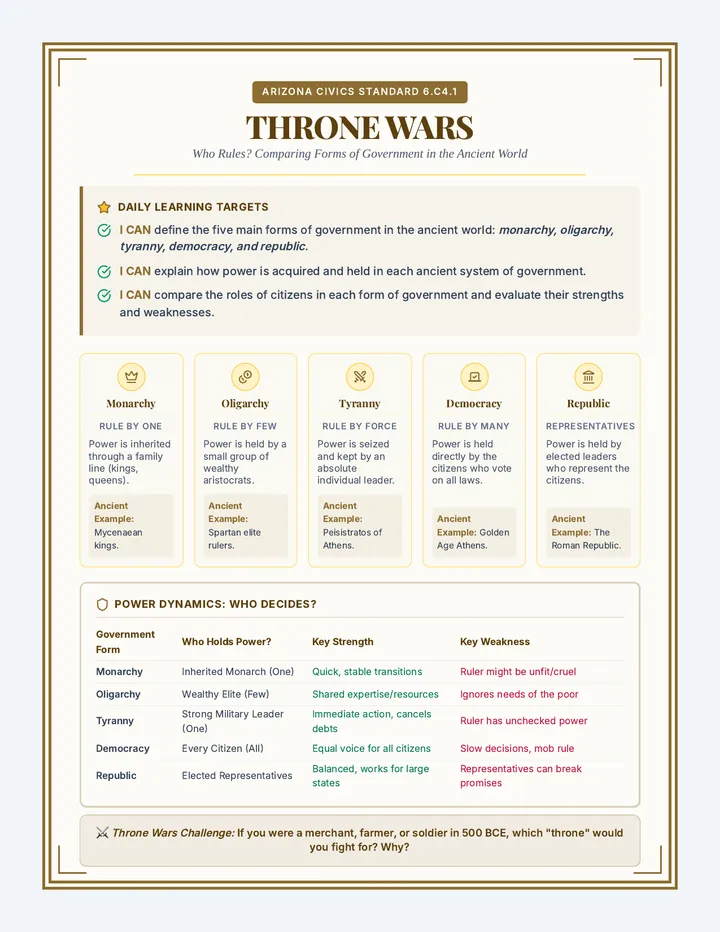
Representative Government
Direct Democracy
Used in Ancient Athens.
Every citizen votes directly on every single law and decision.
Republic
Used in Ancient Rome.
Citizens elect officials to represent them and make decisions on their behalf.
Why did Rome choose this? Efficiency as they expanded! It was hard for everyone to travel to Rome to vote on every tiny law.
Power & Privilege
CITIZENSHIP STATUS
Patricians
Wealthy land-owning nobles. In the beginning, only they could hold office.
Plebeians
Commoners: farmers, merchants, and artisans. They made up the majority of the population.
The "Conflict of the Orders" was a centuries-long struggle where Plebeians fought for more political rights.
PATRICIANS
PLEBEIANS
OTHERS (NO VOTE)
Separation of Powers
Preventing any one person from becoming a King
The Consuls
Two leaders elected for 1 year .
Led the army and acted as judges.
One could Veto (reject) the other.
The Senate
300-600 men who served for life .
Advised the Consuls and handled foreign policy.
Controlled the state's money.
Assemblies
Where Plebeians had their voice.
Elected officials and voted on laws.
Declared war and peace.
Checks and Balances
No single branch had all the power. Each branch could block or check the actions of the others.
Veto Power
"I Forbid!"
Term Limits
1 Year in Office
Civic Duty
The Republic only worked if citizens actively participated. This is called Civic Virtue .
The Cincinnatus Ideal
A farmer who became Dictator during a crisis, saved Rome in 16 days, and then immediately resigned to go back to his plow.
Role of a Citizen:
• Voting in assemblies
• Paying taxes
• Serving in the military
• Serving in public office
The Rule of Law
The 12 Tables
451 BCE
For years, Patricians changed laws to suit themselves because laws weren't written down.
The Plebeians demanded the laws be carved in bronze and posted in the Forum for everyone to see.
This established that the law applies to everyone , regardless of status.
Voting in the Republic
Who COULD Vote?
Free, adult Roman men who were citizens.
Who COULD NOT?
Women, enslaved people, and foreign residents.
"The struggle for the vote was the pulse of the Republic. It wasn't given; it was won through protest and negotiation."
The Roman Legacy
United States
• We call our upper house the Senate.
• The President has the Veto.
• We have three branches of gov.
Legal Influence
• The idea of "Innocent until proven guilty."
• Rights of the accused to face a trial.
• The power of written constitutions.
The Blueprint Still Stands
The Architect's Challenge
1
How does having a 1-year term limit for Consuls protect the freedom of citizens?
2
Why was writing the laws down on the Twelve Tables a turning point for justice?
3
What part of the Roman "blueprint" do you see most often in your own community today?
The Blueprint Closes
Class Dismissed. Long live the Republic.
Republic Architect Worksheet Republic Architect
Blueprint Design Record: Section 509-BCE
Name:
Date:
1. Breaking the Foundation
Before Rome was a Republic, it was ruled by kings. After the exile of Tarquin the Proud, the Romans created the Res Publica.
Define the term "Res Publica" in your own words:
Contrast: Why did Romans believe a Republic was safer than a Monarchy?
2. Social Strata
Identify the Groups
A. Patricians:
B. Plebeians:
The Struggle for Equality
The "Conflict of the Orders" was a fight for political representation. Which group eventually went on "strike" and left the city to demand more rights?
3. Blueprint Components
Draw a line to match the Roman government branch to its primary responsibility.
THE CONSULS
THE SENATE
THE ASSEMBLIES
Controlled the state budget, managed foreign policy, and advised top leaders. Served for life.
Elected officials and voted on laws. Primarily where the common people (Plebeians) held power.
Two leaders who commanded the army and presided over the government. One-year term limits.
ROME-ARCH-REV.1 // PAGE 01
4. Structural Safety Controls
The Power of the Veto
In Latin, veto means "I forbid."
Describe a situation where one branch of the Roman government might use a veto against another:
The Twelve Tables
Why was it so important to the Plebeians that the laws were written down and posted publicly?
5. The Citizen's Responsibility
Case Study: Cincinnatus
Cincinnatus was a farmer who was named Dictator during an emergency. He led the army to victory in 16 days, then immediately resigned and returned to his farm.
How does this story demonstrate "Civic Virtue"?
What is one responsibility modern citizens have that is similar to those in Rome?
6. Legacy Analysis
Identify three ways the government of the United States (or another modern democracy) was influenced by the Roman Republic:
Consider: Branch names, voting systems, legal principles, or symbols.
Influence 1
Influence 2
Influence 3
Architect's Summary Reflection:
If you were to design a perfect government, would you include a "Veto" power? Why or why not?
ROME-ARCH-REV.1 // PAGE 02
Republic Architect Answer Key Republic Architect
Teacher Answer Key
VERSION 1.0 // KEY
1. Breaking the Foundation
Definition of "Res Publica":
Literally "the public thing" or "the people's matter." It means the government is not the private property of a king, but belongs to the citizens.
Why a Republic was safer than a Monarchy:
In a monarchy, one person has all the power forever (or until they die), which often leads to tyranny. In a republic, power is shared, elected, and limited by time.
2. Social Strata
A. Patricians:
Wealthy land-owning nobles; the upper class who initially held all political power.
B. Plebeians:
The common people (farmers, merchants, artisans); the majority of the population who fought for more rights.
Group that went on "strike":
The Plebeians (Secession of the Plebs).
3. Blueprint Components (Matching)
CONSULS Two leaders who commanded the army and presided over the government. One-year term limits.
SENATE Controlled the state budget, managed foreign policy, and advised top leaders. Served for life.
ASSEMBLIES Elected officials and voted on laws. Primarily where the common people (Plebeians) held power.
4. Structural Safety Controls
Veto Situation Example:
One Consul might veto the other's decision to go to war, or a Tribune of the Plebs might veto a law passed by the Senate that harms the common people.
Importance of Written Law (12 Tables):
It prevented Patrician judges from making up or changing laws on the spot. It meant that laws applied to everyone and couldn't be ignored.
5. The Citizen's Responsibility
How Cincinnatus demonstrated Civic Virtue:
He put the needs of the Republic above his own power. He only took power to solve a crisis and gave it up as soon as the job was done, rather than becoming a king.
Similar Modern Responsibility:
Voting in elections, serving on a jury, paying taxes, or serving in the military.
6. Legacy Analysis
US Senate: Directly inspired by the Roman Senate as a body for debate and policy.
The Veto: The US President's power to reject a bill is modeled on the Roman Consuls and Tribunes.
Three Branches: Separation of power into Legislative, Executive, and Judicial mirrors the Roman split.