Pumpkin Patch Slides
3rd Grade Life Science
Unit: Plant Structures & Cycles
Investigation Lab
Pumpkin Patch Detectives
Investigating the secret parts inside every pumpkin and tracking the amazing journey from a tiny seed to giant fruit!
Mission 1
Identify Anatomy
Mission 2
Map the Life Cycle
Mission 3
Team Lab Squads
Science Mystery
Part 1: The Basics
Fruit or Vegetable? What Is a Pumpkin?
Botanically, It's a FRUIT!
In science, any plant part that develops from a flower and contains seeds is classified as a fruit.
Fun Science Fact: A pumpkin is actually a giant berry called a pepo!
The Gourd Family
Pumpkins belong to the Cucurbitaceae plant family. They are close cousins with:
Watermelon
Cucumber
Zucchini
Detective Clue: Always look for seeds! If it has seeds inside, a botanist calls it a fruit.
Pumpkin Anatomy
Outside Inspection
Exterior Features: Built for Protection
Stem
Peduncle
The tough woody lifeline that attached the fruit to the vine, pumping water and sugar!
Never carry a pumpkin by its stem!
Skin / Rind
Exocarp
The tough, waterproof outer armor. Keeps moisture inside and shields against pests and bacteria.
Starts green, turns orange in autumn sunlight.
Ribs & Creases
Grooves
The vertical ridges running top to bottom. They indicate internal sections and expand as it swells!
More shallow ribs = smoother carving skin.
Bottom Feature: Blossom Scar (where the yellow flower detached after pollination!)
Pumpkin Anatomy
Inside Inspection
Interior Features: The Engine of Life
Flesh / Meat
Mesocarp
The thick, firm, edible orange layer right underneath the skin. Rich in Vitamin A and nutrients!
This is what makes pumpkin pie & soup!
Fibrous Strands
"Pumpkin Guts"
Tangled, gooey, stringy fibers that hold each seed in place and deliver nutrients directly to them.
Cradles and nourishes growing seeds!
Seeds
Pepitas
Each seed contains a baby plant embryo and stored food. One pumpkin can hold over 500 seeds!
Guarantees the next generation!
The hollow center where seeds and pulp live is called the Seed Cavity.
Anatomy Summary
Part & Purpose
Every Structure Has a Survival Job!
| Pumpkin Structure | Vital Biological Job | Detective Memory Key |
|---|
| Stem (Peduncle) | Anchors fruit to vine; channels water, minerals, and sugars. | The Pipeline |
| Rind / Skin | Tough waterproof coat protecting inner fruit from bugs and rot. | The Armor |
| Flesh (Pulp) | Stores water and nutrients while cushioning developing seeds. | The Cushion & Feast |
| Fibrous Strands | Grip seeds securely and deliver nourishment during growth. | The Safety Web |
| Seeds | Hold genetic code and plant embryo to sprout new pumpkin vines. | The Future Plant |
Ready to discover how a tiny seed builds all these amazing parts? Let's follow the Life Cycle!
The Pumpkin Life Cycle
Stages 1 – 3
From Soil to Vine: The Early Journey
1
Seed Planting
Planted in warm, moist spring soil. Water softens the outer seed coat and triggers germination.
Time: 7 to 10 days to crack open
2
Sprout & Seedling
Roots push downward into soil for moisture. Two smooth seed leaves (cotyledons) reach up toward sunlight.
Begins making food via sunlight!
3
Vine & Tendrils
Vines spread up to 30 feet long! Big jagged leaves gather sun; curly spring-like tendrils curl and anchor the plant.
Vines can grow 6 inches a day!
Detective Check: What do leaves need to make food? Sunlight, water, and carbon dioxide!
The Pumpkin Life Cycle
Stages 4 – 6
Blossoms to Harvest: Creating Fruit
4
Golden Blossoms
Bright yellow flowers bloom. Male flowers provide pollen; female flowers have a tiny swollen ball at the base.
Bees must pollinate the flower!
5
Green Pumpkin
The flower petals fall off. The base swells rapidly into a solid green ball, filled with water and chlorophyll.
Takes 45 to 55 days to swell!
6
Mature Pumpkin
Chlorophyll fades and orange carotenes show through. Stem turns woody and dry. Ready for autumn harvest!
Full Cycle: ~90 to 120 days total!
And inside each ripe pumpkin? Hundreds of seeds ready to repeat the cycle next spring!
Group Mission
Team Investigation
Assemble Your Pumpkin Detective Squad!
Work in teams of 4 to complete your Pumpkin Squad Lab Activity Sheet.
Lead Botanist
Guides the team through anatomy labels and structure definitions.
Inspector
Checks evidence: texture, ribs, seeds, and pulp observations.
Data Scribe
Records all squad answers, descriptions, and life cycle steps neatly.
Lead Reporter
Shares squad discoveries with the whole class during the final debrief.
Squad Investigation Time: 20 Minutes
Work together, listen to everyone's ideas!
Debrief & Share
Case Closed
Detective Debrief: Test Your Plant Power!
Question 1
Why is a pumpkin classified scientifically as a fruit?
Can your reporter explain what makes it a fruit instead of a root or leaf vegetable?
Question 2
What vital job do the stringy fibrous strands do?
How do they protect and nourish the baby seeds as the pumpkin grows on the vine?
Question 3
What would happen if honeybees did not visit the blossoms?
Would female flowers grow into giant orange pumpkins? Why or why not?
Great job, Pumpkin Detectives! Turn in your Squad Activity sheets for botanical certification!
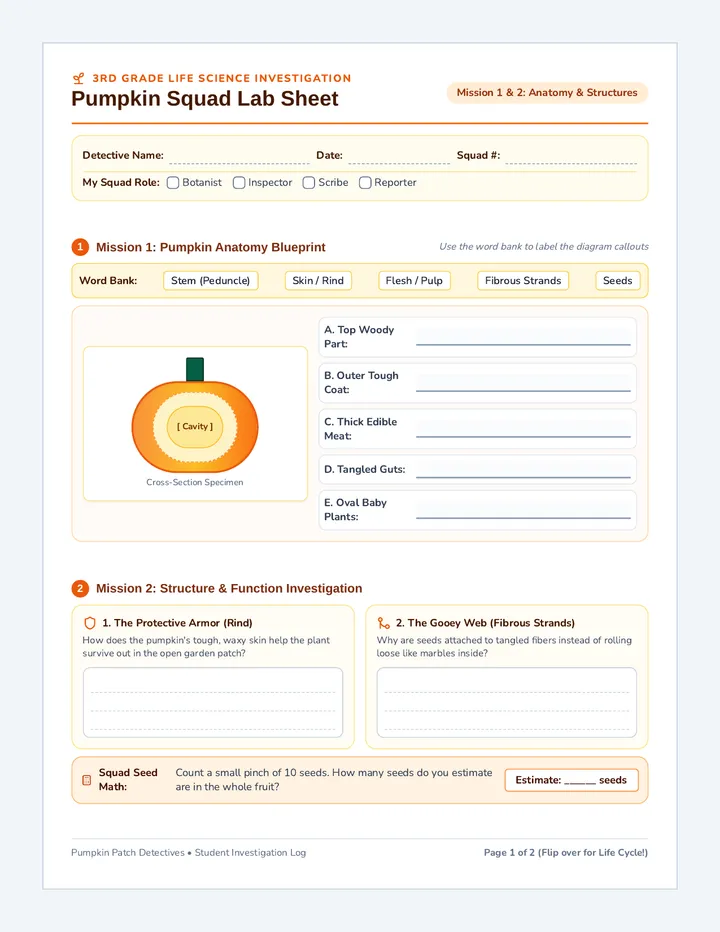
Pumpkin Squad Activity
3rd Grade Life Science Investigation
Pumpkin Squad Lab Sheet
Mission 1 & 2: Anatomy & Structures
Detective Name:
Date:
Squad #:
My Squad Role:
Botanist Inspector Scribe Reporter
1 Mission 1: Pumpkin Anatomy Blueprint
Use the word bank to label the diagram callouts
Word Bank: Stem (Peduncle) Skin / Rind Flesh / Pulp Fibrous Strands Seeds
[ Cavity ]
Cross-Section Specimen
A. Top Woody Part:
B. Outer Tough Coat:
C. Thick Edible Meat:
D. Tangled Guts:
E. Oval Baby Plants:
2 Mission 2: Structure & Function Investigation
1. The Protective Armor (Rind)
How does the pumpkin's tough, waxy skin help the plant survive out in the open garden patch?
2. The Gooey Web (Fibrous Strands)
Why are seeds attached to tangled fibers instead of rolling loose like marbles inside?
Squad Seed Math: Count a small pinch of 10 seeds. How many seeds do you estimate are in the whole fruit?
Estimate: ______ seeds
Pumpkin Patch Detectives • Student Investigation Log Page 1 of 2 (Flip over for Life Cycle!)
3rd Grade Life Science Investigation
The Great Growth Cycle & Case Files
Mission 3 & 4: Stages & Problem Solving
3 Mission 3: Pumpkin Life Cycle Sequencing
Number the 6 growth stages in correct chronological order (1 to 6)
Green Pumpkin
#____
The pollinated flower base swells into a hard green sphere. Chlorophyll makes it green!
Swells for 45-55 days
Planted Seed
#____
Rests in warm, damp spring soil. Soaks up water to begin germination.
7 to 10 days to crack open
Long Vine & Leaves
#____
Sprawls up to 30 feet across soil. Large prickly leaves collect sunshine for photosynthesis.
Grows 6 inches daily!
Ripe Orange Fruit
#____
Turns deep orange in autumn. The woody stem hardens; seeds inside are ready to harvest!
90-120 days total
Sprout / Seedling
#____
Pushes roots down and sends two round seed leaves (cotyledons) up toward the sun.
First leaves appear
Yellow Blossoms
#____
Golden flowers open in the morning. Friendly bumblebees transfer pollen between flowers.
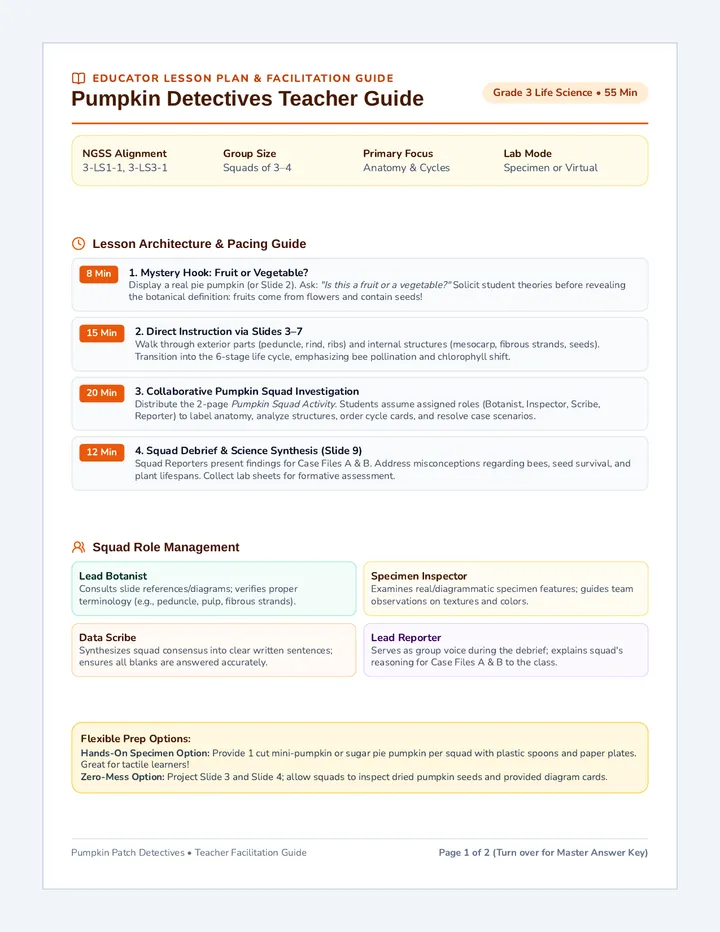
Pumpkin Detectives Teacher Guide
Educator Lesson Plan & Facilitation Guide
Pumpkin Detectives Teacher Guide
Grade 3 Life Science • 55 Min
NGSS Alignment 3-LS1-1, 3-LS3-1
Group Size Squads of 3–4
Primary Focus Anatomy & Cycles
Lab Mode Specimen or Virtual
Lesson Architecture & Pacing Guide
8 Min
1. Mystery Hook: Fruit or Vegetable?
Display a real pie pumpkin (or Slide 2). Ask: "Is this a fruit or a vegetable?" Solicit student theories before revealing the botanical definition: fruits come from flowers and contain seeds!
15 Min
2. Direct Instruction via Slides 3–7
Walk through exterior parts (peduncle, rind, ribs) and internal structures (mesocarp, fibrous strands, seeds). Transition into the 6-stage life cycle, emphasizing bee pollination and chlorophyll shift.
20 Min
3. Collaborative Pumpkin Squad Investigation
Distribute the 2-page Pumpkin Squad Activity. Students assume assigned roles (Botanist, Inspector, Scribe, Reporter) to label anatomy, analyze structures, order cycle cards, and resolve case scenarios.
12 Min
4. Squad Debrief & Science Synthesis (Slide 9)
Squad Reporters present findings for Case Files A & B. Address misconceptions regarding bees, seed survival, and plant lifespans. Collect lab sheets for formative assessment.
Squad Role Management
Lead Botanist
Consults slide references/diagrams; verifies proper terminology (e.g., peduncle, pulp, fibrous strands).
Specimen Inspector
Examines real/diagrammatic specimen features; guides team observations on textures and colors.
Data Scribe
Synthesizes squad consensus into clear written sentences; ensures all blanks are answered accurately.
Lead Reporter
Serves as group voice during the debrief; explains squad's reasoning for Case Files A & B to the class.
Flexible Prep Options:
Hands-On Specimen Option: Provide 1 cut mini-pumpkin or sugar pie pumpkin per squad with plastic spoons and paper plates. Great for tactile learners!
Zero-Mess Option: Project Slide 3 and Slide 4; allow squads to inspect dried pumpkin seeds and provided diagram cards.
Pumpkin Patch Detectives • Teacher Facilitation Guide Page 1 of 2 (Turn over for Master Answer Key)
Assessment & Support Reference
Master Answer Key & Differentiation